Bangladesh Induction Furnace Market Size Growth Rate
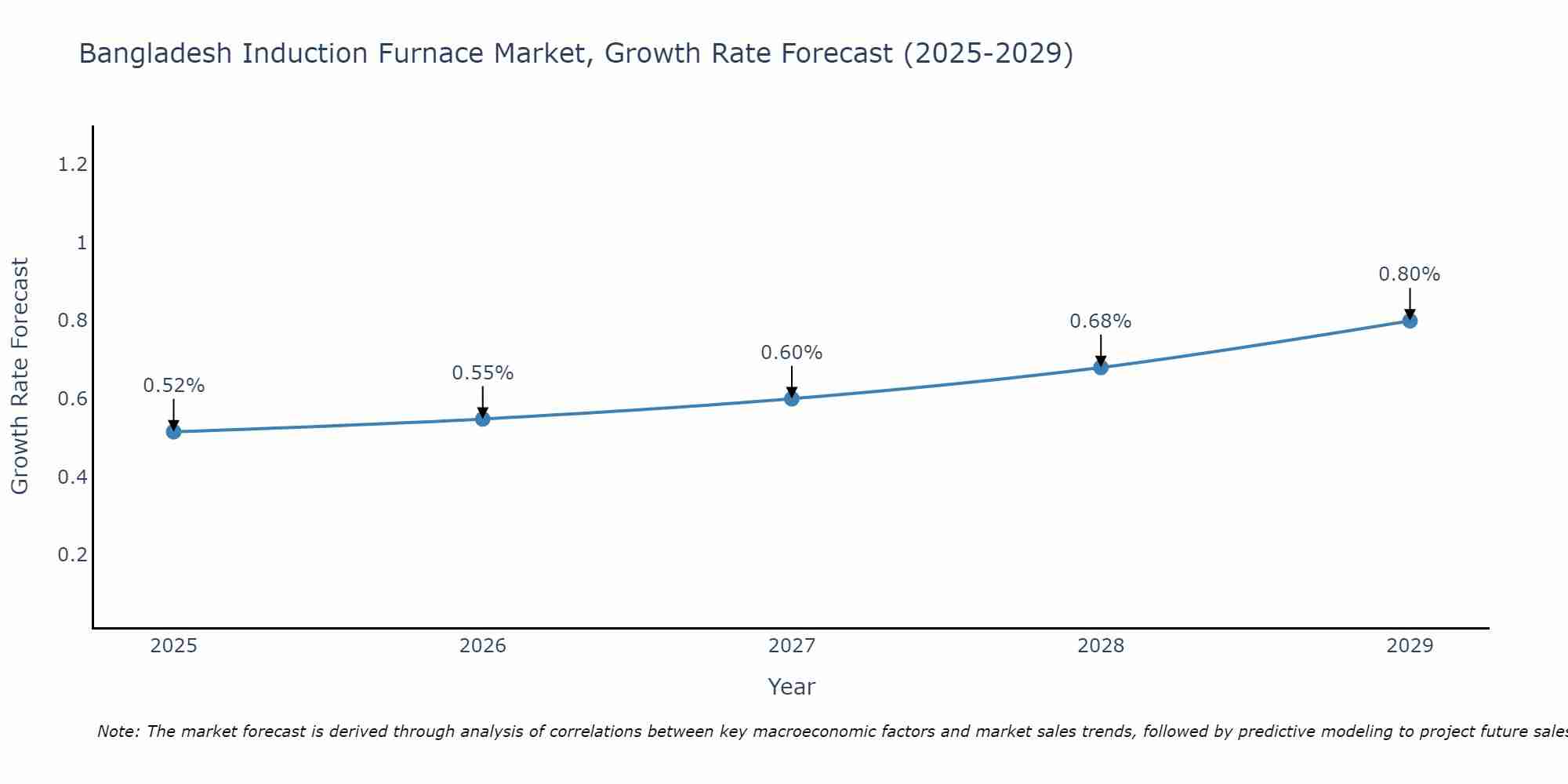
The Bangladesh Induction Furnace Market is likely to experience consistent growth rate gains over the period 2025 to 2029. Commencing at 0.52% in 2025, growth builds up to 0.80% by 2029.
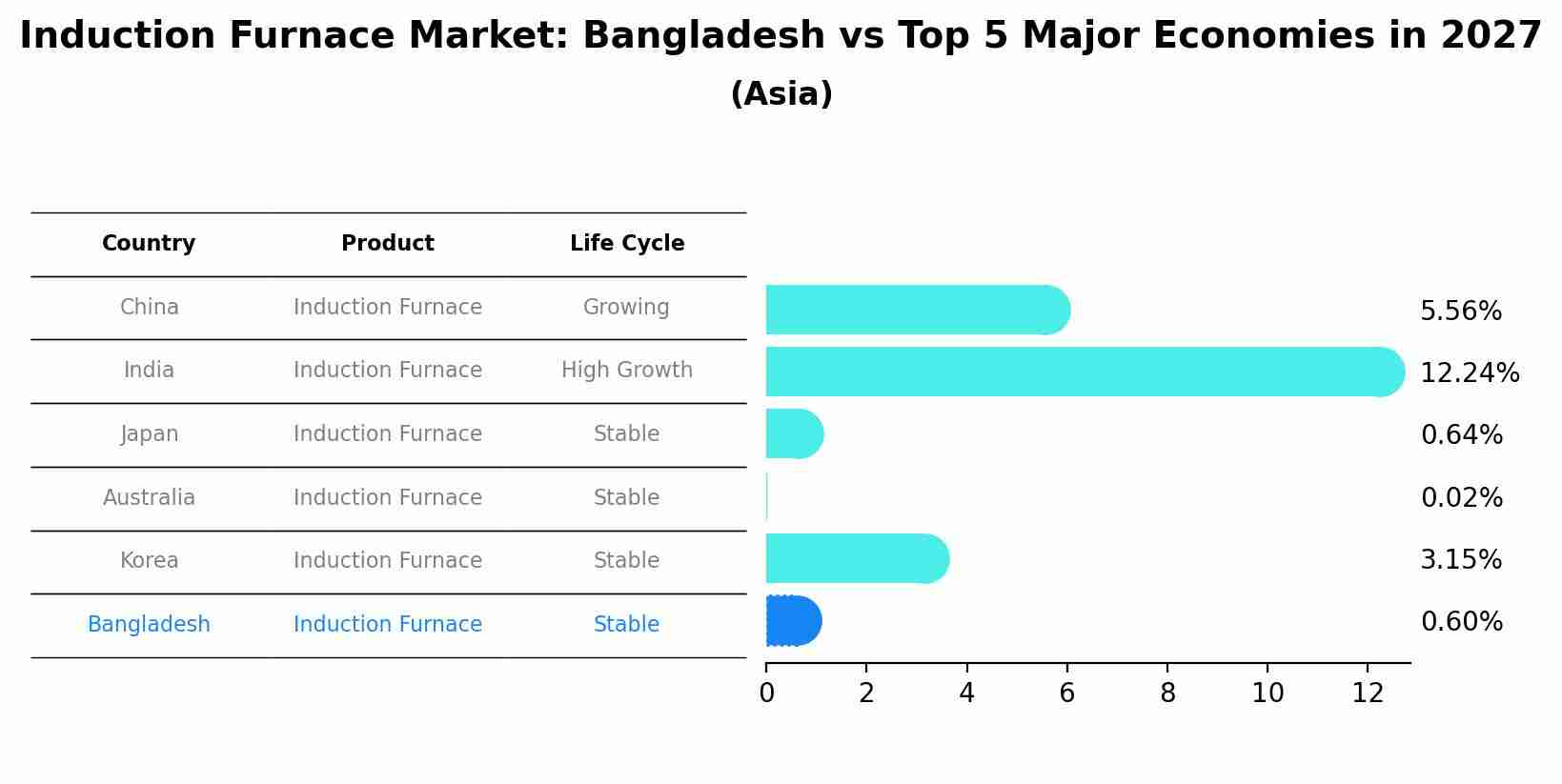
Induction Furnace Market: Bangladesh vs Top 5 Major Economies in 2027 (Asia)
By 2027, Bangladesh's Induction Furnace market is forecasted to achieve a stable growth rate of 0.60%, with China leading the Asia region, followed by India, Japan, Australia and South Korea.
Bangladesh Induction Furnace Market Overview
The Bangladesh induction furnace market is witnessing steady growth driven by factors such as increasing demand for steel products in the construction and manufacturing sectors. Induction furnaces are preferred for their energy efficiency, faster melting times, and lower operating costs compared to traditional furnaces. The market is experiencing technological advancements leading to higher productivity and improved product quality. Key players in the industry are focusing on expanding their product offerings and enhancing their distribution networks to cater to the growing market demand. Government initiatives to boost the manufacturing sector and infrastructure development projects are further fueling the demand for induction furnaces in Bangladesh. Overall, the market is poised for continued growth in the coming years as industries continue to adopt induction furnace technology for their operations.
Bangladesh Induction Furnace Market Trends
The Bangladesh induction furnace market is experiencing a growing demand for energy-efficient and environmentally friendly technologies. With a focus on sustainability and reducing carbon emissions, there is a shift towards using induction furnaces that offer higher energy efficiency and lower greenhouse gas emissions compared to traditional furnaces. Additionally, there is an increasing adoption of advanced control systems and automation technology in induction furnaces to improve productivity and reduce operational costs. The market is also witnessing a trend towards the integration of digital solutions for real-time monitoring and optimization of furnace operations. Overall, the Bangladesh induction furnace market is evolving towards more sustainable and efficient practices to meet the growing demand for metal production in a cost-effective and environmentally responsible manner.
Bangladesh Induction Furnace Market Challenges
In the Bangladesh Induction Furnace Market, several challenges are prevalent. These include inconsistent power supply, which affects the efficiency and reliability of induction furnaces, leading to production delays and increased operating costs. Furthermore, the industry faces competition from traditional methods of metal melting, such as cupola furnaces, due to their lower initial investment costs. Additionally, environmental regulations regarding emissions and waste management pose challenges for induction furnace operators in ensuring compliance while maintaining profitability. Moreover, the limited availability of skilled labor with expertise in operating and maintaining induction furnaces is another hurdle that the market must address to sustain growth and competitiveness. Overall, overcoming these challenges will require investments in technology, training, and regulatory compliance to drive the advancement of the Bangladesh Induction Furnace Market.
Bangladesh Induction Furnace Market Investment Opportunities
The Bangladesh induction furnace market presents attractive investment opportunities due to the country`s growing industrial sector and increasing demand for efficient and sustainable metal melting technologies. With the government`s focus on promoting industrialization and infrastructure development, there is a rising need for induction furnaces in sectors such as steel, foundries, and metal recycling. Investing in the Bangladesh induction furnace market can offer potential for strong returns, especially with advancements in technology leading to better energy efficiency and reduced environmental impact. Additionally, the market is relatively untapped, providing room for growth and expansion for investors looking to capitalize on the country`s industrial evolution. Conducting a thorough market analysis and partnering with local stakeholders could help investors make informed decisions and leverage the growing opportunities in the Bangladesh induction furnace market.
Bangladesh Induction Furnace Market Government Policy
The Bangladesh government has implemented various policies related to the induction furnace market to promote sustainable industrial growth and environmental protection. In 2015, the government imposed a ban on the installation of new induction furnaces using scrap metal to address environmental concerns and promote energy efficiency. Additionally, the government introduced the Induction Furnace Policy 2018, which focuses on regulating the production, operation, and maintenance of induction furnaces to ensure compliance with environmental standards and safety regulations. The policy emphasizes the use of advanced technology and best practices to reduce carbon emissions and improve overall efficiency in the metal industry. These policies aim to create a more sustainable and competitive market environment for induction furnace manufacturers and operators in Bangladesh.
Bangladesh Induction Furnace Market Future Outlook
The Bangladesh induction furnace market is poised for steady growth in the coming years due to factors such as rapid industrialization, increasing demand for steel and other metal products, and government initiatives to boost the manufacturing sector. The construction and infrastructure development projects in the country are driving the demand for steel, which in turn fuels the growth of the induction furnace market. Moreover, the focus on renewable energy sources and environmental sustainability is likely to drive the adoption of energy-efficient induction furnaces in Bangladesh. Market players are also investing in research and development to enhance product efficiency and cater to the evolving needs of the industry. Overall, the outlook for the Bangladesh induction furnace market appears promising, with opportunities for expansion and technological advancement on the horizon.
Key Highlights of the Report:
- Bangladesh Induction Furnace Market Outlook
- Market Size of Bangladesh Induction Furnace Market, 2024
- Forecast of Bangladesh Induction Furnace Market, 2031
- Historical Data and Forecast of Bangladesh Induction Furnace Revenues & Volume for the Period 2021 - 2031
- Bangladesh Induction Furnace Market Trend Evolution
- Bangladesh Induction Furnace Market Drivers and Challenges
- Bangladesh Induction Furnace Price Trends
- Bangladesh Induction Furnace Porter's Five Forces
- Bangladesh Induction Furnace Industry Life Cycle
- Historical Data and Forecast of Bangladesh Induction Furnace Market Revenues & Volume By Product for the Period 2021 - 2031
- Historical Data and Forecast of Bangladesh Induction Furnace Market Revenues & Volume By Coreless Induction Furnace for the Period 2021 - 2031
- Historical Data and Forecast of Bangladesh Induction Furnace Market Revenues & Volume By Channel Induction Furnace for the Period 2021 - 2031
- Historical Data and Forecast of Bangladesh Induction Furnace Market Revenues & Volume By Type for the Period 2021 - 2031
- Historical Data and Forecast of Bangladesh Induction Furnace Market Revenues & Volume By Steel for the Period 2021 - 2031
- Historical Data and Forecast of Bangladesh Induction Furnace Market Revenues & Volume By Aluminium for the Period 2021 - 2031
- Historical Data and Forecast of Bangladesh Induction Furnace Market Revenues & Volume By Copper for the Period 2021 - 2031
- Bangladesh Induction Furnace Import Export Trade Statistics
- Market Opportunity Assessment By Product
- Market Opportunity Assessment By Type
- Bangladesh Induction Furnace Top Companies Market Share
- Bangladesh Induction Furnace Competitive Benchmarking By Technical and Operational Parameters
- Bangladesh Induction Furnace Company Profiles
- Bangladesh Induction Furnace Key Strategic Recommendations






































