Bangladesh Telecom Services Market Size, Share & Growth Rate
The Bangladesh Telecom Services Market was estimated at USD 206 Million in 2025 and is projected to reach USD 284 Million by 2032, growing at a CAGR of 4.7% from 2026 to 2032. This growth is fueled by the rapid expansion of mobile telephony and increasing smartphone penetration, which are both driving the demand for high-speed data services. Moreover, government initiatives aimed at enhancing connectivity in rural areas and fostering digital services are pivotal in sustaining this positive trajectory.
Bangladesh Telecom Services Market Year-wise Growth Rate and Key Drivers
This graph highlights how the Bangladesh Telecom Services Market has steadily grown over the years, supported by major growth factors.
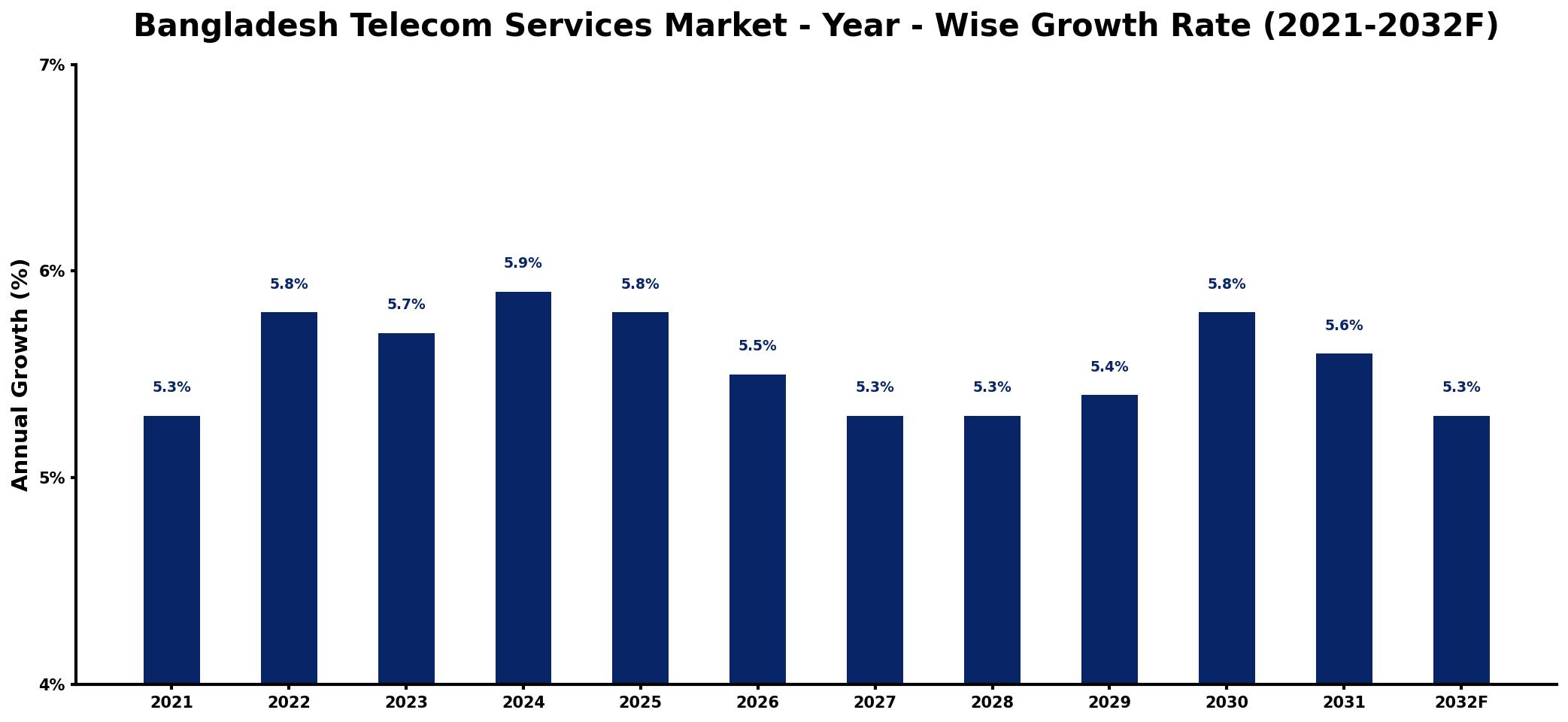
The table below presents the year‑wise growth rates along with the key drivers influencing the market
| Year | Growth Rate | Major Drivers |
| 2021 | 5.3% | increased smartphone penetration rates |
| 2022 | 5.8% | expansion of 4G networks |
| 2023 | 5.7% | rising demand for data consumption |
| 2024 | 5.9% | growth in digital payment adoption |
| 2025 | 5.8% | influx of foreign investments |
| 2026 | 5.5% | emergence of new startups |
| 2027 | 5.3% | enhanced rural connectivity initiatives |
| 2028 | 5.3% | development of IoT applications |
| 2029 | 5.4% | growing interest in cloud solutions |
| 2030 | 5.8% | growing commercial sector adoption |
| 2031 | 5.6% | increased government digital initiatives |
| 2032 | 5.3% | rising mobile app development |
Note: Market size estimations and growth projections presented in this report are based on 6Wresearch's proprietary forecasting methodology, utilizing the latest available industry data, government publications, and primary research inputs.
Bangladesh Telecom Services Market Synopsis
Currently, the Bangladesh Telecom Services Market is witnessing an unprecedented surge in demand for mobile services, driven by a population exceeding 160 million. The competitive landscape is marked by aggressive investments in network infrastructure, especially with the anticipated rollout of 5G technologies that promise to revolutionize data consumption.
In tandem with this growth, the market is also experiencing a cultural shift towards digitalization, where services such as mobile banking and e-commerce are rapidly gaining traction. This trend underscores the necessity for robust telecom networks that can accommodate the increasing data needs of consumers and businesses alike.
Bangladesh Telecom Services Market Key Takeaways
- The market is poised for significant growth, driven by the increased demand for high-speed internet and mobile connectivity.
- Government initiatives aimed at expanding rural connectivity are set to catalyze further market development.
- Investment in digital services and infrastructure will be crucial for operators looking to capitalize on emerging trends.
- The competitive landscape is intensifying, necessitating innovation and adaptability among telecom providers.
- Regulatory policies will continue to shape market dynamics and influence growth trajectories.
Evaluation of Restraints in Bangladesh Telecom Services Market
Despite its robust growth potential, the Bangladesh Telecom Services Market is not without its challenges. Intense competition has led to price wars, squeezing profit margins for operators, while regulatory constraints, including high taxation, pose significant hurdles. Furthermore, inadequate infrastructure development in rural areas restricts access to services, leaving substantial segments of the population underserved. Limited spectrum availability also impedes expansion efforts, as operators grapple with high acquisition costs and regulatory red tape. Additionally, ongoing concerns regarding cybersecurity highlight the need for continuous investment in technological upgrades to safeguard consumer data.
Bangladesh Telecom Services Market Trends
A prominent trend in the Bangladesh Telecom Services Market is the rapid expansion of 4G and the preparation for 5G rollouts. Telecom operators are investing heavily in infrastructure enhancements to improve network quality and service delivery. There is also a noticeable shift towards digital solutions, with rising interest in mobile banking, e-commerce, and streaming services, all demanding reliable high-speed connectivity.
Furthermore, the movement towards smart city initiatives is gaining momentum, necessitating robust telecom networks capable of supporting innovations in areas such as IoT, smart transportation, and healthcare. This evolution is indicative of a broader shift towards advanced technologies that meet the diverse needs of consumers and businesses in an increasingly digital landscape.
Bangladesh Telecom Services Market Opportunities
The Bangladesh Telecom Services Market is rife with investment opportunities stemming from its rapid growth trajectory and escalating demand for connectivity. Key areas for investment include the expansion of 4G networks and preparations for 5G technology, which promise enhanced data services. Additionally, operators can benefit from partnerships focused on innovative services such as mobile money solutions and cloud-based offerings. The government's push for enhanced digitalization further paves the way for substantial growth, making telecom infrastructure development a particularly lucrative sector.
Government Initiatives in the Bangladesh Telecom Services Market
The Bangladesh government plays a crucial role in shaping the telecom sector through its regulatory framework, primarily managed by the Bangladesh Telecommunication Regulatory Commission (BTRC). The government is committed to fostering competition, enhancing consumer protection, and stimulating growth in the telecom industry. Policies facilitating foreign investment have been implemented to drive innovation and improve infrastructure. Furthermore, regulations addressing mobile number portability and cybersecurity demonstrate a proactive approach to enhancing the consumer experience and ensuring service reliability.
Future Insights of the Bangladesh Telecom Services Market
Looking ahead, the Bangladesh Telecom Services Market is set for robust growth through 2026-2032. Key drivers will include rising smartphone adoption and escalating demand for data services, facilitated by ongoing government initiatives to improve digital infrastructure. As competition amongst telecom operators intensifies, innovations in service delivery will be essential for maintaining market relevance. However, the market will need to navigate persistent challenges, including regulatory issues and infrastructure deficits, to ensure sustainable growth amidst an ever-evolving digital landscape.
Bangladesh Telecom Services Market Latest Developments (2025 - 2026)
In recent months, the Bangladesh Telecom Services Market has been characterized by notable advancements in network infrastructure, particularly as operators prepare for the deployment of 5G technologies. Furthermore, strategic partnerships aimed at enhancing digital services have emerged, aligning with the growing demand for mobile banking and e-commerce solutions. The industry is also witnessing increased collaboration among stakeholders to address cybersecurity challenges, underscoring the importance of consumer data protection in an expanding digital ecosystem.
Bangladesh Telecom Services Market - Key Attractiveness of the Report
- 10 Years of Market Numbers
- Historical Data Starting from 2022 to 2025
- Base Year: 2025
- Forecast Data until 2032
- Key Performance Indicators Impacting the Market
- Major Upcoming Developments and Projects
Key Highlights of the Report:
- Bangladesh Telecom Services Market Outlook
- Market Size of Bangladesh Telecom Services Market, 2025
- Forecast of Bangladesh Telecom Services Market, 2032
- Historical Data and Forecast of Bangladesh Telecom Services Revenues & Volume for the Period 2022-2032F
- Bangladesh Telecom Services Market Trend Evolution
- Bangladesh Telecom Services Market Drivers and Challenges
- Bangladesh Telecom Services Price Trends
- Bangladesh Telecom Services Porter's Five Forces
- Bangladesh Telecom Services Industry Life Cycle
- Historical Data and Forecast of Bangladesh Telecom Services Market Revenues & Volume By Service Type for the Period 2022-2032F
- Historical Data and Forecast of Bangladesh Telecom Services Market Revenues & Volume By Fixed Voice Services for the Period 2022-2032F
- Historical Data and Forecast of Bangladesh Telecom Services Market Revenues & Volume By Fixed Internet Access Services for the Period 2022-2032F
- Historical Data and Forecast of Bangladesh Telecom Services Market Revenues & Volume By Mobile Voice Services for the Period 2022-2032F
- Historical Data and Forecast of Bangladesh Telecom Services Market Revenues & Volume By Mobile Data Services for the Period 2022-2032F
- Historical Data and Forecast of Bangladesh Telecom Services Market Revenues & Volume By Pay-TV Services for the Period 2022-2032F
- Historical Data and Forecast of Bangladesh Telecom Services Market Revenues & Volume By Machine-to-Machine (Mobile IoT) Services for the Period 2022-2032F
- Historical Data and Forecast of Bangladesh Telecom Services Market Revenues & Volume By Transmission for the Period 2022-2032F
- Historical Data and Forecast of Bangladesh Telecom Services Market Revenues & Volume By Wireline for the Period 2022-2032F
- Historical Data and Forecast of Bangladesh Telecom Services Market Revenues & Volume By Wireless for the Period 2022-2032F
- Historical Data and Forecast of Bangladesh Telecom Services Market Revenues & Volume By End-use for the Period 2022-2032F
- Historical Data and Forecast of Bangladesh Telecom Services Market Revenues & Volume By Consumer/Residential for the Period 2022-2032F
- Historical Data and Forecast of Bangladesh Telecom Services Market Revenues & Volume By Business for the Period 2022-2032F
- Bangladesh Telecom Services Import Export Trade Statistics
- Market Opportunity Assessment By Service Type
- Market Opportunity Assessment By Transmission
- Market Opportunity Assessment By End-use
- Bangladesh Telecom Services Top Companies Market Share
- Bangladesh Telecom Services Competitive Benchmarking By Technical and Operational Parameters
- Bangladesh Telecom Services Company Profiles
- Bangladesh Telecom Services Key Strategic Recommendations






































