Brazil Cultivator and Tiller Machinery Market Size, Share & Growth Rate
The Brazil Cultivator and Tiller Machinery Market was estimated at USD 309 Million in 2025 and is projected to reach USD 370 Million by 2032, growing at a CAGR of 2.6% from 2026 to 2032. This growth trajectory is primarily driven by the increasing demand for mechanized agricultural practices that boost productivity and efficiency in soil preparation. Additionally, government initiatives supporting agricultural modernization further enhance the adoption of advanced cultivators and tillers across the region.
Brazil Cultivator and Tiller Machinery Market Year-wise Growth Rate and Key Drivers
This graph highlights how the Brazil Cultivator and Tiller Machinery Market has steadily grown over the years, supported by major growth factors.
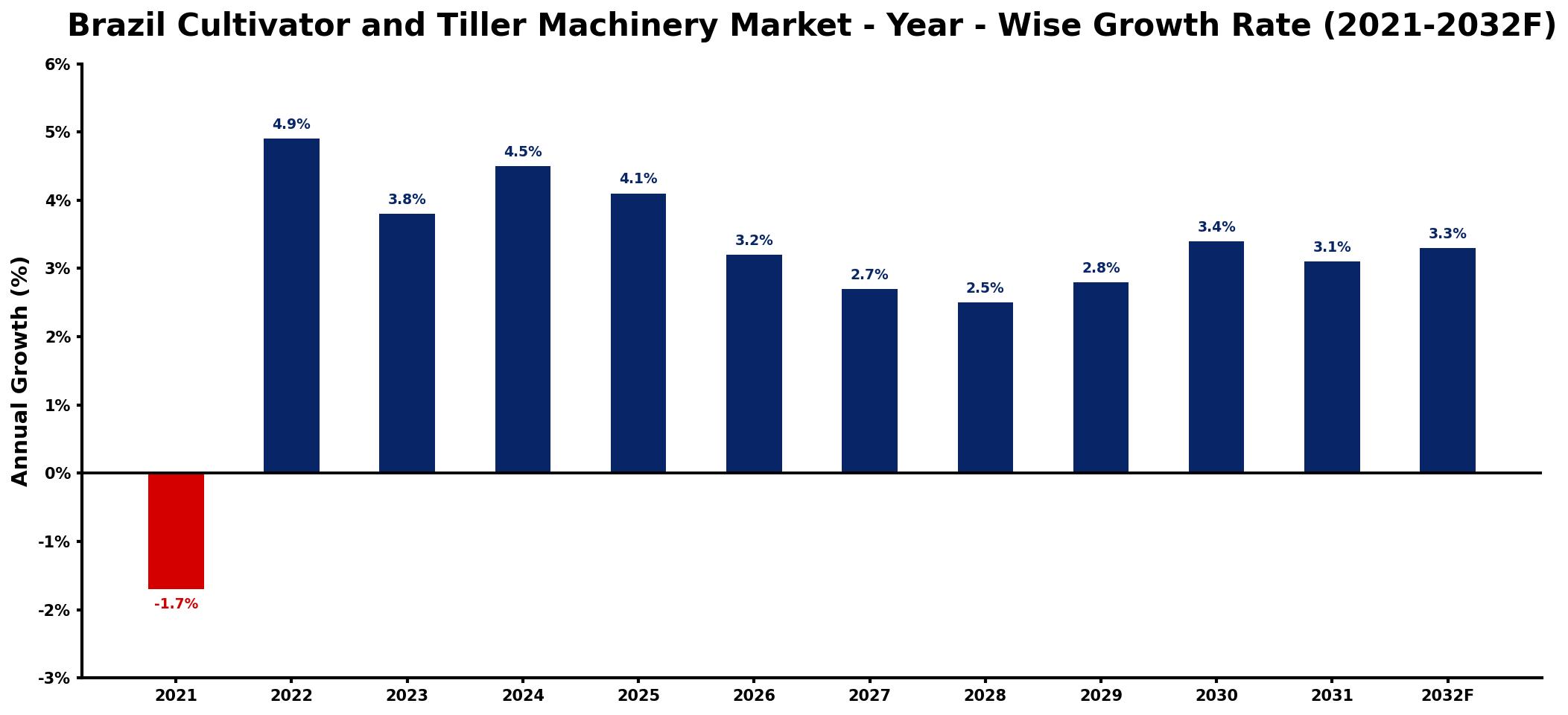
The table below presents the year‑wise growth rates along with the key drivers influencing the market
| Year | Growth Rate | Major Drivers |
| 2021 | -1.7% | Farming investments experiencing reduction |
| 2022 | 4.9% | Increased agricultural export opportunities |
| 2023 | 3.8% | Rising demand for sustainable practices |
| 2024 | 4.5% | Expansion of modern farming techniques |
| 2025 | 4.1% | Growing interest in precision agriculture |
| 2026 | 3.2% | Investments in rural infrastructure projects |
| 2027 | 2.7% | Surge in organic farming initiatives |
| 2028 | 2.5% | Emergence of smart farming technologies |
| 2029 | 2.8% | Increased focus on crop diversification |
| 2030 | 3.4% | Growth in agro-tourism ventures |
| 2031 | 3.1% | expanding healthcare application demand |
| 2032 | 3.3% | Advancements in agricultural research funding |
Note: Market size estimations and growth projections presented in this report are based on 6Wresearch's proprietary forecasting methodology, utilizing the latest available industry data, government publications, and primary research inputs.
Brazil Cultivator and Tiller Machinery Market Synopsis
Brazil's agriculture sector is experiencing a notable shift towards mechanization, particularly in tillage operations. Farmers are increasingly turning to innovative cultivators and tillers to optimize land use, mitigate labor shortages, and increase operational efficiency. This shift is critical to achieving higher crop yields in a competitive market.
The availability of advanced machinery tailored to diverse soil conditions also plays a vital role in driving market growth. As cultivators and tillers become more versatile, Brazilian farmers are empowered to implement more sophisticated cultivation methods, enhancing both soil quality and overall crop health.
Brazil Cultivator and Tiller Machinery Market Key Takeaways
- The market is driven by the increasing demand for efficient soil cultivation technologies.
- Government initiatives are promoting mechanized farming practices to enhance agricultural productivity.
- Technological innovations are leading to more fuel-efficient and reliable cultivator and tiller machinery.
- Growing labor shortages in the agricultural sector underscore the need for mechanization.
- The market faces challenges related to equipment affordability and after-sales service.
Evaluation of Restraints in Brazil Cultivator and Tiller Machinery Market
Despite its growth potential, the Brazil Cultivator and Tiller Machinery Market faces several restraints. Adapting machinery to various soil types and farming practices presents challenges for manufacturers and users alike. Additionally, there are concerns regarding fuel efficiency, as operators seek equipment that minimizes operational costs. Equipment affordability remains a significant barrier, particularly for small and medium-sized farms, which often rely on traditional farming methods due to budget constraints.
Brazil Cultivator and Tiller Machinery Market Trends
Current trends highlight the increasing integration of smart technology in cultivator and tiller designs. Precision agriculture tools, including GPS and IoT capabilities, are becoming commonplace, allowing farmers to monitor and manage soil health more effectively. Furthermore, sustainable farming practices are gaining traction, with manufacturers responding by developing machinery that minimizes soil disruption and promotes conservation.
Brazil Cultivator and Tiller Machinery Market Opportunities
The potential for growth in the Brazil Cultivator and Tiller Machinery Market lies in expanding the range of products tailored to smallholder farms. As these farmers become more engaged with modern agricultural practices, there is an opportunity to offer affordable, innovative machinery that meets their specific needs. Additionally, partnerships with technology providers for smart agricultural solutions can unlock new revenue streams and improve overall market competitiveness.
Government Initiatives in the Brazil Cultivator and Tiller Machinery Market
Government policies in Brazil play a significant role in shaping the cultivator and tiller machinery market. Initiatives aimed at promoting agricultural mechanization include financial incentives for farmers who adopt modern equipment and programs designed to enhance training on new technologies. Regulations regarding machinery performance standards also ensure that equipment aligns with environmental sustainability goals, fostering responsible agricultural practices.
Future Insights of the Brazil Cultivator and Tiller Machinery Market
Looking ahead to 2026-2032, the Brazil Cultivator and Tiller Machinery Market is expected to evolve significantly. As the push for sustainability intensifies, manufacturers will likely focus on developing eco-friendly equipment that meets stricter environmental regulations. The integration of digital technologies will continue to expand, positioning cultivators and tillers as essential tools for modern farming, thereby enhancing their market appeal and driving adoption.
Brazil Cultivator and Tiller Machinery Market Latest Developments (2025 - 2026)
Recent developments in the Brazil cultivator and tiller machinery sector indicate a shift towards the adoption of more sophisticated technologies. Companies are focusing on enhancing the durability and efficiency of their products to cater to the demands of a rapidly evolving market. Additionally, there is a concerted effort to improve customer service and after-sales support, addressing one of the significant barriers to market growth.
Brazil Cultivator and Tiller Machinery Market - Key Attractiveness of the Report
- 10 Years of Market Numbers
- Historical Data Starting from 2022 to 2025
- Base Year: 2025
- Forecast Data until 2032
- Key Performance Indicators Impacting the Market
- Major Upcoming Developments and Projects
Key Highlights of the Report:
- Brazil Cultivator and Tiller Machinery Market Outlook
- Market Size of Brazil Cultivator and Tiller Machinery Market, 2025
- Forecast of Brazil Cultivator and Tiller Machinery Market, 2032
- Historical Data and Forecast of Brazil Cultivator and Tiller Machinery Revenues & Volume for the Period 2022-2032F
- Brazil Cultivator and Tiller Machinery Market Trend Evolution
- Brazil Cultivator and Tiller Machinery Market Drivers and Challenges
- Brazil Cultivator and Tiller Machinery Price Trends
- Brazil Cultivator and Tiller Machinery Porter's Five Forces
- Brazil Cultivator and Tiller Machinery Industry Life Cycle
- Historical Data and Forecast of Brazil Cultivator and Tiller Machinery Market Revenues & Volume By Product Type for the Period 2022-2032F
- Historical Data and Forecast of Brazil Cultivator and Tiller Machinery Market Revenues & Volume By Cultivators for the Period 2022-2032F
- Historical Data and Forecast of Brazil Cultivator and Tiller Machinery Market Revenues & Volume By Tillers for the Period 2022-2032F
- Historical Data and Forecast of Brazil Cultivator and Tiller Machinery Market Revenues & Volume By for the Period 2022-2032F
- Historical Data and Forecast of Brazil Cultivator and Tiller Machinery Market Revenues & Volume By Application for the Period 2022-2032F
- Historical Data and Forecast of Brazil Cultivator and Tiller Machinery Market Revenues & Volume By Agriculture for the Period 2022-2032F
- Historical Data and Forecast of Brazil Cultivator and Tiller Machinery Market Revenues & Volume By Garden for the Period 2022-2032F
- Brazil Cultivator and Tiller Machinery Import Export Trade Statistics
- Market Opportunity Assessment By Product Type
- Market Opportunity Assessment By Application
- Brazil Cultivator and Tiller Machinery Top Companies Market Share
- Brazil Cultivator and Tiller Machinery Competitive Benchmarking By Technical and Operational Parameters
- Brazil Cultivator and Tiller Machinery Company Profiles
- Brazil Cultivator and Tiller Machinery Key Strategic Recommendations






































