Brazil Cultured Meat Market Size, Share & Growth Rate
The Brazil Cultured Meat Market was estimated at USD 225 Million in 2025 and is projected to reach USD 268 Million by 2032, growing at a CAGR of 2.5% from 2026 to 2032. This growth trajectory is driven by increasing environmental concerns among consumers, a rising commitment to animal welfare, and advancements in cell culture technology. The convergence of these factors signals a robust interest in cultured meat as a sustainable alternative to conventional meat production, with Brazil emerging as a pivotal player in this innovative landscape.
Brazil Cultured Meat Market Year-wise Growth Rate and Key Drivers
This graph highlights how the Brazil Cultured Meat Market has steadily grown over the years, supported by major growth factors.
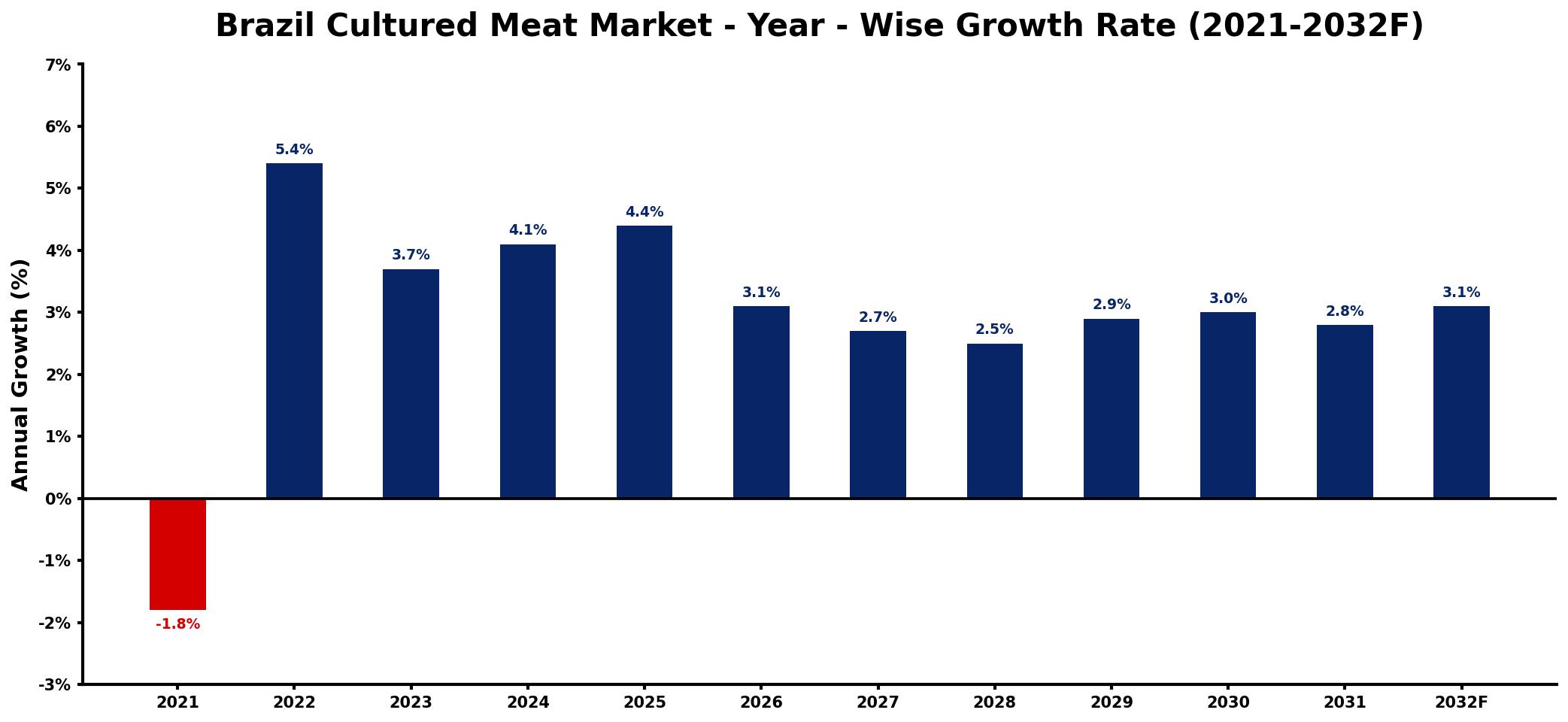
The table below presents the year‑wise growth rates along with the key drivers influencing the market
| Year | Growth Rate | Major Drivers |
| 2021 | -1.8% | decrease in consumer spending habits |
| 2022 | 5.4% | increase in health consciousness trends |
| 2023 | 3.7% | growing environmental sustainability awareness |
| 2024 | 4.1% | expansion of alternative protein startups |
| 2025 | 4.4% | rising investments in food technology |
| 2026 | 3.1% | increased availability of production facilities |
| 2027 | 2.7% | enhanced regulatory support frameworks |
| 2028 | 2.5% | greater consumer acceptance of alternatives |
| 2029 | 2.9% | development of innovative product offerings |
| 2030 | 3.0% | rising procurement volume requirements |
| 2031 | 2.8% | higher demand from younger demographics |
| 2032 | 3.1% | strengthened partnerships with retailers |
Note: Market size estimations and growth projections presented in this report are based on 6Wresearch's proprietary forecasting methodology, utilizing the latest available industry data, government publications, and primary research inputs.
Brazil Cultured Meat Market Synopsis
The most significant force currently shaping the Brazil Cultured Meat Market is the escalating demand for sustainable food sources. As consumers grow increasingly aware of the detrimental environmental impact associated with traditional livestock farming, cultured meat presents a promising solution that aligns with modern ethical standards.
Additionally, technological advancements are enhancing the viability of cultured meat, making it a viable contender in the competitive protein market. These developments not only aim to improve production efficiency but also focus on ensuring product safety and quality, which are critical for consumer acceptance.
Brazil Cultured Meat Market Key Takeaways
- The market is driven by sustainability and animal welfare concerns, reflecting a shift in consumer preferences.
- Technological advancements are crucial for improving production efficiency and product quality.
- Consumer acceptance remains a barrier, influenced by perceptions of taste, safety, and ethics.
- Regulatory frameworks are still evolving, creating an uncertain landscape for companies in the sector.
- Investment in research and development is essential to overcome current production challenges.
Evaluation of Restraints in Brazil Cultured Meat Market
While the Brazil Cultured Meat Market is ripe with potential, several constraints currently inhibit its rapid growth. The technological hurdles associated with scaling up production are significant; companies need substantial investment and time to develop processes that maintain product quality while minimizing costs. Moreover, consumer hesitation regarding the taste and safety of lab-grown meat can stifle market penetration. The regulatory landscape, with its various requirements surrounding production and labeling, further complicates the market dynamics, often leading to confusion and uncertainty among both producers and consumers.
Brazil Cultured Meat Market Trends
Emerging trends within the Brazil Cultured Meat Market indicate a growing integration of biotechnology in food production. As companies strive to replicate the texture and flavor of traditional meat, innovations in cell culture techniques are continuously being explored. Additionally, the rise of plant-based diets is influencing consumer expectations, pushing cultured meat manufacturers to align their products with health-conscious trends. Social media and influencer marketing also play an increasingly important role in shaping consumer perceptions, driving curiosity and acceptance of cultured meat products.
Brazil Cultured Meat Market Opportunities
The opportunities for growth in the Brazil Cultured Meat Market are significant, particularly in urban areas where consumers are more likely to embrace innovative food technologies. With a burgeoning middle class that values sustainability, there is a notable demand for ethically produced food products. Collaborations between tech firms and food manufacturers are expected to foster innovative solutions that address production challenges. Furthermore, as regulatory frameworks become clearer, investments in infrastructure and development will unlock new pathways for commercialization, paving the way for broader consumer acceptance and market penetration.
Government Initiatives in the Brazil Cultured Meat Market
Brazilian government initiatives aimed at promoting sustainability and innovation in the food sector provide a favorable backdrop for the cultured meat industry. Public spending focused on research and development for alternative protein sources is increasing, and there are programs designed to facilitate collaborations between academia and industry. Moreover, as the government becomes more attuned to consumer demand for transparency and ethics in food production, regulations governing cultured meat are likely to evolve, fostering an environment conducive to growth.
Future Insights of the Brazil Cultured Meat Market
Looking ahead to the period from 2026 to 2032, the Brazil Cultured Meat Market is poised for steady growth driven by technological advancements and shifting consumer preferences. As awareness of the environmental and ethical implications of traditional meat production continues to rise, the market for cultured meat will likely expand. With ongoing investments in R&D and infrastructure, producers are expected to overcome current production challenges, enhancing quality and scaling up outputs to meet demand. The integration of cultured meat into mainstream culinary practices will further solidify its position within Brazils food landscape.
Brazil Cultured Meat Market Latest Developments (2025 - 2026)
Recent developments in the Brazil Cultured Meat Market indicate a shift towards increased investments in technological innovation aimed at enhancing production efficiency. Companies are exploring partnerships with research institutions to develop advanced cell culture techniques. Consumer trials and taste tests are being conducted to better understand preferences and improve acceptance rates. Additionally, regulatory bodies are beginning to outline clearer guidelines for labeling and marketing cultured meat, which may foster greater consumer confidence and participation in the market.
Brazil Cultured Meat Market - Key Attractiveness of the Report
- 10 Years of Market Numbers
- Historical Data Starting from 2022 to 2025
- Base Year: 2025
- Forecast Data until 2032
- Key Performance Indicators Impacting the Market
- Major Upcoming Developments and Projects
Key Highlights of the Report:
- Brazil Cultured Meat Market Outlook
- Market Size of Brazil Cultured Meat Market, 2025
- Forecast of Brazil Cultured Meat Market, 2032
- Historical Data and Forecast of Brazil Cultured Meat Revenues & Volume for the Period 2022-2032F
- Brazil Cultured Meat Market Trend Evolution
- Brazil Cultured Meat Market Drivers and Challenges
- Brazil Cultured Meat Price Trends
- Brazil Cultured Meat Porter's Five Forces
- Brazil Cultured Meat Industry Life Cycle
- Historical Data and Forecast of Brazil Cultured Meat Market Revenues & Volume By Product Type for the Period 2022-2032F
- Historical Data and Forecast of Brazil Cultured Meat Market Revenues & Volume By Poultry for the Period 2022-2032F
- Historical Data and Forecast of Brazil Cultured Meat Market Revenues & Volume By Beef for the Period 2022-2032F
- Historical Data and Forecast of Brazil Cultured Meat Market Revenues & Volume By Seafood for the Period 2022-2032F
- Historical Data and Forecast of Brazil Cultured Meat Market Revenues & Volume By Pork for the Period 2022-2032F
- Historical Data and Forecast of Brazil Cultured Meat Market Revenues & Volume By Duck for the Period 2022-2032F
- Historical Data and Forecast of Brazil Cultured Meat Market Revenues & Volume By End-Use for the Period 2022-2032F
- Historical Data and Forecast of Brazil Cultured Meat Market Revenues & Volume By Nuggets for the Period 2022-2032F
- Historical Data and Forecast of Brazil Cultured Meat Market Revenues & Volume By Burgers for the Period 2022-2032F
- Historical Data and Forecast of Brazil Cultured Meat Market Revenues & Volume By Meatballs for the Period 2022-2032F
- Historical Data and Forecast of Brazil Cultured Meat Market Revenues & Volume By Sausage for the Period 2022-2032F
- Historical Data and Forecast of Brazil Cultured Meat Market Revenues & Volume By Hot dogs for the Period 2022-2032F
- Historical Data and Forecast of Brazil Cultured Meat Market Revenues & Volume By Others for the Period 2022-2032F
- Brazil Cultured Meat Import Export Trade Statistics
- Market Opportunity Assessment By Product Type
- Market Opportunity Assessment By End-Use
- Brazil Cultured Meat Top Companies Market Share
- Brazil Cultured Meat Competitive Benchmarking By Technical and Operational Parameters
- Brazil Cultured Meat Company Profiles
- Brazil Cultured Meat Key Strategic Recommendations






































