Brazil Digital Lending Market Size & Growth Rate (2026-2032)
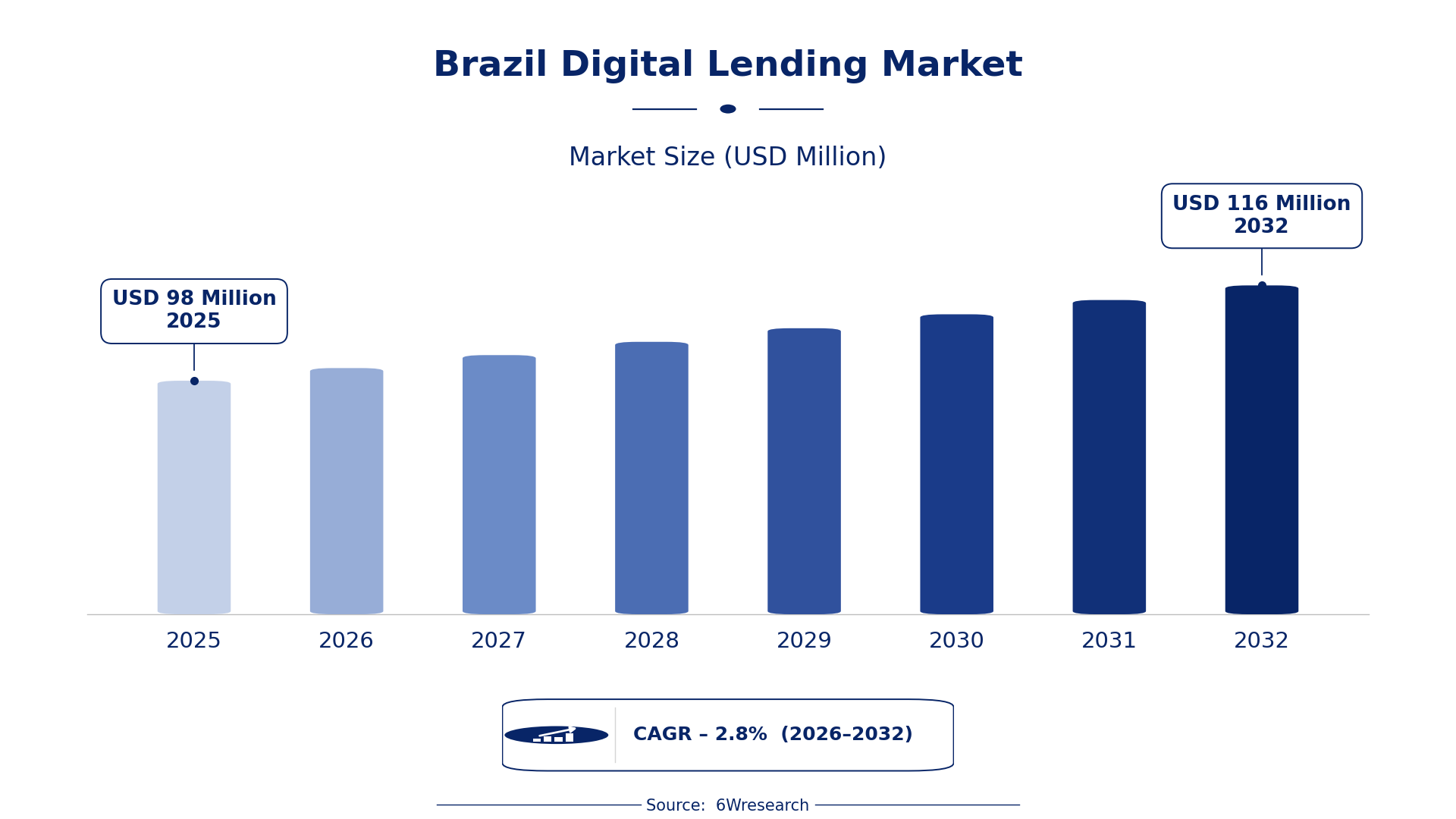
The Brazil Digital Lending Market was estimated at USD 98 Million in 2025 and is projected to reach USD 116 Million by 2032, growing at a CAGR of 2.8% from 2026 to 2032.
Brazil Digital Lending Market Synopsis
The digital lending market in Brazil is thriving, driven by a surge in demand for quick and accessible financing options. Technology is at the forefront, enabling lenders to streamline processes and cater to a growing customer base that favors digital solutions.
Peer-to-peer lending platforms and innovative fintech solutions are reshaping the financial landscape, making it easier for consumers and businesses to secure loans. With government policies actively promoting financial inclusion, the market is set for continued expansion.
Brazil Digital Lending Market Year-wise Growth Rate and Key Drivers
This graph illustrates the annual growth rates of the Brazil Digital Lending Market from 2021 to 2032, highlighting a steady upward trajectory and projected expansion over the forecast period.
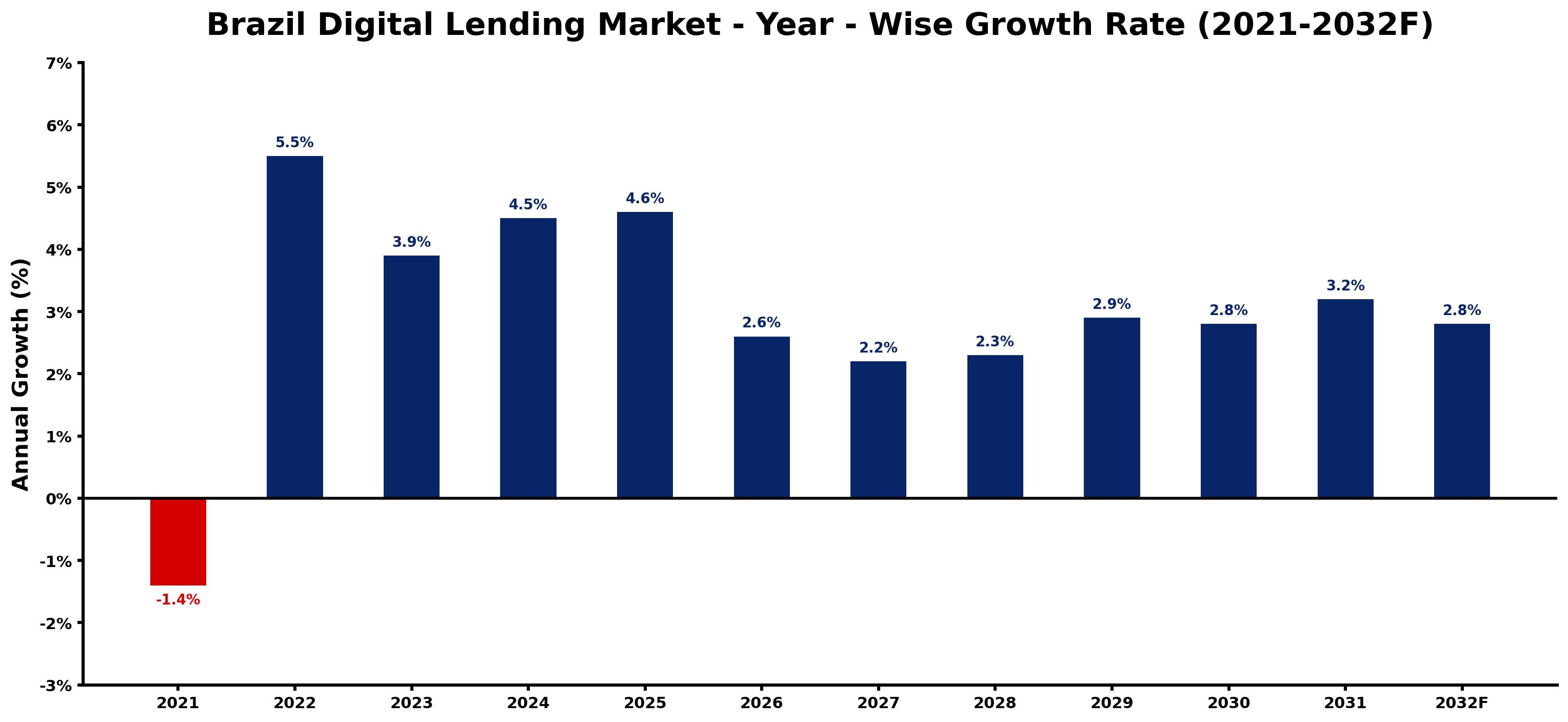
The table below presents the year‑wise growth rates along with the key drivers influencing the market
| Year | Growth Rate | Major Drivers |
| 2021 | -1.4% | Central Bank of Brazil tightened digital lending regulations. |
| 2022 | 5.5% | Increased smartphone penetration facilitates digital lending access. |
| 2023 | 3.9% | Regulatory support from Central Bank for fintech innovation. |
| 2024 | 4.5% | Growing consumer awareness of online loan products. |
| 2025 | 4.6% | Higher e-commerce transactions driving demand for digital credit. |
| 2026 | 2.6% | Youth population increasingly adopting digital financial solutions. |
| 2027 | 2.2% | Financial literacy programs enhancing digital borrowing understanding. |
| 2028 | 2.3% | Rising gig economy participants seeking flexible funding options. |
| 2029 | 2.9% | Partnerships with local merchants boosting in-store digital lending. |
| 2030 | 2.8% | Integration with major payment platforms expanding customer reach. |
| 2031 | 3.2% | Post-pandemic recovery increasing consumer spending on loans. |
| 2032 | 2.8% | Emergence of credit scoring innovations benefiting lenders. |
Note: Market size estimations and growth projections presented in this report are based on 6Wresearch's proprietary forecasting methodology, utilizing the latest available industry data, government publications, and primary research inputs.
Brazil Digital Lending Market Key Takeaways
Below are some of the specific key takeaways from the market, including:
- The increasing adoption of online lending platforms is enhancing access to credit for consumers and businesses.
- Technological advancements are critical in improving risk assessment and loan processing efficiency.
- Government initiatives focused on financial inclusion are driving the growth of digital lending solutions.
- Peer-to-peer lending is gaining traction, providing alternative financing sources beyond traditional banks.
- Challenges around regulatory compliance and credit risk management persist in this dynamic market.
Evaluation of Restraints in Brazil Digital Lending Market
Despite its growth, the Brazil digital lending market faces considerable restraints. Credit risk management remains a pressing challenge, as evaluating the creditworthiness of potential borrowers in a digital environment requires sophisticated analytics. Additionally, ensuring compliance with evolving regulatory standards is crucial for maintaining trust among consumers.
Data privacy concerns also pose risks, as digital lenders must protect sensitive information while fostering a transparent relationship with clients. These issues, if not adequately addressed, could hinder the overall growth trajectory of the market.
Brazil Digital Lending Market Trends
Several trends are shaping the Brazil digital lending market. Increasing customer preferences for online services are compelling lenders to enhance their digital platforms. Automation in loan processing is becoming standard, allowing for faster approvals and disbursements.
The rise of alternative credit scoring models is also noteworthy, as these methodologies allow lenders to assess borrowers beyond traditional credit histories. This trend not only broadens the potential customer base but also aligns with the push for greater financial inclusion.
Brazil Digital Lending Market Opportunities
Significant opportunities lie ahead for investors and stakeholders in the Brazil digital lending market. The demand for financing among small and medium-sized enterprises (SMEs) presents a fertile ground for growth. As these businesses often struggle to access traditional banking services, digital lending solutions can fill the gap effectively.
on top of that, advancements in artificial intelligence and machine learning are paving the way for improved risk assessment tools, which can enhance credit evaluation processes. This can lead to more inclusive lending practices and increased market penetration.
Government Initiatives in the Brazil Digital Lending Market
Government policy is playing a crucial role in shaping the Brazil digital lending market. The focus on financial inclusion and support for SMEs is evident in various initiatives aimed at enhancing access to credit. These efforts are essential for fostering a more equitable financial environment.
- A credit guarantee program launched recently aims to facilitate lending to SMEs, providing them with easier access to financing.
- The Brazilian government is currently implementing a regulatory framework designed to enhance consumer protection and data privacy in digital lending.
- A public-private partnership expected to roll out in 2026 aims to expand digital infrastructure, improving connectivity for lending services.
- Ongoing initiatives to promote fintech innovation are encouraging the development of new digital lending solutions.
- Plans for a national awareness campaign on responsible borrowing practices are set to launch in mid-2026.
Future Insights of the Brazil Digital Lending Market
Looking ahead to 2026-2032, the Brazil digital lending market is likely to experience transformative growth. With technology continuing to evolve, we can expect more sophisticated lending solutions that cater to diverse consumer needs. The emphasis on financial inclusion will further drive demand, especially among underserved segments.
As regulatory frameworks mature, the market will benefit from increased stability and trust, encouraging more participants to enter the space. Investment in technological advancements will remain vital, particularly in enhancing security and customer experience.
Brazil Digital Lending Market Latest Developments
In the past year, the Brazil digital lending market has seen a flurry of activity. Companies are increasingly adopting innovative technologies to improve their services and reach a broader audience. The competitive environment is pushing players to refine their offerings and explore new partnerships.
- A leading regional operator launched an AI-driven loan processing platform in early 2025, significantly reducing approval times.
- In Q3 2025, a major technology vendor partnered with several fintech firms to enhance digital credit scoring systems.
- An ongoing initiative began in late 2025, focusing on integrating blockchain technology to improve transparency in loan transactions.
- A rollout expected to begin in early 2026 will introduce a new online platform aimed specifically at rural borrowers.
- A recent collaboration among industry stakeholders was announced in late 2025, focusing on developing standardized practices for digital lending.
Brazil Digital Lending Market - Key Attractiveness of the Report
- 10 Years of Market Numbers
- Historical Data Starting from 2022 to 2025
- Base Year: 2025
- Forecast Data until 2032
- Key Performance Indicators Impacting the Market
- Major Upcoming Developments and Projects
Key Highlights of the Report:
- Brazil Digital Lending Market Outlook
- Market Size of Brazil Digital Lending Market, 2025
- Forecast of Brazil Digital Lending Market, 2032
- Historical Data and Forecast of Brazil Digital Lending Revenues & Volume for the Period 2022-2032F
- Brazil Digital Lending Market Trend Evolution
- Brazil Digital Lending Market Drivers and Challenges
- Brazil Digital Lending Price Trends
- Brazil Digital Lending Porter's Five Forces
- Brazil Digital Lending Industry Life Cycle
- Historical Data and Forecast of Brazil Digital Lending Market Revenues & Volume By Offering for the Period 2022-2032F
- Historical Data and Forecast of Brazil Digital Lending Market Revenues & Volume By Solutions for the Period 2022-2032F
- Historical Data and Forecast of Brazil Digital Lending Market Revenues & Volume By Services for the Period 2022-2032F
- Historical Data and Forecast of Brazil Digital Lending Market Revenues & Volume By Deployment Mode for the Period 2022-2032F
- Historical Data and Forecast of Brazil Digital Lending Market Revenues & Volume By Cloud for the Period 2022-2032F
- Historical Data and Forecast of Brazil Digital Lending Market Revenues & Volume By On-premises for the Period 2022-2032F
- Historical Data and Forecast of Brazil Digital Lending Market Revenues & Volume By End User for the Period 2022-2032F
- Historical Data and Forecast of Brazil Digital Lending Market Revenues & Volume By Banks for the Period 2022-2032F
- Historical Data and Forecast of Brazil Digital Lending Market Revenues & Volume By Credit Unions for the Period 2022-2032F
- Historical Data and Forecast of Brazil Digital Lending Market Revenues & Volume By NBFCs for the Period 2022-2032F
- Brazil Digital Lending Import Export Trade Statistics
- Market Opportunity Assessment By Offering
- Market Opportunity Assessment By Deployment Mode
- Market Opportunity Assessment By End User
- Brazil Digital Lending Top Companies Market Share
- Brazil Digital Lending Competitive Benchmarking By Technical and Operational Parameters
- Brazil Digital Lending Company Profiles
- Brazil Digital Lending Key Strategic Recommendations






































