Brazil Electrical Testing Equipment Market Size, Share & Growth Rate
The Brazil Electrical Testing Equipment Market was estimated at USD 172 Million in 2025 and is projected to reach USD 205 Million by 2032, growing at a CAGR of 2.5% from 2026 to 2032. This growth trajectory is largely driven by the increasing demands for safety and reliability in electrical systems across various sectors, particularly energy, telecommunications, and electronics manufacturing. As the complexity of these systems escalates, the necessity for advanced testing solutions becomes paramount, prompting a shift towards innovative and multifunctional devices.
Brazil Electrical Testing Equipment Market Year-wise Growth Rate and Key Drivers
This graph highlights how the Brazil Electrical Testing Equipment Market has steadily grown over the years, supported by major growth factors.
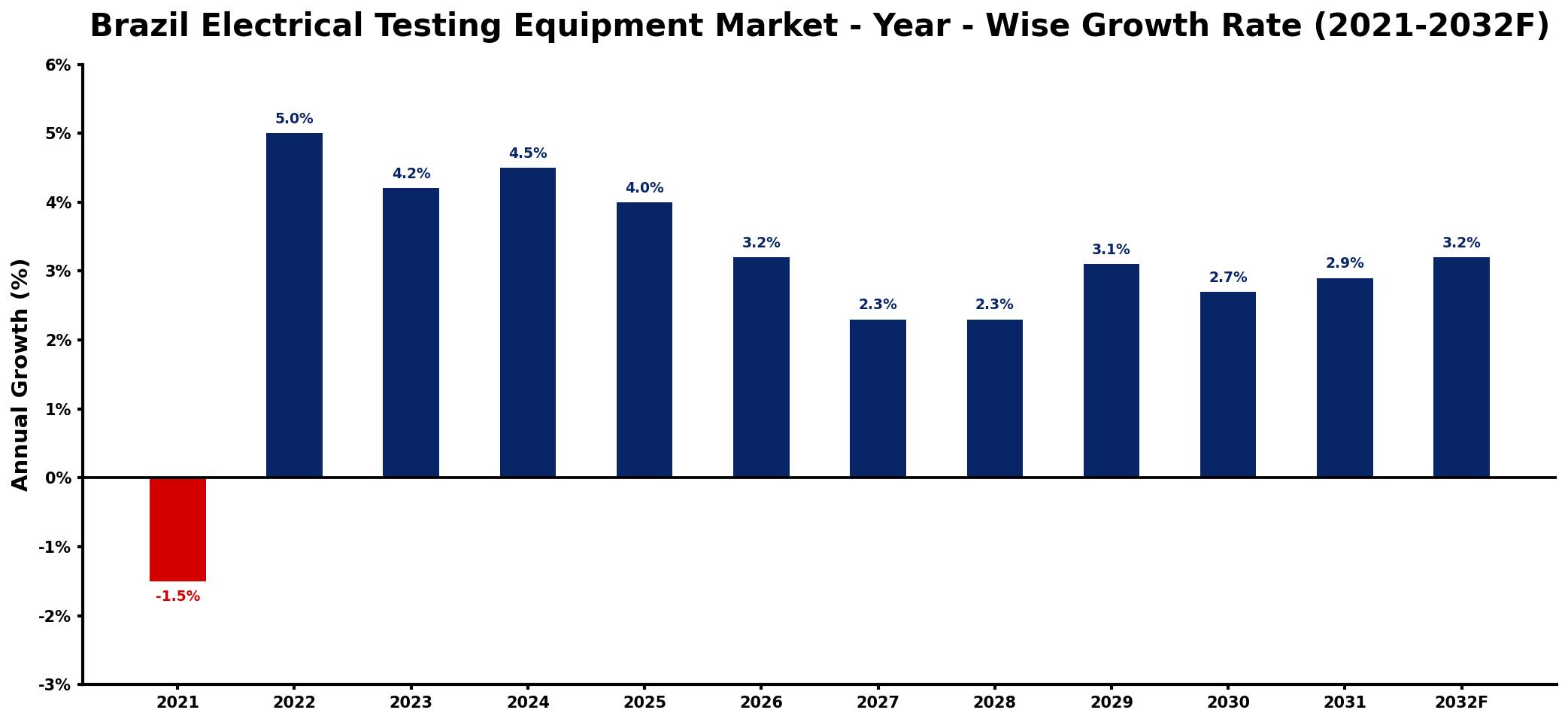
The table below presents the year‑wise growth rates along with the key drivers influencing the market
| Year | Growth Rate | Major Drivers |
| 2021 | -1.5% | reduced infrastructure investment activities |
| 2022 | 5.0% | growing renewable energy projects |
| 2023 | 4.2% | increased industrial automation adoption |
| 2024 | 4.5% | expansion in smart grid initiatives |
| 2025 | 4.0% | rising demand for safety standards |
| 2026 | 3.2% | growth in residential construction market |
| 2027 | 2.3% | enhanced regulatory compliance requirements |
| 2028 | 2.3% | emerging technologies in manufacturing |
| 2029 | 3.1% | increased focus on energy efficiency |
| 2030 | 2.7% | growing demand for maintenance services |
| 2031 | 2.9% | expanding telecommunications infrastructure projects |
| 2032 | 3.2% | rising investments in sustainable technologies |
Note: Market size estimations and growth projections presented in this report are based on 6Wresearch's proprietary forecasting methodology, utilizing the latest available industry data, government publications, and primary research inputs.
Brazil Electrical Testing Equipment Market Synopsis
In recent years, the Brazilian market for electrical testing equipment has witnessed significant evolution, largely in response to the rapid advancements in technology. The increasing integration of smart grid systems is reshaping the landscape, compelling stakeholders to prioritize robust testing methodologies to maintain high safety standards.
Brazils industrial growth and stringent safety regulations further underline the critical nature of electrical testing equipment. Companies are increasingly investing in reliable technologies to meet regulatory compliance, ensuring that their systems can withstand both operational demands and environmental challenges.
Brazil Electrical Testing Equipment Market Key Takeaways
- The market is experiencing steady growth driven by safety and performance needs across various industries.
- Technological advancements, especially in smart grid integration, are crucial to market expansion.
- Compliance with national and international safety standards is essential for manufacturers operating in Brazil.
- The shift towards multifunctional testing devices is reshaping product offerings and customer expectations.
- Adapting to complex electrical systems remains a pivotal challenge for industry players.
Evaluation of Restraints in Brazil Electrical Testing Equipment Market
Despite the positive growth outlook, the Brazil Electrical Testing Equipment market faces significant constraints, particularly due to the increasing complexity of electrical systems. Manufacturers are often challenged by the necessity to develop multifunctional testing devices that can meet diverse applications. Moreover, the need to stay updated with evolving industry standards poses a continuous challenge, potentially leading to delays in product launches and increased R&D costs. Additionally, a skills gap among technicians regarding the operation of advanced testing devices can limit market penetration and effectiveness.
Brazil Electrical Testing Equipment Market Trends
One of the most noteworthy trends is the increasing adoption of smart technology within electrical testing equipment. The integration of IoT capabilities is becoming more prevalent, allowing for real-time monitoring and analysis. Furthermore, there is a growing demand for user-friendly interfaces, enabling technicians to operate sophisticated devices more efficiently. Sustainability trends are also influencing the market, with an emphasis on eco-friendly materials and processes in manufacturing testing equipment.
Brazil Electrical Testing Equipment Market Opportunities
The transition to renewable energy sources presents a genuine opportunity for growth within the Brazil Electrical Testing Equipment market. As Brazil increases its investment in solar and wind energy, the need for testing equipment that can ensure system reliability and compliance with safety standards will rise. Additionally, emerging markets within Brazil's interior regions are beginning to see infrastructural developments, which will bolster demand for electrical testing solutions.
Government Initiatives in the Brazil Electrical Testing Equipment Market
Government policies are critical in shaping the landscape of the Brazil Electrical Testing Equipment market. The Brazilian government has initiated programs focusing on enhancing electrical safety and establishing stringent quality standards, aimed at reducing risks associated with electrical systems. Financial incentives for renewable energy projects and public spending on infrastructure improvements also provide a favorable environment for market growth.
Future Insights of the Brazil Electrical Testing Equipment Market
Looking ahead to 2026-2032, the Brazil Electrical Testing Equipment market is set to evolve further with technological advancements and regulatory changes. As safety standards become increasingly stringent, manufacturers will need to innovate continuously. The anticipated expansion of renewable energy and smart grid technologies will likely catalyze further investment in advanced testing solutions, ensuring that the market remains vibrant and responsive to industry demands.
Brazil Electrical Testing Equipment Market Latest Developments (2025 - 2026)
Recent developments in the Brazil Electrical Testing Equipment market reflect a push towards greater innovation and compliance with emerging safety regulations. Companies are increasingly focusing on integrating IoT technologies into their products, allowing for more advanced diagnostic capabilities. Additionally, there have been collaborations between manufacturers and research institutions aimed at developing new testing standards that align with international benchmarks.
Brazil Electrical Testing Equipment Market - Key Attractiveness of the Report
- 10 Years of Market Numbers
- Historical Data Starting from 2022 to 2025
- Base Year: 2025
- Forecast Data until 2032
- Key Performance Indicators Impacting the Market
- Major Upcoming Developments and Projects
Key Highlights of the Report:
- Brazil Electrical Testing Equipment Market Outlook
- Market Size of Brazil Electrical Testing Equipment Market, 2025
- Forecast of Brazil Electrical Testing Equipment Market, 2032
- Historical Data and Forecast of Brazil Electrical Testing Equipment Revenues & Volume for the Period 2022-2032F
- Brazil Electrical Testing Equipment Market Trend Evolution
- Brazil Electrical Testing Equipment Market Drivers and Challenges
- Brazil Electrical Testing Equipment Price Trends
- Brazil Electrical Testing Equipment Porter's Five Forces
- Brazil Electrical Testing Equipment Industry Life Cycle
- Historical Data and Forecast of Brazil Electrical Testing Equipment Market Revenues & Volume By Service Type for the Period 2022-2032F
- Historical Data and Forecast of Brazil Electrical Testing Equipment Market Revenues & Volume By Electrical Testing Equipment Calibration Services for the Period 2022-2032F
- Historical Data and Forecast of Brazil Electrical Testing Equipment Market Revenues & Volume By Electrical Testing Equipment Repair Services or After Sales Services for the Period 2022-2032F
- Historical Data and Forecast of Brazil Electrical Testing Equipment Market Revenues & Volume By Product Type for the Period 2022-2032F
- Historical Data and Forecast of Brazil Electrical Testing Equipment Market Revenues & Volume By General Purpose Electrical Testing Equipment for the Period 2022-2032F
- Historical Data and Forecast of Brazil Electrical Testing Equipment Market Revenues & Volume By Mechanical Electrical Test Equipment for the Period 2022-2032F
- Historical Data and Forecast of Brazil Electrical Testing Equipment Market Revenues & Volume By End User for the Period 2022-2032F
- Historical Data and Forecast of Brazil Electrical Testing Equipment Market Revenues & Volume By Aerospace and Defense for the Period 2022-2032F
- Historical Data and Forecast of Brazil Electrical Testing Equipment Market Revenues & Volume By Telecommunications for the Period 2022-2032F
- Historical Data and Forecast of Brazil Electrical Testing Equipment Market Revenues & Volume By Semiconductor and Electronics for the Period 2022-2032F
- Brazil Electrical Testing Equipment Import Export Trade Statistics
- Market Opportunity Assessment By Service Type
- Market Opportunity Assessment By Product Type
- Market Opportunity Assessment By End User
- Brazil Electrical Testing Equipment Top Companies Market Share
- Brazil Electrical Testing Equipment Competitive Benchmarking By Technical and Operational Parameters
- Brazil Electrical Testing Equipment Company Profiles
- Brazil Electrical Testing Equipment Key Strategic Recommendations






































