Brazil Fruit Powder Market Size, Share & Growth Rate
The Brazil Fruit Powder Market was estimated at USD 214 Million in 2025 and is projected to reach USD 254 Million by 2032, growing at a CAGR of 2.5% from 2026 to 2032. This growth is largely attributed to the rising demand for convenient, nutrient-rich products that fit modern lifestyles. As health-conscious consumers gravitate towards natural options, fruit powders are becoming essential ingredients in various food and beverage applications, driving further market expansion.
Brazil Fruit Powder Market Year-wise Growth Rate and Key Drivers
This graph highlights how the Brazil Fruit Powder Market has steadily grown over the years, supported by major growth factors.
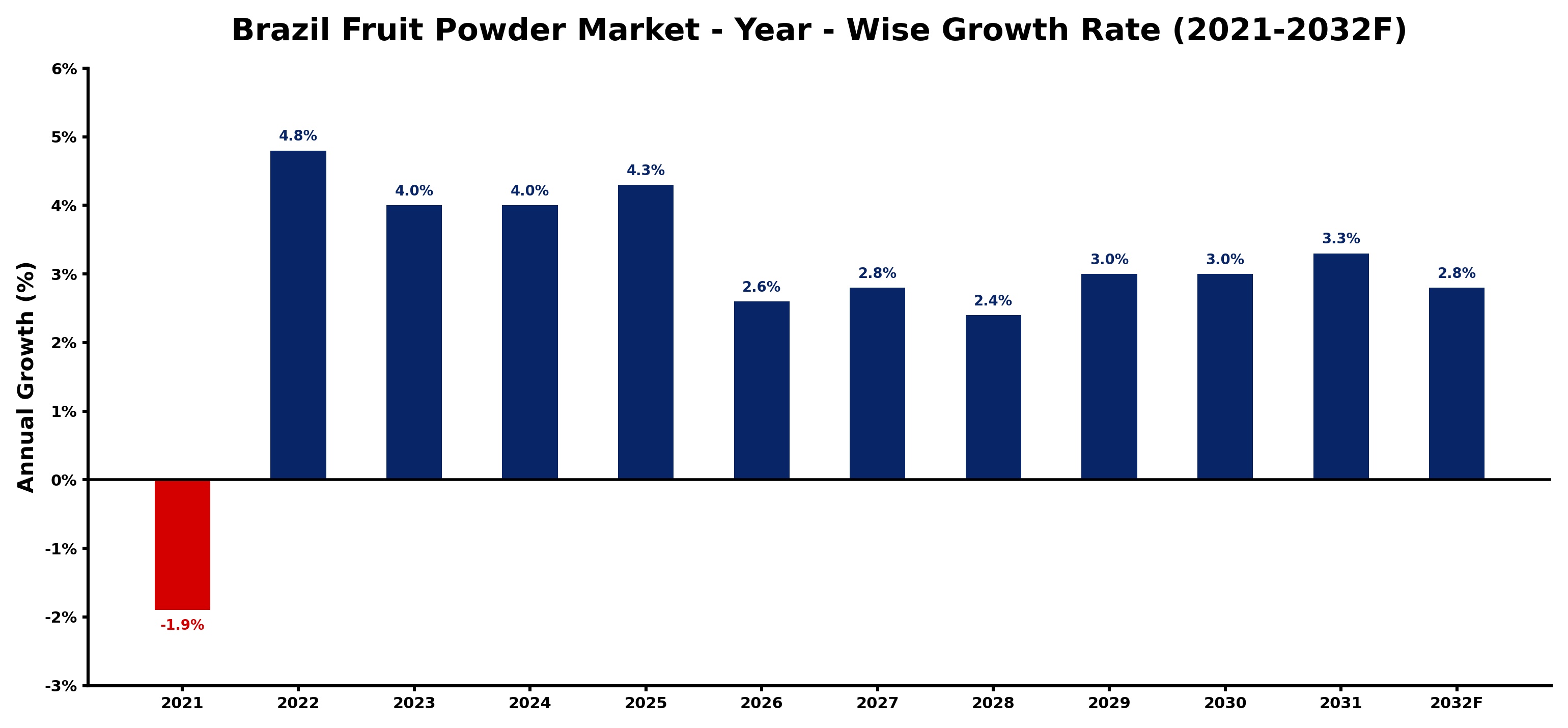
The table below presents the year‑wise growth rates along with the key drivers influencing the market
| Year | Growth Rate | Major Drivers |
| 2021 | -1.9% | Manufacturing slowdowns dampened demand for fruit powder production |
| 2022 | 4.8% | Domestic manufacturing recovery boosted demand for fruit powder exports |
| 2023 | 4.0% | Manufacturing investments boost local fruit powder production capabilities |
| 2024 | 4.0% | Modernized processing techniques boosted domestic fruit powder production efficiency |
| 2025 | 4.3% | Technological upgrades in fruit powder production boost export competitiveness |
| 2026 | 2.6% | Domestic fruit powder manufacturers boost production line investments |
| 2027 | 2.8% | Domestic fruit powder manufacturing adapts advanced processing technologies swiftly |
| 2028 | 2.4% | Manufacturing investments in fruit powder facilities boost domestic output |
| 2029 | 3.0% | Manufacturing investments boost Brazil's fruit powder production capacity |
| 2030 | 3.0% | Improved production efficiency boosted domestic fruit powder exports |
| 2031 | 3.3% | Domestic fruit powder production expansion boosts export competitiveness significantly |
| 2032 | 2.8% | Domestic fruit powder manufacturers adopt technology for quality consistency |
Note - Market size estimations and growth projections presented in this report are based on 6Wresearch's advanced forecasting approach, validated with industry datasets as of June 2026.
Brazil Fruit Powder Market Synopsis
The Brazil Fruit Powder Market has experienced significant growth as the preference for quick and nutritious alternatives to fresh fruit escalates. Consumers are increasingly opting for products that offer both convenience and health benefits, propelling the popularity of fruit powders in smoothies, desserts, and snacks. This shift is indicative of a broader trend towards functional and natural foods within the Brazilian consumer base.
Additionally, the Brazilian market has observed a growing awareness surrounding clean labeling and the avoidance of artificial ingredients. As manufacturers innovate their product formulations to meet these demands, the market for fruit powders is set to flourish. This evolving consumer behavior presents a compelling opportunity for stakeholders in the fruit powder sector.
Brazil Fruit Powder Market Key Takeaways
- The market is projected to grow from USD 214 Million in 2025 to USD 254 Million by 2032.
- There is a significant rise in demand for nutritious snacks and beverages, driving fruit powder utilization.
- Health-conscious consumers are increasingly favoring products with minimal additives and preservatives.
- Challenges in supply chain management pose risks to quality assurance in production.
- Government regulations ensure product safety and promote sustainable farming practices in the industry.
Evaluation of Restraints in Brazil Fruit Powder Market
Despite the positive growth trajectory, the Brazil Fruit Powder Market faces certain constraints that can impede its progress. Supply chain complexities present a significant hurdle; factors such as climate variability, pest infestations, and logistical challenges can disrupt the consistent availability of high-quality fruits necessary for powder production. Moreover, maintaining stringent quality standards across the supply chain is essential, yet any lapses can lead to market instability and consumer mistrust.
Brazil Fruit Powder Market Trends
Emerging trends in the Brazil Fruit Powder Market are largely shaped by the growing preference for clean-label products. Consumers are increasingly scrutinizing ingredient lists, making transparency and health benefits crucial factors in their purchasing decisions. Furthermore, innovative product development, including new fruit powder varieties and applications, continues to expand the market's appeal. The rise of online retailing has also made fruit powders more accessible to a broader audience, enhancing growth potential.
Brazil Fruit Powder Market Opportunities
There exists a wealth of opportunities within the Brazil Fruit Powder Market, particularly for companies focusing on unique formulations and niche applications. The rising popularity of health and wellness products positions fruit powders as an ideal addition to dietary supplements and functional foods. Additionally, export opportunities may arise as demand for Brazilian fruit powders grows in international markets, driven by the country's rich biodiversity and agricultural capabilities.
Government Initiatives in the Brazil Fruit Powder Market
Government initiatives in the Brazil Fruit Powder Market are aimed at promoting sustainable agricultural practices and ensuring food safety. Regulatory frameworks are in place that oversee quality standards for fruit powder production, providing consumers with assurance regarding safety and integrity. Moreover, public policies are increasingly geared towards supporting smallholder farmers, enhancing the overall sustainability and resilience of the fruit powder supply chain.
Future Insights of the Brazil Fruit Powder Market
Looking ahead to 2026-2032, the Brazil Fruit Powder Market is expected to continue on its growth trajectory as consumer preferences further evolve. The demand for natural and functional ingredients will drive innovation, and producers who adapt to these trends are likely to thrive. Additionally, advancements in technology related to powder processing may enhance product quality, reducing waste and improving efficiency, thereby solidifying the market's position both locally and internationally.
Brazil Fruit Powder Market Latest Developments (May 2025 - June 2026)
Recent developments in the Brazil Fruit Powder Market indicate a surge in product innovation aimed at meeting rising consumer demands. Manufacturers are increasingly incorporating exotic fruit varieties into their offerings, appealing to health-focused consumers looking for new flavors and nutritional benefits. Additionally, a notable trend is the growth of online platforms for distribution, which enhances accessibility and convenience for consumers. These shifts suggest a vibrant and adaptable market landscape in the coming years.
Brazil Fruit Powder Market - Key Attractiveness of the Report
- 10 Years of Market Numbers
- Historical Data Starting from 2022 to 2025
- Base Year: 2025
- Forecast Data until 2032
- Key Performance Indicators Impacting the Market
- Major Upcoming Developments and Projects
Key Highlights of the Report:
- Brazil Fruit Powder Market Outlook
- Market Size of Brazil Fruit Powder Market, 2025
- Forecast of Brazil Fruit Powder Market, 2032
- Historical Data and Forecast of Brazil Fruit Powder Revenues & Volume for the Period 2022-2032F
- Brazil Fruit Powder Market Trend Evolution
- Brazil Fruit Powder Market Drivers and Challenges
- Brazil Fruit Powder Price Trends
- Brazil Fruit Powder Porter's Five Forces
- Brazil Fruit Powder Industry Life Cycle
- Historical Data and Forecast of Brazil Fruit Powder Market Revenues & Volume By Type for the Period 2022-2032F
- Historical Data and Forecast of Brazil Fruit Powder Market Revenues & Volume By Banana for the Period 2022-2032F
- Historical Data and Forecast of Brazil Fruit Powder Market Revenues & Volume By Grapes for the Period 2022-2032F
- Historical Data and Forecast of Brazil Fruit Powder Market Revenues & Volume By Blueberry for the Period 2022-2032F
- Historical Data and Forecast of Brazil Fruit Powder Market Revenues & Volume By Mango for the Period 2022-2032F
- Historical Data and Forecast of Brazil Fruit Powder Market Revenues & Volume By others for the Period 2022-2032F
- Historical Data and Forecast of Brazil Fruit Powder Market Revenues & Volume By Application for the Period 2022-2032F
- Historical Data and Forecast of Brazil Fruit Powder Market Revenues & Volume By Bakery & Confectionery for the Period 2022-2032F
- Historical Data and Forecast of Brazil Fruit Powder Market Revenues & Volume By Dairy & Frozen Desserts for the Period 2022-2032F
- Historical Data and Forecast of Brazil Fruit Powder Market Revenues & Volume By Beverages for the Period 2022-2032F
- Historical Data and Forecast of Brazil Fruit Powder Market Revenues & Volume By Food Supplements for the Period 2022-2032F
- Historical Data and Forecast of Brazil Fruit Powder Market Revenues & Volume By others for the Period 2022-2032F
- Brazil Fruit Powder Import Export Trade Statistics
- Market Opportunity Assessment By Type
- Market Opportunity Assessment By Application
- Brazil Fruit Powder Top Companies Market Share
- Brazil Fruit Powder Competitive Benchmarking By Technical and Operational Parameters
- Brazil Fruit Powder Company Profiles
- Brazil Fruit Powder Key Strategic Recommendations






































