Brazil Greenhouse Horticulture Market Size, Share & Growth Rate
The Brazil Greenhouse Horticulture Market was estimated at USD 308 Million in 2025 and is projected to reach USD 369 Million by 2032, growing at a CAGR of 2.6% from 2026 to 2032. This growth trajectory is primarily driven by the increasing demand for high-quality, year-round produce and the adoption of advanced agricultural technologies. As Brazilian growers leverage innovations such as climate control systems and hydroponic techniques, they are better equipped to meet both domestic and international market needs, enhancing overall sector resilience.
Brazil Greenhouse Horticulture Market Year-wise Growth Rate and Key Drivers
This graph highlights how the Brazil Greenhouse Horticulture Market has steadily grown over the years, supported by major growth factors.
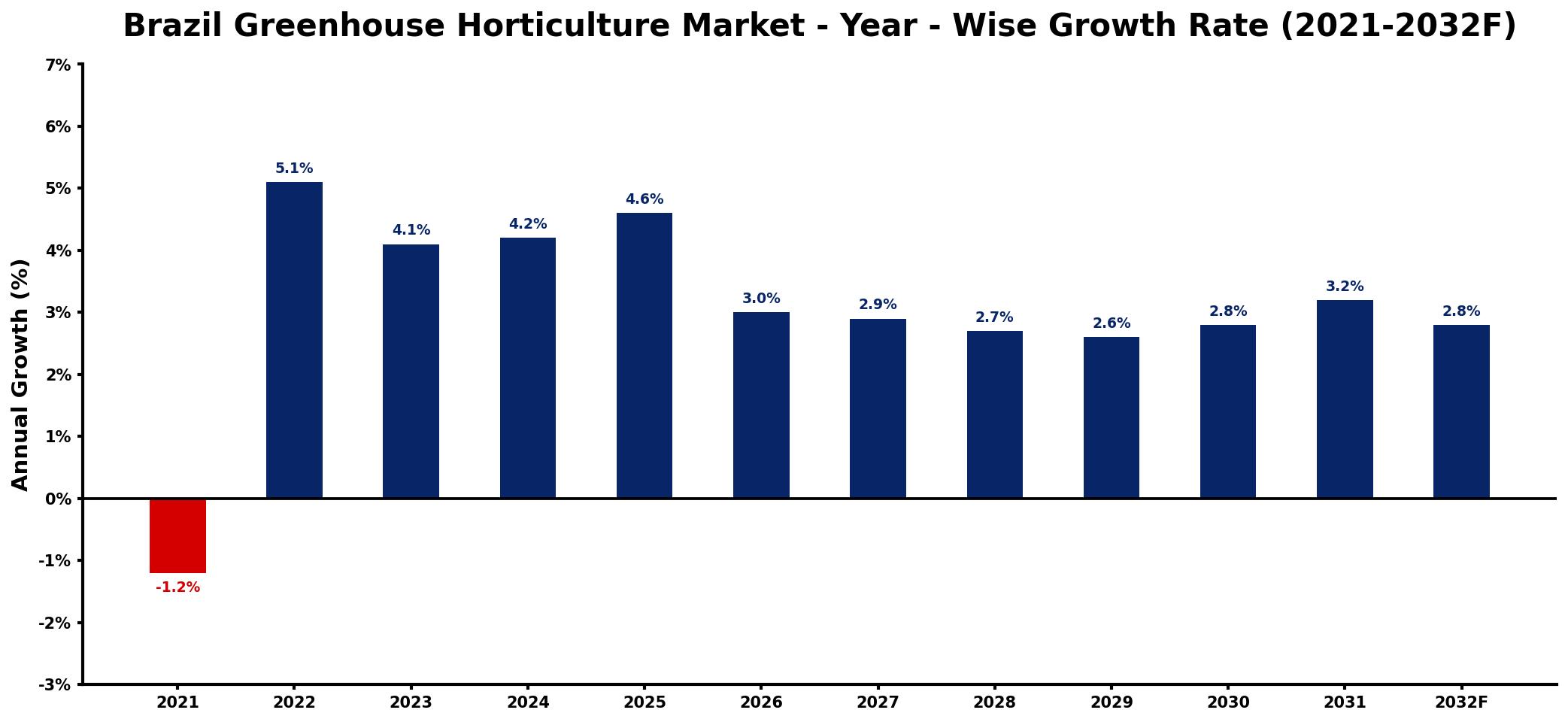
The table below presents the year‑wise growth rates along with the key drivers influencing the market
| Year | Growth Rate | Major Drivers |
| 2021 | -1.2% | decrease in consumer spending habits |
| 2022 | 5.1% | rising demand for organic produce |
| 2023 | 4.1% | expansion of local farmers markets |
| 2024 | 4.2% | increased investment in technology |
| 2025 | 4.6% | growing interest in sustainable practices |
| 2026 | 3.0% | enhanced distribution network efficiency |
| 2027 | 2.9% | increased urban agriculture initiatives |
| 2028 | 2.7% | development of innovative growing techniques |
| 2029 | 2.6% | growing preference for fresh produce |
| 2030 | 2.8% | strengthened export market opportunities |
| 2031 | 3.2% | growing emerging market penetration |
| 2032 | 2.8% | increased collaboration among stakeholders |
Note: Market size estimations and growth projections presented in this report are based on 6Wresearch's proprietary forecasting methodology, utilizing the latest available industry data, government publications, and primary research inputs.
Brazil Greenhouse Horticulture Market Synopsis
The Brazilian greenhouse horticulture sector is marked by its ability to produce a diverse array of crops, including fruits, vegetables, and ornamental plants. This adaptability not only meets local consumer demand but also positions Brazil as a competitive player in the export market for greenhouse-grown produce.
Technological integration plays a significant role in shaping the landscape of this market. With advancements in cultivation methods, such as hydroponics and automated systems, Brazilian growers can achieve higher yields and better-quality products, thereby enhancing profitability and sustainability.
Brazil Greenhouse Horticulture Market Key Takeaways
- The market demonstrates robust growth potential due to technological innovations and increasing consumer demand.
- Brazil's favorable climate and geographical diversity support year-round cultivation of a variety of crops.
- Resource management remains a critical concern, necessitating sustainable practices within greenhouse operations.
- Government support and initiatives are pivotal in advancing the greenhouse horticulture sector.
- Adaptation strategies to climate variability are essential for maintaining crop resilience and yield stability.
Evaluation of Restraints in Brazil Greenhouse Horticulture Market
Despite its growth, the Brazil Greenhouse Horticulture Market grapples with significant challenges. Resource management poses a critical restraint, as greenhouse operations require extensive inputs, such as water and energy, which may strain local ecosystems. Furthermore, unpredictable weather patterns driven by climate change present ongoing risks that could affect crop yields and necessitate the development of innovative adaptation strategies to ensure sustainable production practices in the sector.
Brazil Greenhouse Horticulture Market Trends
Current trends indicate a strong shift toward organic and sustainable farming methods, driven by consumer preferences for healthy, environmentally friendly products. Additionally, the integration of smart technology in greenhouse operations is on the rise, with automation and real-time data analytics becoming vital tools for enhancing productivity and resource efficiency.
Furthermore, as climate control systems evolve, Brazilian growers are increasingly able to optimize their production cycles, extending growing seasons and diversifying crop outputs, which is key to meeting both domestic needs and export demands.
Brazil Greenhouse Horticulture Market Opportunities
The Brazil Greenhouse Horticulture Market presents several growth opportunities, particularly in niche segments such as organic produce and specialty crops. With rising global demand for high-quality agricultural products, Brazilian producers who invest in advanced cultivation techniques are well-positioned to capture lucrative market share. Additionally, the increasing focus on sustainability opens avenues for partnerships and funding in eco-friendly initiatives, fostering innovation and long-term viability.
Government Initiatives in the Brazil Greenhouse Horticulture Market
The Brazilian government has been actively promoting the greenhouse horticulture sector through various initiatives. These include providing financial support for greenhouse construction, offering technical assistance for farmers adopting cutting-edge cultivation practices, and implementing regulatory frameworks to ensure the quality and safety of produce. Such policies not only bolster production capacity but also enhance the competitiveness of Brazilian horticultural exports.
Future Insights of the Brazil Greenhouse Horticulture Market
Looking ahead to 2026-2032, the Brazil Greenhouse Horticulture Market is poised for significant transformation. Increased investment in technology and sustainability practices will likely drive efficiencies and growth. Furthermore, as global environmental concerns intensify, Brazilian growers are expected to embrace sustainable production methods, aligning with both local and international consumer trends. This proactive approach will not only enhance crop resilience but will also strengthen Brazil's position as a key player in the global horticulture market.
Brazil Greenhouse Horticulture Market Latest Developments (2025 - 2026)
Recent developments in the Brazil Greenhouse Horticulture Market highlight the ongoing evolution of cultivation technologies, with many producers increasingly adopting automated systems for monitoring and managing greenhouse environments. Additionally, collaborations between agricultural technology firms and local growers have emerged, aimed at improving resource efficiency and crop yield. There is also a rising trend of organic certification among growers, reflecting the changing preferences of consumers and the growing focus on sustainability in agricultural practices.
Brazil Greenhouse Horticulture Market - Key Attractiveness of the Report
- 10 Years of Market Numbers
- Historical Data Starting from 2022 to 2025
- Base Year: 2025
- Forecast Data until 2032
- Key Performance Indicators Impacting the Market
- Major Upcoming Developments and Projects
Key Highlights of the Report:
- Brazil Greenhouse Horticulture Market Outlook
- Market Size of Brazil Greenhouse Horticulture Market, 2025
- Forecast of Brazil Greenhouse Horticulture Market, 2032
- Historical Data and Forecast of Brazil Greenhouse Horticulture Revenues & Volume for the Period 2022-2032F
- Brazil Greenhouse Horticulture Market Trend Evolution
- Brazil Greenhouse Horticulture Market Drivers and Challenges
- Brazil Greenhouse Horticulture Price Trends
- Brazil Greenhouse Horticulture Porter's Five Forces
- Brazil Greenhouse Horticulture Industry Life Cycle
- Historical Data and Forecast of Brazil Greenhouse Horticulture Market Revenues & Volume By Material Type for the Period 2022-2032F
- Historical Data and Forecast of Brazil Greenhouse Horticulture Market Revenues & Volume By Glass for the Period 2022-2032F
- Historical Data and Forecast of Brazil Greenhouse Horticulture Market Revenues & Volume By Plastic for the Period 2022-2032F
- Historical Data and Forecast of Brazil Greenhouse Horticulture Market Revenues & Volume By Crop Type for the Period 2022-2032F
- Historical Data and Forecast of Brazil Greenhouse Horticulture Market Revenues & Volume By Fruits and Vegetables for the Period 2022-2032F
- Historical Data and Forecast of Brazil Greenhouse Horticulture Market Revenues & Volume By Flowers and Ornamentals for the Period 2022-2032F
- Historical Data and Forecast of Brazil Greenhouse Horticulture Market Revenues & Volume By Nursery Crops for the Period 2022-2032F
- Historical Data and Forecast of Brazil Greenhouse Horticulture Market Revenues & Volume By Others for the Period 2022-2032F
- Historical Data and Forecast of Brazil Greenhouse Horticulture Market Revenues & Volume By Technology for the Period 2022-2032F
- Historical Data and Forecast of Brazil Greenhouse Horticulture Market Revenues & Volume By Heating System for the Period 2022-2032F
- Historical Data and Forecast of Brazil Greenhouse Horticulture Market Revenues & Volume By Cooling System for the Period 2022-2032F
- Brazil Greenhouse Horticulture Import Export Trade Statistics
- Market Opportunity Assessment By Material Type
- Market Opportunity Assessment By Crop Type
- Market Opportunity Assessment By Technology
- Brazil Greenhouse Horticulture Top Companies Market Share
- Brazil Greenhouse Horticulture Competitive Benchmarking By Technical and Operational Parameters
- Brazil Greenhouse Horticulture Company Profiles
- Brazil Greenhouse Horticulture Key Strategic Recommendations






































