Mexico Greenhouse Horticulture Market Size, Share & Growth Rate
The Mexico Greenhouse Horticulture Market was estimated at USD 199 Million in 2025 and is projected to reach USD 231 Million by 2032, growing at a CAGR of 2.2% from 2026 to 2032. This growth is underpinned by an increasing consumer demand for high-quality produce, which has been amplified by the rising focus on sustainable agricultural practices. Furthermore, supportive government policies aimed at fostering greenhouse farming are catalyzing investments and expanding the market's potential.
Mexico Greenhouse Horticulture Market Year-wise Growth Rate and Key Drivers
This graph highlights how the Mexico Greenhouse Horticulture Market has steadily grown over the years, supported by major growth factors.
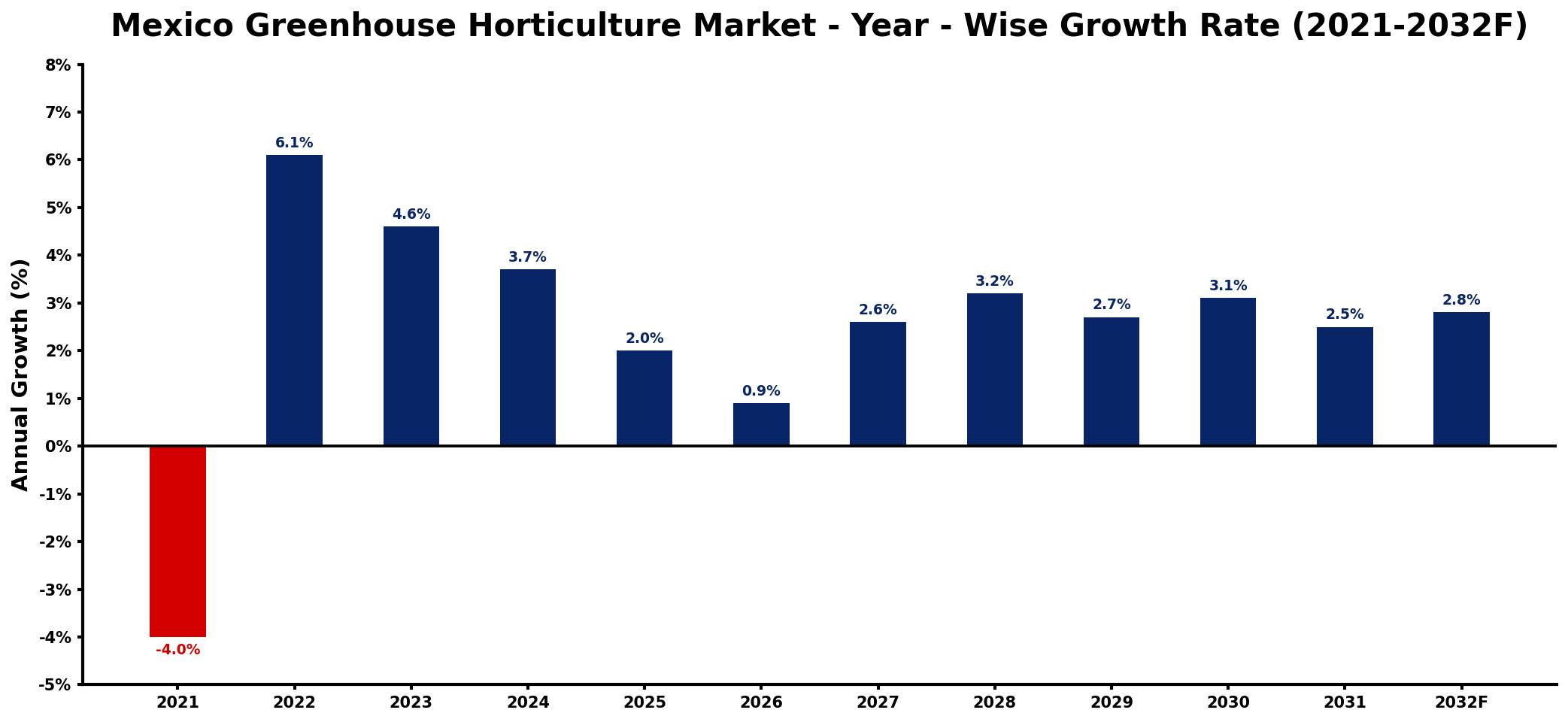
The table below presents the year‑wise growth rates along with the key drivers influencing the market
| Year | Growth Rate | Major Drivers |
| 2021 | -4.0% | decreased consumer spending patterns |
| 2022 | 6.1% | increased investment in technology |
| 2023 | 4.6% | growing interest in sustainability |
| 2024 | 3.7% | rising demand for local produce |
| 2025 | 2.0% | expansion of export markets |
| 2026 | 0.9% | enhanced distribution networks efficiency |
| 2027 | 2.6% | greater adoption of organic practices |
| 2028 | 3.2% | increased urban farming initiatives |
| 2029 | 2.7% | stronger government support programs |
| 2030 | 3.1% | advancements in agricultural innovations |
| 2031 | 2.5% | growing consumer health consciousness |
| 2032 | 2.8% | expanding healthcare application demand |
Note: Market size estimations and growth projections presented in this report are based on 6Wresearch's proprietary forecasting methodology, utilizing the latest available industry data, government publications, and primary research inputs.
Mexico Greenhouse Horticulture Market Synopsis
The most significant force shaping the Mexico Greenhouse Horticulture Market today is the escalating demand for fresh, high-quality vegetables and fruits. This demand is largely driven by both domestic consumption and the robust export potential of greenhouse-grown crops, which have positioned Mexico as a key player in the horticultural sector.
In addition, the integration of advanced technologies in greenhouse operations is propelling efficiency and productivity. Technologies such as climate control systems and hydroponics not only improve crop quality but also contribute to sustainable practices, aligning with global trends toward environmental responsibility.
Mexico Greenhouse Horticulture Market Key Takeaways
- The market is driven by increasing consumer demand for high-quality, year-round produce.
- Government initiatives are enhancing greenhouse farming practices and technologies.
- Technological advancements are improving yields and reducing environmental impacts.
- Challenges related to water scarcity and energy costs are being addressed through innovation.
- Investment opportunities are emerging in organic crops and greenhouse technology.
Evaluation of Restraints in Mexico Greenhouse Horticulture Market
Despite the promising growth prospects, the Mexico Greenhouse Horticulture Market faces several restraints. High energy costs associated with greenhouse operations can cut into profitability, making it difficult for operators to maintain competitive pricing. Additionally, the region's susceptibility to water scarcity necessitates efficient water management strategies, which can be a hurdle for many growers. Pest management in controlled environments also poses challenges, as navigating regulatory complexities requires careful attention and resources. These factors can limit the pace of growth, particularly for smaller operators who may lack the capital to invest in advanced technologies.
Mexico Greenhouse Horticulture Market Trends
Key trends in the Mexico Greenhouse Horticulture Market include the adoption of hydroponic systems and vertical farming practices, which enhance land use efficiency and crop output. As consumer preferences increasingly lean toward organic produce, the expansion of organic greenhouse farming is gaining traction. Additionally, there is a growing emphasis on integrating renewable energy sources into greenhouse operations to mitigate environmental impacts and reduce reliance on traditional energy methods. These trends reflect a broader movement towards more sustainable and innovative agricultural practices.
Mexico Greenhouse Horticulture Market Opportunities
The market is rife with opportunities for investment and development. The growing demand for organic and specialty crops presents a lucrative avenue for greenhouse operators looking to differentiate themselves. Furthermore, advancements in greenhouse technology offer pathways for efficiency gains, and companies focusing on value-added services, such as consulting and training for new growers, can thrive. With Mexico's geographic advantages for export markets, the greenhouse horticulture sector is positioned to attract significant investment from domestic and international stakeholders alike.
Government Initiatives in the Mexico Greenhouse Horticulture Market
The Mexican government has introduced a series of initiatives aimed at bolstering the greenhouse horticulture sector. Financial incentives such as grants for greenhouse construction and subsidies for technology upgrades are actively supporting growers. There are also regulations in place that promote sustainable practices, including water conservation and the use of environmentally friendly agricultural inputs. Additionally, efforts to facilitate access to both domestic and international markets for greenhouse produce reflect a commitment to enhancing the competitive landscape for Mexican horticulturists.
Future Insights of the Mexico Greenhouse Horticulture Market
Looking ahead to 2026-2032, the Mexico Greenhouse Horticulture Market is set to experience steady growth. Increased consumer demand for locally grown produce, coupled with ongoing governmental support, will act as catalysts for market expansion. Innovations in greenhouse technology are expected to play a pivotal role in enhancing production capabilities. Moreover, the rising focus on food security and the potential for urban farming initiatives indicate that greenhouse horticulture will become increasingly integral to Mexico's agricultural landscape.
Mexico Greenhouse Horticulture Market Latest Developments (2025 - 2026)
Recent developments in the Mexico Greenhouse Horticulture Market highlight the ongoing commitment to sustainability and innovation. New projects focused on the integration of climate-smart technologies are underway, aiming to further enhance productivity while addressing environmental concerns. Moreover, collaborations between industry stakeholders and academic institutions are being established to facilitate research on pest management and crop optimization. These trends signal a dynamic shift toward more efficient and environmentally responsible greenhouse operations.
Mexico Greenhouse Horticulture Market - Key Attractiveness of the Report
- 10 Years of Market Numbers
- Historical Data Starting from 2022 to 2025
- Base Year: 2025
- Forecast Data until 2032
- Key Performance Indicators Impacting the Market
- Major Upcoming Developments and Projects
Key Highlights of the Report:
- Mexico Greenhouse Horticulture Market Outlook
- Market Size of Mexico Greenhouse Horticulture Market, 2025
- Forecast of Mexico Greenhouse Horticulture Market, 2032
- Historical Data and Forecast of Mexico Greenhouse Horticulture Revenues & Volume for the Period 2022-2032F
- Mexico Greenhouse Horticulture Market Trend Evolution
- Mexico Greenhouse Horticulture Market Drivers and Challenges
- Mexico Greenhouse Horticulture Price Trends
- Mexico Greenhouse Horticulture Porter's Five Forces
- Mexico Greenhouse Horticulture Industry Life Cycle
- Historical Data and Forecast of Mexico Greenhouse Horticulture Market Revenues & Volume By Material Type for the Period 2022-2032F
- Historical Data and Forecast of Mexico Greenhouse Horticulture Market Revenues & Volume By Glass for the Period 2022-2032F
- Historical Data and Forecast of Mexico Greenhouse Horticulture Market Revenues & Volume By Plastic for the Period 2022-2032F
- Historical Data and Forecast of Mexico Greenhouse Horticulture Market Revenues & Volume By Crop Type for the Period 2022-2032F
- Historical Data and Forecast of Mexico Greenhouse Horticulture Market Revenues & Volume By Fruits and Vegetables for the Period 2022-2032F
- Historical Data and Forecast of Mexico Greenhouse Horticulture Market Revenues & Volume By Flowers and Ornamentals for the Period 2022-2032F
- Historical Data and Forecast of Mexico Greenhouse Horticulture Market Revenues & Volume By Nursery Crops for the Period 2022-2032F
- Historical Data and Forecast of Mexico Greenhouse Horticulture Market Revenues & Volume By Others for the Period 2022-2032F
- Historical Data and Forecast of Mexico Greenhouse Horticulture Market Revenues & Volume By Technology for the Period 2022-2032F
- Historical Data and Forecast of Mexico Greenhouse Horticulture Market Revenues & Volume By Heating System for the Period 2022-2032F
- Historical Data and Forecast of Mexico Greenhouse Horticulture Market Revenues & Volume By Cooling System for the Period 2022-2032F
- Mexico Greenhouse Horticulture Import Export Trade Statistics
- Market Opportunity Assessment By Material Type
- Market Opportunity Assessment By Crop Type
- Market Opportunity Assessment By Technology
- Mexico Greenhouse Horticulture Top Companies Market Share
- Mexico Greenhouse Horticulture Competitive Benchmarking By Technical and Operational Parameters
- Mexico Greenhouse Horticulture Company Profiles
- Mexico Greenhouse Horticulture Key Strategic Recommendations






































