Brazil Online Grocery Market Size, Share & Growth Rate
The Brazil Online Grocery Market was estimated at USD 181 Million in 2025 and is projected to reach USD 215 Million by 2032, growing at a CAGR of 2.5% from 2026 to 2032. This trajectory reflects a transformation in consumer behavior, accelerated by the COVID-19 pandemic, which has prompted a shift towards online purchasing. Urbanization and increased internet connectivity are driving factors that enhance the accessibility and convenience of online grocery shopping in Brazil.
Brazil Online Grocery Market Year-wise Growth Rate and Key Drivers
This graph highlights how the Brazil Online Grocery Market has steadily grown over the years, supported by major growth factors.
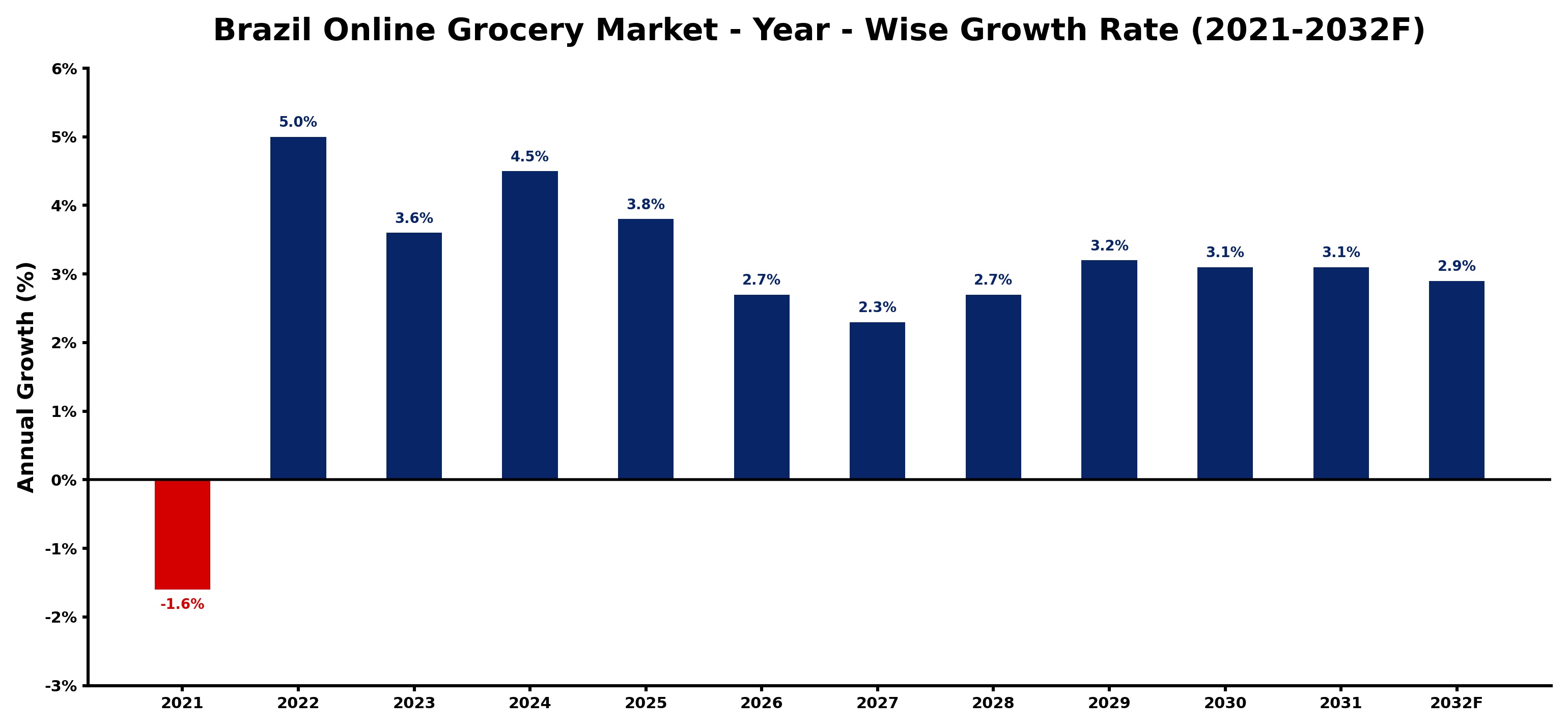
The table below presents the year‑wise growth rates along with the key drivers influencing the market
| Year | Growth Rate | Major Drivers |
| 2021 | -1.6% | Consumer spending decreased significantly |
| 2022 | 5.0% | E-commerce adoption accelerated rapidly |
| 2023 | 3.6% | Mobile shopping platforms gained popularity |
| 2024 | 4.5% | Subscription services enhanced convenience |
| 2025 | 3.8% | Local sourcing initiatives expanded offerings |
| 2026 | 2.7% | Sustainability trends influenced purchasing |
| 2027 | 2.3% | Digital marketing strategies attracted consumers |
| 2028 | 2.7% | Health-conscious products gained traction |
| 2029 | 3.2% | Innovative delivery methods improved service |
| 2030 | 3.1% | Partnerships with local farms increased |
| 2031 | 3.1% | Customer loyalty programs enhanced retention |
| 2032 | 2.9% | Technology integration streamlined operations |
Note - Market size estimations and growth projections presented in this report are based on 6Wresearch’s advanced forecasting approach, validated with industry datasets as of June 2026.
Brazil Online Grocery Market Synopsis
While the Brazilian online grocery market has surged in recent years, the future reveals both challenges and opportunities. Retailers have rapidly adapted to meet shifting consumer expectations, focusing on seamless e-commerce experiences. However, the market is still in a formative stage, with room for growth as digital literacy expands and logistical frameworks improve.
As we look ahead, the online grocery sector in Brazil is poised for continued evolution, characterized by innovations in delivery models and customer engagement strategies. Embracing technology will be essential for market players to enhance service reliability and capitalize on the increasing preference for online shopping.
Brazil Online Grocery Market Key Takeaways
- Significant growth potential exists in the Brazil Online Grocery Market, with an expected increase of USD 34 Million over the next seven years.
- Urbanization and busy lifestyles are major catalysts driving the shift to e-commerce for grocery shopping.
- Technological advancements play a crucial role in improving supply chain efficiencies and consumer experience.
- Investment in cold chain logistics is imperative for sustaining quality and safety in the delivery of perishable goods.
- Government initiatives are fostering competition and consumer protection, enhancing the regulatory framework around e-commerce.
Evaluation of Restraints in Brazil Online Grocery Market
Despite its promising growth, the Brazilian online grocery market faces significant restraints. One major hurdle is the logistical complexity involved in delivering perishable goods while ensuring their quality and safety. Establishing a robust cold chain infrastructure and efficient last-mile delivery systems incurs high costs. Additionally, many consumers still favor the tactile experience of in-store shopping, and concerns regarding the freshness of products can deter online purchases. Furthermore, varying levels of digital literacy and internet access across different demographics, particularly in rural and low-income areas, limit the reach of online grocery services.
Brazil Online Grocery Market Trends
Emerging trends are shaping the landscape of the Brazil Online Grocery Market. A growing preference for sustainability has led to increased demand for eco-friendly packaging and local sourcing of products. Additionally, the integration of advanced technologies, such as artificial intelligence and data analytics, is enhancing personalization in shopping experiences. The rise of subscription services and on-demand delivery options reflects changing consumer expectations for convenience and accessibility.
Brazil Online Grocery Market Opportunities
The current landscape presents genuine growth opportunities for businesses in the Brazilian online grocery sector. Investing in technology that streamlines operations and improves user experience can significantly enhance market penetration. Expansion into underserved rural areas, coupled with targeted digital literacy programs, could unlock a substantial customer base. Furthermore, partnerships with local producers can facilitate the sourcing of fresher goods, directly appealing to increasingly health-conscious consumers.
Government Initiatives in the Brazil Online Grocery Market
The Brazilian government has been proactive in promoting e-commerce through various policies aimed at enhancing consumer protection and competition. These initiatives include regulations that ensure fair pricing practices and transparency in online transactions. Additionally, efforts to improve digital literacy among consumers are underway, which are essential for fostering trust and encouraging the adoption of online grocery shopping across different demographic segments.
Future Insights of the Brazil Online Grocery Market
Looking toward the future, the Brazil Online Grocery Market is anticipated to expand steadily from 2026 to 2032. The integration of innovative technologies will likely redefine customer engagement strategies, making shopping more personalized and efficient. With increased urbanization and a growing number of consumers accustomed to online purchasing, the market is set to evolve, potentially paving the way for new entrants and reshaping competitive dynamics.
Brazil Online Grocery Market Latest Developments (May 2025 - June 2026)
Recent developments in the Brazilian online grocery market indicate a strong focus on enhancing delivery capabilities and customer experience. Companies are investing in technology solutions aimed at streamlining logistics, especially for perishable goods. Additionally, there is a noticeable trend towards leveraging data analytics to better understand consumer preferences and optimize inventory management. As market players adapt to changing dynamics, the emphasis on sustainability and ethical sourcing continues to gain traction.
Brazil Online Grocery Market - Key Attractiveness of the Report
- 10 Years of Market Numbers
- Historical Data Starting from 2022 to 2025
- Base Year: 2025
- Forecast Data until 2032
- Key Performance Indicators Impacting the Market
- Major Upcoming Developments and Projects
Key Highlights of the Report:
- Brazil Online Grocery Market Outlook
- Market Size of Brazil Online Grocery Market, 2025
- Forecast of Brazil Online Grocery Market, 2032
- Historical Data and Forecast of Brazil Online Grocery Revenues & Volume for the Period 2022-2032F
- Brazil Online Grocery Market Trend Evolution
- Brazil Online Grocery Market Drivers and Challenges
- Brazil Online Grocery Price Trends
- Brazil Online Grocery Porter's Five Forces
- Brazil Online Grocery Industry Life Cycle
- Historical Data and Forecast of Brazil Online Grocery Market Revenues & Volume By Product Type for the Period 2022-2032F
- Historical Data and Forecast of Brazil Online Grocery Market Revenues & Volume By Food Grains for the Period 2022-2032F
- Historical Data and Forecast of Brazil Online Grocery Market Revenues & Volume By Bread, Bakery and Dairy Products for the Period 2022-2032F
- Historical Data and Forecast of Brazil Online Grocery Market Revenues & Volume By Fruits and Vegetables for the Period 2022-2032F
- Historical Data and Forecast of Brazil Online Grocery Market Revenues & Volume By Personal Care for the Period 2022-2032F
- Historical Data and Forecast of Brazil Online Grocery Market Revenues & Volume By Dry and Baking Products for the Period 2022-2032F
- Historical Data and Forecast of Brazil Online Grocery Market Revenues & Volume By Household Products for the Period 2022-2032F
- Historical Data and Forecast of Brazil Online Grocery Market Revenues & Volume By Meat and Meat Products for the Period 2022-2032F
- Historical Data and Forecast of Brazil Food Grains Online Grocery Market Revenues & Volume By Others for the Period 2022-2032F
- Historical Data and Forecast of Brazil Online Grocery Market Revenues & Volume By Platform for the Period 2022-2032F
- Historical Data and Forecast of Brazil Online Grocery Market Revenues & Volume By App-based for the Period 2022-2032F
- Historical Data and Forecast of Brazil Online Grocery Market Revenues & Volume By Web-based for the Period 2022-2032F
- Brazil Online Grocery Import Export Trade Statistics
- Market Opportunity Assessment By Product Type
- Market Opportunity Assessment By Platform
- Brazil Online Grocery Top Companies Market Share
- Brazil Online Grocery Competitive Benchmarking By Technical and Operational Parameters
- Brazil Online Grocery Company Profiles
- Brazil Online Grocery Key Strategic Recommendations






































