Brazil Organic Fruits And Vegetables Market Size, Share & Growth Rate
The Brazil Organic Fruits And Vegetables Market was estimated at USD 232 Million in 2025 and is projected to reach USD 276 Million by 2032, growing at a CAGR of 2.5% from 2026 to 2032. This growth trajectory is largely fueled by a notable shift in consumer preferences toward organic produce, driven by health and environmental concerns. As Brazilian consumers become more health-conscious, they are increasingly opting for organic fruits and vegetables, which are perceived as safer and more environmentally friendly than their conventional counterparts.
Brazil Organic Fruits And Vegetables Market Year-wise Growth Rate and Key Drivers
This graph highlights how the Brazil Organic Fruits And Vegetables Market has steadily grown over the years, supported by major growth factors.
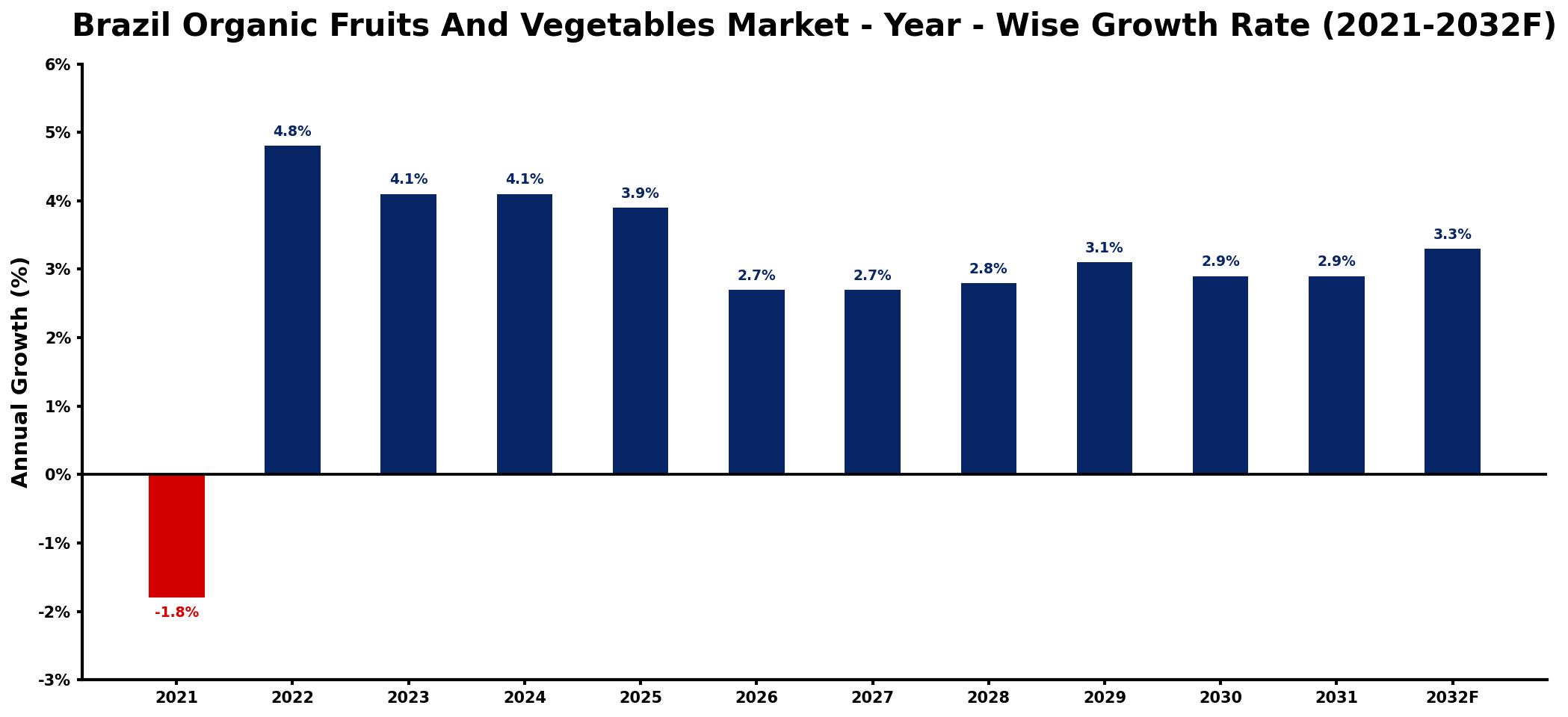
The table below presents the year‑wise growth rates along with the key drivers influencing the market
| Year | Growth Rate | Major Drivers |
| 2021 | -1.8% | Consumer interest in health alternatives |
| 2022 | 4.8% | Rising demand for sustainable sourcing |
| 2023 | 4.1% | Increased investment in local farms |
| 2024 | 4.1% | Growing awareness of nutritional benefits |
| 2025 | 3.9% | Expansion of distribution channels |
| 2026 | 2.7% | Enhanced focus on eco-friendly practices |
| 2027 | 2.7% | Surge in urban farming initiatives |
| 2028 | 2.8% | Higher consumer spending on quality |
| 2029 | 3.1% | Development of innovative packaging solutions |
| 2030 | 2.9% | Strengthening of export market opportunities |
| 2031 | 2.9% | Promotion of farm-to-table concepts |
| 2032 | 3.3% | Emergence of new retail formats |
Note: Market size estimations and growth projections presented in this report are based on 6Wresearch's proprietary forecasting methodology, utilizing the latest available industry data, government publications, and primary research inputs.
Brazil Organic Fruits And Vegetables Market Synopsis
The Brazilian landscape is uniquely suited for organic farming, thanks to its rich biodiversity and varied climate, allowing for the cultivation of a wide array of organic fruits and vegetables. As a result, the market is experiencing heightened demand, not just locally, but also for export, as international markets seek Brazilian organic products.
Moreover, Brazilian consumers are becoming increasingly aware of the benefits of organic produce, which include better nutritional content and the absence of harmful chemicals. This growing awareness is prompting both smallholder and large-scale farmers to enhance their organic farming practices and expand their offerings.
Brazil Organic Fruits And Vegetables Market Key Takeaways
- Increasing consumer health consciousness is driving demand for organic produce in Brazil.
- Favorable climatic conditions and fertile land position Brazil as a strong competitor in the global organic market.
- Market players are investing in certifications and marketing to appeal to the eco-conscious consumer.
- Government initiatives are bolstering the organic farming infrastructure and certification processes.
- Organic fruits and vegetables are gaining traction in both local and export markets, indicating robust growth potential.
Evaluation of Restraints in Brazil Organic Fruits And Vegetables Market
Despite the favorable outlook for the Brazil Organic Fruits And Vegetables Market, several restraints pose challenges to its growth. Limited access to high-quality organic seeds and the initial costs associated with transitioning from conventional to organic farming can deter farmers from making the switch. Moreover, logistical issues, including distribution and transportation of organic products, can impact market availability and pricing, making it harder for consumers to access these desirable goods.
Brazil Organic Fruits And Vegetables Market Trends
A significant trend in the Brazil Organic Fruits And Vegetables Market is the increasing adoption of innovative agricultural technologies. Farmers are leveraging precision agriculture techniques to enhance yields while minimizing environmental impacts. Additionally, the rise of community-supported agriculture (CSA) and direct-to-consumer sales platforms is changing the way organic produce is marketed and distributed, fostering a stronger connection between consumers and local producers.
Furthermore, sustainability continues to be a key driver, with many consumers not only seeking organic products but also looking for brands that embody ethical farming practices and environmental stewardship. This trend has led to the emergence of new marketing campaigns that emphasize the ecological benefits of organic farming.
Brazil Organic Fruits And Vegetables Market Opportunities
The expanding organic fruits and vegetables market in Brazil presents several lucrative opportunities for investment and growth. There's a strong potential for collaboration between farmers and tech companies to develop solutions that enhance yield and reduce costs. Furthermore, the growing trend towards online grocery shopping provides a unique avenue for organic producers to reach consumers directly. As awareness of health benefits continues to rise, organic farmers are well-positioned to meet this increasing demand.
Government Initiatives in the Brazil Organic Fruits And Vegetables Market
The Brazilian government has implemented several initiatives to support the growth of the organic fruits and vegetables market. These include policies aimed at simplifying the organic certification process, providing financial incentives for farmers transitioning to organic practices, and investing in infrastructure to facilitate the distribution of organic products. Additionally, public campaigns are being launched to raise consumer awareness about the benefits of organic produce, which further strengthens market demand.
Future Insights of the Brazil Organic Fruits And Vegetables Market
Looking ahead to the period from 2026 to 2032, the Brazil Organic Fruits And Vegetables Market is poised for continued growth. As consumer preferences shift more towards health-oriented and sustainable choices, organic farming practices will likely see increased adoption. Furthermore, ongoing government support and investment in the organic sector will enhance infrastructure and education, helping to overcome existing barriers and propel the market forward.
Brazil Organic Fruits And Vegetables Market Latest Developments (2025 - 2026)
Recently, there has been a significant uptick in consumer interest for local organic produce, with various initiatives encouraging farmers to engage directly with urban consumers. Farmers' markets and pop-up shops showcasing organic fruits and vegetables have seen an increase in participation. Additionally, awareness campaigns surrounding the environmental benefits of organic farming practices have gained traction, further driving consumer demand for organic options.
Brazil Organic Fruits And Vegetables Market - Key Attractiveness of the Report
- 10 Years of Market Numbers
- Historical Data Starting from 2022 to 2025
- Base Year: 2025
- Forecast Data until 2032
- Key Performance Indicators Impacting the Market
- Major Upcoming Developments and Projects
Key Highlights of the Report:
- Brazil Organic Fruits And Vegetables Market Outlook
- Market Size of Brazil Organic Fruits And Vegetables Market, 2025
- Forecast of Brazil Organic Fruits And Vegetables Market, 2032
- Historical Data and Forecast of Brazil Organic Fruits And Vegetables Revenues & Volume for the Period 2022-2032F
- Brazil Organic Fruits And Vegetables Market Trend Evolution
- Brazil Organic Fruits And Vegetables Market Drivers and Challenges
- Brazil Organic Fruits And Vegetables Price Trends
- Brazil Organic Fruits And Vegetables Porter's Five Forces
- Brazil Organic Fruits And Vegetables Industry Life Cycle
- Historical Data and Forecast of Brazil Organic Fruits And Vegetables Market Revenues & Volume By Product Type for the Period 2022-2032F
- Historical Data and Forecast of Brazil Organic Fruits And Vegetables Market Revenues & Volume By Organic Fruits for the Period 2022-2032F
- Historical Data and Forecast of Brazil Organic Fruits And Vegetables Market Revenues & Volume By Organic Vegetables for the Period 2022-2032F
- Historical Data and Forecast of Brazil Organic Fruits And Vegetables Market Revenues & Volume By Form for the Period 2022-2032F
- Historical Data and Forecast of Brazil Organic Fruits And Vegetables Market Revenues & Volume By Fresh for the Period 2022-2032F
- Historical Data and Forecast of Brazil Organic Fruits And Vegetables Market Revenues & Volume By Frozen for the Period 2022-2032F
- Historical Data and Forecast of Brazil Organic Fruits And Vegetables Market Revenues & Volume By End User for the Period 2022-2032F
- Historical Data and Forecast of Brazil Organic Fruits And Vegetables Market Revenues & Volume By Residential for the Period 2022-2032F
- Historical Data and Forecast of Brazil Organic Fruits And Vegetables Market Revenues & Volume By Commercial for the Period 2022-2032F
- Historical Data and Forecast of Brazil Organic Fruits And Vegetables Market Revenues & Volume By Distribution Channel for the Period 2022-2032F
- Historical Data and Forecast of Brazil Organic Fruits And Vegetables Market Revenues & Volume By Supermarket for the Period 2022-2032F
- Historical Data and Forecast of Brazil Organic Fruits And Vegetables Market Revenues & Volume By Hypermarket for the Period 2022-2032F
- Historical Data and Forecast of Brazil Organic Fruits And Vegetables Market Revenues & Volume By Convenience Store for the Period 2022-2032F
- Historical Data and Forecast of Brazil Organic Fruits And Vegetables Market Revenues & Volume By Online Sale Channel for the Period 2022-2032F
- Historical Data and Forecast of Brazil Organic Fruits And Vegetables Market Revenues & Volume By Others for the Period 2022-2032F
- Brazil Organic Fruits And Vegetables Import Export Trade Statistics
- Market Opportunity Assessment By Product Type
- Market Opportunity Assessment By Form
- Market Opportunity Assessment By End User
- Market Opportunity Assessment By Distribution Channel
- Brazil Organic Fruits And Vegetables Top Companies Market Share
- Brazil Organic Fruits And Vegetables Competitive Benchmarking By Technical and Operational Parameters
- Brazil Organic Fruits And Vegetables Company Profiles
- Brazil Organic Fruits And Vegetables Key Strategic Recommendations






































