Brazil Perchloroethylene Market Size, Share & Growth Rate
The Brazil Perchloroethylene Market was estimated at USD 283 Million in 2025 and is projected to reach USD 338 Million by 2032, growing at a CAGR of 2.6% from 2026 to 2032. This growth trajectory is primarily fueled by the rising demand for effective solvent solutions in dry cleaning and industrial cleaning processes. Furthermore, the expansion of Brazils automotive and metalworking sectors enhances the usage of perchloroethylene, making it a key component for various applications across the country.
Brazil Perchloroethylene Market Year-wise Growth Rate and Key Drivers
This graph highlights how the Brazil Perchloroethylene Market has steadily grown over the years, supported by major growth factors.
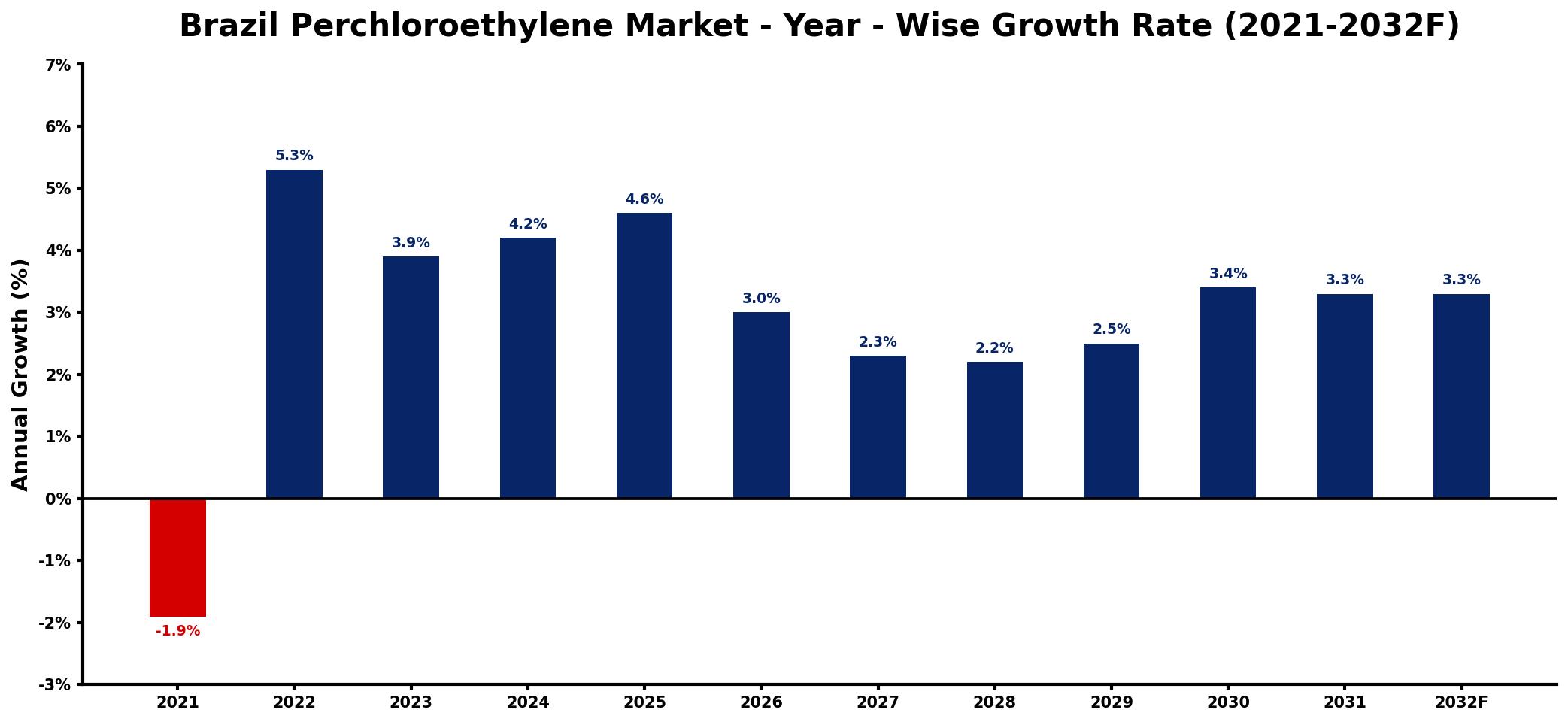
The table below presents the year‑wise growth rates along with the key drivers influencing the market
| Year | Growth Rate | Major Drivers |
| 2021 | -1.9% | decreased industrial cleaning demand |
| 2022 | 5.3% | increased focus on sustainability initiatives |
| 2023 | 3.9% | expansion of textile manufacturing sector |
| 2024 | 4.2% | growth in automotive maintenance services |
| 2025 | 4.6% | rising demand for dry cleaning |
| 2026 | 3.0% | enhanced regulations for solvent usage |
| 2027 | 2.3% | development of eco-friendly alternatives |
| 2028 | 2.2% | increased investment in chemical production |
| 2029 | 2.5% | increased capital investment inflows |
| 2030 | 3.4% | increased production capacity utilization |
| 2031 | 3.3% | increased pharmaceutical industry usage |
| 2032 | 3.3% | increased automation in industrial processes |
Note: Market size estimations and growth projections presented in this report are based on 6Wresearch's proprietary forecasting methodology, utilizing the latest available industry data, government publications, and primary research inputs.
Brazil Perchloroethylene Market Synopsis
Currently, regulatory policies surrounding environmental protection are the most significant force shaping the Brazil Perchloroethylene Market. As authorities enforce stricter standards on chemical usage and disposal, market players are adapting their strategies to comply, while ensuring safety and sustainability in their operations.
Additionally, growing environmental concerns regarding solvent emissions and the increasing popularity of eco-friendly alternatives are influencing the market landscape. Stakeholders are compelled to balance the efficacy of perchloroethylene as a solvent with the necessity for compliance and commitment to sustainable practices.
Brazil Perchloroethylene Market Key Takeaways
- The market is expected to experience steady growth driven by industrial demands.
- Regulatory compliance and environmental concerns are shaping operational practices.
- Perchloroethylene remains a preferred solvent in dry cleaning and metal degreasing.
- The automotive sector is a significant contributor to market expansion.
- Investment in eco-friendly alternatives is increasingly important for market players.
Evaluation of Restraints in Brazil Perchloroethylene Market
The growth of the Brazil Perchloroethylene Market is notably restrained by stringent environmental regulations and safety concerns regarding the chemical's usage. Compliance with government policies necessitates significant operational adjustments, which can incur additional costs for manufacturers and distributors. Furthermore, the rising competition from alternative solvents poses a challenge, compelling businesses to invest in research and innovation to retain their market share while addressing ecological impacts effectively.
Brazil Perchloroethylene Market Trends
There is a marked trend towards sustainability within the Brazil Perchloroethylene Market, as stakeholders increasingly seek to develop and adopt eco-friendly cleaning solutions. This shift is partially a response to government regulations aimed at reducing harmful emissions. Additionally, technological advancements are enabling the formulation of high-performance solvent alternatives that offer comparable efficacy with reduced environmental impact. The ongoing modernization of industrial processes also supports the demand for advanced cleaning solutions.
Brazil Perchloroethylene Market Opportunities
Significant growth opportunities lie in the automotive and metalworking sectors, where the demand for effective cleaning agents is on the rise. Companies that prioritize research into sustainable alternatives and innovative formulations may capture a larger share of this expanding market. Moreover, the push towards more efficient industrial processes presents avenues for investment in improved manufacturing practices that align with regulatory expectations.
Government Initiatives in the Brazil Perchloroethylene Market
The Brazilian government plays a crucial role in regulating the perchloroethylene market, focusing on environmental protection and public health. Regulatory bodies, including the Ministry of Environment and IBAMA, establish guidelines that dictate manufacturing processes and emissions controls. These policies aim to minimize ecological damage and promote responsible practices among market participants. Continued government support for sustainability initiatives will likely influence future market dynamics.
Future Insights of the Brazil Perchloroethylene Market
Looking ahead to the period from 2026 to 2032, the Brazil Perchloroethylene Market is anticipated to navigate a landscape increasingly defined by regulatory pressures and the imperative for sustainability. Demand will likely remain stable as industries adjust to incorporate more environmentally friendly practices. With technological innovations and proactive investment in alternative solvents, stakeholders can expect to enhance their market positions while contributing to sustainable development efforts.
Brazil Perchloroethylene Market Latest Developments (2025 - 2026)
Recent developments in the Brazil Perchloroethylene Market indicate a growing focus on compliance with stringent environmental regulations. Companies are increasingly adopting advanced manufacturing technologies aimed at reducing emissions and improving overall safety in handling perchloroethylene. Furthermore, there is a notable uptick in industry collaborations aiming to research and develop more sustainable solvents, reflecting the market's shift towards eco-friendliness and regulatory alignment.
Brazil Perchloroethylene Market - Key Attractiveness of the Report
- 10 Years of Market Numbers
- Historical Data Starting from 2022 to 2025
- Base Year: 2025
- Forecast Data until 2032
- Key Performance Indicators Impacting the Market
- Major Upcoming Developments and Projects
Key Highlights of the Report:
- Brazil Perchloroethylene Market Outlook
- Market Size of Brazil Perchloroethylene Market, 2025
- Forecast of Brazil Perchloroethylene Market, 2032
- Historical Data and Forecast of Brazil Perchloroethylene Revenues & Volume for the Period 2022-2032F
- Brazil Perchloroethylene Market Trend Evolution
- Brazil Perchloroethylene Market Drivers and Challenges
- Brazil Perchloroethylene Price Trends
- Brazil Perchloroethylene Porter's Five Forces
- Brazil Perchloroethylene Industry Life Cycle
- Historical Data and Forecast of Brazil Perchloroethylene Market Revenues & Volume By Type for the Period 2022-2032F
- Historical Data and Forecast of Brazil Perchloroethylene Market Revenues & Volume By Ethylene Oxychlorination for the Period 2022-2032F
- Historical Data and Forecast of Brazil Perchloroethylene Market Revenues & Volume By Acetylene Method for the Period 2022-2032F
- Historical Data and Forecast of Brazil Perchloroethylene Market Revenues & Volume By Ethylene Direct Chlorination for the Period 2022-2032F
- Historical Data and Forecast of Brazil Perchloroethylene Market Revenues & Volume By End-use for the Period 2022-2032F
- Historical Data and Forecast of Brazil Perchloroethylene Market Revenues & Volume By Dry Cleaning Agent for the Period 2022-2032F
- Historical Data and Forecast of Brazil Perchloroethylene Market Revenues & Volume By Solvent for the Period 2022-2032F
- Historical Data and Forecast of Brazil Perchloroethylene Market Revenues & Volume By Others for the Period 2022-2032F
- Brazil Perchloroethylene Import Export Trade Statistics
- Market Opportunity Assessment By Type
- Market Opportunity Assessment By End-use
- Brazil Perchloroethylene Top Companies Market Share
- Brazil Perchloroethylene Competitive Benchmarking By Technical and Operational Parameters
- Brazil Perchloroethylene Company Profiles
- Brazil Perchloroethylene Key Strategic Recommendations






































