Brazil Photosensitive Semiconductor Device Market Size, Share & Growth Rate
The Brazil Photosensitive Semiconductor Device Market was estimated at USD 227 Million in 2025 and is projected to reach USD 308 Million by 2032, growing at a CAGR of 4.5% from 2026 to 2032. This growth is largely driven by the increasing adoption of advanced sensor technologies across multiple sectors, particularly automotive, healthcare, and consumer electronics. These industries are actively seeking high-performance solutions for imaging and automation, further catalyzing the demand for photosensitive semiconductor devices.
Brazil Photosensitive Semiconductor Device Market Year-wise Growth Rate and Key Drivers
This graph highlights how the Brazil Photosensitive Semiconductor Device Market has steadily grown over the years, supported by major growth factors.
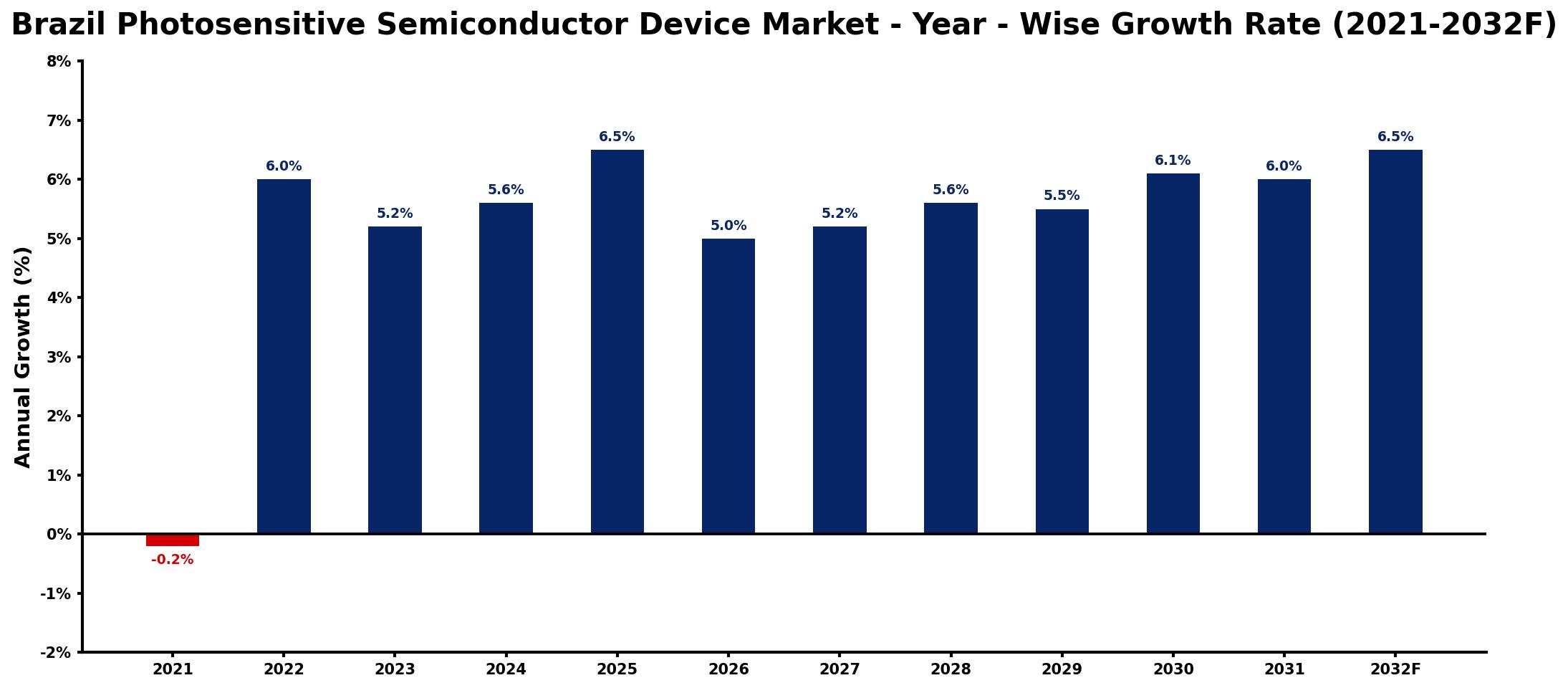
The table below presents the year‑wise growth rates along with the key drivers influencing the market
| Year | Growth Rate | Major Drivers |
| 2021 | -0.2% | decrease in industrial investments |
| 2022 | 6.0% | rise in renewable energy projects |
| 2023 | 5.2% | increased consumer electronics demand |
| 2024 | 5.6% | expansion of automotive sector |
| 2025 | 6.5% | growth in smart home technology |
| 2026 | 5.0% | surge in telecommunications infrastructure |
| 2027 | 5.2% | enhanced government funding initiatives |
| 2028 | 5.6% | development of IoT applications |
| 2029 | 5.5% | expanding industrial usage applications |
| 2030 | 6.1% | increase in energy efficiency regulations |
| 2031 | 6.0% | rising demand for automation solutions |
| 2032 | 6.5% | expanding manufacturing base activity |
Note: Market size estimations and growth projections presented in this report are based on 6Wresearch's proprietary forecasting methodology, utilizing the latest available industry data, government publications, and primary research inputs.
Brazil Photosensitive Semiconductor Device Market Synopsis
A surge in applications for photosensitive semiconductor devices in Brazil is transforming the landscape of electronic and automotive industries. Innovations are enabling the development of compact, efficient sensors that meet the evolving needs of modern devices, thereby enhancing functionalities while reducing energy consumption.
The push for advanced imaging technologies in healthcare is driving significant investments in R&D. Moreover, government initiatives aimed at bolstering domestic manufacturing and research collaboration are positioning Brazil as an attractive hub for semiconductor innovation.
Brazil Photosensitive Semiconductor Device Market Key Takeaways
- The market is fueled by advancements in sensor technology, particularly in imaging and automation applications.
- Government support for R&D and domestic manufacturing is essential for maintaining competitive advantages.
- Consumer demand for high-performance, energy-efficient devices continues to rise, influencing market dynamics.
- Challenges such as global competition necessitate continuous innovation and strategic partnerships.
- Intellectual property concerns are prominent, requiring robust strategies for protection and compliance.
Evaluation of Restraints in Brazil Photosensitive Semiconductor Device Market
Despite the growth potential, the Brazil Photosensitive Semiconductor Device Market faces significant constraints. The urgent need for miniaturization and multifunctionality in electronic devices often leads to increased production complexities. Additionally, rising consumer expectations for high-performance, low-energy products place pressure on manufacturers to innovate rapidly. The competitive global landscape demands cost-effective solutions, while maintaining compliance with international standards poses further challenges. Companies must navigate these hurdles carefully to succeed in this evolving market.
Brazil Photosensitive Semiconductor Device Market Trends
Key trends shaping the Brazil Photosensitive Semiconductor Device Market include a growing emphasis on sensor miniaturization and integration with IoT technologies. As the demand for interconnected devices rises, semiconductor manufacturers are innovating to develop more compact sensors that retain high sensitivity and efficiency. Furthermore, there is a notable shift towards sustainable manufacturing practices as companies increasingly focus on environmentally friendly production processes.
Brazil Photosensitive Semiconductor Device Market Opportunities
Opportunities in the Brazil Photosensitive Semiconductor Device Market lie primarily in emerging applications within healthcare and automotive sectors. The integration of advanced imaging systems into medical devices presents a significant growth avenue, as does the transition towards autonomous driving technologies in vehicles. Additionally, the expanding consumer electronics market provides ample scope for innovative sensor applications, driving further investment and development within the sector.
Government Initiatives in the Brazil Photosensitive Semiconductor Device Market
The Brazilian government plays a vital role in fostering the growth of the semiconductor industry through various policies and initiatives. These include incentives for local manufacturing and R&D, which aim to cultivate a robust ecosystem for innovation. Collaborative programs between academia and industry are designed to strengthen technological capabilities and propel Brazil towards becoming a leader in semiconductor technology.
Future Insights of the Brazil Photosensitive Semiconductor Device Market
Looking ahead to 2026-2032, the Brazil Photosensitive Semiconductor Device Market is poised for substantial growth, driven by technological advancements and government support. As industries increasingly adopt cutting-edge sensor technologies, Brazil's strategic focus on innovation and collaboration is expected to further enhance its competitive standing. The convergence of healthcare and automotive applications with sensor technology will likely accelerate growth, positioning Brazil as a key player in the global semiconductor landscape.
Brazil Photosensitive Semiconductor Device Market Latest Developments (2025 - 2026)
Recent developments in the Brazil Photosensitive Semiconductor Device Market reflect a clear trajectory towards innovation and collaboration. Numerous initiatives have emerged, focusing on enhancing domestic manufacturing capabilities while addressing the growing demand for advanced sensor technologies. In this period, significant strides have been made to streamline R&D efforts and enhance partnerships between academia and industry, contributing to a dynamic and competitive market environment.
Brazil Photosensitive Semiconductor Device Market - Key Attractiveness of the Report
- 10 Years of Market Numbers
- Historical Data Starting from 2022 to 2025
- Base Year: 2025
- Forecast Data until 2032
- Key Performance Indicators Impacting the Market
- Major Upcoming Developments and Projects
Key Highlights of the Report:
- Brazil Photosensitive Semiconductor Device Market Outlook
- Market Size of Brazil Photosensitive Semiconductor Device Market, 2025
- Forecast of Brazil Photosensitive Semiconductor Device Market, 2032
- Historical Data and Forecast of Brazil Photosensitive Semiconductor Device Revenues & Volume for the Period 2022-2032F
- Brazil Photosensitive Semiconductor Device Market Trend Evolution
- Brazil Photosensitive Semiconductor Device Market Drivers and Challenges
- Brazil Photosensitive Semiconductor Device Price Trends
- Brazil Photosensitive Semiconductor Device Porter's Five Forces
- Brazil Photosensitive Semiconductor Device Industry Life Cycle
- Historical Data and Forecast of Brazil Photosensitive Semiconductor Device Market Revenues & Volume By Device for the Period 2022-2032F
- Historical Data and Forecast of Brazil Photosensitive Semiconductor Device Market Revenues & Volume By Photocell for the Period 2022-2032F
- Historical Data and Forecast of Brazil Photosensitive Semiconductor Device Market Revenues & Volume By Photodiode for the Period 2022-2032F
- Historical Data and Forecast of Brazil Photosensitive Semiconductor Device Market Revenues & Volume By Phototransistor for the Period 2022-2032F
- Historical Data and Forecast of Brazil Photosensitive Semiconductor Device Market Revenues & Volume By Photoresistor for the Period 2022-2032F
- Historical Data and Forecast of Brazil Photosensitive Semiconductor Device Market Revenues & Volume By Photo IC for the Period 2022-2032F
- Historical Data and Forecast of Brazil Photosensitive Semiconductor Device Market Revenues & Volume By End User for the Period 2022-2032F
- Historical Data and Forecast of Brazil Photosensitive Semiconductor Device Market Revenues & Volume By Automotive and Transportation for the Period 2022-2032F
- Historical Data and Forecast of Brazil Photosensitive Semiconductor Device Market Revenues & Volume By Consumer Electronics for the Period 2022-2032F
- Historical Data and Forecast of Brazil Photosensitive Semiconductor Device Market Revenues & Volume By Aerospace and Defence for the Period 2022-2032F
- Historical Data and Forecast of Brazil Photosensitive Semiconductor Device Market Revenues & Volume By Healthcare for the Period 2022-2032F
- Historical Data and Forecast of Brazil Photosensitive Semiconductor Device Market Revenues & Volume By Industrial for the Period 2022-2032F
- Historical Data and Forecast of Brazil Photosensitive Semiconductor Device Market Revenues & Volume By Security and Survelliance for the Period 2022-2032F
- Brazil Photosensitive Semiconductor Device Import Export Trade Statistics
- Market Opportunity Assessment By Device
- Market Opportunity Assessment By End User
- Brazil Photosensitive Semiconductor Device Top Companies Market Share
- Brazil Photosensitive Semiconductor Device Competitive Benchmarking By Technical and Operational Parameters
- Brazil Photosensitive Semiconductor Device Company Profiles
- Brazil Photosensitive Semiconductor Device Key Strategic Recommendations






































