Brazil Poultry processing Market (2026-2032) | Industry, Value, Size, Outlook, Analysis, Share, Growth, Trends, Forecast, Companies & Revenue
Market Forecast By Type (Chicken Meat, Turkey Meat, Eggs), By Product Type (Organic, Seasoned, Frozen, Ready-to-Cook, Ready-to-Eat, Others), By End-users (Restaurants, Food Manufacturers, Retail) And Competitive Landscape
| Product Code: ETC028882 | Publication Date: Oct 2020 | Updated Date: Jun 2026 | Product Type: Report | |
| Publisher: 6Wresearch | Author: Ravi Bhandari | No. of Pages: 70 | No. of Figures: 35 | No. of Tables: 5 |
Brazil Poultry processing Market Summary
The brazil poultry processing market was estimated at USD 336 Million in 2025 and is projected to reach USD 402 Million by 2032, growing at a CAGR of 2.8% from 2026 to 2032.
Brazil Poultry processing Market Growth Rate Analysis (2021-2032)
The Brazilian poultry processing market experienced a notable recovery following a challenging contraction of -1.5% in 2021, primarily driven by pandemic-related disruptions. The sector rebounded with a growth of 5.4% in 2022, fueled by rising consumer demand for protein-rich diets and an increase in exports. Continued investments in modern processing technology and automation have further enhanced efficiency, propelling the market to grow by 3.7% in 2023 and a projected 3.9% in 2024. As domestic consumption stabilizes, growth is expected to moderate to around 2.8-3.4% from 2025 through 2032, reflecting a robust adaptation to evolving market dynamics and a commitment to sustainability in production practices.
Brazil Poultry processing Market Year-wise Growth Rate and Key Drivers
This graph highlights how the Brazil Poultry processing Market has steadily grown over the past five years, supported by major growth factors.
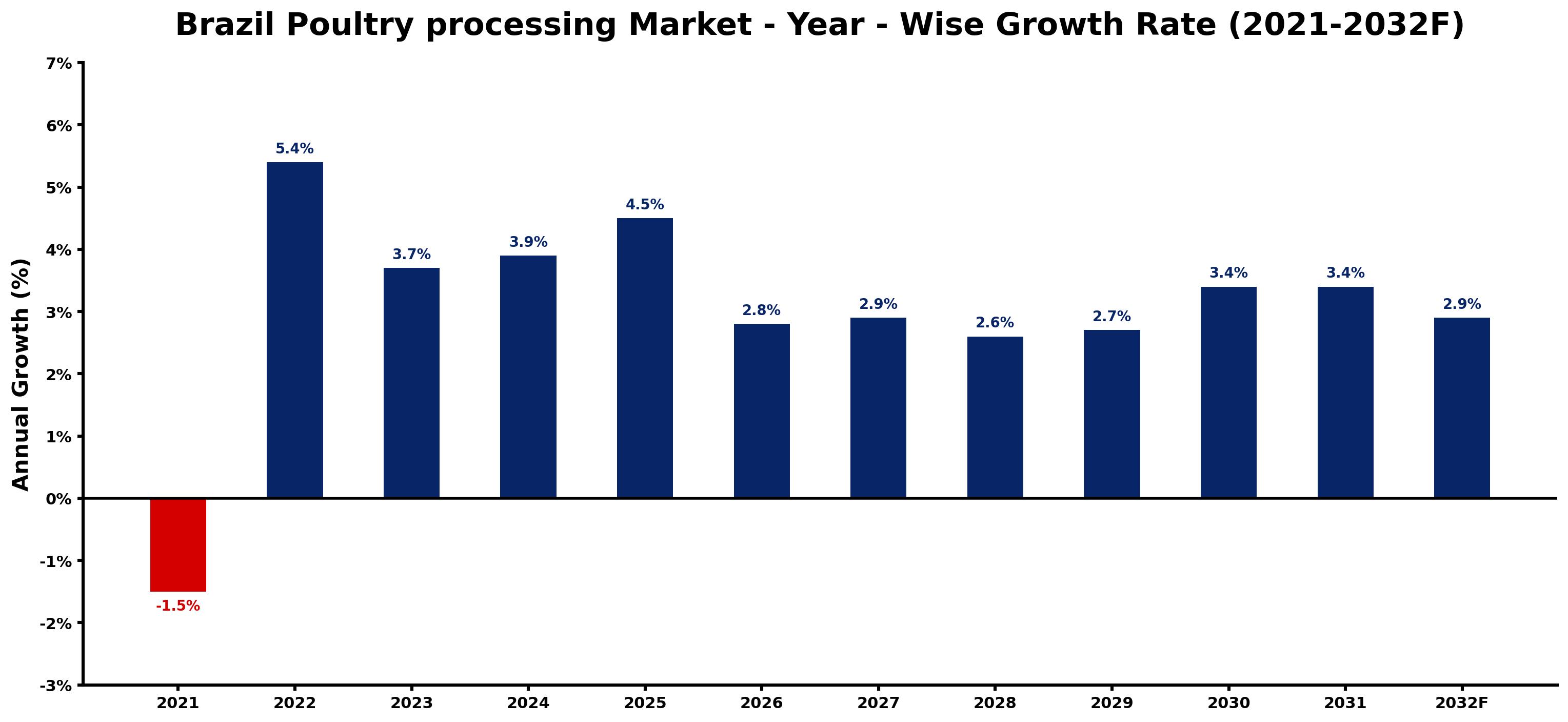
The table below presents the year wise growth rates along with the key drivers influencing the market
| Year | Growth Rate | Major Drivers |
| 2021 | -1.5% | Pandemicinduced labor shortages limited processing capacity, leading to reduced output and lost market opportunities. |
| 2022 | 5.4% | Consumer preferences shifted towards sustainable and ethically sourced poultry products. |
| 2023 | 3.7% | Investments in technology improved efficiency and reduced waste in processing plants. |
| 2024 | 3.9% | Export potential expanded as international markets sought Brazilian poultry products. |
| 2025 | 4.5% | Rising urbanization increased the demand for convenient poultry food options. |
| 2026 | 2.8% | Innovative processing techniques enhanced product quality and shelf life considerably. |
| 2027 | 2.9% | Health trends focused on protein consumption boosted poultry's market appeal. |
| 2028 | 2.6% | E-commerce platforms enhanced accessibility, transforming poultry distribution channels significantly. |
| 2029 | 2.7% | Partnerships with local farmers improved supply chain resilience and product freshness. |
| 2030 | 3.4% | Technological advancements in automation reduced labor costs across processing facilities. |
| 2031 | 3.4% | Environmental regulations pushed for cleaner processing methods and waste management practices. |
| 2032 | 2.9% | Emerging markets showed an increasing appetite for processed poultry exports from Brazil. |
Note - Market size estimations and growth projections presented in this report are based on 6Wresearch's advanced forecasting approach, validated with industry datasets as of June 2026.
Brazil Poultry processing Market Synopsis
The Brazil Poultry processing Market is projected to reach 2.8% and witness significant growth during the forecast period (2026-2032). As a cornerstone of the country's agribusiness sector, the poultry processing industry in Brazil stands out due to its scale, innovation, and compliance with global standards. With Brazil being one of the leading poultry producers worldwide, the market is poised for continued expansion driven by technological advancements and the evolving global trade landscape.
Brazil Poultry processing Market Growth Drivers
The growth trajectory of the Brazil Poultry processing Market is significantly bolstered by several key drivers:
- The increasing demand for poultry products, particularly chicken and turkey, continues to elevate the need for cutting-edge processing equipment and facilities to ensure efficiency and quality.
- Export opportunities are expanding, with Brazilian poultry being favorably positioned in international markets due to quality certifications and competitive pricing.
- Technological advancements in processing techniques aim to enhance productivity and reduce waste, aligning with the industry's focus on sustainability.
- Consumer preferences are shifting towards convenience foods, driving growth in processed and ready-to-cook poultry options, necessitating improved processing capabilities.
- The growth of the global protein market, where poultry is becoming increasingly popular due to health benefits and dietary trends, provides additional impetus for market expansion.
Brazil Poultry processing Market Challenges and Restraints
Despite its robust growth, the Brazil Poultry processing Market faces several challenges:
- Strict regulatory standards imposed by both domestic and international bodies impact production processes and necessitate compliance, which can be resource-intensive.
- Quality control measures and biosecurity concerns, necessitated by the need to ensure food safety and animal welfare, present operational complexities that require dedicated management.
- The rising consumer demand for ethically sourced and organic poultry products places pressure on producers to adjust their supply chains and production practices.
- Market volatility associated with commodity prices can affect profitability and operational planning, leading to uncertainties in cost management.
- The integration of new technology, while beneficial, requires significant investment and staff training, which can be a barrier for smaller producers.
Brazil Poultry processing Market Trends and Opportunities
The Brazil Poultry processing Market is experiencing several transformative trends that present opportunities for growth:
- A notable trend is the implementation of automation technology and smart processing solutions, which enhance operational efficiency and product consistency.
- Sustainability initiatives are being adopted more broadly within processing plants, reducing the environmental footprint and appealing to environmentally conscious consumers.
- Research and development in poultry genetics and nutrition are expected to yield higher yields and healthier products, which can meet rising consumer expectations.
- The expansion of value-added product lines, such as marinated and pre-cooked poultry, allows producers to cater to changing consumer preferences and drive higher margins.
- Cross-border trade agreements and partnerships could enhance export opportunities, thus benefiting the market by expanding the reach of Brazilian poultry products.
Brazil Poultry processing Market Government Investment and Initiatives
The Brazilian government plays a pivotal role in shaping the poultry processing market through various investments and initiatives aimed at enhancing food safety, animal welfare, and trade facilitation:
- The government has established regulations that promote hygiene standards across poultry processing facilities, ensuring adherence to both domestic and international food safety norms.
- Public funding initiatives target research in sustainable poultry farming, aiming to bolster the industry's long-term viability and competitiveness.
- Development plans include improving transportation infrastructure, which is crucial for maintaining the quality and freshness of poultry products during distribution.
- Incentives for producers adopting environmentally friendly practices are being encouraged, aligning with global trends towards sustainable agriculture.
- The Brazilian government is actively working to enhance its international trade framework, facilitating easier access for Brazilian poultry products to key global markets.
Brazil Poultry processing Market Latest Developments (May 2025 - June 2026)
In recent months, the Brazil Poultry processing Market has undergone various developments indicative of the industry's direction:
- Innovations in processing technology have gained traction, with facilities increasingly integrating advanced automation to streamline operations and reduce labor dependency.
- A growing emphasis on sustainability has led many processing plants to adopt environmentally friendly waste management practices and reduce emissions.
- The industry has seen partnerships form between producers and technology providers to enhance product safety and traceability, appealing to an increasingly health-conscious consumer base.
- Regulatory updates regarding labeling and transparency have been rolled out, ensuring consumers are better informed about the origins and quality of poultry products.
- Export demand has shown signs of recovery post-pandemic, with Brazil capitalizing on its competitive advantages to strengthen its position in international markets.
Brazil Poultry processing Market - Key Attractiveness of the Report
- 10 Years of Market Numbers
- Historical Data Starting from 2022 to 2025
- Base Year: 2025
- Forecast Data until 2032
- Key Performance Indicators Impacting the Market
- Major Upcoming Developments and Projects
Key Highlights of the Report:
- Brazil Poultry processing Market Outlook
- Market Size of Brazil Poultry processing Market, 2025
- Forecast of Brazil Poultry processing Market, 2032
- Historical Data and Forecast of Brazil Poultry processing Revenues & Volume for the Period 2022-2032F
- Brazil Poultry processing Market Trend Evolution
- Brazil Poultry processing Market Drivers and Challenges
- Brazil Poultry processing Price Trends
- Brazil Poultry processing Porter's Five Forces
- Brazil Poultry processing Industry Life Cycle
- Historical Data and Forecast of Brazil Poultry processing Market Revenues & Volume By Type for the Period 2022-2032F
- Historical Data and Forecast of Brazil Poultry processing Market Revenues & Volume By Chicken Meat for the Period 2022-2032F
- Historical Data and Forecast of Brazil Poultry processing Market Revenues & Volume By Turkey Meat for the Period 2022-2032F
- Historical Data and Forecast of Brazil Poultry processing Market Revenues & Volume By Eggs for the Period 2022-2032F
- Historical Data and Forecast of Brazil Poultry processing Market Revenues & Volume By Product Type for the Period 2022-2032F
- Historical Data and Forecast of Brazil Poultry processing Market Revenues & Volume By Organic for the Period 2022-2032F
- Historical Data and Forecast of Brazil Poultry processing Market Revenues & Volume By Seasoned for the Period 2022-2032F
- Historical Data and Forecast of Brazil Poultry processing Market Revenues & Volume By Frozen for the Period 2022-2032F
- Historical Data and Forecast of Brazil Poultry processing Market Revenues & Volume By Ready-to-Cook for the Period 2022-2032F
- Historical Data and Forecast of Brazil Poultry processing Market Revenues & Volume By Ready-to-Eat for the Period 2022-2032F
- Historical Data and Forecast of Brazil Poultry processing Market Revenues & Volume By Others for the Period 2022-2032F
- Historical Data and Forecast of Brazil Poultry processing Market Revenues & Volume By End-users for the Period 2022-2032F
- Historical Data and Forecast of Brazil Poultry processing Market Revenues & Volume By Restaurants for the Period 2022-2032F
- Historical Data and Forecast of Brazil Poultry processing Market Revenues & Volume By Food Manufacturers for the Period 2022-2032F
- Historical Data and Forecast of Brazil Poultry processing Market Revenues & Volume By Retail for the Period 2022-2032F
- Brazil Poultry processing Import Export Trade Statistics
- Market Opportunity Assessment By Type
- Market Opportunity Assessment By Product Type
- Market Opportunity Assessment By End-users
- Brazil Poultry processing Top Companies Market Share
- Brazil Poultry processing Competitive Benchmarking By Technical and Operational Parameters
- Brazil Poultry processing Company Profiles
- Brazil Poultry processing Key Strategic Recommendations
Frequently Asked Questions About the Market Study (FAQs):
The growth is driven by rising consumption of poultry products, the expansion of export opportunities, technological advancements in processing, and changing consumer preferences towards convenience food.
Challenges include stringent regulatory compliance, quality control requirements, evolving consumer preferences towards organic products, and operational complexities related to biosecurity.
The government supports the market through policies that promote food safety, public investments in sustainable practices, and enhancing trade frameworks for easier access to global markets.
Recent trends include increased automation in processing facilities, emphasis on sustainability, and the introduction of value-added poultry products to cater to changing consumer demands.
6Wresearch actively monitors the Brazil Poultry processing Market and publishes its comprehensive annual report, highlighting emerging trends, growth drivers, revenue analysis, and forecast outlook. Our insights help businesses to make data-backed strategic decisions with ongoing market dynamics. Our analysts track relevent industries related to the Brazil Poultry processing Market, allowing our clients with actionable intelligence and reliable forecasts tailored to emerging regional needs.
Yes, we provide customisation as per your requirements. To learn more, feel free to contact us on sales@6wresearch.com
1 Executive Summary |
2 Introduction |
2.1 Key Highlights of the Report |
2.2 Report Description |
2.3 Market Scope & Segmentation |
2.4 Research Methodology |
2.5 Assumptions |
3 Brazil Poultry processing Market Overview |
3.1 Brazil Country Macro Economic Indicators |
3.2 Brazil Poultry processing Market Revenues & Volume, 2022 & 2032F |
3.3 Brazil Poultry processing Market - Industry Life Cycle |
3.4 Brazil Poultry processing Market - Porter's Five Forces |
3.5 Brazil Poultry processing Market Revenues & Volume Share, By Type, 2022 & 2032F |
3.6 Brazil Poultry processing Market Revenues & Volume Share, By Product Type, 2022 & 2032F |
3.7 Brazil Poultry processing Market Revenues & Volume Share, By End-users, 2022 & 2032F |
4 Brazil Poultry processing Market Dynamics |
4.1 Impact Analysis |
4.2 Market Drivers |
4.2.1 Increasing demand for poultry products in Brazil due to their affordability and nutritional value |
4.2.2 Technological advancements in poultry processing leading to increased efficiency and productivity |
4.2.3 Growing focus on food safety and quality standards driving investments in modern processing facilities |
4.3 Market Restraints |
4.3.1 Fluctuations in raw material prices impacting profit margins of poultry processing companies |
4.3.2 Regulatory challenges and compliance requirements adding operational costs and complexities |
4.3.3 Intense competition within the market leading to pricing pressures |
5 Brazil Poultry processing Market Trends |
6 Brazil Poultry processing Market, By Types |
6.1 Brazil Poultry processing Market, By Type |
6.1.1 Overview and Analysis |
6.1.2 Brazil Poultry processing Market Revenues & Volume, By Type, 2022-2032F |
6.1.3 Brazil Poultry processing Market Revenues & Volume, By Chicken Meat, 2022-2032F |
6.1.4 Brazil Poultry processing Market Revenues & Volume, By Turkey Meat, 2022-2032F |
6.1.5 Brazil Poultry processing Market Revenues & Volume, By Eggs, 2022-2032F |
6.2 Brazil Poultry processing Market, By Product Type |
6.2.1 Overview and Analysis |
6.2.2 Brazil Poultry processing Market Revenues & Volume, By Organic, 2022-2032F |
6.2.3 Brazil Poultry processing Market Revenues & Volume, By Seasoned, 2022-2032F |
6.2.4 Brazil Poultry processing Market Revenues & Volume, By Frozen, 2022-2032F |
6.2.5 Brazil Poultry processing Market Revenues & Volume, By Ready-to-Cook, 2022-2032F |
6.2.6 Brazil Poultry processing Market Revenues & Volume, By Ready-to-Eat, 2022-2032F |
6.2.7 Brazil Poultry processing Market Revenues & Volume, By Others, 2022-2032F |
6.3 Brazil Poultry processing Market, By End-users |
6.3.1 Overview and Analysis |
6.3.2 Brazil Poultry processing Market Revenues & Volume, By Restaurants, 2022-2032F |
6.3.3 Brazil Poultry processing Market Revenues & Volume, By Food Manufacturers, 2022-2032F |
6.3.4 Brazil Poultry processing Market Revenues & Volume, By Retail, 2022-2032F |
7 Brazil Poultry processing Market Import-Export Trade Statistics |
7.1 Brazil Poultry processing Market Export to Major Countries |
7.2 Brazil Poultry processing Market Imports from Major Countries |
8 Brazil Poultry processing Market Key Performance Indicators |
8.1 Percentage of poultry processing plants in Brazil that are adopting automation and technology solutions |
8.2 Average processing time per unit of poultry product, indicating operational efficiency |
8.3 Compliance rate with food safety and quality standards in poultry processing facilities |
8.4 Investment in research and development for new processing techniques and product innovations |
9 Brazil Poultry processing Market - Opportunity Assessment |
9.1 Brazil Poultry processing Market Opportunity Assessment, By Type, 2022 & 2032F |
9.2 Brazil Poultry processing Market Opportunity Assessment, By Product Type, 2022 & 2032F |
9.3 Brazil Poultry processing Market Opportunity Assessment, By End-users, 2022 & 2032F |
10 Brazil Poultry processing Market - Competitive Landscape |
10.1 Brazil Poultry processing Market Revenue Share, By Companies, 2025 |
10.2 Brazil Poultry processing Market Competitive Benchmarking, By Operating and Technical Parameters |
11 Company Profiles |
12 Recommendations |
13 Disclaimer |
Global Go To Market Strategy - 2030
Export potential enables firms to identify high-growth global markets with greater confidence by combining advanced trade intelligence with a structured quantitative methodology. The framework analyzes emerging demand trends and country-level import patterns while integrating macroeconomic and trade datasets such as GDP and population forecasts, bilateral import–export flows, tariff structures, elasticity differentials between developed and developing economies, geographic distance, and import demand projections. Using weighted trade values from 2020–2024 as the base period to project country-to-country export potential for 2030, these inputs are operationalized through calculated drivers such as gravity model parameters, tariff impact factors, and projected GDP per-capita growth. Through an analysis of hidden potentials, demand hotspots, and market conditions that are most favorable to success, this method enables firms to focus on target countries, maximize returns, and global expansion with data, backed by accuracy.
By factoring in the projected importer demand gap that is currently unmet and could be potential opportunity, it identifies the potential for the Exporter (Country) among 190 countries, against the general trade analysis, which identifies the biggest importer or exporter.
To discover high-growth global markets and optimize your business strategy:
Click Here
Pricing
- Single User License$ 1,995
- Department License$ 2,400
- Site License$ 3,120
- Global License$ 3,795

Leadership Perspectives from Industry Events
Search
Thought Leadership and Analyst Meet





Our Clients








6WResearch In News
- Doha a strategic location for EV manufacturing hub: IPA Qatar
- Demand for luxury TVs surging in the GCC, says Samsung
- Empowering Growth: The Thriving Journey of Bangladesh’s Cable Industry
- Demand for luxury TVs surging in the GCC, says Samsung
- Video call with a traditional healer? Once unthinkable, it’s now common in South Africa
- Intelligent Buildings To Smooth GCC’s Path To Net Zero
Latest Reports
- Cape Verde Portable Hand-Thrown Extinguisher Market (2026-2032)
- Canada Portable Hand-Thrown Extinguisher Market (2026-2032)
- Cameroon Portable Hand-Thrown Extinguisher Market (2026-2032)
- Burundi Portable Hand-Thrown Extinguisher Market (2026-2032)
- Burkina Faso Portable Hand-Thrown Extinguisher Market (2026-2032)
- Bulgaria Portable Hand-Thrown Extinguisher Market (2026-2032)
- Brunei Portable Hand-Thrown Extinguisher Market (2026-2032)
- Botswana Portable Hand-Thrown Extinguisher Market (2026-2032)
- Bosnia and Herzegovina Portable Hand-Thrown Extinguisher Market (2026-2032)
- Bolivia Portable Hand-Thrown Extinguisher Market (2026-2032)
Industry Events and Analyst Meet

HIMTEX 2026

India Refining Summit 2026

India EV Show 2026

EV tech India Expo 2026

Auto Tech Asia 2026
Whitepaper
- Middle East & Africa Commercial Security Market Click here to view more.
- Middle East & Africa Fire Safety Systems & Equipment Market Click here to view more.
- GCC Drone Market Click here to view more.
- Middle East Lighting Fixture Market Click here to view more.
- GCC Physical & Perimeter Security Market Click here to view more.


