Brazil Prepaid Cards Market Size, Share & Growth Rate
The Brazil Prepaid Cards Market was estimated at USD 356 Million in 2025 and is projected to reach USD 489 Million by 2032, growing at a CAGR of 4.6% from 2026 to 2032. This growth trajectory is primarily fueled by a surge in financial inclusion initiatives that are broadening access to payment solutions among unbanked populations. Furthermore, the escalating preference for cashless transactions is prompting consumers to adopt prepaid cards for their flexibility and security.
Brazil Prepaid Cards Market Year-wise Growth Rate and Key Drivers
This graph highlights how the Brazil Prepaid Cards Market has steadily grown over the years, supported by major growth factors.
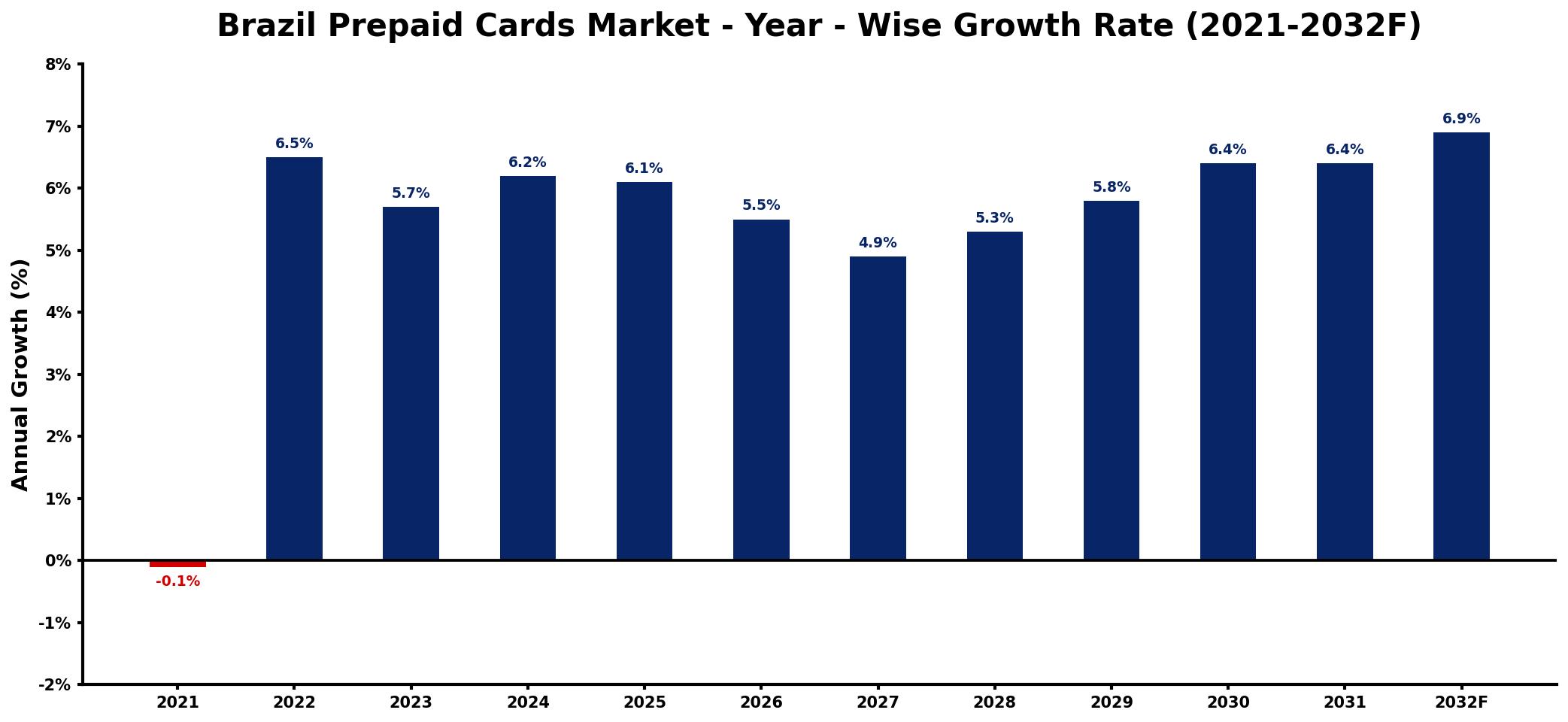
The table below presents the year‑wise growth rates along with the key drivers influencing the market
| Year | Growth Rate | Major Drivers |
| 2021 | -0.1% | decreased consumer spending patterns |
| 2022 | 6.5% | growing digital payment adoption |
| 2023 | 5.7% | expansion of e-commerce platforms |
| 2024 | 6.2% | increased financial inclusion initiatives |
| 2025 | 6.1% | rising mobile transaction volumes |
| 2026 | 5.5% | enhanced security features integration |
| 2027 | 4.9% | strengthening underlying market demand |
| 2028 | 5.3% | wider acceptance in retail outlets |
| 2029 | 5.8% | increased partnerships with fintech firms |
| 2030 | 6.4% | growing interest from millennials |
| 2031 | 6.4% | expansion into emerging markets |
| 2032 | 6.9% | increased regulatory support initiatives |
Note: Market size estimations and growth projections presented in this report are based on 6Wresearch's proprietary forecasting methodology, utilizing the latest available industry data, government publications, and primary research inputs.
Brazil Prepaid Cards Market Synopsis
The most significant force shaping the Brazil Prepaid Cards Market currently is the ongoing shift towards digital payment solutions, especially among younger consumers. This demographic is increasingly drawn to the convenience of prepaid cards for online shopping and international transactions, further boosting market demand.
Additionally, the retail sectors rapid evolution is facilitating an expanding acceptance network for prepaid cards. As merchants recognize the benefits of offering multiple payment options, the integration of prepaid cards into their systems is becoming commonplace, enhancing their attractiveness as a viable alternative to traditional payment methods.
Brazil Prepaid Cards Market Key Takeaways
- Significant growth driven by financial inclusion efforts and a cashless society shift.
- Rising acceptance across retail outlets enhances the usability of prepaid cards.
- Technological advancements are leading to improved security features and mobile integration.
- Government initiatives focus on consumer protection and financial literacy, boosting market credibility.
- Prepaid cards are increasingly popular among various consumer segments, including travelers and online shoppers.
Evaluation of Restraints in Brazil Prepaid Cards Market
The Brazil prepaid cards market grapples with several restraints that hinder its full potential. Notably, regulatory compliance presents ongoing challenges as issuers must navigate a complex framework to ensure adherence. Coupled with this, concerns surrounding fraud prevention necessitate robust security measures to protect cardholders. Additionally, saturation in the market and heightened competition from alternative payment methods require constant innovation and adaptation from stakeholders to maintain their competitive edge.
Brazil Prepaid Cards Market Trends
Current trends in the Brazil Prepaid Cards Market indicate a strong movement towards mobile wallet integration, enabling users to manage their prepaid cards directly from their smartphones. This technological shift not only enhances user experience but also appeals to tech-savvy consumers who prioritize convenience. Moreover, theres a growing interest in prepaid cards that incorporate rewards programs, encouraging increased usage and customer loyalty.
Emerging payment technologies, such as contactless payments and QR code transactions, are also shaping consumer preferences. As these methods gain traction, they further enhance the appeal of prepaid cards by aligning with modern payment behaviors, thereby fostering greater adoption among Brazilian consumers.
Brazil Prepaid Cards Market Opportunities
The Brazil Prepaid Cards Market is ripe with growth and investment opportunities, especially in enhancing features that cater to niche consumer segments. There is potential for product development aimed at travelers, such as prepaid cards offering low foreign transaction fees. Moreover, partnerships with e-commerce platforms could unlock access to a broader audience, driving usage among online shoppers. As the focus on financial literacy continues to grow, educational initiatives to raise awareness about the benefits of prepaid cards can foster deeper market penetration.
Government Initiatives in the Brazil Prepaid Cards Market
Government policies in Brazil increasingly emphasize consumer protection and financial inclusion, crucial for the prepaid cards market. Regulatory bodies are overseeing the issuance of prepaid card programs to enhance transparency and security for users. Financial literacy initiatives are also being rolled out to educate consumers about responsible prepaid card usage and their rights, thereby fostering trust in these financial instruments. Additionally, anti-fraud measures are being prioritized to safeguard users and maintain the integrity of the prepaid card ecosystem.
Future Insights of the Brazil Prepaid Cards Market
Looking ahead to 2026-2032, the Brazil Prepaid Cards Market is set to thrive on the convergence of digitalization and consumer demand for flexibility. As e-commerce continues to expand, prepaid cards are expected to become an essential tool for online transactions, especially among younger consumers. Additionally, advancements in technology will likely lead to innovative features, enhancing security and user experience. This combination of factors will propel the market forward, ensuring sustained growth and widespread adoption across various consumer segments.
Brazil Prepaid Cards Market Latest Developments (2025 - 2026)
Recent developments in the Brazil prepaid cards market indicate a strong focus on technological integration, with many issuers exploring partnerships with fintech companies to enhance service delivery. The adoption of biometric security features is gaining traction, reflecting a broader trend towards heightened security in digital payments. Additionally, consumer feedback mechanisms are being implemented more widely, allowing companies to tailor their offerings based on user preferences, further boosting engagement and satisfaction.
Brazil Prepaid Cards Market - Key Attractiveness of the Report
- 10 Years of Market Numbers
- Historical Data Starting from 2022 to 2025
- Base Year: 2025
- Forecast Data until 2032
- Key Performance Indicators Impacting the Market
- Major Upcoming Developments and Projects
Key Highlights of the Report:
- Brazil Prepaid Cards Market Outlook
- Market Size of Brazil Prepaid Cards Market, 2025
- Forecast of Brazil Prepaid Cards Market, 2032
- Historical Data and Forecast of Brazil Prepaid Cards Revenues & Volume for the Period 2022-2032F
- Brazil Prepaid Cards Market Trend Evolution
- Brazil Prepaid Cards Market Drivers and Challenges
- Brazil Prepaid Cards Price Trends
- Brazil Prepaid Cards Porter's Five Forces
- Brazil Prepaid Cards Industry Life Cycle
- Historical Data and Forecast of Brazil Prepaid Cards Market Revenues & Volume By Offering for the Period 2022-2032F
- Historical Data and Forecast of Brazil Prepaid Cards Market Revenues & Volume By General Purpose Card for the Period 2022-2032F
- Historical Data and Forecast of Brazil Prepaid Cards Market Revenues & Volume By Gift Card for the Period 2022-2032F
- Historical Data and Forecast of Brazil Prepaid Cards Market Revenues & Volume By Government Benefit/Disbursement Card for the Period 2022-2032F
- Historical Data and Forecast of Brazil Prepaid Cards Market Revenues & Volume By Incentive/Payroll Card for the Period 2022-2032F
- Historical Data and Forecast of Brazil Prepaid Cards Market Revenues & Volume By Others for the Period 2022-2032F
- Historical Data and Forecast of Brazil Prepaid Cards Market Revenues & Volume By Card Type for the Period 2022-2032F
- Historical Data and Forecast of Brazil Prepaid Cards Market Revenues & Volume By Closed Loop Card for the Period 2022-2032F
- Historical Data and Forecast of Brazil Prepaid Cards Market Revenues & Volume By Open Loop Card for the Period 2022-2032F
- Historical Data and Forecast of Brazil Prepaid Cards Market Revenues & Volume By End User for the Period 2022-2032F
- Historical Data and Forecast of Brazil Prepaid Cards Market Revenues & Volume By Retail for the Period 2022-2032F
- Historical Data and Forecast of Brazil Prepaid Cards Market Revenues & Volume By Corporate for the Period 2022-2032F
- Historical Data and Forecast of Brazil Prepaid Cards Market Revenues & Volume By Government/Public Sector for the Period 2022-2032F
- Brazil Prepaid Cards Import Export Trade Statistics
- Market Opportunity Assessment By Offering
- Market Opportunity Assessment By Card Type
- Market Opportunity Assessment By End User
- Brazil Prepaid Cards Top Companies Market Share
- Brazil Prepaid Cards Competitive Benchmarking By Technical and Operational Parameters
- Brazil Prepaid Cards Company Profiles
- Brazil Prepaid Cards Key Strategic Recommendations






































