Brazil Smart Locks & Keys Market Summary
The brazil smart locks & keys market was estimated at USD 253 Million in 2025 and is projected to reach USD 334 Million by 2032, growing at a CAGR of 4.7% from 2026 to 2032.
Brazil Smart Locks & Keys Market Year-wise Growth Rate and Key Drivers
This graph highlights how the Brazil Smart Locks & Keys Market has steadily grown over the past five years, supported by major growth factors.
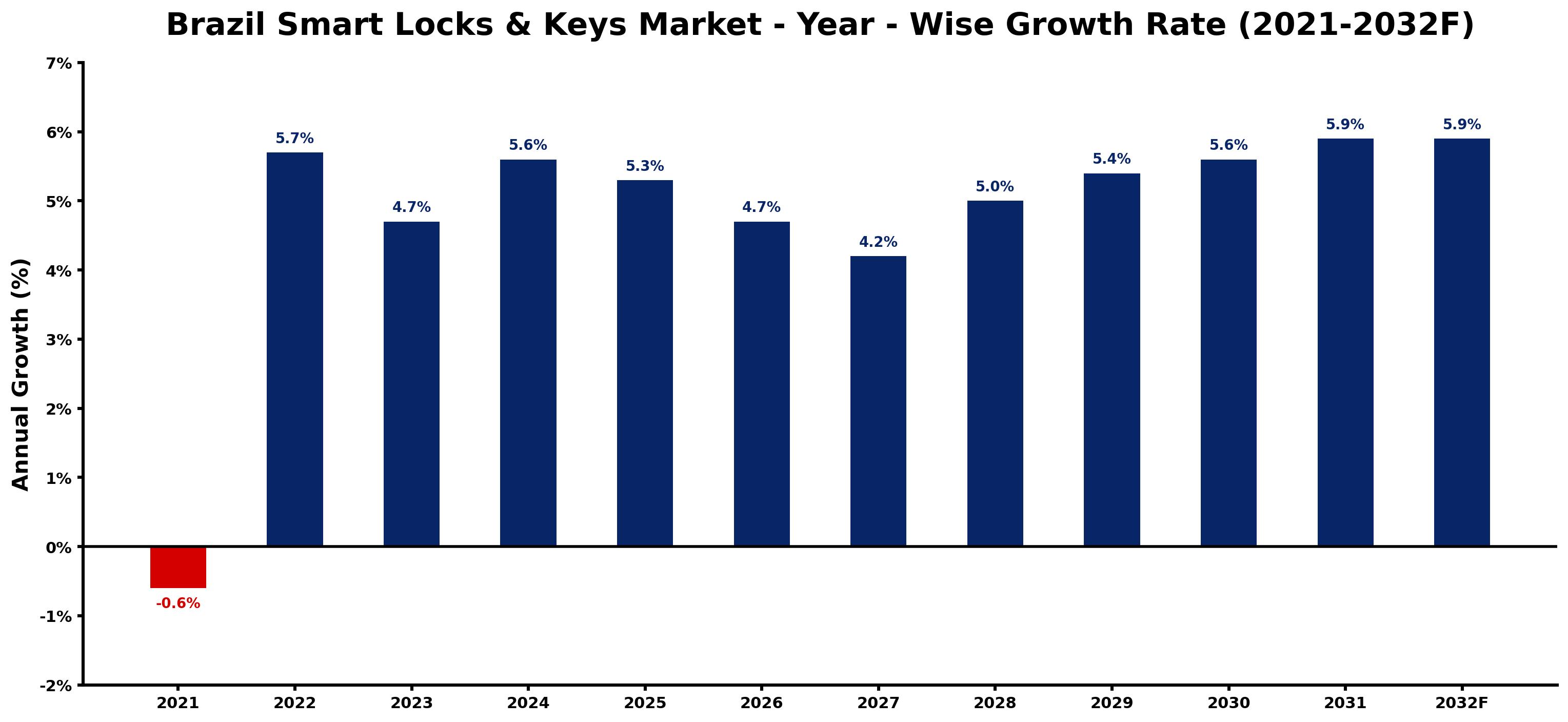
The table below presents the year wise growth rates along with the key drivers influencing the market
| Year | Growth Rate | Major Drivers |
| 2021 | -0.6% | Intensified competition from emerging technologies discouraged investment in traditional smart lock solutions. |
| 2022 | 5.7% | Urbanization trends prompted a surge in smart home integrations across major cities. |
| 2023 | 4.7% | Technological partnerships between security firms and tech giants enhanced product offerings. |
| 2024 | 5.6% | Consumer interest shifted towards convenience and remote access features in home security. |
| 2025 | 5.3% | Smart home ecosystems gained popularity, with locks becoming central to security systems. |
| 2026 | 4.7% | E-commerce platforms expanded, facilitating easier access to smart lock products for consumers. |
| 2027 | 4.2% | Local manufacturers began producing affordable smart lock options, appealing to new demographics. |
| 2028 | 5.0% | Increased consumer awareness of cybersecurity risks drove demand for advanced locking mechanisms. |
| 2029 | 5.4% | Rising crime rates in urban areas accelerated the transition to smart security solutions. |
| 2030 | 5.6% | Home automation renovations became common, integrating smart locks with other technologies. |
| 2031 | 5.9% | Sustainability trends influenced products, with eco-friendly materials gaining consumer interest. |
| 2032 | 5.9% | Market consolidation occurred, leading to fewer but more innovative players in smart locks. |
Note - Market size estimations and growth projections presented in this report are based on 6Wresearch's advanced forecasting approach, validated with industry datasets as of June 2026.
Brazil Smart Locks & Keys Market Synopsis
The Brazil Smart Locks Keys Market is projected to reach 4.7% and witness significant growth during the forecast period (2026-2032). This expansion is largely driven by a surge in demand for enhanced security solutions including biometric access control systems, electronic lockers, and RFID tags and readers. As corporate offices and governmental organizations increasingly adopt these advanced technologies, the market is poised for robust growth. Additionally, rising security concerns among residential users are stimulating demand for smart locks and keys throughout Brazil.
Brazil Smart Locks & Keys Market Growth Drivers
A variety of factors contribute to the growth of the Brazil Smart Locks & Keys Market. One primary driver is the increasing concerns regarding personal and property security, propelling the adoption of smart locking mechanisms that provide higher levels of safety and convenience. The penetration of advanced technologies such as biometric systems is making these products more appealing to both residential and commercial users.
- Adoption of biometric access control systems is rising, offering sophisticated security features that are difficult to bypass.
- The advancement of IoT technologies is enhancing the capabilities of smart locks, allowing seamless integration with home automation systems.
- Increasing urbanization in Brazil leads to more residential developments where smart locks are seen as a valuable amenity.
- Corporate sectors are prioritizing employee safety and asset protection, leading to higher investments in smart locking solutions.
- The growth in e-commerce and the need for secure transactions are driving demand for locking mechanisms designed for digital environments.
Brazil Smart Locks & Keys Market Trends and Opportunities
The Brazil Smart Locks & Keys Market is experiencing notable trends that indicate promising opportunities for growth. The increasing preference for online shopping has heightened consumer expectations for security, further driving demand for innovative smart locking systems that can secure both physical and digital access points. These trends suggest a burgeoning market for products that incorporate advanced safety features with user-friendly interfaces.
- The integration of mobile applications with smart locks is becoming standard, providing users with remote control and monitoring capabilities.
- Development of multi-functional smart locks that offer features like video surveillance and alarm notifications is gaining traction.
- Collaboration among technology companies is fostering innovation, leading to the creation of smarter, more efficient locking systems.
- Consumer education regarding the benefits of smart locks is improving, driving adoption rates among the general public.
- Growing interest in sustainable and energy-efficient products is influencing manufacturers to develop eco-friendly smart locking solutions.
Brazil Smart Locks & Keys Market Challenges and Restraints
While the Brazil Smart Locks & Keys Market shows significant promise, it also faces challenges that could hinder growth. Concerns regarding privacy, data security, and the potential for hacking remain prevalent among consumers, leading to hesitance in adoption. Additionally, the initial high cost of smart locking systems compared to traditional locks may deter some consumers from making the switch.
- Consumers often express concerns about the reliability and longevity of smart locks compared to traditional options.
- Higher upfront costs may limit the accessibility of smart locks to lower-income households.
- The rapid pace of technological change can lead to products becoming obsolete quickly, affecting long-term investment decisions.
- Piracy and hacking of smart devices pose significant security risks, leading to consumer distrust.
- Inadequate infrastructure for supporting advanced technologies in rural areas may inhibit market growth in those regions.
Brazil Smart Locks & Keys Market Government Investment and Initiatives
The Brazilian government is increasingly recognizing the importance of advanced security technologies and is actively investing in initiatives aimed at enhancing public safety. This includes funding for research and development in security technology, as well as initiatives that encourage the adoption of smart locking systems across various sectors.
- Government programs focusing on urban safety are promoting the adoption of smart locks in both residential and commercial properties.
- Incentives for businesses to upgrade their security infrastructure are being introduced, making smart locks a viable option.
- Public awareness campaigns on the benefits of smart locks and overall cybersecurity are being supported, enhancing consumer education.
- The government is collaborating with technology providers to ensure the availability of cutting-edge security solutions in public facilities.
- Long-term strategic plans aim to improve national security, potentially allocating funds toward the integration of smart locks in government buildings.
Brazil Smart Locks & Keys Market Latest Developments (May 2025 - June 2026)
The period from May 2025 to June 2026 has witnessed several noteworthy developments in the Brazil Smart Locks & Keys Market. Technological advancements continue to shape the landscape, with companies exploring next-generation locking solutions that incorporate AI and machine learning for enhanced security functionalities. Additionally, the increasing integration of smart locks with home automation systems is expected to facilitate smoother user experiences.
- Emerging technologies are being incorporated into smart lock designs, leading to innovations such as automated locking mechanisms and mobile access options.
- Collaborations within the tech industry are fostering the development of integrated solutions that combine security with convenience.
- Consumer feedback is being utilized to refine smart lock designs, focusing on ease of use and reliability.
- Smart locks are becoming a standard feature in new residential developments, reflecting changing consumer preferences for enhanced security.
- E-commerce platforms are increasingly offering smart locking solutions, making them more accessible to a wider consumer base.
Brazil Smart Locks & Keys Market - Key Attractiveness of the Report
- 10 Years of Market Numbers
- Historical Data Starting from 2022 to 2025
- Base Year: 2025
- Forecast Data until 2032
- Key Performance Indicators Impacting the Market
- Major Upcoming Developments and Projects
Key Highlights of the Report:
- Brazil Smart Locks & Keys Market Outlook
- Market Size of Brazil Smart Locks & Keys Market, 2025
- Forecast of Brazil Smart Locks & Keys Market, 2032
- Historical Data and Forecast of Brazil Smart Locks & Keys Revenues & Volume for the Period 2022-2032
- Brazil Smart Locks & Keys Market Trend Evolution
- Brazil Smart Locks & Keys Market Drivers and Challenges
- Brazil Smart Locks & Keys Price Trends
- Brazil Smart Locks & Keys Porter's Five Forces
- Brazil Smart Locks & Keys Industry Life Cycle
- Historical Data and Forecast of Brazil Smart Locks & Keys Market Revenues & Volume By Types for the Period 2022-2032
- Historical Data and Forecast of Brazil Smart Locks & Keys Market Revenues & Volume By Deadbolt for the Period 2022-2032
- Historical Data and Forecast of Brazil Smart Locks & Keys Market Revenues & Volume By Lever Handles for the Period 2022-2032
- Historical Data and Forecast of Brazil Smart Locks & Keys Market Revenues & Volume By Padlock for the Period 2022-2032
- Historical Data and Forecast of Brazil Smart Locks & Keys Market Revenues & Volume By Others for the Period 2022-2032
- Historical Data and Forecast of Brazil Smart Locks & Keys Market Revenues & Volume By Applications for the Period 2022-2032
- Historical Data and Forecast of Brazil Smart Locks & Keys Market Revenues & Volume By Residential for the Period 2022-2032
- Historical Data and Forecast of Brazil Smart Locks & Keys Market Revenues & Volume By Hospitality for the Period 2022-2032
- Historical Data and Forecast of Brazil Smart Locks & Keys Market Revenues & Volume By Enterprise for the Period 2022-2032
- Historical Data and Forecast of Brazil Smart Locks & Keys Market Revenues & Volume By Critical Infrastructure for the Period 2022-2032
- Historical Data and Forecast of Brazil Smart Locks & Keys Market Revenues & Volume By Others for the Period 2022-2032
- Brazil Smart Locks & Keys Import Export Trade Statistics
- Market Opportunity Assessment By Types
- Market Opportunity Assessment By Applications
- Brazil Smart Locks & Keys Top Companies Market Share
- Brazil Smart Locks & Keys Competitive Benchmarking By Technical and Operational Parameters
- Brazil Smart Locks & Keys Company Profiles
- Brazil Smart Locks & Keys Key Strategic Recommendations






































