Brazil Smokeless Tobacco Product Market Size, Share & Growth Rate
The Brazil Smokeless Tobacco Product Market was estimated at USD 285 Million in 2025 and is projected to reach USD 341 Million by 2032, growing at a CAGR of 2.6% from 2026 to 2032. This growth trajectory is largely driven by an increasing consumer shift towards alternative nicotine delivery methods, with health-conscious users seeking smoke-free options. Additionally, the Brazilian tobacco landscape continues to evolve under the influence of robust public health campaigns and a gradual acceptance of smokeless products as viable substitutes for traditional smoking.
Brazil Smokeless Tobacco Product Market Year-wise Growth Rate and Key Drivers
This graph highlights how the Brazil Smokeless Tobacco Product Market has steadily grown over the years, supported by major growth factors.
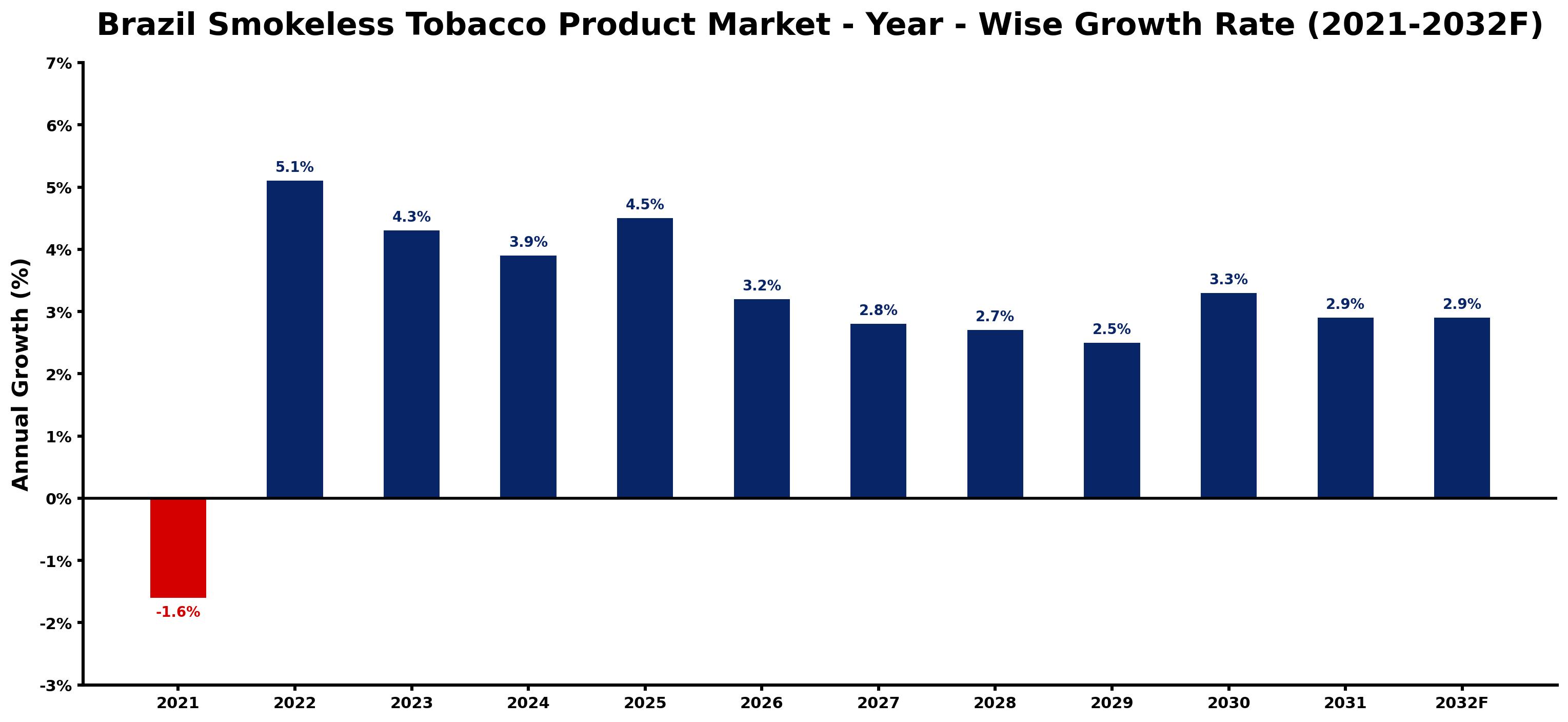
The table below presents the year‑wise growth rates along with the key drivers influencing the market
| Year | Growth Rate | Major Drivers |
| 2021 | -1.6% | Growing renewable energy integration projects |
| 2022 | 5.1% | Increasing industrial infrastructure investments |
| 2023 | 4.3% | Government infrastructure modernization initiatives |
| 2024 | 3.9% | Increasing adoption of advanced technologies |
| 2025 | 4.5% | Rapid growth in telecom and data center sectors |
| 2026 | 3.2% | Expansion of manufacturing activities |
| 2027 | 2.8% | Expansion of manufacturing activities |
| 2028 | 2.7% | Increasing industrial infrastructure investments |
| 2029 | 2.5% | Increasing industrial automation investments |
| 2030 | 3.3% | Increasing industrial automation investments |
| 2031 | 2.9% | Growing renewable energy integration projects |
| 2032 | 2.9% | Increasing industrial automation investments |
Note - Market size estimations and growth projections presented in this report are based on 6Wresearch’s advanced forecasting approach, validated with industry datasets as of June 2026.
Brazil Smokeless Tobacco Product Market Synopsis
The most significant force shaping the Brazil Smokeless Tobacco Product Market is the rising consumer demand for alternatives to traditional tobacco products. As awareness about the health implications of smoking grows, more users are turning to chewing tobacco, snuff, and pouches for a satisfying nicotine experience without the harmful effects of combustion.
In this context, regulatory frameworks also play a crucial role. The Brazilian government is focused on implementing stringent measures that impact product packaging and advertising. These measures are designed to inform consumers about the risks associated with tobacco use, further shaping consumer preferences towards smokeless options.
Brazil Smokeless Tobacco Product Market Key Takeaways
- The market is expected to experience steady growth driven by changing consumer preferences.
- Robust public health policies significantly influence market dynamics and product acceptance.
- Smokeless tobacco products are increasingly recognized as healthier alternatives amidst health concerns.
- Regulatory measures are focused on controlling tobacco consumption through taxation and awareness campaigns.
- Opportunities exist for innovation in product development catering to health-conscious consumers.
Evaluation of Restraints in Brazil Smokeless Tobacco Product Market
Despite its promising growth, the Brazil Smokeless Tobacco Product Market faces several restraints. Stringent regulations regarding product advertising and packaging can limit market visibility and consumer engagement. Moreover, the increasing competition from alternative nicotine delivery systems, such as e-cigarettes and vaping products, poses a significant challenge to traditional smokeless tobacco products. Additionally, consumer sentiment towards tobacco use is shifting towards stricter health considerations, which can hinder market expansion.
Brazil Smokeless Tobacco Product Market Trends
Current trends indicate a significant shift towards innovative product offerings that prioritize user experience and health benefits. Manufacturers are investing in research and development to create more appealing flavors and packaging designed to attract a broader demographic. Furthermore, the rise of online retail platforms is reshaping distribution channels, allowing consumers easier access to smokeless products. There is also an increasing trend of socially responsible marketing, emphasizing the reduced harm associated with smokeless tobacco compared to traditional smoking.
Brazil Smokeless Tobacco Product Market Opportunities
The evolving landscape of the smokeless tobacco market in Brazil presents ample growth opportunities for investors and businesses. With consumers becoming more health-conscious, there is a genuine demand for products that deliver nicotine satisfaction without combustion. Additionally, there is potential for expansion into untapped demographics, including younger adults and women, who may be seeking alternative tobacco experiences. Capitalizing on these opportunities will require a keen understanding of market dynamics and consumer preferences.
Government Initiatives in the Brazil Smokeless Tobacco Product Market
Government initiatives in Brazil focus primarily on public health and tobacco control, shaping the smokeless tobacco product market significantly. Regulations surround packaging, labeling, and advertising are intended to educate consumers about health risks associated with tobacco use while discouraging consumption. Additionally, the government supports various tobacco cessation programs and public awareness campaigns designed to promote smoke-free environments and reduce the incidence of tobacco-related diseases.
Future Insights of the Brazil Smokeless Tobacco Product Market
Looking ahead to the years 2026-2032, the Brazil Smokeless Tobacco Product Market is poised for steady growth. As consumer preferences continue to shift towards healthier alternatives, the market may witness a diversification of product offerings. Innovations focusing on taste, convenience, and reduced health risks are likely to gain traction. Moreover, as regulatory frameworks evolve, companies that adapt to these changes while aligning with public health objectives will be better positioned to succeed in this competitive market.
Brazil Smokeless Tobacco Product Market Latest Developments (May 2025 - June 2026)
In recent months, the Brazilian smokeless tobacco landscape has seen notable developments focused on product innovation and consumer engagement. Many companies are enhancing their offerings by introducing new flavors and convenient packaging aimed at attracting a younger audience. Furthermore, there is a growing trend of digital marketing strategies being employed to reach consumers more effectively, allowing for a more targeted approach in promoting smokeless tobacco products. These initiatives reflect the industry's responsiveness to evolving consumer demands and preferences.
Brazil Smokeless Tobacco Product Market - Key Attractiveness of the Report
- 10 Years of Market Numbers
- Historical Data Starting from 2022 to 2025
- Base Year: 2025
- Forecast Data until 2032
- Key Performance Indicators Impacting the Market
- Major Upcoming Developments and Projects
Key Highlights of the Report:
- Brazil Smokeless Tobacco Product Market Outlook
- Market Size of Brazil Smokeless Tobacco Product Market, 2025
- Forecast of Brazil Smokeless Tobacco Product Market, 2032
- Historical Data and Forecast of Brazil Smokeless Tobacco Product Revenues & Volume for the Period 2022-2032F
- Brazil Smokeless Tobacco Product Market Trend Evolution
- Brazil Smokeless Tobacco Product Market Drivers and Challenges
- Brazil Smokeless Tobacco Product Price Trends
- Brazil Smokeless Tobacco Product Porter's Five Forces
- Brazil Smokeless Tobacco Product Industry Life Cycle
- Historical Data and Forecast of Brazil Smokeless Tobacco Product Market Revenues & Volume By Product Type for the Period 2022-2032F
- Historical Data and Forecast of Brazil Smokeless Tobacco Product Market Revenues & Volume By Chewing Tobacco for the Period 2022-2032F
- Historical Data and Forecast of Brazil Smokeless Tobacco Product Market Revenues & Volume By Snuff for the Period 2022-2032F
- Historical Data and Forecast of Brazil Smokeless Tobacco Product Market Revenues & Volume By Others for the Period 2022-2032F
- Historical Data and Forecast of Brazil Smokeless Tobacco Product Market Revenues & Volume By Distribution Channel for the Period 2022-2032F
- Historical Data and Forecast of Brazil Smokeless Tobacco Product Market Revenues & Volume By Online for the Period 2022-2032F
- Historical Data and Forecast of Brazil Smokeless Tobacco Product Market Revenues & Volume By Offline for the Period 2022-2032F
- Brazil Smokeless Tobacco Product Import Export Trade Statistics
- Market Opportunity Assessment By Product Type
- Market Opportunity Assessment By Distribution Channel
- Brazil Smokeless Tobacco Product Top Companies Market Share
- Brazil Smokeless Tobacco Product Competitive Benchmarking By Technical and Operational Parameters
- Brazil Smokeless Tobacco Product Company Profiles
- Brazil Smokeless Tobacco Product Key Strategic Recommendations






































