Brazil Stackers Market Size, Share & Growth Rate
The Brazil Stackers Market was estimated at USD 210 Million in 2025 and is projected to reach USD 249 Million by 2032, growing at a CAGR of 2.5% from 2026 to 2032. This growth trajectory can be attributed to a surge in e-commerce activities and increasing demand for efficient storage solutions in logistics and warehousing. The market is further bolstered by the ongoing industrial automation trends that are reshaping operational efficiencies across sectors.
Brazil Stackers Market Year-wise Growth Rate and Key Drivers
This graph highlights how the Brazil Stackers Market has steadily grown over the years, supported by major growth factors.
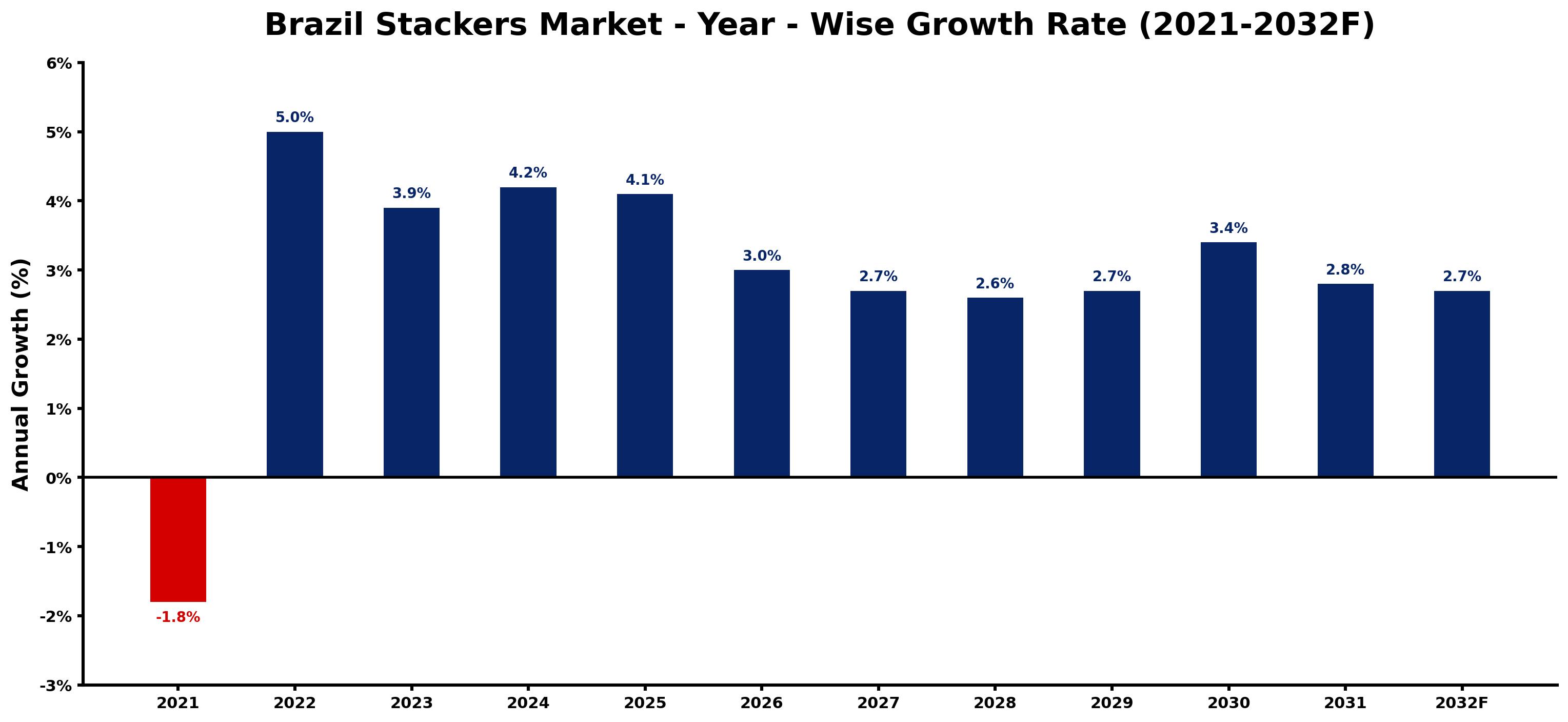
The table below presents the year‑wise growth rates along with the key drivers influencing the market
| Year | Growth Rate | Major Drivers |
| 2021 | -1.8% | Expansion of transportation and logistics networks |
| 2022 | 5.0% | Expansion of commercial construction activities |
| 2023 | 3.9% | Increasing industrial infrastructure investments |
| 2024 | 4.2% | Expansion of transportation and logistics networks |
| 2025 | 4.1% | Increasing adoption of advanced technologies |
| 2026 | 3.0% | Growing renewable energy integration projects |
| 2027 | 2.7% | Growing renewable energy integration projects |
| 2028 | 2.6% | Increasing industrial automation investments |
| 2029 | 2.7% | Rising electricity demand across industries |
| 2030 | 3.4% | Increasing industrial infrastructure investments |
| 2031 | 2.8% | Increasing adoption of advanced technologies |
| 2032 | 2.7% | Rapid growth in telecom and data center sectors |
Note - Market size estimations and growth projections presented in this report are based on 6Wresearch’s advanced forecasting approach, validated with industry datasets as of June 2026.
Brazil Stackers Market Synopsis
The Brazil Stackers Market is currently witnessing a pivotal transformation, largely driven by the rapid expansion of the logistics and warehouse sector. As e-commerce continues to flourish, the need for robust stacking solutions to facilitate efficient inventory management is becoming more pronounced.
In addition to this, companies are increasingly recognizing the importance of stackers for optimizing operational efficiency in their supply chains. The integration of advanced technologies and automation is further enhancing the appeal of stackers, making them essential assets for any modern warehouse or distribution center.
Brazil Stackers Market Key Takeaways
- The Brazil Stackers Market is positioned for steady growth due to the expansion of the e-commerce sector.
- Industrial automation and the necessity for efficient storage solutions are primary market drivers.
- The market faces infrastructure challenges that could impede growth and adoption.
- Government initiatives are supporting the advancement of safety standards and operational efficiency.
- Investment in skilled labor and training programs is critical for overcoming labor shortages in the sector.
Evaluation of Restraints in Brazil Stackers Market
Despite the positive outlook, the Brazil Stackers Market is constrained by certain infrastructural limitations. Inadequate logistics networks and insufficient warehouse space can significantly hinder the effectiveness and deployment of stackers. Additionally, economic uncertainties may delay investment decisions, limiting the market's growth potential. As companies contemplate the capital-intensive nature of stackers, they may defer purchases during periods of instability, which can adversely affect the market landscape.
Brazil Stackers Market Trends
Emerging trends in the Brazil Stackers Market highlight a notable shift towards automation and technology integration. Companies are increasingly investing in smart stackers equipped with advanced features such as IoT connectivity, which allows for real-time data monitoring and enhanced inventory management. Furthermore, sustainability considerations are pushing businesses to adopt energy-efficient stacker solutions, aligning with global efforts to minimize carbon footprints.
Brazil Stackers Market Opportunities
Significant growth opportunities exist within the Brazil Stackers Market, particularly in urban areas experiencing rapid industrialization. The demand for automated warehouse solutions is escalating, driven by a need for efficiency in logistics operations. Moreover, innovations in stacker technology, such as robotic stackers and AI-driven systems, present avenues for investment and growth, attracting businesses eager to enhance their operational capabilities.
Government Initiatives in the Brazil Stackers Market
Government policies aimed at bolstering the Brazil Stackers Market are centered around improving safety standards in material handling operations. Initiatives are being introduced to ensure compliance with equipment safety regulations while supporting training and certification programs for stacker operators. Furthermore, the government is keen on promoting research and development, encouraging innovations that enhance stacker design and functionality to improve overall industry efficiency.
Future Insights of the Brazil Stackers Market
Looking ahead to 2026-2032, the Brazil Stackers Market is expected to evolve significantly, driven by continued advancements in technology and growing industrial automation. As logistics operations expand and adapt to new consumer demands, stackers will increasingly become integral to efficient supply chain management. Investment in infrastructure and workforce training will also play a crucial role in shaping the market's trajectory, fostering an environment ripe for innovation and growth.
Brazil Stackers Market Latest Developments (May 2025 - June 2026)
In recent months, the Brazil Stackers Market has seen an uptick in the adoption of automated stackers as companies seek to enhance efficiency in their operations. The push towards integrating advanced technology in stacker designs is gaining momentum, with various stakeholders exploring new partnerships to expedite product development. Simultaneously, efforts to improve training programs for stacker operators are being implemented, ensuring a skilled workforce that can effectively manage modern material handling systems.
Brazil Stackers Market - Key Attractiveness of the Report
- 10 Years of Market Numbers
- Historical Data Starting from 2022 to 2025
- Base Year: 2025
- Forecast Data until 2032
- Key Performance Indicators Impacting the Market
- Major Upcoming Developments and Projects
Key Highlights of the Report:
- Brazil Stackers Market Outlook
- Market Size of Brazil Stackers Market, 2025
- Forecast of Brazil Stackers Market, 2032
- Historical Data and Forecast of Brazil Stackers Revenues & Volume for the Period 2022-2032F
- Brazil Stackers Market Trend Evolution
- Brazil Stackers Market Drivers and Challenges
- Brazil Stackers Price Trends
- Brazil Stackers Porter's Five Forces
- Brazil Stackers Industry Life Cycle
- Historical Data and Forecast of Brazil Stackers Market Revenues & Volume By Type for the Period 2022-2032F
- Historical Data and Forecast of Brazil Stackers Market Revenues & Volume By Electric for the Period 2022-2032F
- Historical Data and Forecast of Brazil Stackers Market Revenues & Volume By Manual/Hydraulic for the Period 2022-2032F
- Historical Data and Forecast of Brazil Stackers Market Revenues & Volume By Semi-Electric for the Period 2022-2032F
- Historical Data and Forecast of Brazil Stackers Market Revenues & Volume By End-User for the Period 2022-2032F
- Historical Data and Forecast of Brazil Stackers Market Revenues & Volume By Retail & Wholesale for the Period 2022-2032F
- Historical Data and Forecast of Brazil Stackers Market Revenues & Volume By Logistics for the Period 2022-2032F
- Historical Data and Forecast of Brazil Stackers Market Revenues & Volume By Automobile for the Period 2022-2032F
- Historical Data and Forecast of Brazil Stackers Market Revenues & Volume By Food & Beverages for the Period 2022-2032F
- Historical Data and Forecast of Brazil Stackers Market Revenues & Volume By Others for the Period 2022-2032F
- Brazil Stackers Import Export Trade Statistics
- Market Opportunity Assessment By Type
- Market Opportunity Assessment By End-User
- Brazil Stackers Top Companies Market Share
- Brazil Stackers Competitive Benchmarking By Technical and Operational Parameters
- Brazil Stackers Company Profiles
- Brazil Stackers Key Strategic Recommendations






































