Brazil Windows Market Summary
The brazil windows market was estimated at USD 331 Million in 2025 and is projected to reach USD 396 Million by 2032, growing at a CAGR of 3.0% from 2026 to 2032.
Brazil Windows Market Year-wise Growth Rate and Key Drivers
This graph highlights how the Brazil Windows Market has steadily grown over the past five years, supported by major growth factors.
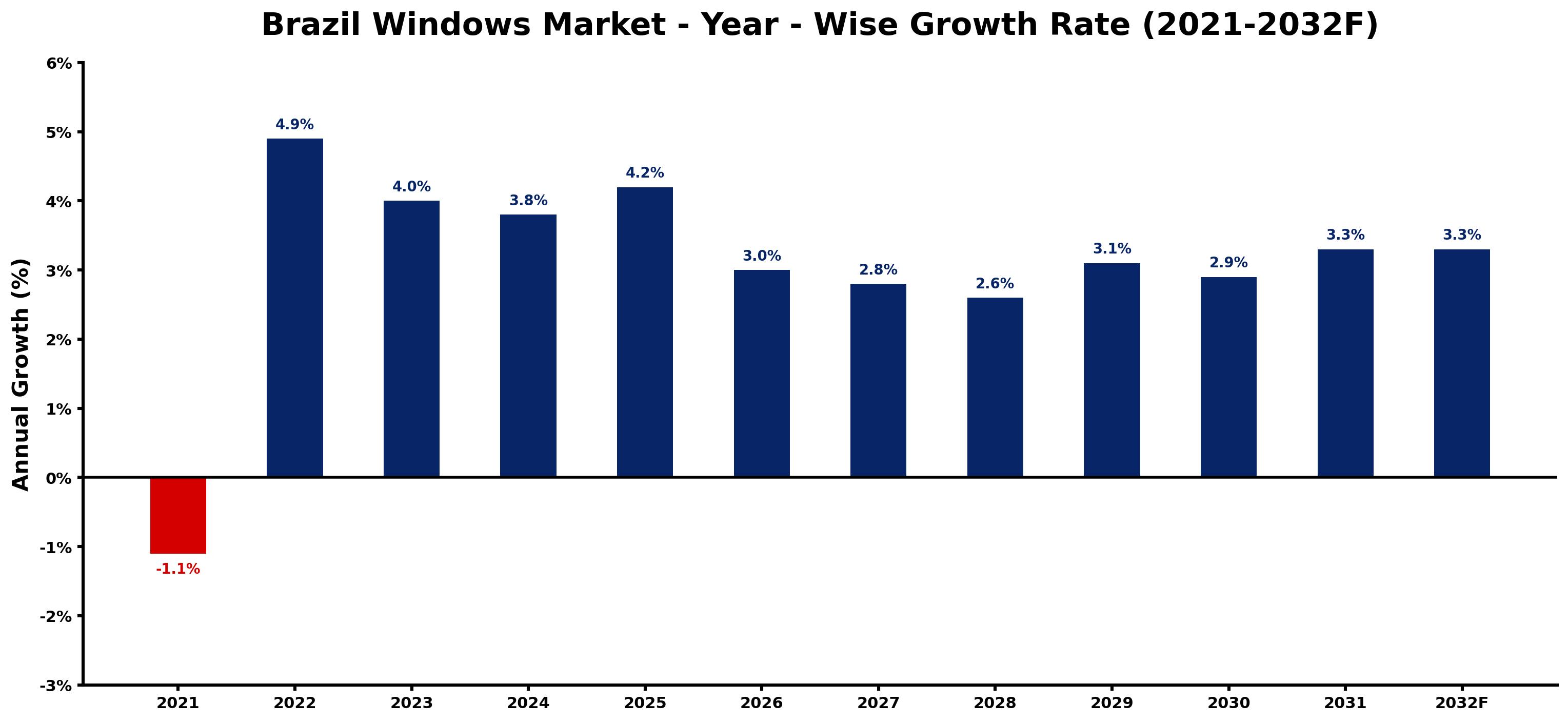
The table below presents the year wise growth rates along with the key drivers influencing the market
| Year | Growth Rate | Major Drivers |
| 2021 | -1.1% | Evolving energy efficiency standards compelled homeowners to delay window upgrades, reducing market demand in 2021. |
| 2022 | 4.9% | Increased urbanization in Brazil leads to higher demand for energy-efficient window solutions. |
| 2023 | 4.0% | Local manufacturers embrace innovative technologies for enhanced product durability and aesthetics. |
| 2024 | 3.8% | Expanding middle-class population drives investments in residential building refurbishments. |
| 2025 | 4.2% | Emerging trends favor smart windows, integrating technology for energy management. |
| 2026 | 3.0% | Investment in green building certifications enhances market appeal for eco-friendly windows. |
| 2027 | 2.8% | Market players focus on sustainability, aligning production processes with environmental standards. |
| 2028 | 2.6% | Rising awareness about climate change impacts consumer preferences towards energy-efficient options. |
| 2029 | 3.1% | Competitive landscape shifts as international companies increase presence in Brazilian market. |
| 2030 | 2.9% | Technological collaborations among firms enhance product offerings and improve supply chain efficiency. |
| 2031 | 3.3% | Ongoing architectural innovations create niche markets for specialized window designs. |
| 2032 | 3.3% | Economic stability and foreign investments further fuel growth across the construction sector. |
Note - Market size estimations and growth projections presented in this report are based on 6Wresearch's advanced forecasting approach, validated with industry datasets as of June 2026.
Brazil Windows Market Synopsis
The Brazil Windows Market is projected to reach 3.0% and witness significant growth during the forecast period (2026-2032). This evolution is largely attributable to the robust expansion of construction activities and a marked increase in urbanization across the nation. The growing inclination towards energy-efficient and aesthetically pleasing windows aligns with global trends and local consumer preferences, setting the stage for a dynamic landscape in which manufacturers are continuously innovating.
Brazil Windows Market Growth Drivers
In the Brazil Windows Market, several factors are catalyzing growth. The rapid increase in construction activities in urban areas significantly contributes to this expanding sector. A few key drivers include:
- The surge in residential and commercial construction projects fosters a higher demand for windows, driven by new architectural styles and a shift towards modern designs.
- Rising urbanization encourages developers to invest in multi-family units and office spaces, further amplifying the need for reliable window solutions.
- A heightened awareness of energy conservation among consumers is leading to an increased demand for energy-efficient windows that reduce heating and cooling costs.
- Growing consumer preferences for customizable and aesthetically pleasing window designs motivate manufacturers to innovate and offer diverse product lines.
- The Brazilian government's initiatives promoting sustainable building practices enhance market growth by encouraging eco-friendly product adoption, including energy-efficient windows.
Brazil Windows Market Challenges and Restraints
Despite the positive outlook for the Brazil Windows Market, various challenges persist that may impact growth trajectories. Key challenges include:
- The fluctuation in raw material prices can significantly affect production costs, making it difficult for manufacturers to maintain pricing strategies while ensuring quality.
- Compliance with stringent energy efficiency standards requires continued investment in technology and innovation, presenting a considerable barrier for smaller players.
- Complex regulatory frameworks surrounding building codes and materials can create hurdles for market entry and ongoing operations.
- Balancing affordability with quality remains a significant challenge, as consumers increasingly seek cost-effective solutions without compromising on performance.
- The competitive landscape is intensifying as both domestic and international manufacturers vie for market share, necessitating strategic positioning and differentiation.
Brazil Windows Market Government Investment and Initiatives
The Brazilian government has played a pivotal role in shaping the windows market by implementing policies aimed at fostering sustainable development. Key initiatives include:
- Incentives for energy-efficient building projects, such as tax reductions and grants, encourage both consumers and manufacturers to prioritize energy conservation in their choices.
- Regulatory frameworks that mandate energy efficiency standards for new constructions, driving demand for compliant window solutions.
- Public investment in infrastructure development, including housing initiatives that boost the construction sector, thereby creating additional opportunities for window suppliers.
- Support for research and development in sustainable materials, promoting innovation within the windows market and encouraging manufacturers to adopt eco-friendly practices.
- Collaborations between government bodies and industry associations focus on educating the public and businesses regarding the benefits of energy-efficient windows, creating a more informed market.
Brazil Windows Market Latest Developments (May 2025 - June 2026)
Recent developments in the Brazil Windows Market reflect a trend towards sustainability and technological innovation. Over the period from May 2025 to June 2026, the market has seen an increase in initiatives focused on integrating smart technology into window designs. This includes advancements in automated systems that enhance energy efficiency and user comfort.
Moreover, industry stakeholders are increasingly collaborating to develop new materials that not only comply with stringent energy standards but also improve durability and aesthetic appeal. The market is also witnessing a heightened emphasis on consumer education regarding the benefits of energy-efficient windows, spurred by government campaigns aimed at promoting sustainable building practices across Brazil.
Brazil Windows Market - Key Attractiveness of the Report
- 10 Years of Market Numbers
- Historical Data Starting from 2022 to 2025
- Base Year: 2025
- Forecast Data until 2032
- Key Performance Indicators Impacting the Market
- Major Upcoming Developments and Projects
Key Highlights of the Report:
- Brazil Windows Market Outlook
- Market Size of Brazil Windows Market, 2025
- Forecast of Brazil Windows Market, 2032
- Historical Data and Forecast of Brazil Windows Revenues & Volume for the Period 2022-2032F
- Brazil Windows Market Trend Evolution
- Brazil Windows Market Drivers and Challenges
- Brazil Windows Price Trends
- Brazil Windows Porter's Five Forces
- Brazil Windows Industry Life Cycle
- Historical Data and Forecast of Brazil Windows Market Revenues & Volume By Material for the Period 2022-2032F
- Historical Data and Forecast of Brazil Windows Market Revenues & Volume By uPVC for the Period 2022-2032F
- Historical Data and Forecast of Brazil Windows Market Revenues & Volume By Wood for the Period 2022-2032F
- Historical Data and Forecast of Brazil Windows Market Revenues & Volume By Metal for the Period 2022-2032F
- Historical Data and Forecast of Brazil Windows Market Revenues & Volume By Others for the Period 2022-2032F
- Historical Data and Forecast of Brazil Windows Market Revenues & Volume By Application for the Period 2022-2032F
- Historical Data and Forecast of Brazil Windows Market Revenues & Volume By Residential for the Period 2022-2032F
- Historical Data and Forecast of Brazil Windows Market Revenues & Volume By Commercial for the Period 2022-2032F
- Brazil Windows Import Export Trade Statistics
- Market Opportunity Assessment By Material
- Market Opportunity Assessment By Application
- Brazil Windows Top Companies Market Share
- Brazil Windows Competitive Benchmarking By Technical and Operational Parameters
- Brazil Windows Company Profiles
- Brazil Windows Key Strategic Recommendations






































