Cambodia Air Traffic Control Market Size, Share & Growth Rate
The Cambodia Air Traffic Control Market was estimated at USD 1363 Million in 2025 and is projected to reach USD 2441 Million by 2032, growing at a CAGR of 8.7% from 2026 to 2032. This robust growth trajectory is underpinned by the increasing volume of air traffic in Cambodia, propelled by its strategic geographical location in Southeast Asia, which acts as a gateway for regional and international travel. Additionally, ongoing government investments aimed at modernizing infrastructure and upgrading air traffic control systems are set to enhance operational efficiency, thereby attracting more airlines and passengers.
Cambodia Air Traffic Control Market Year-wise Growth Rate and Key Drivers
This graph highlights how the Cambodia Air Traffic Control Market has steadily grown over the years, supported by major growth factors.
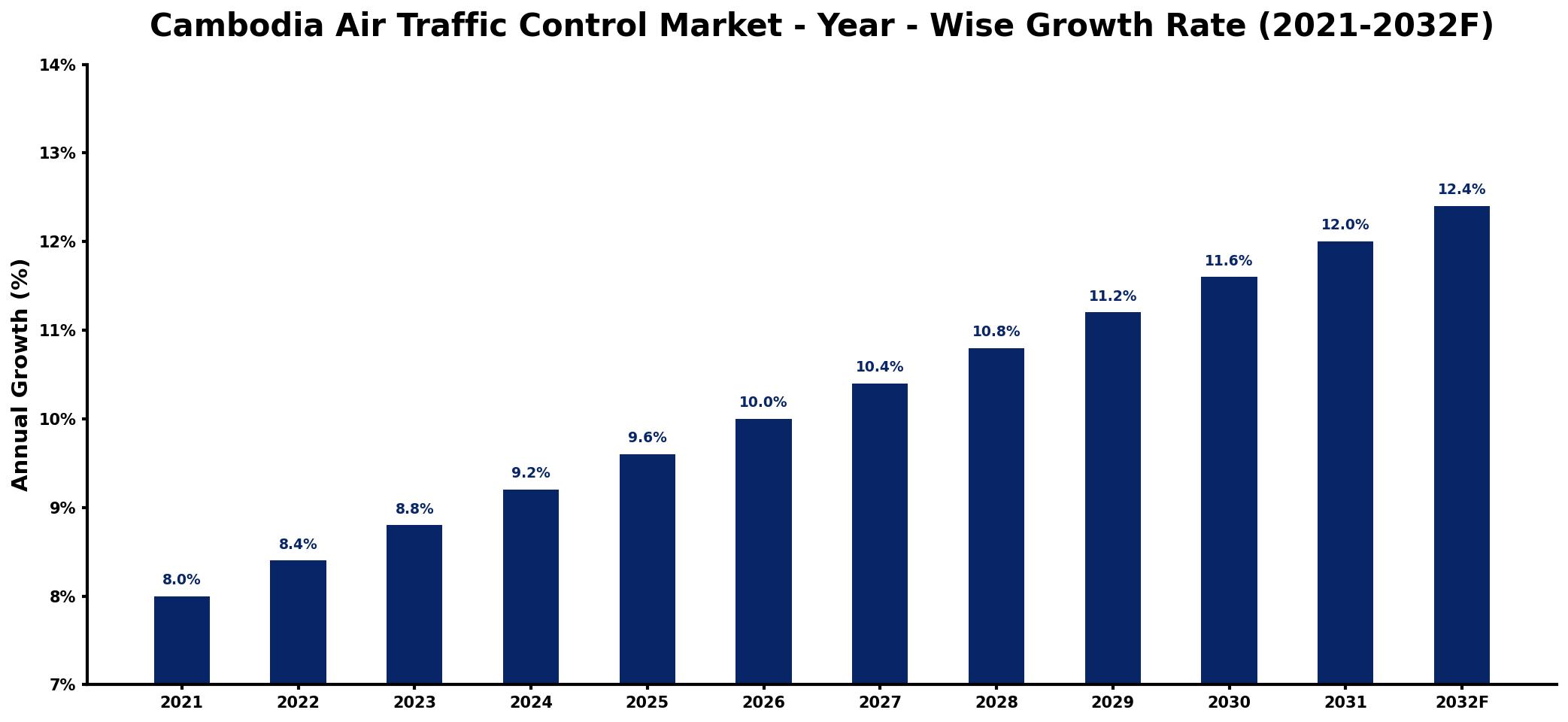
The table below presents the year‑wise growth rates along with the key drivers influencing the market
| Year | Growth Rate | Major Drivers |
| 2021 | 8.0% | Rising tourism boosting flight demand |
| 2022 | 8.4% | Increased foreign investment in infrastructure |
| 2023 | 8.8% | increased overall sector activity |
| 2024 | 9.2% | Growing cargo transportation requirements |
| 2025 | 9.6% | Government initiatives supporting aviation growth |
| 2026 | 10.0% | Advancements in technology adoption |
| 2027 | 10.4% | Strengthening international partnerships emerging |
| 2028 | 10.8% | Enhanced safety regulations implementation |
| 2029 | 11.2% | rising infrastructure development spending |
| 2030 | 11.6% | rising demand from electronics |
| 2031 | 12.0% | Increased public-private partnerships forming |
| 2032 | 12.4% | improved processing technologies adoption |
Note: Market size estimations and growth projections presented in this report are based on 6Wresearch's proprietary forecasting methodology, utilizing the latest available industry data, government publications, and primary research inputs.
Cambodia Air Traffic Control Market Synopsis
The Cambodia Air Traffic Control market has gained significant momentum in recent years, driven by a burgeoning aviation sector. As air traffic volumes continue to rise, the market is set to transition into a more technologically advanced era, embracing automation and improved safety protocols. This evolution reflects a broader commitment to aligning with international standards in air traffic management.
Looking forward, the market is poised for continuous expansion. With increasing international tourism and business travel, demand for sophisticated air traffic control solutions is expected to escalate. The focus on integrating advanced navigation systems and enhancing communication among stakeholders signifies the ongoing transformation of Cambodias air traffic landscape.
Cambodia Air Traffic Control Market Key Takeaways
- The market is set to grow at a CAGR of 8.7% from 2026 to 2032, reflecting robust demand for air traffic services.
- Government investments in infrastructure modernization are pivotal for market growth.
- Technological advancements, including automation and satellite navigation, are reshaping operational practices.
- Enhanced safety measures and training programs for air traffic controllers are essential for compliance with international standards.
- Collaborative efforts among airlines, regulators, and service providers will drive efficient airspace management.
Evaluation of Restraints in Cambodia Air Traffic Control Market
Despite the positive growth outlook, the Cambodia Air Traffic Control market faces several constraints. One major challenge is the limited airspace capacity, which has become increasingly strained due to the rapid rise in air traffic. Outdated infrastructure further complicates efficient airspace management, leading to congestion and potential safety risks. Additionally, there is a notable shortage of skilled air traffic controllers, highlighting the need for ongoing training and capacity-building initiatives. These factors necessitate strategic investments to modernize systems and enhance workforce capabilities, ensuring safety and efficiency in air traffic operations.
Cambodia Air Traffic Control Market Trends
The current trends in the Cambodia Air Traffic Control market are significantly shaped by technological advancements and a focus on operational efficiency. The adoption of automation tools and artificial intelligence is becoming increasingly common, allowing for better resource allocation and reduced human error. Furthermore, the introduction of remote tower systems is providing innovative solutions for managing air traffic from afar, enabling airports to optimize operational capacity. These trends underscore a commitment to modernizing air traffic control practices while aligning with global safety standards.
Cambodia Air Traffic Control Market Opportunities
Significant investment opportunities exist within the Cambodia Air Traffic Control market, particularly in the modernization of air traffic management systems. Stakeholders can explore partnerships with governmental bodies to implement advanced radar technologies and communication systems. There is also a growing demand for professional development programs aimed at training air traffic controllers, which presents an opportunity for educational institutions and training centers. By tapping into these avenues, investors can contribute to enhancing aviation safety and operational efficiency, ultimately supporting the burgeoning travel sector in Cambodia.
Government Initiatives in the Cambodia Air Traffic Control Market
The Cambodian government is actively engaged in regulatory efforts to bolster the air traffic control market. Under the oversight of the State Secretariat of Civil Aviation, various initiatives have been implemented to modernize existing infrastructure and enhance service delivery. This includes collaboration with international organizations to align with best practices and global standards in aviation safety. Furthermore, public spending on the upgrade of air traffic control systems and training programs reflects a robust commitment to improving the aviation framework and fostering industry growth.
Future Insights of the Cambodia Air Traffic Control Market
Looking ahead to 2026-2032, the Cambodia Air Traffic Control market is poised for sustained expansion driven by several factors. Continued growth in air traffic, along with strategic investments in infrastructure, will enhance the efficiency and safety of airspace management. The focus on integrating state-of-the-art technologies will further support the evolving demands of the aviation industry. Additionally, an emphasis on international compliance and collaboration among key stakeholders will be critical in fostering a safe and efficient air travel environment in Cambodia.
Cambodia Air Traffic Control Market Latest Developments (2025 - 2026)
Recent developments in the Cambodia Air Traffic Control market indicate a marked shift toward modernization and enhanced operational efficiency. The implementation of new communication technologies has improved coordination between air traffic control authorities and airlines. Concurrently, pilot programs focusing on advanced training for air traffic controllers are being rolled out, aiming to address the skills gap in the sector. These initiatives reflect a proactive approach to maintaining safety and efficiency as air traffic continues to grow.
Cambodia Air Traffic Control Market - Key Attractiveness of the Report
- 10 Years of Market Numbers
- Historical Data Starting from 2022 to 2025
- Base Year: 2025
- Forecast Data until 2032
- Key Performance Indicators Impacting the Market
- Major Upcoming Developments and Projects
Key Highlights of the Report:
- Cambodia Air Traffic Control Market Outlook
- Market Size of Cambodia Air Traffic Control Market, 2025
- Forecast of Cambodia Air Traffic Control Market, 2032
- Historical Data and Forecast of Cambodia Air Traffic Control Revenues & Volume for the Period 2022-2032F
- Cambodia Air Traffic Control Market Trend Evolution
- Cambodia Air Traffic Control Market Drivers and Challenges
- Cambodia Air Traffic Control Price Trends
- Cambodia Air Traffic Control Porter's Five Forces
- Cambodia Air Traffic Control Industry Life Cycle
- Historical Data and Forecast of Cambodia Air Traffic Control Market Revenues & Volume By Airspace for the Period 2022-2032F
- Historical Data and Forecast of Cambodia Air Traffic Control Market Revenues & Volume By Air Route Traffic Control Centers for the Period 2022-2032F
- Historical Data and Forecast of Cambodia Air Traffic Control Market Revenues & Volume By Terminal Radar Approach Control for the Period 2022-2032F
- Historical Data and Forecast of Cambodia Air Traffic Control Market Revenues & Volume By Air Traffic Control Tower for the Period 2022-2032F
- Historical Data and Forecast of Cambodia Air Traffic Control Market Revenues & Volume By Remote Tower for the Period 2022-2032F
- Historical Data and Forecast of Cambodia Air Traffic Control Market Revenues & Volume By Application for the Period 2022-2032F
- Historical Data and Forecast of Cambodia Air Traffic Control Market Revenues & Volume By Communication for the Period 2022-2032F
- Historical Data and Forecast of Cambodia Air Traffic Control Market Revenues & Volume By Navigation for the Period 2022-2032F
- Historical Data and Forecast of Cambodia Air Traffic Control Market Revenues & Volume By Surveillance for the Period 2022-2032F
- Historical Data and Forecast of Cambodia Air Traffic Control Market Revenues & Volume By Automation for the Period 2022-2032F
- Historical Data and Forecast of Cambodia Air Traffic Control Market Revenues & Volume By Offerings for the Period 2022-2032F
- Historical Data and Forecast of Cambodia Air Traffic Control Market Revenues & Volume By Hardware for the Period 2022-2032F
- Historical Data and Forecast of Cambodia Air Traffic Control Market Revenues & Volume By Software & Solutions for the Period 2022-2032F
- Historical Data and Forecast of Cambodia Air Traffic Control Market Revenues & Volume By Services for the Period 2022-2032F
- Historical Data and Forecast of Cambodia Air Traffic Control Market Revenues & Volume By Airport Size for the Period 2022-2032F
- Historical Data and Forecast of Cambodia Air Traffic Control Market Revenues & Volume By Large for the Period 2022-2032F
- Historical Data and Forecast of Cambodia Air Traffic Control Market Revenues & Volume By Medium for the Period 2022-2032F
- Historical Data and Forecast of Cambodia Air Traffic Control Market Revenues & Volume By Small for the Period 2022-2032F
- Historical Data and Forecast of Cambodia Air Traffic Control Market Revenues & Volume By Sector for the Period 2022-2032F
- Historical Data and Forecast of Cambodia Air Traffic Control Market Revenues & Volume By Commercial for the Period 2022-2032F
- Historical Data and Forecast of Cambodia Air Traffic Control Market Revenues & Volume By Military & Defense for the Period 2022-2032F
- Cambodia Air Traffic Control Import Export Trade Statistics
- Market Opportunity Assessment By Airspace
- Market Opportunity Assessment By Application
- Market Opportunity Assessment By Offerings
- Market Opportunity Assessment By Airport Size
- Market Opportunity Assessment By Sector
- Cambodia Air Traffic Control Top Companies Market Share
- Cambodia Air Traffic Control Competitive Benchmarking By Technical and Operational Parameters
- Cambodia Air Traffic Control Company Profiles
- Cambodia Air Traffic Control Key Strategic Recommendations






































