Cambodia Automotive Drive Shaft Market Size, Share & Growth Rate
The Cambodia Automotive Drive Shaft Market was estimated at USD 385 Million in 2025 and is projected to reach USD 507 Million by 2032, growing at a CAGR of 4.0% from 2026 to 2032. This growth trajectory is fueled by the burgeoning demand for passenger and commercial vehicles, particularly amid infrastructure development and urbanization initiatives. The increasing preference for SUVs and pickup trucks also indicates a shift in consumer behavior, further contributing to the drive shaft market's expansion.
Cambodia Automotive Drive Shaft Market Year-wise Growth Rate and Key Drivers
This graph highlights how the Cambodia Automotive Drive Shaft Market has steadily grown over the years, supported by major growth factors.
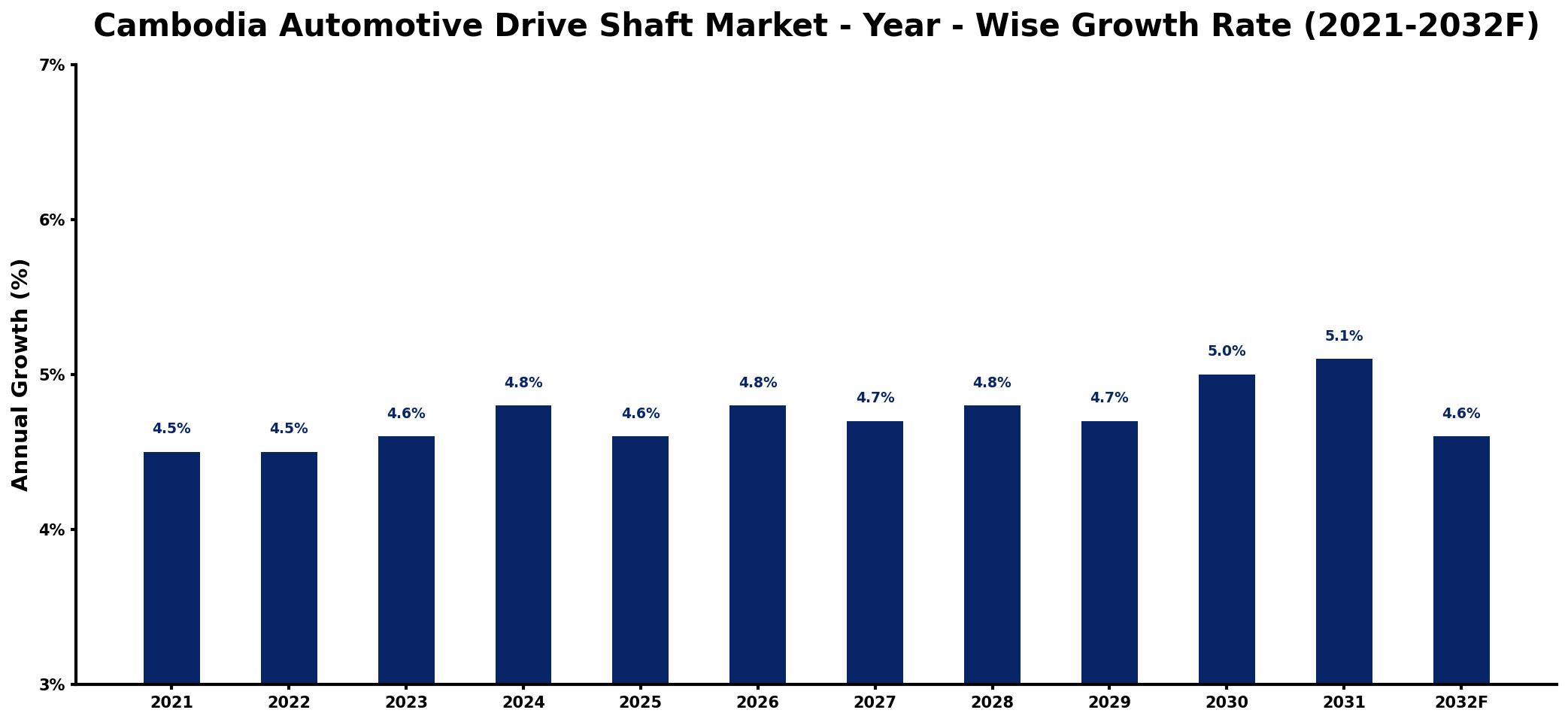
The table below presents the year‑wise growth rates along with the key drivers influencing the market
| Year | Growth Rate | Major Drivers |
| 2021 | 4.5% | Rising vehicle ownership rates |
| 2022 | 4.5% | Increased infrastructure development projects |
| 2023 | 4.6% | Growing domestic manufacturing capabilities |
| 2024 | 4.8% | Expansion of electric vehicle market |
| 2025 | 4.6% | Increasing foreign investment influx |
| 2026 | 4.8% | Surge in logistics sector growth |
| 2027 | 4.7% | Boost in local supplier networks |
| 2028 | 4.8% | Strengthened export opportunities emerging |
| 2029 | 4.7% | Heightened consumer spending confidence |
| 2030 | 5.0% | Advancements in technology adoption |
| 2031 | 5.1% | Growing demand for performance upgrades |
| 2032 | 4.6% | improved processing technologies adoption |
Note: Market size estimations and growth projections presented in this report are based on 6Wresearch's proprietary forecasting methodology, utilizing the latest available industry data, government publications, and primary research inputs.
Cambodia Automotive Drive Shaft Market Synopsis
The Cambodia Automotive Drive Shaft Market is on an upward trajectory, driven primarily by the rapid growth of the automotive sector in response to rising consumer disposable incomes. This growth is also reflective of broader economic trends that favor vehicle ownership, particularly for larger, more capable models like SUVs and pickups.
With notable technological advancements, manufacturers are increasingly incorporating lightweight materials into drive shafts, enhancing durability and performance. However, challenges such as limited local manufacturing capabilities and a shortage of skilled labor persist, which could hinder market growth if not addressed promptly.
Cambodia Automotive Drive Shaft Market Key Takeaways
- Passenger vehicles dominate the market, driven by a preference for larger models.
- Technological innovations in materials are enhancing the durability and efficiency of drive shafts.
- Infrastructure development initiatives are creating significant demand for commercial vehicles.
- Government policies are focused on boosting local manufacturing and research in the automotive sector.
- The market faces challenges from limited consumer awareness and the prevalence of low-quality products.
Evaluation of Restraints in Cambodia Automotive Drive Shaft Market
Despite its growth potential, the Cambodia Automotive Drive Shaft Market encounters significant restraints. One major issue is the lack of skilled labor, which hampers manufacturing capabilities and product quality. Furthermore, the market struggles with consumer awareness regarding the importance of drive shafts in vehicle safety and performance. Compounding these challenges is the presence of counterfeit products, which erode trust in the market. Additionally, with no standardized regulations for automotive parts, the risk of subpar products entering the market remains high, further complicating the landscape for legitimate manufacturers.
Cambodia Automotive Drive Shaft Market Trends
Emerging trends in the Cambodia Automotive Drive Shaft Market highlight a shift towards vehicles that are both fuel-efficient and environmentally friendly. As manufacturers strive to meet consumer demand for high-performance vehicles, there is an emphasis on developing advanced drive shaft technologies that not only improve efficiency but also reduce vehicle weight. Moreover, the increasing need for reliable transportation solutions in commercial sectors, including construction and logistics, is driving demand for robust drive shafts capable of handling heavy loads.
Cambodia Automotive Drive Shaft Market Opportunities
Investors and manufacturers have a wealth of opportunities within the Cambodia Automotive Drive Shaft Market. The ongoing growth of the automotive industry presents a lucrative environment for developing partnerships with local manufacturers. Additionally, investment in local production facilities can help to mitigate import dependencies while capitalizing on the government's initiatives aimed at enhancing the automotive sector. By focusing on innovative product development and high-quality standards, industry players can seize the expanding demand for reliable automotive components.
Government Initiatives in the Cambodia Automotive Drive Shaft Market
The Cambodian government has established several policies to bolster the automotive drive shaft market, including tax incentives for local manufacturers and import tariffs designed to encourage domestic production. These initiatives aim to foster a competitive automotive landscape while improving vehicle quality through stricter regulations on emissions and safety standards. Furthermore, the government is promoting research and development projects within the automotive sector to stimulate innovation and attract investment.
Future Insights of the Cambodia Automotive Drive Shaft Market
Looking ahead to 2026-2032, the Cambodia Automotive Drive Shaft Market is projected to sustain its growth momentum. Rising urbanization, increased disposable income, and ongoing infrastructure projects will support the continuous demand for automobiles. As the automotive industry pivots towards energy-efficient solutions, manufacturers are likely to prioritize lightweight and durable drive shaft technologies to meet evolving consumer preferences. This alignment with global trends will position the market favorably for future expansion, underscoring its potential for investors and stakeholders alike.
Cambodia Automotive Drive Shaft Market Latest Developments (2025 - 2026)
Recent developments in the Cambodia Automotive Drive Shaft Market indicate a burgeoning interest in sustainable manufacturing practices and product innovation. Manufacturers are increasingly investing in research to enhance the performance of drive shafts, focusing on material improvements and design efficiency. Moreover, collaboration between local businesses and international firms is expected to foster knowledge transfer and boost local production capabilities. The evolving regulatory landscape is also prompting industry players to align their operations with safety and environmental standards.
Cambodia Automotive Drive Shaft Market - Key Attractiveness of the Report
- 10 Years of Market Numbers
- Historical Data Starting from 2022 to 2025
- Base Year: 2025
- Forecast Data until 2032
- Key Performance Indicators Impacting the Market
- Major Upcoming Developments and Projects
Key Highlights of the Report:
- Cambodia Automotive Drive Shaft Market Outlook
- Market Size of Cambodia Automotive Drive Shaft Market, 2025
- Forecast of Cambodia Automotive Drive Shaft Market, 2032
- Historical Data and Forecast of Cambodia Automotive Drive Shaft Revenues & Volume for the Period 2022-2032F
- Cambodia Automotive Drive Shaft Market Trend Evolution
- Cambodia Automotive Drive Shaft Market Drivers and Challenges
- Cambodia Automotive Drive Shaft Price Trends
- Cambodia Automotive Drive Shaft Porter's Five Forces
- Cambodia Automotive Drive Shaft Industry Life Cycle
- Historical Data and Forecast of Cambodia Automotive Drive Shaft Market Revenues & Volume By Design Type for the Period 2022-2032F
- Historical Data and Forecast of Cambodia Automotive Drive Shaft Market Revenues & Volume By Hollow Shaft for the Period 2022-2032F
- Historical Data and Forecast of Cambodia Automotive Drive Shaft Market Revenues & Volume By Solid Shaft for the Period 2022-2032F
- Historical Data and Forecast of Cambodia Automotive Drive Shaft Market Revenues & Volume By Position Type for the Period 2022-2032F
- Historical Data and Forecast of Cambodia Automotive Drive Shaft Market Revenues & Volume By Rear Axle for the Period 2022-2032F
- Historical Data and Forecast of Cambodia Automotive Drive Shaft Market Revenues & Volume By Front Axle for the Period 2022-2032F
- Historical Data and Forecast of Cambodia Automotive Drive Shaft Market Revenues & Volume By Vehicle Type for the Period 2022-2032F
- Historical Data and Forecast of Cambodia Automotive Drive Shaft Market Revenues & Volume By Passenger Cars for the Period 2022-2032F
- Historical Data and Forecast of Cambodia Automotive Drive Shaft Market Revenues & Volume By Commercial Vehicles for the Period 2022-2032F
- Cambodia Automotive Drive Shaft Import Export Trade Statistics
- Market Opportunity Assessment By Design Type
- Market Opportunity Assessment By Position Type
- Market Opportunity Assessment By Vehicle Type
- Cambodia Automotive Drive Shaft Top Companies Market Share
- Cambodia Automotive Drive Shaft Competitive Benchmarking By Technical and Operational Parameters
- Cambodia Automotive Drive Shaft Company Profiles
- Cambodia Automotive Drive Shaft Key Strategic Recommendations






































