Cambodia Telecom Services Market Size, Share & Growth Rate
The Cambodia Telecom Services Market was estimated at USD 468 Million in 2025 and is projected to reach USD 620 Million by 2032, growing at a CAGR of 4.1% from 2026 to 2032. This growth trajectory is propelled by a notable surge in mobile phone penetration, coupled with rising internet usage driven by the popularity of social media and online gaming. As local operators expand their networks to meet consumer demand for faster connectivity, the market is positioned for significant advancement.
Cambodia Telecom Services Market Year-wise Growth Rate and Key Drivers
This graph highlights how the Cambodia Telecom Services Market has steadily grown over the years, supported by major growth factors.
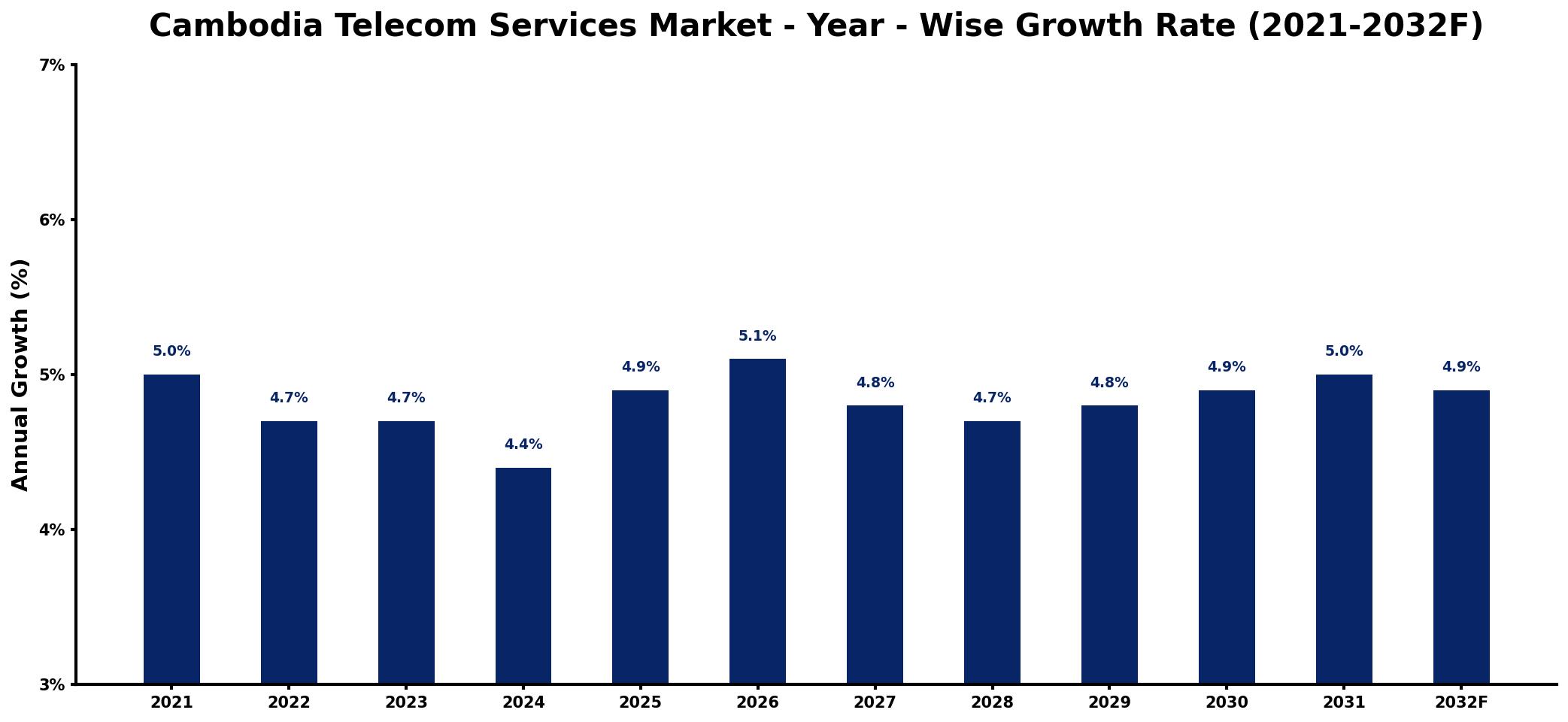
The table below presents the year‑wise growth rates along with the key drivers influencing the market
| Year | Growth Rate | Major Drivers |
| 2021 | 5.0% | Increased smartphone adoption rates |
| 2022 | 4.7% | Expansion of 4G network coverage |
| 2023 | 4.7% | Growing demand for digital content |
| 2024 | 4.4% | Rise in mobile payment usage |
| 2025 | 4.9% | Investments in fiber optic infrastructure |
| 2026 | 5.1% | Emergence of 5G technology rollout |
| 2027 | 4.8% | Boost in IoT device connectivity |
| 2028 | 4.7% | Growth in remote work solutions |
| 2029 | 4.8% | Increase in e-commerce transactions |
| 2030 | 4.9% | Adoption of smart home devices |
| 2031 | 5.0% | improved raw material availability |
| 2032 | 4.9% | rising end-use demand growth |
Note: Market size estimations and growth projections presented in this report are based on 6Wresearch's proprietary forecasting methodology, utilizing the latest available industry data, government publications, and primary research inputs.
Cambodia Telecom Services Market Synopsis
The strongest force currently shaping the Cambodia Telecom Services Market is the accelerating digital transformation across various sectors. This trend is characterized by an increasing reliance on mobile data services and high-speed internet, which is essential for both personal and business needs. As smartphone adoption rises, the demand for seamless connectivity continues to fuel growth.
Simultaneously, government initiatives aimed at enhancing digital infrastructure play a pivotal role in shaping the market. With a focus on expanding coverage to rural areas, these policies ensure that a broader segment of the population has access to reliable telecommunications services, thereby encouraging further investment and competition among service providers.
Cambodia Telecom Services Market Key Takeaways
- High growth potential driven by mobile penetration and increased internet usage.
- Government initiatives are enhancing infrastructure and service accessibility.
- Shift towards bundled services, including internet, TV, and voice offerings.
- Growing trends in 5G, IoT, and digital services present new opportunities.
- Partnerships between telecom and technology firms are becoming more prevalent.
Evaluation of Restraints in Cambodia Telecom Services Market
Despite the positive outlook, several restraints challenge the Cambodia Telecom Services Market. The competitive landscape is intense, with numerous players vying for market share, which can inhibit profitability. Additionally, rapid technological changes demand substantial investments in infrastructure to keep pace. The relatively small population limits purchasing power, complicating the profitability of certain service tiers. Furthermore, the geographic diversity of Cambodia, with its underdeveloped rural areas, poses logistical challenges for widespread network expansion, making reliable connectivity a persistent issue.
Cambodia Telecom Services Market Trends
Recent trends in the Cambodia Telecom Services Market include a strong shift towards digital innovation, notably the implementation of 5G technology and the Internet of Things (IoT). With consumers increasingly seeking high-speed internet and mobile data services, telecom companies are focusing on upgrading existing infrastructure to enhance service quality. Additionally, the emergence of bundled services is reshaping consumer expectations, as users prefer comprehensive solutions that encompass multiple services like internet, TV, and voice, all under one subscription.
Cambodia Telecom Services Market Opportunities
The market presents lucrative investment opportunities, particularly in expanding 4G networks and preparing for the rollout of 5G services. Addressing the connectivity needs of underserved rural areas will be crucial, as this segment represents a significant growth potential. Investments in digital services such as mobile payment platforms, e-commerce, and content creation are also gaining traction, particularly among the younger, tech-savvy demographic, who are eager for innovative solutions tailored to their evolving preferences.
Government Initiatives in the Cambodia Telecom Services Market
Regulatory oversight in the Cambodia Telecom Services Market is primarily under the purview of the Ministry of Posts and Telecommunications. The government has enacted several policies, including the Telecommunications Law, aimed at fostering competition while protecting consumer rights. Initiatives to promote access to telecommunications services in rural areas are critical, as is the establishment of the Telecommunications Regulator of Cambodia (TRC), which oversees licensing and compliance. Overall, government policies are designed to support a competitive environment conducive to investment and innovation.
Future Insights of the Cambodia Telecom Services Market
Looking ahead to 2026-2032, the Cambodia Telecom Services Market is poised for sustained growth. The increasing penetration of smartphones and escalating demand for mobile internet will drive investments in both existing and next-generation network technologies. The ongoing popularity of digital services, particularly in mobile payments and e-commerce, will further amplify demand for telecom services. However, industry stakeholders will need to navigate regulatory complexities and address cybersecurity threats to maintain a trajectory of innovation and customer satisfaction.
Cambodia Telecom Services Market Latest Developments (2025 - 2026)
In recent months, the Cambodia Telecom Services Market has seen advancements in network infrastructure, with significant efforts directed towards expanding high-speed internet access across both urban and rural regions. Telecom companies are actively exploring partnerships with technology providers to enhance their service offerings, especially in the realm of value-added services. Additionally, regulatory updates have emerged focusing on enhancing consumer protections and ensuring fair competition, reflecting the government's commitment to fostering a robust telecom landscape.
Cambodia Telecom Services Market - Key Attractiveness of the Report
- 10 Years of Market Numbers
- Historical Data Starting from 2022 to 2025
- Base Year: 2025
- Forecast Data until 2032
- Key Performance Indicators Impacting the Market
- Major Upcoming Developments and Projects
Key Highlights of the Report:
- Cambodia Telecom Services Market Outlook
- Market Size of Cambodia Telecom Services Market, 2025
- Forecast of Cambodia Telecom Services Market, 2032
- Historical Data and Forecast of Cambodia Telecom Services Revenues & Volume for the Period 2022-2032F
- Cambodia Telecom Services Market Trend Evolution
- Cambodia Telecom Services Market Drivers and Challenges
- Cambodia Telecom Services Price Trends
- Cambodia Telecom Services Porter's Five Forces
- Cambodia Telecom Services Industry Life Cycle
- Historical Data and Forecast of Cambodia Telecom Services Market Revenues & Volume By Service Type for the Period 2022-2032F
- Historical Data and Forecast of Cambodia Telecom Services Market Revenues & Volume By Fixed Voice Services for the Period 2022-2032F
- Historical Data and Forecast of Cambodia Telecom Services Market Revenues & Volume By Fixed Internet Access Services for the Period 2022-2032F
- Historical Data and Forecast of Cambodia Telecom Services Market Revenues & Volume By Mobile Voice Services for the Period 2022-2032F
- Historical Data and Forecast of Cambodia Telecom Services Market Revenues & Volume By Mobile Data Services for the Period 2022-2032F
- Historical Data and Forecast of Cambodia Telecom Services Market Revenues & Volume By Pay-TV Services for the Period 2022-2032F
- Historical Data and Forecast of Cambodia Telecom Services Market Revenues & Volume By Machine-to-Machine (Mobile IoT) Services for the Period 2022-2032F
- Historical Data and Forecast of Cambodia Telecom Services Market Revenues & Volume By Transmission for the Period 2022-2032F
- Historical Data and Forecast of Cambodia Telecom Services Market Revenues & Volume By Wireline for the Period 2022-2032F
- Historical Data and Forecast of Cambodia Telecom Services Market Revenues & Volume By Wireless for the Period 2022-2032F
- Historical Data and Forecast of Cambodia Telecom Services Market Revenues & Volume By End-use for the Period 2022-2032F
- Historical Data and Forecast of Cambodia Telecom Services Market Revenues & Volume By Consumer/Residential for the Period 2022-2032F
- Historical Data and Forecast of Cambodia Telecom Services Market Revenues & Volume By Business for the Period 2022-2032F
- Cambodia Telecom Services Import Export Trade Statistics
- Market Opportunity Assessment By Service Type
- Market Opportunity Assessment By Transmission
- Market Opportunity Assessment By End-use
- Cambodia Telecom Services Top Companies Market Share
- Cambodia Telecom Services Competitive Benchmarking By Technical and Operational Parameters
- Cambodia Telecom Services Company Profiles
- Cambodia Telecom Services Key Strategic Recommendations






































