Cameroon Converter Transformer Market: Top 5 Importing Countries and Market Competition (HHI) Analysis
Cameroon converter transformer import shipments in 2023 saw a shift in the market landscape, with top exporters being France, Germany, Italy, Lebanon, and the United Kingdom. The market concentration, as measured by the HHI, decreased from very high in 2022 to high in 2023. Despite a negative Compound Annual Growth Rate (CAGR) of -4.12%, the industry experienced a significant growth rate of 46.49%. This indicates a dynamic market with changing trends and opportunities for both exporters and importers in the converter transformer sector.
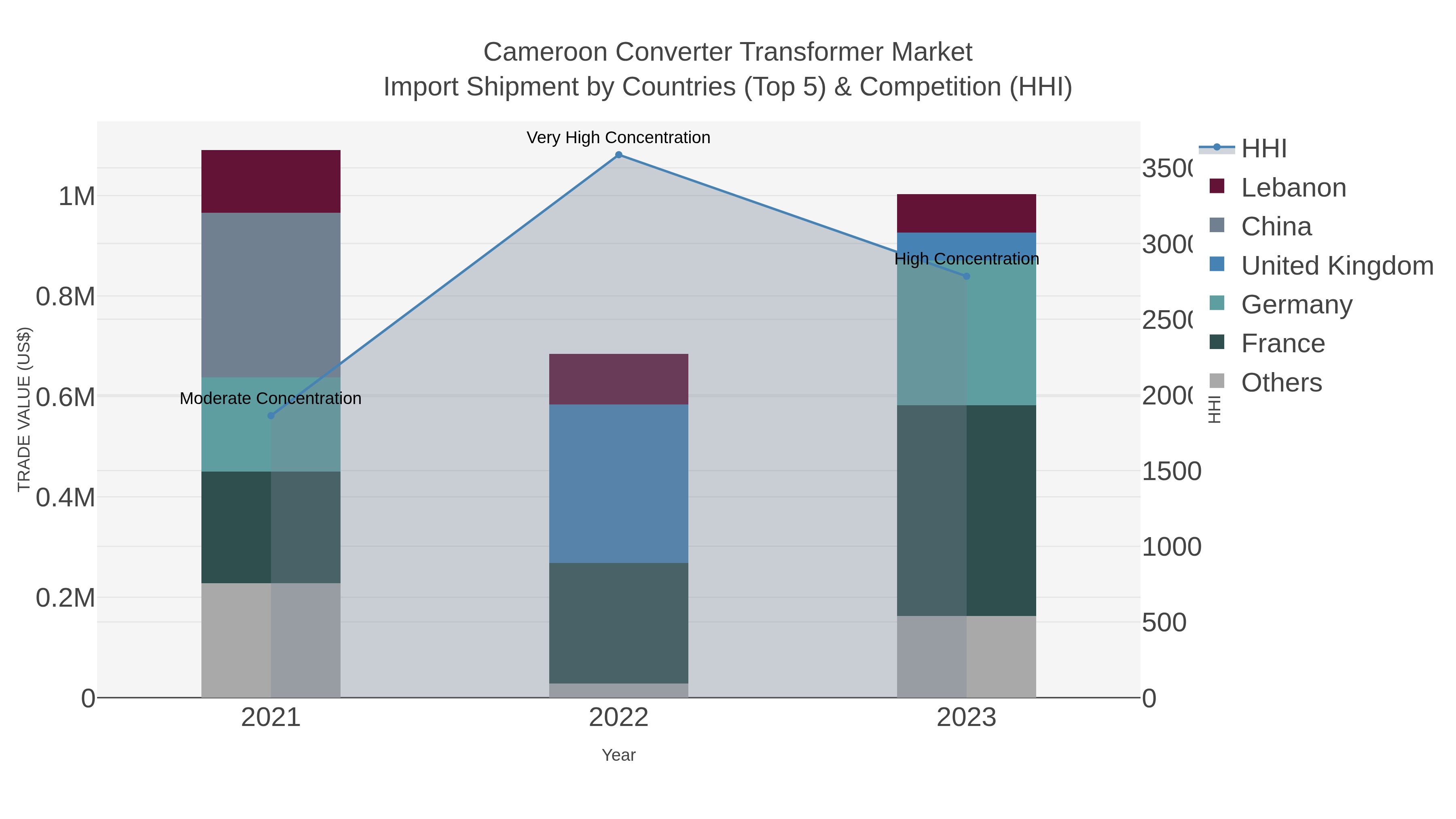
Cameroon Converter Transformer Market Overview
The converter transformer market in Cameroon is pivotal for accommodating the increasing demand for electrical energy and infrastructure development. Converter transformers, which are essential for converting alternating current (AC) to direct current (DC) and vice versa, support various applications including renewable energy integration, high-voltage direct current (HVDC) transmission systems, and industrial processes. The market is influenced by the country`s growing industrial sector and the need for reliable power distribution networks. Investments in infrastructure projects and the expansion of the electrical grid are expected to drive the demand for converter transformers.
Drivers of the market
The Cameroon converter transformer market is driven by the country`s increasing demand for reliable electrical infrastructure due to rapid urbanization and industrial growth. The expansion of the power grid and investments in renewable energy projects also contribute significantly to market growth. Additionally, government initiatives to improve energy efficiency and reduce power losses boost the adoption of advanced transformer technologies.
Challenges of the market
The Cameroon Converter Transformer Market faces several challenges including a reliance on imported components which can be costly and subject to international trade fluctuations. Additionally, there is a limited local manufacturing capacity which affects supply reliability and price stability. The market also struggles with a lack of skilled technicians to handle advanced transformer technology, which impacts installation and maintenance quality.
Government Policy of the market
In Cameroon, the converter transformer market is influenced by the government`s push to expand and modernize the country`s power infrastructure. Policies aimed at increasing access to electricity in rural and underserved areas are driving demand for advanced transformer technologies. The government has also introduced incentives for investments in renewable energy projects, which often require sophisticated transformer systems to integrate with the grid.
Key Highlights of the Report:
- Cameroon Converter Transformer Market Outlook
- Market Size of Cameroon Converter Transformer Market, 2024
- Forecast of Cameroon Converter Transformer Market, 2031
- Historical Data and Forecast of Cameroon Converter Transformer Revenues & Volume for the Period 2021-2031
- Cameroon Converter Transformer Market Trend Evolution
- Cameroon Converter Transformer Market Drivers and Challenges
- Cameroon Converter Transformer Price Trends
- Cameroon Converter Transformer Porter`s Five Forces
- Cameroon Converter Transformer Industry Life Cycle
- Historical Data and Forecast of Cameroon Converter Transformer Market Revenues & Volume By Configuration for the Period 2021-2031
- Historical Data and Forecast of Cameroon Converter Transformer Market Revenues & Volume By Back-to-Back for the Period 2021-2031
- Historical Data and Forecast of Cameroon Converter Transformer Market Revenues & Volume By Monopolar for the Period 2021-2031
- Historical Data and Forecast of Cameroon Converter Transformer Market Revenues & Volume By Bipolar for the Period 2021-2031
- Historical Data and Forecast of Cameroon Converter Transformer Market Revenues & Volume By Multi-terminal for the Period 2021-2031
- Historical Data and Forecast of Cameroon Converter Transformer Market Revenues & Volume By Application for the Period 2021-2031
- Historical Data and Forecast of Cameroon Converter Transformer Market Revenues & Volume By Windfarms for the Period 2021-2031
- Historical Data and Forecast of Cameroon Converter Transformer Market Revenues & Volume By Oil & Gas for the Period 2021-2031
- Historical Data and Forecast of Cameroon Converter Transformer Market Revenues & Volume By Grid interconnections for the Period 2021-2031
- Cameroon Converter Transformer Import Export Trade Statistics
- Market Opportunity Assessment By Configuration
- Market Opportunity Assessment By Application
- Cameroon Converter Transformer Top Companies Market Share
- Cameroon Converter Transformer Competitive Benchmarking By Technical and Operational Parameters
- Cameroon Converter Transformer Company Profiles
- Cameroon Converter Transformer Key Strategic Recommendations






































