Canada Packaged Water Market: Import Trend Analysis
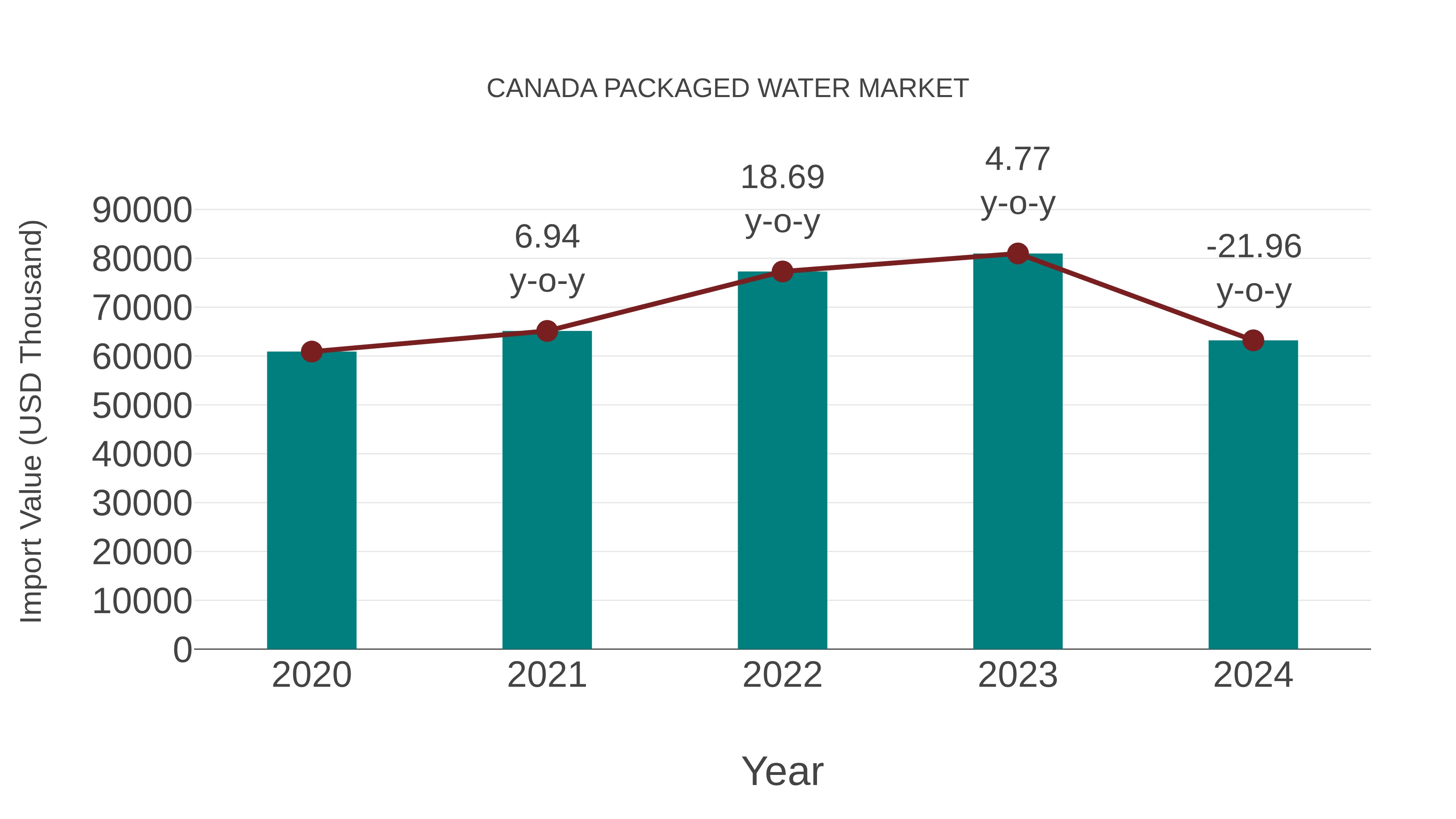
In the Canada packaged water market, the import trend experienced a decline from 2023 to 2024, with a growth rate of -21.96%. The compound annual growth rate (CAGR) for imports over the period 2020-2024 stood at 0.93%. This negative momentum in import growth could be attributed to shifts in consumer preferences, changing market dynamics, or alterations in trade policies impacting the market stability.
Canada Packaged water Market Overview
The Canada packaged water market is experiencing steady growth driven by factors such as increasing consumer awareness about the importance of hydration, convenience, and health consciousness. The market is witnessing a shift from traditional sugary beverages to healthier alternatives like packaged water. Key players in the market are focusing on innovative packaging, sustainable practices, and product differentiation to cater to evolving consumer preferences. Additionally, the growing trend of on-the-go consumption and the rise in demand for flavored and functional waters are further contributing to the market`s expansion. With a competitive landscape and stringent regulations on packaging and labeling, companies are investing in research and development to introduce new products and maintain market share in this dynamic and evolving industry.
Canada Packaged water Market Trends and Opportunities
The Canada Packaged water market is experiencing steady growth driven by increasing health consciousness among consumers and a growing preference for convenience. Key trends in the market include the rising demand for flavored and functional water, sustainable packaging solutions, and the emergence of premium and luxury water brands targeting niche segments. Opportunities for growth lie in expanding distribution networks to reach more remote areas, investing in innovative packaging technologies to reduce environmental impact, and leveraging e-commerce channels to cater to changing consumer preferences. With the increasing focus on hydration and wellness, there is potential for market players to differentiate their products through unique value propositions such as enhanced hydration benefits, natural ingredients, and eco-friendly packaging.
Canada Packaged water Market Challenges
In the Canada Packaged water market, some challenges include increasing competition from other beverage options like flavored waters and sports drinks, as well as environmental concerns related to plastic waste and sustainability. Consumer preferences are shifting towards healthier and more eco-friendly choices, leading to a demand for alternative packaging materials and production methods. Additionally, stringent regulations around water quality and labeling require companies to invest in maintaining high standards and compliance, which can increase operational costs. To stay competitive in this evolving market landscape, companies need to innovate by offering unique value propositions such as functional benefits, eco-friendly packaging, or enhanced convenience to appeal to the changing consumer preferences and address sustainability concerns.
Canada Packaged water Market Drivers
The Canada Packaged water market is primarily driven by the increasing health consciousness among consumers, leading to a growing preference for clean and safe drinking water. The convenience factor of packaged water, especially for on-the-go consumption, is another key driver as consumers seek portable hydration options. Additionally, concerns over the quality of tap water in certain regions and the convenience of single-serve packaging contribute to the market growth. The rise in outdoor activities, sports events, and the tourism industry further boosts the demand for packaged water in Canada. Sustainable packaging initiatives, such as the use of recyclable materials, are also becoming important drivers as consumers become more environmentally conscious and seek eco-friendly options in the packaged water market.
Canada Packaged water Market Government Policy
In Canada, the packaged water market is regulated by various government policies aimed at ensuring the safety and quality of bottled water products. The Canadian Food Inspection Agency (CFIA) is responsible for overseeing and enforcing regulations related to packaged water labeling, ingredient requirements, and manufacturing practices to protect consumer health. Health Canada also sets standards for the quality and safety of bottled water, including limits on contaminants such as bacteria, chemicals, and heavy metals. Additionally, provincial governments may have their own regulations in place to govern the production and sale of packaged water within their jurisdictions. Overall, government policies in Canada are focused on maintaining high standards of safety and quality in the packaged water market to safeguard public health and consumer confidence.
Canada Packaged water Market Future Outlook
The future outlook for the Canada Packaged water Market appears positive, driven by increasing consumer awareness about the importance of hydration and health consciousness. With a growing trend towards healthier beverage options and a shift away from sugary drinks, the demand for packaged water is expected to continue rising. Additionally, the convenience factor of on-the-go hydration and the emphasis on sustainability and eco-friendly packaging are likely to further propel market growth. Key players in the industry are likely to focus on product innovation, such as infused or flavored waters, to cater to evolving consumer preferences. Overall, the Canada Packaged water Market is anticipated to experience steady growth in the coming years, supported by changing consumer lifestyles and preferences.
Key Highlights of the Report:
- Canada Packaged water Market Outlook
- Market Size of Canada Packaged water Market, 2025
- Forecast of Canada Packaged water Market, 2032
- Historical Data and Forecast of Canada Packaged water Revenues & Volume for the Period 2022 - 2032F
- Canada Packaged water Market Trend Evolution
- Canada Packaged water Market Drivers and Challenges
- Canada Packaged water Price Trends
- Canada Packaged water Porter's Five Forces
- Canada Packaged water Industry Life Cycle
- Historical Data and Forecast of Canada Packaged water Market Revenues & Volume By Product for the Period 2022 - 2032F
- Historical Data and Forecast of Canada Packaged water Market Revenues & Volume By Still for the Period 2022 - 2032F
- Historical Data and Forecast of Canada Packaged water Market Revenues & Volume By Carbonated for the Period 2022 - 2032F
- Historical Data and Forecast of Canada Packaged water Market Revenues & Volume By Flavored for the Period 2022 - 2032F
- Historical Data and Forecast of Canada Packaged water Market Revenues & Volume By Functional for the Period 2022 - 2032F
- Canada Packaged water Import Export Trade Statistics
- Market Opportunity Assessment By Product
- Canada Packaged water Top Companies Market Share
- Canada Packaged water Competitive Benchmarking By Technical and Operational Parameters
- Canada Packaged water Company Profiles
- Canada Packaged water Key Strategic Recommendations






































