Chile Automotive Aftermarket Market Size, Share & Growth Rate
The Chile Automotive Aftermarket Market was estimated at USD 600 Million in 2025 and is projected to reach USD 865 Million by 2032, growing at a CAGR of 5.4% from 2026 to 2032. This promising trajectory is propelled by the rising vehicle fleet in Chile and a burgeoning demand for enhanced vehicle performance and customization. As consumers increasingly prioritize vehicle maintenance and personalization, the aftermarket sector is positioned for sustained growth.
Chile Automotive Aftermarket Market Year-wise Growth Rate and Key Drivers
This graph highlights how the Chile Automotive Aftermarket Market has steadily grown over the years, supported by major growth factors.
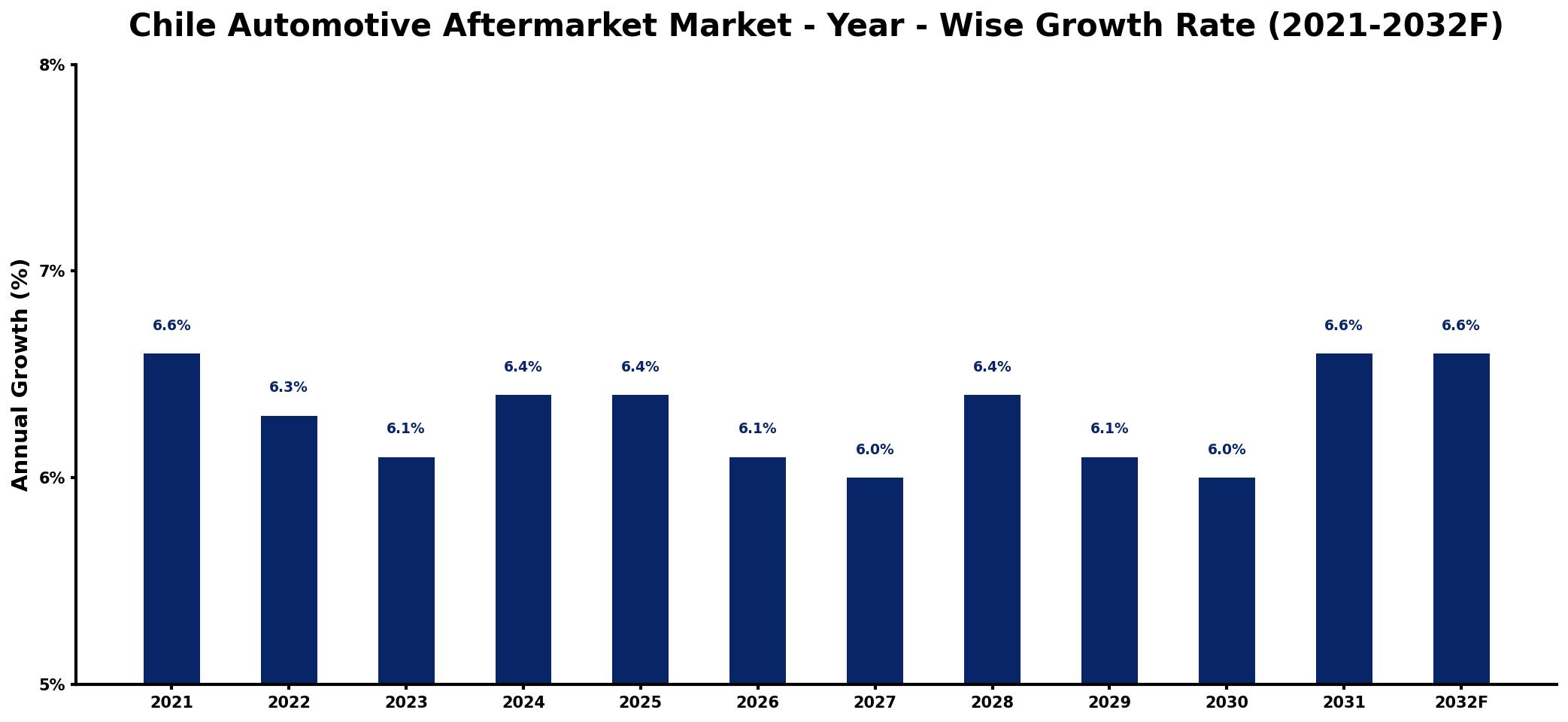
The table below presents the year‑wise growth rates along with the key drivers influencing the market
| Year | Growth Rate | Major Drivers |
| 2021 | 6.6% | Rising consumer spending habits |
| 2022 | 6.3% | Increased vehicle ownership rates |
| 2023 | 6.1% | Expansion of e-commerce platforms |
| 2024 | 6.4% | Growth in vehicle maintenance services |
| 2025 | 6.4% | Investment in electric vehicle infrastructure |
| 2026 | 6.1% | Technological advancements in diagnostics |
| 2027 | 6.0% | Increase in vehicle customization options |
| 2028 | 6.4% | Growing awareness of sustainability practices |
| 2029 | 6.1% | Enhanced distribution network efficiency |
| 2030 | 6.0% | Development of innovative repair solutions |
| 2031 | 6.6% | Strengthening of local supply chains |
| 2032 | 6.6% | Rising popularity of online marketplaces |
Note: Market size estimations and growth projections presented in this report are based on 6Wresearch's proprietary forecasting methodology, utilizing the latest available industry data, government publications, and primary research inputs.
Chile Automotive Aftermarket Market Synopsis
The Chilean automotive aftermarket has gained remarkable momentum, characterized by an expanding range of services and products that cater to diverse consumer needs. With a strong automotive culture and a well-established distribution network, the sector is evolving towards increased customization and repair services, reflecting the shifting preferences of car owners.
Looking ahead, the aftermarket is set to benefit from the growth in the vehicle parc and average vehicle age, both of which drive demand for maintenance and spare parts. Coupled with the rise of e-commerce in automotive sales, the Chile Automotive Aftermarket Market is on an upward trajectory, offering lucrative opportunities for growth and innovation.
Chile Automotive Aftermarket Market Key Takeaways
- The Chile automotive aftermarket is poised for steady expansion, fueled by a growing vehicle fleet and increasing average vehicle age.
- Customization and personalization products are witnessing heightened consumer interest, enhancing demand across the sector.
- E-commerce platforms are revolutionizing distribution, making products and services more accessible to a broader audience.
- Government policies are supporting quality assurance and environmental initiatives in the aftermarket, promoting sustainable practices.
- Investment opportunities are emerging in specialized services catering to automotive enthusiasts and the general consumer base alike.
Evaluation of Restraints in Chile Automotive Aftermarket Market
Despite its positive trajectory, the Chile automotive aftermarket faces significant challenges that may restrict growth. The proliferation of counterfeit parts remains a critical concern, as these products jeopardize vehicle performance and safety. Additionally, inconsistent regulations and quality control measures can create confusion for consumers, potentially undermining trust in the market. Competition from unauthorized dealers and online platforms selling subpar products at attractive prices further complicates the landscape. Addressing these challenges is essential for ensuring the sector's long-term viability and consumer satisfaction.
Chile Automotive Aftermarket Market Trends
Several trends are shaping the Chile automotive aftermarket landscape. The demand for customization products, including performance parts and advanced electronics, is on the rise as consumers seek to personalize their vehicles. The increasing popularity of e-commerce is altering traditional distribution channels, enabling consumers to easily access a diverse array of products. Furthermore, sustainability has become a focal point, with eco-friendly components and practices gaining traction among environmentally conscious consumers. These trends collectively indicate a dynamic and rapidly evolving market.
Chile Automotive Aftermarket Market Opportunities
The Chile automotive aftermarket presents a wealth of investment opportunities. As the vehicle parc expands, so does the demand for replacement parts and maintenance services. Establishing distribution networks or retail partnerships could effectively meet this growing need. Additionally, there is significant potential in specialized services catering to automotive enthusiasts, such as vehicle tuning and performance upgrades. These emerging sectors represent compelling avenues for investors looking to capitalize on the expanding Chilean automotive landscape.
Government Initiatives in the Chile Automotive Aftermarket Market
The Chilean government has instituted several key policies aimed at regulating and enhancing the automotive aftermarket sector. Mandatory vehicle inspections ensure roadworthiness and safety standards are upheld. Regulations govern the importation and sale of aftermarket parts to maintain quality and compatibility. Additionally, environmental policies address the disposal of automotive waste products, encouraging the adoption of eco-friendly materials. Such initiatives aim to foster consumer protection, support innovation, and promote sustainable practices within the industry.
Future Insights of the Chile Automotive Aftermarket Market
The future of the Chile Automotive Aftermarket appears bright, driven by various factors including a growing vehicle parc and increasing consumer interest in customization and performance enhancements. As disposable incomes rise in line with the economic recovery, car owners are likely to invest in maintaining and upgrading their vehicles beyond manufacturer warranties. The proliferation of online retail platforms, alongside technology-driven solutions for aftermarket services, is expected to further stimulate growth. Consequently, the market is anticipated to experience consistent expansion, with numerous opportunities for local and international stakeholders.
Chile Automotive Aftermarket Market Latest Developments (2025 - 2026)
Recent developments in the Chile automotive aftermarket highlight a noticeable shift towards digital transformation, with many businesses enhancing their online presence to cater to the growing e-commerce trend. Additionally, an increasing number of workshops and service providers are adopting advanced technologies to improve efficiency and customer service. The market is also witnessing collaborative efforts among industry stakeholders to combat counterfeit products and promote quality standards, thereby enhancing consumer confidence in aftermarket offerings.
Chile Automotive Aftermarket Market - Key Attractiveness of the Report
- 10 Years of Market Numbers
- Historical Data Starting from 2022 to 2025
- Base Year: 2025
- Forecast Data until 2032
- Key Performance Indicators Impacting the Market
- Major Upcoming Developments and Projects
Key Highlights of the Report:
- Chile Automotive Aftermarket Market Outlook
- Market Size of Chile Automotive Aftermarket Market, 2025
- Forecast of Chile Automotive Aftermarket Market, 2032
- Historical Data and Forecast of Chile Automotive Aftermarket Revenues & Volume for the Period 2022-2032F
- Chile Automotive Aftermarket Market Trend Evolution
- Chile Automotive Aftermarket Market Drivers and Challenges
- Chile Automotive Aftermarket Price Trends
- Chile Automotive Aftermarket Porter's Five Forces
- Chile Automotive Aftermarket Industry Life Cycle
- Historical Data and Forecast of Chile Automotive Aftermarket Market Revenues & Volume By Replacement Parts for the Period 2022-2032F
- Historical Data and Forecast of Chile Automotive Aftermarket Market Revenues & Volume By Tire for the Period 2022-2032F
- Historical Data and Forecast of Chile Automotive Aftermarket Market Revenues & Volume By Battery for the Period 2022-2032F
- Historical Data and Forecast of Chile Automotive Aftermarket Market Revenues & Volume By Brake Parts for the Period 2022-2032F
- Historical Data and Forecast of Chile Automotive Aftermarket Market Revenues & Volume By Filters for the Period 2022-2032F
- Historical Data and Forecast of Chile Automotive Aftermarket Market Revenues & Volume By Body parts for the Period 2022-2032F
- Historical Data and Forecast of Chile Automotive Aftermarket Market Revenues & Volume By Lighting & Electronic Components for the Period 2022-2032F
- Historical Data and Forecast of Chile Automotive Aftermarket Market Revenues & Volume By Wheels for the Period 2022-2032F
- Historical Data and Forecast of Chile Tire Automotive Aftermarket Market Revenues & Volume By Exhaust components for the Period 2022-2032F
- Historical Data and Forecast of Chile Automotive Aftermarket Market Revenues & Volume By Distribution Channel for the Period 2022-2032F
- Historical Data and Forecast of Chile Automotive Aftermarket Market Revenues & Volume By Retailers for the Period 2022-2032F
- Historical Data and Forecast of Chile Automotive Aftermarket Market Revenues & Volume By Wholesalers & Distributors for the Period 2022-2032F
- Historical Data and Forecast of Chile Automotive Aftermarket Market Revenues & Volume By Service Channel for the Period 2022-2032F
- Historical Data and Forecast of Chile Automotive Aftermarket Market Revenues & Volume By DIY (Do it Yourself) for the Period 2022-2032F
- Historical Data and Forecast of Chile Automotive Aftermarket Market Revenues & Volume By DIFM (Do it for Me) for the Period 2022-2032F
- Historical Data and Forecast of Chile Automotive Aftermarket Market Revenues & Volume By OE (Delegating to OEM??s) for the Period 2022-2032F
- Historical Data and Forecast of Chile Automotive Aftermarket Market Revenues & Volume By Certification for the Period 2022-2032F
- Historical Data and Forecast of Chile Automotive Aftermarket Market Revenues & Volume By Genuine Parts for the Period 2022-2032F
- Historical Data and Forecast of Chile Automotive Aftermarket Market Revenues & Volume By Certified Parts for the Period 2022-2032F
- Historical Data and Forecast of Chile Automotive Aftermarket Market Revenues & Volume By Uncertified Parts for the Period 2022-2032F
- Chile Automotive Aftermarket Import Export Trade Statistics
- Market Opportunity Assessment By Replacement Parts
- Market Opportunity Assessment By Distribution Channel
- Market Opportunity Assessment By Service Channel
- Market Opportunity Assessment By Certification
- Chile Automotive Aftermarket Top Companies Market Share
- Chile Automotive Aftermarket Competitive Benchmarking By Technical and Operational Parameters
- Chile Automotive Aftermarket Company Profiles
- Chile Automotive Aftermarket Key Strategic Recommendations






































