Chile Automotive Drive Shaft Market Size, Share & Growth Rate
The Chile Automotive Drive Shaft Market was estimated at USD 350 Million in 2025 and is projected to reach USD 509 Million by 2032, growing at a CAGR of 5.5% from 2026 to 2032. This growth is fueled by increasing automobile production, particularly in the commercial vehicle segment, alongside a surge in consumer preference for fuel-efficient and environmentally friendly vehicles. As manufacturers innovate in the use of lightweight materials and advanced technologies, the demand for high-performance drive shafts is set to rise significantly.
Chile Automotive Drive Shaft Market Year-wise Growth Rate and Key Drivers
This graph highlights how the Chile Automotive Drive Shaft Market has steadily grown over the years, supported by major growth factors.
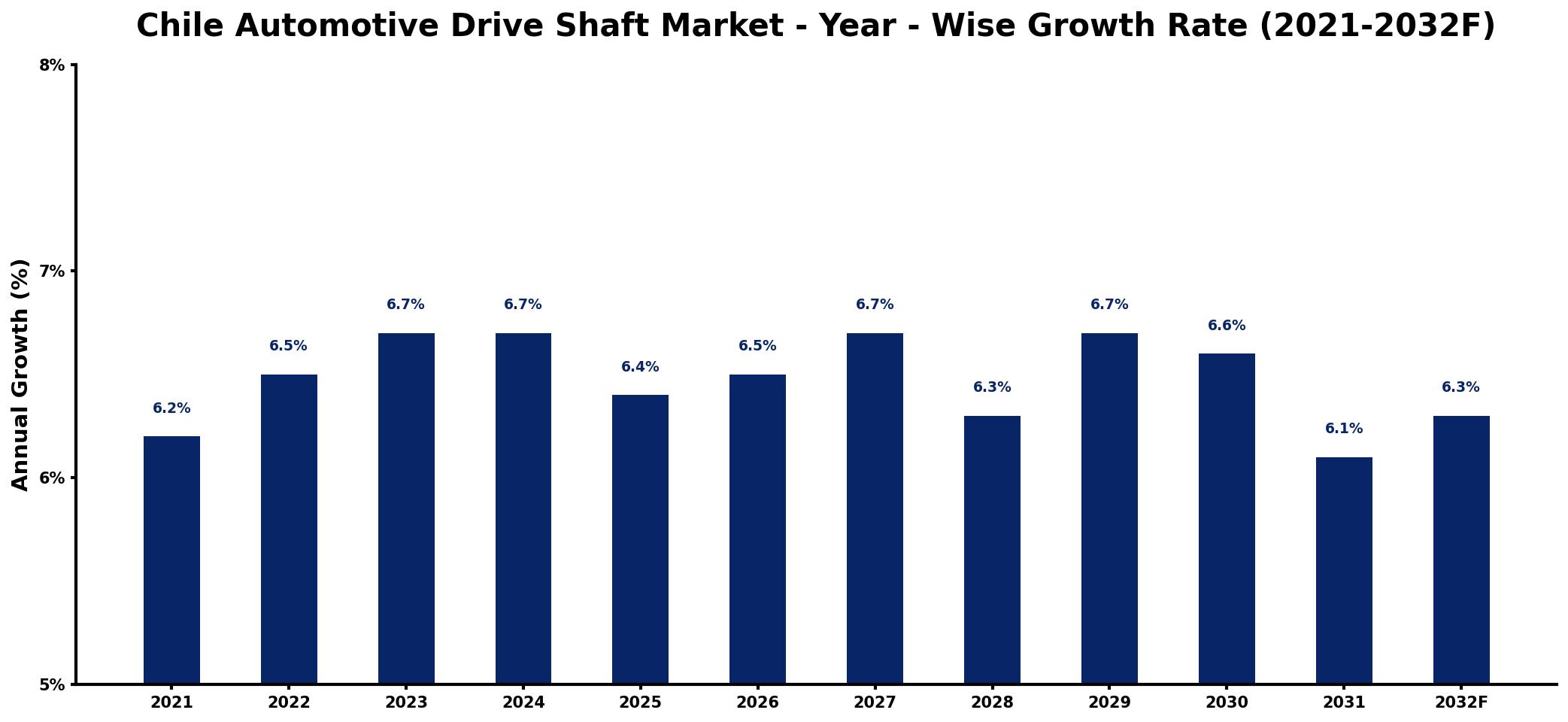
The table below presents the year‑wise growth rates along with the key drivers influencing the market
| Year | Growth Rate | Major Drivers |
| 2021 | 6.2% | Rising vehicle production rates |
| 2022 | 6.5% | Increased consumer spending trends |
| 2023 | 6.7% | Growing demand for transportation |
| 2024 | 6.7% | Expansion of manufacturing facilities |
| 2025 | 6.4% | Investment in renewable technologies |
| 2026 | 6.5% | Surge in electric vehicle adoption |
| 2027 | 6.7% | Enhanced logistics and infrastructure |
| 2028 | 6.3% | Higher export opportunities available |
| 2029 | 6.7% | Increased focus on sustainability |
| 2030 | 6.6% | Technological advancements in design |
| 2031 | 6.1% | Growing aftermarket service demand |
| 2032 | 6.3% | Strengthened regional trade agreements |
Note: Market size estimations and growth projections presented in this report are based on 6Wresearch's proprietary forecasting methodology, utilizing the latest available industry data, government publications, and primary research inputs.
Chile Automotive Drive Shaft Market Synopsis
The Chilean automotive landscape is witnessing a notable demand for advanced drive shaft solutions due to a booming automotive sector, which includes both traditional and electric vehicles. This demand is coupled with a robust aftermarket for replacement parts, necessitating a diverse range of drive shaft products that accommodate various vehicle types.
As the market evolves, manufacturers are increasingly adopting innovative materials and manufacturing processes to produce drive shafts that are not only lightweight but also capable of meeting stringent performance and durability standards. This focus on technology is essential for adapting to changing consumer preferences towards sustainability and efficiency.
Chile Automotive Drive Shaft Market Key Takeaways
- The market is benefitting from the rising production of electric and hybrid vehicles, requiring specialized drive shafts.
- Investment in advanced manufacturing processes, like additive manufacturing, is enhancing product quality and performance.
- Environmental regulations are pushing manufacturers to develop lighter and more fuel-efficient drive shafts.
- The competitive landscape is intensifying with both domestic and international players vying for market share.
- Government incentives for sustainable automotive technologies are supporting market growth.
Evaluation of Restraints in Chile Automotive Drive Shaft Market
While the Chile Automotive Drive Shaft Market shows promise, several factors can inhibit its growth. The pressure to produce more fuel-efficient and lightweight drive shafts poses a significant challenge for manufacturers striving to balance performance with cost-efficiency. Moreover, the competitive environment, characterized by numerous entrants, leads to price wars that can erode profit margins. Fluctuating prices of key raw materials, particularly steel and aluminum, further complicate production costs and operational planning. Addressing these constraints is essential for businesses aiming to maintain product quality while navigating a dynamic market landscape.
Chile Automotive Drive Shaft Market Trends
The push for lightweight materials and advanced technology is reshaping the Chile Automotive Drive Shaft Market. Manufacturers are increasingly investing in materials such as carbon fiber and aluminum to achieve a perfect blend of weight reduction and enhanced durability. Additionally, the demand for electric and hybrid vehicles is propelling the development of specialized drive shafts that cater to the unique requirements of these vehicles, emphasizing performance and efficiency. As consumers continue to prioritize sustainability, the adoption of eco-friendly materials and innovative design practices is becoming more prevalent, signaling a significant shift in the industry.
Chile Automotive Drive Shaft Market Opportunities
The market presents numerous investment opportunities stemming from Chile's burgeoning automotive industry. The increasing need for advanced, high-quality drive shafts is creating a fertile ground for investors focusing on innovation and sustainability. Companies that develop lightweight solutions and leverage advanced manufacturing techniques stand to gain a competitive edge. Additionally, the government's efforts to encourage electric vehicle adoption open avenues for specialized drive shafts tailored to alternative powertrains, making this a strategically promising area for investment.
Government Initiatives in the Chile Automotive Drive Shaft Market
The Chilean government has implemented several policies aimed at enhancing the automotive sector, particularly focusing on sustainability and emissions reduction. These initiatives encourage the use of electric and hybrid vehicles, creating a demand for efficient drive shaft solutions. Additionally, regulations are in place to ensure the safety and quality of automotive components, which includes drive shafts, through strict certification and compliance processes. Such governmental support fosters innovation and competitiveness within the automotive industry, propelling growth in the drive shaft market.
Future Insights of the Chile Automotive Drive Shaft Market
Looking ahead to 2026-2032, the Chile Automotive Drive Shaft Market is poised for continued expansion driven by several pivotal factors. The increasing demand for both traditional and electric vehicles will maintain pressure on manufacturers to develop advanced drive shafts that meet evolving performance standards. As infrastructure improves and automotive manufacturing ramps up in Chile, there will be ample opportunities for businesses to innovate and cater to diverse customer needs. This trajectory suggests a robust market landscape filled with potential for both established and emerging players.
Chile Automotive Drive Shaft Market Latest Developments (2025 - 2026)
In recent months, the Chile Automotive Drive Shaft Market has seen significant shifts as manufacturers embrace cutting-edge technologies and innovative materials to enhance product performance. There is a noted increase in collaborations among automotive players to foster research and development efforts aimed at creating more sustainable and efficient drive shafts. Additionally, the regulatory landscape is evolving, encouraging further investments in cleaner technologies and advanced automotive solutions that promise to drive growth in the sector.
Chile Automotive Drive Shaft Market - Key Attractiveness of the Report
- 10 Years of Market Numbers
- Historical Data Starting from 2022 to 2025
- Base Year: 2025
- Forecast Data until 2032
- Key Performance Indicators Impacting the Market
- Major Upcoming Developments and Projects
Key Highlights of the Report:
- Chile Automotive Drive Shaft Market Outlook
- Market Size of Chile Automotive Drive Shaft Market, 2025
- Forecast of Chile Automotive Drive Shaft Market, 2032
- Historical Data and Forecast of Chile Automotive Drive Shaft Revenues & Volume for the Period 2022-2032F
- Chile Automotive Drive Shaft Market Trend Evolution
- Chile Automotive Drive Shaft Market Drivers and Challenges
- Chile Automotive Drive Shaft Price Trends
- Chile Automotive Drive Shaft Porter's Five Forces
- Chile Automotive Drive Shaft Industry Life Cycle
- Historical Data and Forecast of Chile Automotive Drive Shaft Market Revenues & Volume By Design Type for the Period 2022-2032F
- Historical Data and Forecast of Chile Automotive Drive Shaft Market Revenues & Volume By Hollow Shaft for the Period 2022-2032F
- Historical Data and Forecast of Chile Automotive Drive Shaft Market Revenues & Volume By Solid Shaft for the Period 2022-2032F
- Historical Data and Forecast of Chile Automotive Drive Shaft Market Revenues & Volume By Position Type for the Period 2022-2032F
- Historical Data and Forecast of Chile Automotive Drive Shaft Market Revenues & Volume By Rear Axle for the Period 2022-2032F
- Historical Data and Forecast of Chile Automotive Drive Shaft Market Revenues & Volume By Front Axle for the Period 2022-2032F
- Historical Data and Forecast of Chile Automotive Drive Shaft Market Revenues & Volume By Vehicle Type for the Period 2022-2032F
- Historical Data and Forecast of Chile Automotive Drive Shaft Market Revenues & Volume By Passenger Cars for the Period 2022-2032F
- Historical Data and Forecast of Chile Automotive Drive Shaft Market Revenues & Volume By Commercial Vehicles for the Period 2022-2032F
- Chile Automotive Drive Shaft Import Export Trade Statistics
- Market Opportunity Assessment By Design Type
- Market Opportunity Assessment By Position Type
- Market Opportunity Assessment By Vehicle Type
- Chile Automotive Drive Shaft Top Companies Market Share
- Chile Automotive Drive Shaft Competitive Benchmarking By Technical and Operational Parameters
- Chile Automotive Drive Shaft Company Profiles
- Chile Automotive Drive Shaft Key Strategic Recommendations






































