Chile Cloud ERP Market Size & Growth Rate (2026-2032)
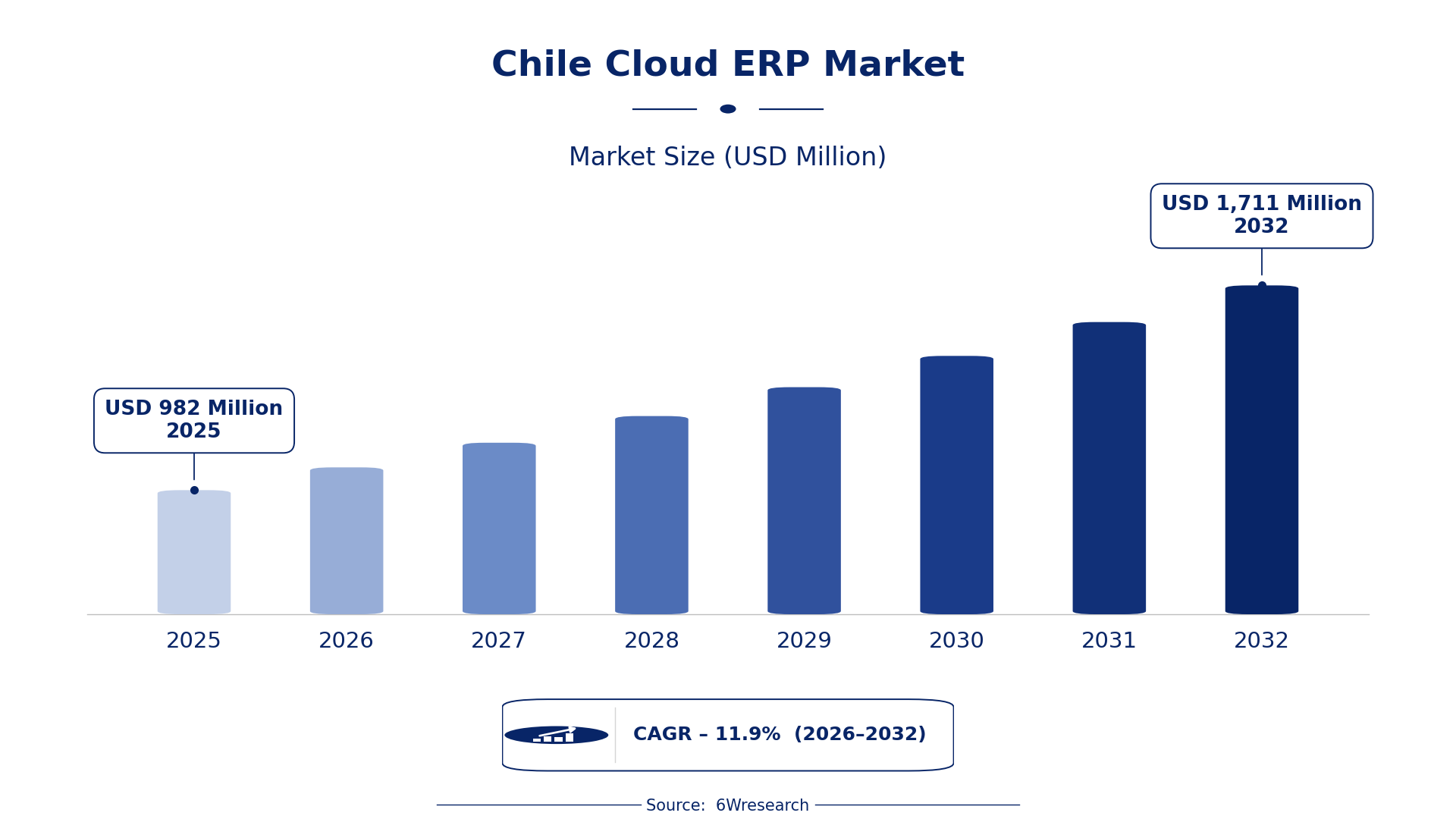
The Chile Cloud ERP Market was estimated at USD 982 Million in 2025 and is projected to reach USD 1711 Million by 2032, growing at a CAGR of 11.9% from 2026 to 2032.
Chile Cloud ERP Market Synopsis
The shift towards cloud-based ERP solutions in Chile is unmistakable, as businesses recognize the need for greater flexibility and efficiency. In an economy that values innovation, companies are increasingly adopting these systems to streamline operations and improve decision-making processes.
With the pressures of a competitive market, cloud ERP solutions are no longer optional for many enterprises in Chile. These platforms provide a vital framework for modernizing business practices, enabling organizations to stay agile and responsive to shifting demands.
Chile Cloud ERP Market Year-wise Growth Rate and Key Drivers
This graph illustrates the annual growth rates of the Chile Cloud ERP Market from 2021 to 2032, highlighting a steady upward trajectory and projected expansion over the forecast period.
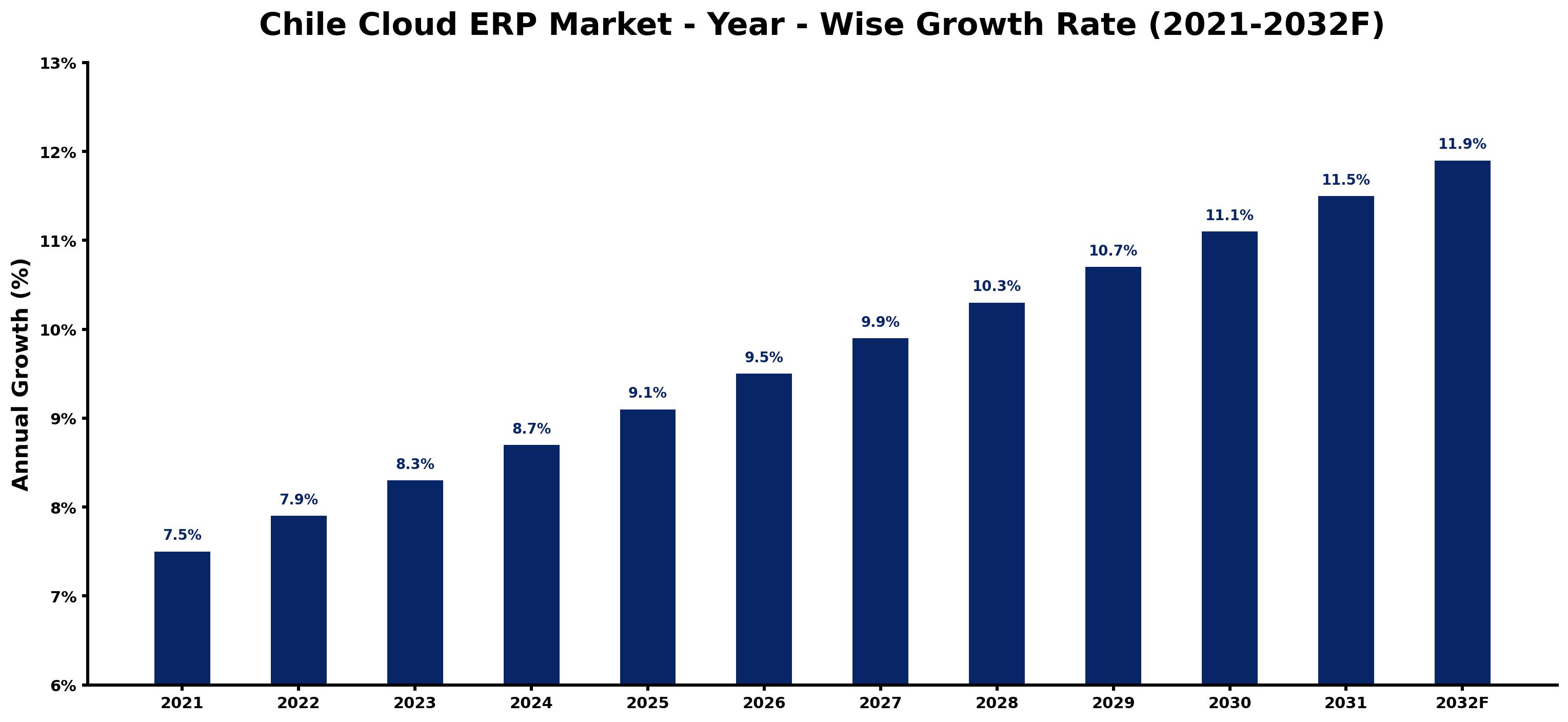
The table below presents the year‑wise growth rates along with the key drivers influencing the market
| Year | Growth Rate | Major Drivers |
| 2021 | 7.5% | Rising adoption of digital tools among Chilean SMEs. |
| 2022 | 7.9% | Increased regulatory support for cloud compliance standards. |
| 2023 | 8.3% | Emergence of local tech hubs driving ERP innovation. |
| 2024 | 8.7% | Growing investments in tech startups focused on ERP. |
| 2025 | 9.1% | Mounting focus on data analytics for business growth. |
| 2026 | 9.5% | Legislative changes boosting e-commerce and digital reporting. |
| 2027 | 9.9% | Increased focus on sustainability driving cloud migrations. |
| 2028 | 10.3% | Surge in remote work necessitating cloud-based solutions. |
| 2029 | 10.7% | Strong digital literacy growth among young professionals. |
| 2030 | 11.1% | Favorable tax regulations for tech service providers. |
| 2031 | 11.5% | Public sector projects integrating cloud ERP systems. |
| 2032 | 11.9% | Local partnerships enhancing cloud service reliability. |
Note: Market size estimations and growth projections presented in this report are based on 6Wresearch's proprietary forecasting methodology, utilizing the latest available industry data, government publications, and primary research inputs.
Chile Cloud ERP Market Key Takeaways
Below are some of the specific key takeaways from the market, including:
- The Chile Cloud ERP market is experiencing rapid growth due to the migration from traditional systems.
- Flexibility and cost-effectiveness are primary drivers for businesses adopting cloud ERP solutions.
- Government initiatives are enhancing the regulatory framework, promoting ERP adoption across industries.
- Organizations face challenges with legacy system integration and data integrity during transitions.
- Increasing focus on digital transformation is pushing enterprises to prioritize cloud-based solutions.
Evaluation of Restraints in Chile Cloud ERP Market
Despite the clear advantages of cloud ERP solutions, several restraints hinder faster adoption in Chile. Many businesses grapple with migrating from outdated legacy systems, which can be both complex and costly. Concerns about data security and integrity during the transition also pose challenges. Customizing cloud ERP solutions to meet specific industry needs is another hurdle, leading some organizations to hesitate in making the switch. These factors collectively slow down the market’s potential growth.
Chile Cloud ERP Market Trends
Current trends in the Chile Cloud ERP market highlight a growing emphasis on integration with emerging technologies such as artificial intelligence and machine learning. Companies are seeking ERP systems that not only manage resources but also provide advanced analytics for better decision-making. Additionally, businesses are increasingly focused on user experience, pushing vendors to develop more intuitive interfaces that enhance productivity.
Chile Cloud ERP Market Opportunities
The potential for growth in the Chile Cloud ERP market is substantial, particularly in industries such as retail, manufacturing, and healthcare. As companies prioritize digital transformation, opportunities arise for vendors to offer tailored solutions that address specific operational challenges. Investments in cybersecurity and data protection are also becoming key areas for growth, as businesses seek to secure their cloud environments.
Government Initiatives in the Chile Cloud ERP Market
The Chilean government is actively shaping the Cloud ERP market through various initiatives aimed at promoting digital transformation and operational efficiency. With a focus on enhancing competitiveness, regulatory reforms are driving businesses to modernize their ERP systems. These policies not only support technological advancement but also facilitate access to funding for companies transitioning to cloud-based solutions.
- A national program initiated in early 2025 to support small and medium enterprises in adopting cloud technologies.
- Ongoing regulatory reforms aimed at improving data transparency and compliance, influencing ERP adoption trends.
- A planned public-private partnership expected to expand digital infrastructure access by 2028, facilitating cloud deployments.
- Recent government workshops focused on educating businesses about the benefits of cloud ERP solutions.
- An initiative launched in late 2025 to streamline the procurement process for cloud services in public sector organizations.
Future Insights of the Chile Cloud ERP Market
Looking ahead, the Chile Cloud ERP market is set to witness transformative changes between 2026 and 2032. As organizations increasingly prioritize agility, the demand for customizable and scalable solutions will grow. Vendors that can offer innovative features integrated with AI and analytics will have a competitive edge. The focus on sustainability in business operations will also drive the adoption of cloud solutions, making them essential for future-proofing enterprises in Chile.
Chile Cloud ERP Market Latest Developments
In the past year, the Chile Cloud ERP market has seen various developments that reflect its dynamic nature. Companies are actively seeking partnerships to enhance their service offerings, and new technology rollouts are becoming commonplace as firms aim to stay competitive. The market is experiencing an influx of innovative solutions designed to meet the evolving needs of businesses across multiple sectors.
- A major technology vendor launched a new cloud ERP solution in Q3 2025, tailored for the retail sector.
- An ongoing partnership between regional firms aims to integrate cloud ERP systems with advanced analytics, improving operational efficiencies.
- A pilot program that began in early 2025 is testing cloud ERP solutions in public sector agencies, with promising initial results.
- Upcoming in early 2026, a comprehensive upgrade of existing cloud ERP features to enhance user experience and security.
- A recent initiative to provide training sessions for ERP users is currently underway, aimed at improving adoption rates among local businesses.
Chile Cloud ERP Market - Key Attractiveness of the Report
- 10 Years of Market Numbers
- Historical Data Starting from 2022 to 2025
- Base Year: 2025
- Forecast Data until 2032
- Key Performance Indicators Impacting the Market
- Major Upcoming Developments and Projects
Key Highlights of the Report:
- Chile Cloud ERP Market Outlook
- Market Size of Chile Cloud ERP Market, 2025
- Forecast of Chile Cloud ERP Market, 2032
- Historical Data and Forecast of Chile Cloud ERP Revenues & Volume for the Period 2022-2032F
- Chile Cloud ERP Market Trend Evolution
- Chile Cloud ERP Market Drivers and Challenges
- Chile Cloud ERP Price Trends
- Chile Cloud ERP Porter's Five Forces
- Chile Cloud ERP Industry Life Cycle
- Historical Data and Forecast of Chile Cloud ERP Market Revenues & Volume By Component for the Period 2022-2032F
- Historical Data and Forecast of Chile Cloud ERP Market Revenues & Volume By Solution for the Period 2022-2032F
- Historical Data and Forecast of Chile Cloud ERP Market Revenues & Volume By Services for the Period 2022-2032F
- Historical Data and Forecast of Chile Cloud ERP Market Revenues & Volume By Vertical for the Period 2022-2032F
- Historical Data and Forecast of Chile Cloud ERP Market Revenues & Volume By BFSI for the Period 2022-2032F
- Historical Data and Forecast of Chile Cloud ERP Market Revenues & Volume By Manufacturing for the Period 2022-2032F
- Historical Data and Forecast of Chile Cloud ERP Market Revenues & Volume By IT and Telecom for the Period 2022-2032F
- Historical Data and Forecast of Chile Cloud ERP Market Revenues & Volume By Business Function for the Period 2022-2032F
- Historical Data and Forecast of Chile Cloud ERP Market Revenues & Volume By Accounting and Finance for the Period 2022-2032F
- Historical Data and Forecast of Chile Cloud ERP Market Revenues & Volume By Sales and Marketing for the Period 2022-2032F
- Historical Data and Forecast of Chile Cloud ERP Market Revenues & Volume By Inventory and Order Management for the Period 2022-2032F
- Historical Data and Forecast of Chile Cloud ERP Market Revenues & Volume By Organization Size for the Period 2022-2032F
- Historical Data and Forecast of Chile Cloud ERP Market Revenues & Volume By SMEs for the Period 2022-2032F
- Historical Data and Forecast of Chile Cloud ERP Market Revenues & Volume By Large Enterprises for the Period 2022-2032F
- Chile Cloud ERP Import Export Trade Statistics
- Market Opportunity Assessment By Component
- Market Opportunity Assessment By Vertical
- Market Opportunity Assessment By Business Function
- Market Opportunity Assessment By Organization Size
- Chile Cloud ERP Top Companies Market Share
- Chile Cloud ERP Competitive Benchmarking By Technical and Operational Parameters
- Chile Cloud ERP Company Profiles
- Chile Cloud ERP Key Strategic Recommendations






































