Chile Critical Infrastructure Protection Market Size & Growth Rate (2026-2032)
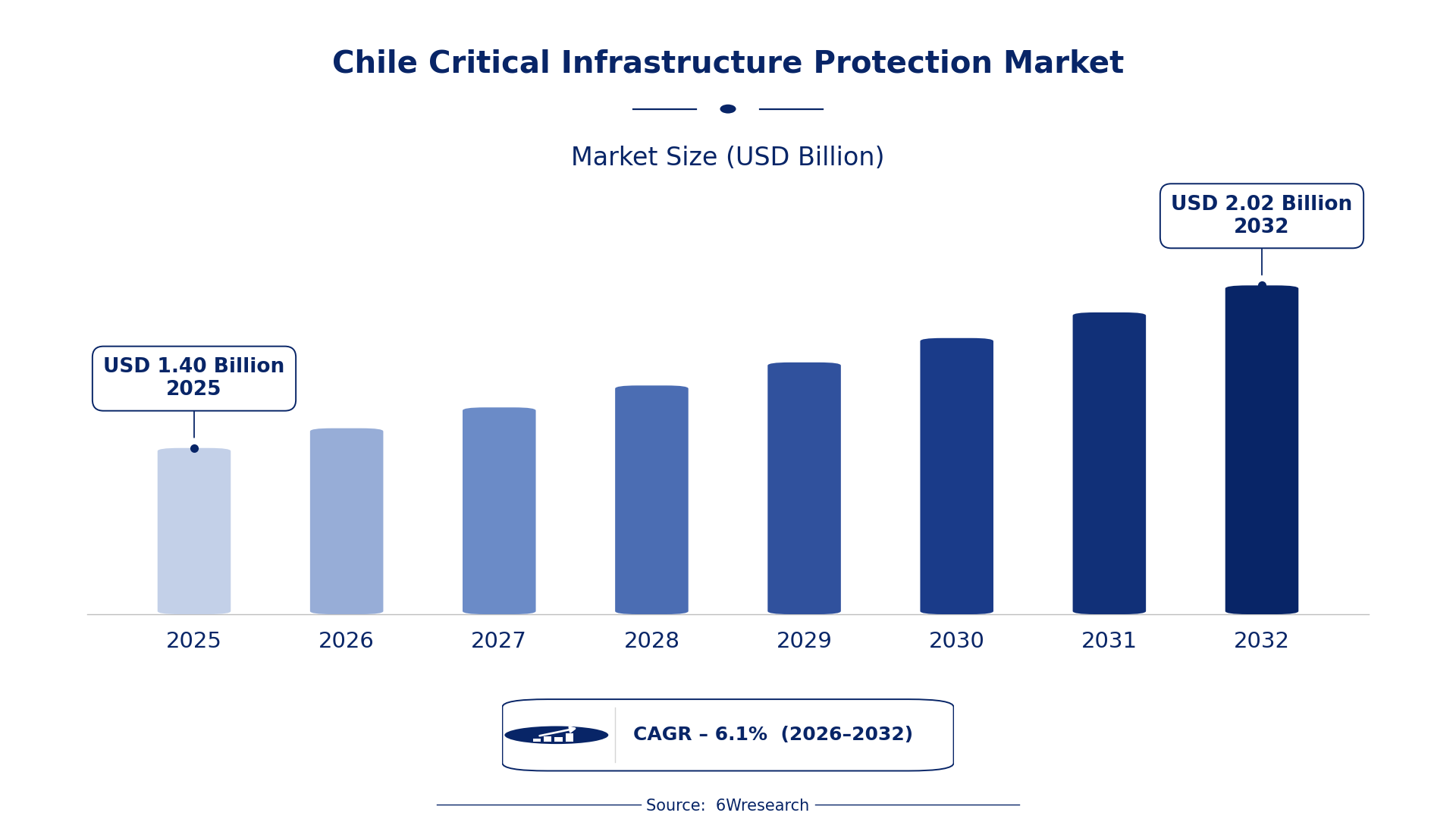
The Chile Critical Infrastructure Protection Market was estimated at USD 1402 Million in 2025 and is projected to reach USD 2019 Million by 2032, growing at a CAGR of 6.1% from 2026 to 2032.
Chile Critical Infrastructure Protection Market Synopsis
The increasing cyber threats targeting vital assets is the dominant force shaping the Chile Critical Infrastructure Protection Market today. This urgency for protection is steering investments and innovations towards advanced security technologies and proactive measures across various sectors.
In response to these threats, the Chilean government is intensifying its focus on safeguarding critical infrastructure. Sectors such as energy, transportation, and telecommunications are particularly in the spotlight, as they are essential for the nation's functioning and economic stability.
Chile Critical Infrastructure Protection Market Year-wise Growth Rate and Key Drivers
This graph illustrates the annual growth rates of the Chile Critical Infrastructure Protection Market from 2021 to 2032, highlighting a steady upward trajectory and projected expansion over the forecast period.
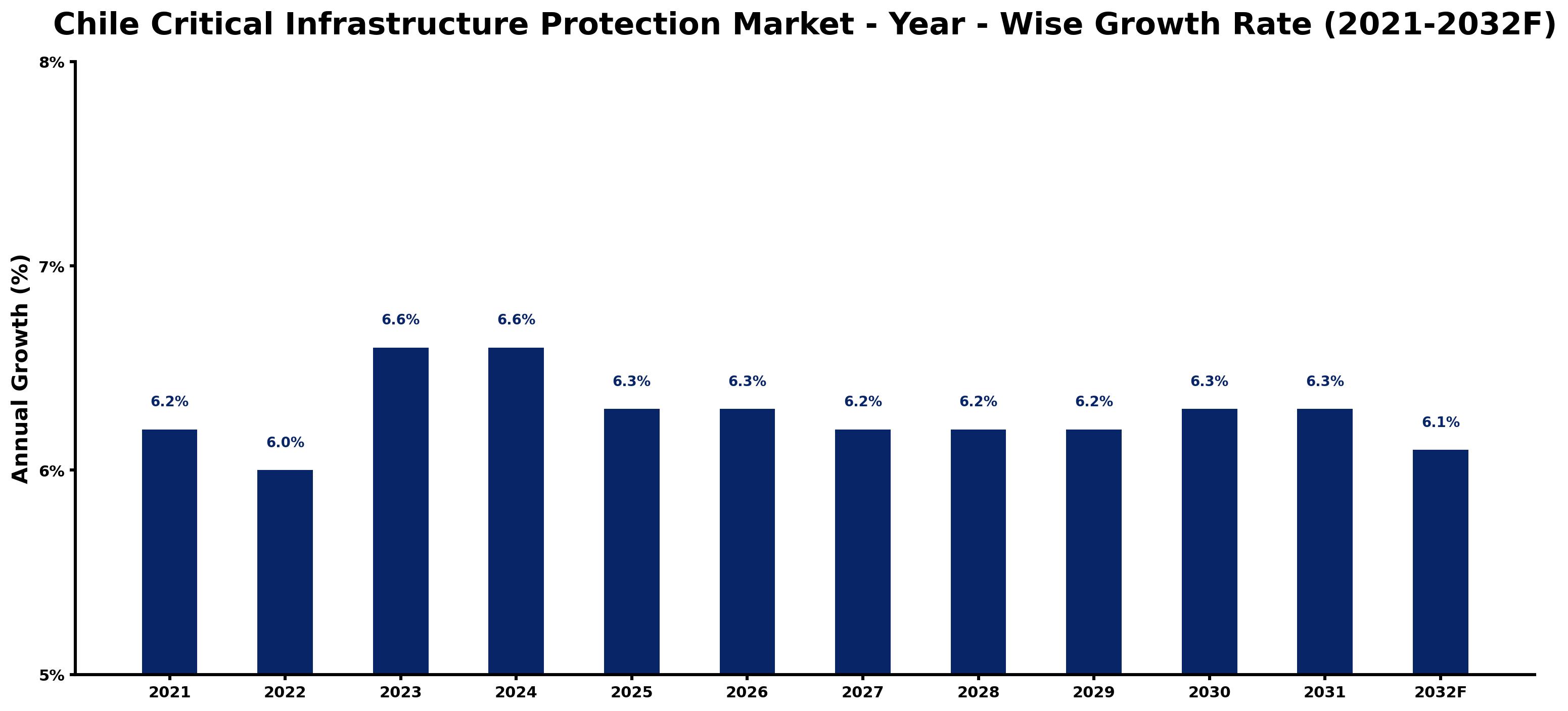
The table below presents the year‑wise growth rates along with the key drivers influencing the market
| Year | Growth Rate | Major Drivers |
| 2021 | 6.2% | Increase in government spending on disaster resilience programs. |
| 2022 | 6.0% | New regulations from ONEMI enhancing infrastructure protection standards. |
| 2023 | 6.6% | Adoption of cybersecurity measures following critical threats. |
| 2024 | 6.6% | Growing public-private partnerships for infrastructure safety initiatives. |
| 2025 | 6.3% | Rising awareness of climate change impacts on infrastructure. |
| 2026 | 6.3% | Investment in resilience technologies post-2023 earthquake recovery. |
| 2027 | 6.2% | Strengthened national policies focusing on infrastructure risk management. |
| 2028 | 6.2% | Integration of smart technologies in urban infrastructure planning. |
| 2029 | 6.2% | Development projects prioritizing environmental security measures. |
| 2030 | 6.3% | Enhanced training programs for critical infrastructure operators launched. |
| 2031 | 6.3% | Increased collaboration with international security agencies. |
| 2032 | 6.1% | Focus on indigenous community involvement in infrastructure protection. |
Note: Market size estimations and growth projections presented in this report are based on 6Wresearch's proprietary forecasting methodology, utilizing the latest available industry data, government publications, and primary research inputs.
Chile Critical Infrastructure Protection Market Key Takeaways
Below are some of the specific key takeaways from the market, including:
- The market is heavily influenced by the rise in cyber threats and the corresponding need for advanced security solutions.
- Investment in AI and IoT technologies is crucial for enhancing the effectiveness of infrastructure protection measures.
- Regulatory compliance remains a significant driver, as businesses must align with national cybersecurity strategies.
- There is a growing awareness among organizations about the importance of a proactive stance against potential threats.
- Vendors have a unique opportunity to develop specialized solutions tailored to the unique challenges of the Chilean market.
Evaluation of Restraints in Chile Critical Infrastructure Protection Market
Despite the market's growth potential, several obstacles hinder progress. One critical issue is the gap in investment levels required to adequately safeguard essential infrastructures against evolving threats. Regulatory compliance adds another layer of complexity, as different sectors face varying requirements. The geographical diversity of Chile complicates the implementation of unified protection strategies, while a lack of skilled cybersecurity professionals further strains the market. As organizations grapple with these challenges, comprehensive risk assessments and effective incident response plans are essential for moving forward.
Chile Critical Infrastructure Protection Market Trends
Currently, there's a pronounced shift toward advanced cybersecurity solutions to protect critical assets from cyber threats. Organizations increasingly recognize the need for resilient infrastructures, pushing demand for technologies such as AI-driven threat detection systems and comprehensive incident response frameworks.
The implementation of secure communication networks is gaining momentum, alongside a growing emphasis on regulatory compliance. These trends collectively highlight the importance of specialized cybersecurity solutions, underscoring the market's evolution as a response to a digitizing and interconnected world.
Chile Critical Infrastructure Protection Market Opportunities
The Chile Critical Infrastructure Protection Market presents lucrative investment opportunities, particularly within sectors like energy, transportation, telecommunications, and water supply. As technological reliance grows, so does the demand for robust security solutions capable of addressing both physical and cyber threats.
Investors can explore avenues in providing innovative security technologies, consulting services, and tailored training programs. With government initiatives aimed at enhancing cybersecurity measures, the market's investment landscape appears promising, ripe for organizations willing to take the plunge.
Government Initiatives in the Chile Critical Infrastructure Protection Market
Government policies play a critical role in shaping the Chile Critical Infrastructure Protection Market. With a focus on resilience and security, regulatory frameworks are being established to address vulnerabilities across various sectors, ensuring a safer operational environment.
- A national cybersecurity strategy was recently implemented to strengthen collaboration among government, private sector, and academic institutions.
- Currently ongoing is the development of a comprehensive incident response program aimed at enhancing organizational preparedness against cyber threats.
- A planned initiative to upgrade telecommunication security protocols is expected to roll out by late 2026, reinforcing communication infrastructure.
- The Cybersecurity Agency is actively providing guidance and training, focusing on critical sectors to bolster their defenses.
- In 2024, a regulatory framework was introduced mandating adherence to cybersecurity standards across energy and transportation sectors.
Future Insights of the Chile Critical Infrastructure Protection Market
Looking ahead, the Chile Critical Infrastructure Protection Market is on an upward trajectory, driven by increased investments and heightened awareness of cybersecurity's importance. With the rise in cyber incidents prompting organizations to prioritize security, demand for advanced technologies and comprehensive protection strategies will continue to grow.
The government's commitment to strengthening the cybersecurity framework will further catalyze market growth, ensuring that infrastructure remains resilient against evolving threats. As stakeholders prioritize the safeguarding of critical assets, the market is anticipated to expand consistently between 2026 and 2032.
Chile Critical Infrastructure Protection Market Latest Developments
In the last 12-14 months, the Chile Critical Infrastructure Protection Market has seen a surge in activity, particularly as organizations seek to bolster their defenses against escalating cyber threats. This has catalyzed collaborations and initiatives aimed at enhancing overall security measures across critical sectors.
- In mid-2025, a leading technology provider launched an advanced threat detection platform tailored specifically for the energy sector, improving real-time monitoring capabilities.
- An initiative began in early 2025 to develop secure communication frameworks for the transportation sector, currently ongoing.
- A major cybersecurity training program was recently completed in late 2025, aimed at equipping professionals with the necessary skills to respond to emerging threats.
- Upcoming in 2026, a public-private partnership is expected to enhance surveillance capabilities across Chile's critical infrastructure.
- By early 2026, the implementation of updated security protocols is anticipated to be finalized, strengthening protective measures across telecommunications networks.
Chile Critical Infrastructure Protection Market - Key Attractiveness of the Report
- 10 Years of Market Numbers
- Historical Data Starting from 2022 to 2025
- Base Year: 2025
- Forecast Data until 2032
- Key Performance Indicators Impacting the Market
- Major Upcoming Developments and Projects
Key Highlights of the Report:
- Chile Critical Infrastructure Protection Market Outlook
- Market Size of Chile Critical Infrastructure Protection Market, 2025
- Forecast of Chile Critical Infrastructure Protection Market, 2032
- Historical Data and Forecast of Chile Critical Infrastructure Protection Revenues & Volume for the Period 2022-2032F
- Chile Critical Infrastructure Protection Market Trend Evolution
- Chile Critical Infrastructure Protection Market Drivers and Challenges
- Chile Critical Infrastructure Protection Price Trends
- Chile Critical Infrastructure Protection Porter's Five Forces
- Chile Critical Infrastructure Protection Industry Life Cycle
- Historical Data and Forecast of Chile Critical Infrastructure Protection Market Revenues & Volume By Solution for the Period 2022-2032F
- Historical Data and Forecast of Chile Critical Infrastructure Protection Market Revenues & Volume By Physical Safety for the Period 2022-2032F
- Historical Data and Forecast of Chile Critical Infrastructure Protection Market Revenues & Volume By Security Video Surveillance Systems for the Period 2022-2032F
- Historical Data and Forecast of Chile Critical Infrastructure Protection Market Revenues & Volume By Screening for the Period 2022-2032F
- Historical Data and Forecast of Chile Critical Infrastructure Protection Market Revenues & Volume By Scanning for the Period 2022-2032F
- Historical Data and Forecast of Chile Critical Infrastructure Protection Market Revenues & Volume By Cybersecurity for the Period 2022-2032F
- Historical Data and Forecast of Chile Critical Infrastructure Protection Market Revenues & Volume By Encryption for the Period 2022-2032F
- Historical Data and Forecast of Chile Critical Infrastructure Protection Market Revenues & Volume By Threat Intelligence for the Period 2022-2032F
- Historical Data and Forecast of Chile Critical Infrastructure Protection Market Revenues & Volume By Component for the Period 2022-2032F
- Historical Data and Forecast of Chile Critical Infrastructure Protection Market Revenues & Volume By Solution for the Period 2022-2032F
- Historical Data and Forecast of Chile Critical Infrastructure Protection Market Revenues & Volume By Services for the Period 2022-2032F
- Historical Data and Forecast of Chile Critical Infrastructure Protection Market Revenues & Volume By Vertical for the Period 2022-2032F
- Historical Data and Forecast of Chile Critical Infrastructure Protection Market Revenues & Volume By Financial Institutions for the Period 2022-2032F
- Historical Data and Forecast of Chile Critical Infrastructure Protection Market Revenues & Volume By Government for the Period 2022-2032F
- Historical Data and Forecast of Chile Critical Infrastructure Protection Market Revenues & Volume By Defense for the Period 2022-2032F
- Historical Data and Forecast of Chile Critical Infrastructure Protection Market Revenues & Volume By Transport and Logistics for the Period 2022-2032F
- Historical Data and Forecast of Chile Critical Infrastructure Protection Market Revenues & Volume By Energy and Power for the Period 2022-2032F
- Historical Data and Forecast of Chile Critical Infrastructure Protection Market Revenues & Volume By Commercial Sector for the Period 2022-2032F
- Historical Data and Forecast of Chile Critical Infrastructure Protection Market Revenues & Volume By Telecom for the Period 2022-2032F
- Historical Data and Forecast of Chile Critical Infrastructure Protection Market Revenues & Volume By Chemicals and Manufacturing for the Period 2022-2032F
- Chile Critical Infrastructure Protection Import Export Trade Statistics
- Market Opportunity Assessment By Solution
- Market Opportunity Assessment By Cybersecurity
- Market Opportunity Assessment By Component
- Market Opportunity Assessment By Vertical
- Chile Critical Infrastructure Protection Top Companies Market Share
- Chile Critical Infrastructure Protection Competitive Benchmarking By Technical and Operational Parameters
- Chile Critical Infrastructure Protection Company Profiles
- Chile Critical Infrastructure Protection Key Strategic Recommendations






































