Chile Higher Education Market Size & Growth Rate (2026-2032)
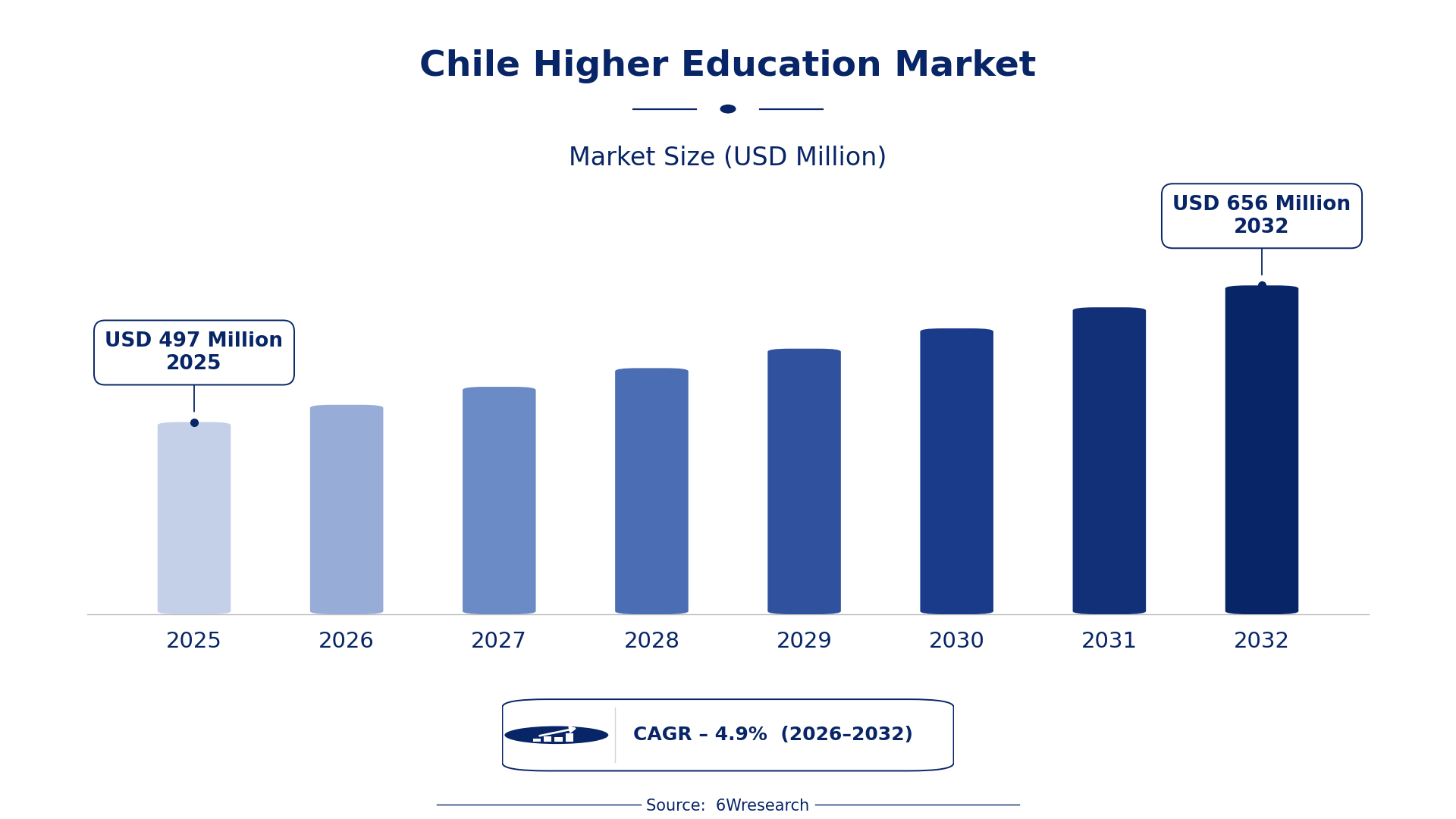
The Chile Higher Education Market was estimated at USD 497 Million in 2025 and is projected to reach USD 656 Million by 2032, growing at a CAGR of 4.9% from 2026 to 2032.
Chile Higher Education Market Synopsis
The Chile higher education market has recently gained momentum, driven by a growing demand for skilled professionals and an increasing focus on educational quality. While the current environment supports innovation and infrastructure development, the sector is also challenged by issues such as access and affordability.
Looking ahead, the market is expected to evolve significantly, propelled by government initiatives and collaborations between educational institutions and industry. The emphasis on online learning and competency-based models will likely redefine traditional education pathways in Chile.
Chile Higher Education Market Year-wise Growth Rate and Key Drivers
This graph illustrates the annual growth rates of the Chile Higher Education Market from 2021 to 2032, highlighting a steady upward trajectory and projected expansion over the forecast period.
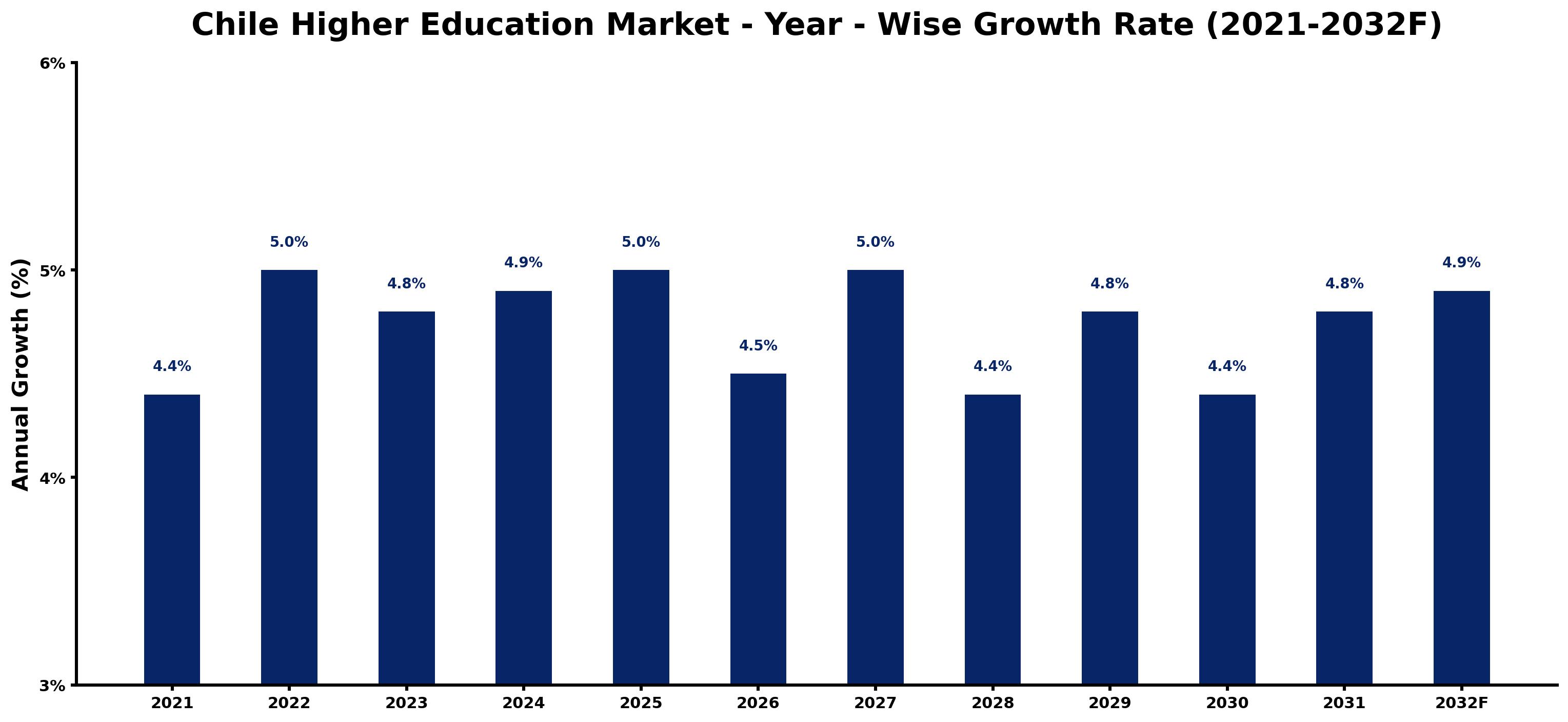
The table below presents the year‑wise growth rates along with the key drivers influencing the market
| Year | Growth Rate | Major Drivers |
| 2021 | 4.4% | Increased government funding for STEM education programs. |
| 2022 | 5.0% | Growing student interest in international exchange opportunities. |
| 2023 | 4.8% | Higher education reforms enhancing quality assurance policies. |
| 2024 | 4.9% | Emerging online degree programs from local universities. |
| 2025 | 5.0% | Increased demand for post-graduate degrees in health sciences. |
| 2026 | 4.5% | Government incentives for vocational training collaborations. |
| 2027 | 5.0% | Expanding partnerships with foreign universities for research. |
| 2028 | 4.4% | Surge in enrollment for environmental sustainability programs. |
| 2029 | 4.8% | Rising focus on entrepreneurship education initiatives. |
| 2030 | 4.4% | Increased support for digital literacy in schools. |
| 2031 | 4.8% | Growing awareness of global educational standards adoption. |
| 2032 | 4.9% | Strengthened ties between colleges and local industries. |
Note: Market size estimations and growth projections presented in this report are based on 6Wresearch's proprietary forecasting methodology, utilizing the latest available industry data, government publications, and primary research inputs.
Chile Higher Education Market Key Takeaways
Below are some of the specific key takeaways from the market, including:
- Growth driven by increased demand for skilled workforce and lifelong learning.
- Emphasis on quality education and accreditation standards to enhance institutional credibility.
- Expansion of online learning platforms and competency-based education models.
- Collaborations between academia and industry fostering curriculum innovation.
- Government policies focused on accessibility and quality improvements in higher education.
Evaluation of Restraints in Chile Higher Education Market
Several factors currently limit the full potential of the Chile higher education market. Limited funding hampers institutions' abilities to enhance infrastructure and resources, leading to disparities in access and quality. Additionally, socio-economic factors contribute to unequal educational opportunities, which further complicates the landscape. Tackling these challenges will require targeted investments and comprehensive reforms aimed at improving equity and educational outcomes.
Chile Higher Education Market Trends
The trend towards online learning is reshaping the educational experience in Chile. Institutions are increasingly adopting digital platforms to reach a wider audience and meet diverse learning needs. Competency-based education models are gaining traction, allowing students to progress at their own pace and aligning closely with industry requirements.
on top of that, partnerships between educational institutions and various industries are enhancing curriculum relevance and preparing graduates for evolving workforce demands. This integration not only facilitates practical training but also fosters innovation and entrepreneurship within the sector.
Chile Higher Education Market Opportunities
The Chile higher education market presents multiple avenues for growth and investment. Expansion in online education and distance learning programs offers significant potential to reach underserved populations. Additionally, initiatives aimed at improving educational quality and access can attract both domestic and international students.
Investing in research initiatives and technology integration will further bolster the academic infrastructure. Collaborations with industry can also pave the way for new educational programs that address skill gaps, enhancing the employability of graduates.
Government Initiatives in the Chile Higher Education Market
The Chilean government recognizes the vital role of higher education in national development and is actively shaping policies to enhance its accessibility and quality. Recent efforts have focused on funding mechanisms, partnerships, and regulatory frameworks to support educational institutions and improve the overall educational experience.
- A national scholarship program launched in early 2025 to increase accessibility for underprivileged students.
- Current initiatives include a comprehensive review of accreditation standards to ensure quality in higher education.
- A planned public-private partnership aimed at upgrading digital infrastructure in universities, expected to begin in 2026.
- Ongoing efforts to promote international exchange programs to enhance academic mobility among institutions.
- Introduction of a new policy framework in 2025 encouraging industry-academia collaborations to develop skill-oriented curricula.
Future Insights of the Chile Higher Education Market
As we look towards 2026-2032, the Chile higher education market is set to undergo transformative changes. The integration of technology into educational practices will continue to grow, making education more accessible and tailored to individual needs. With a strong emphasis on quality and relevance, institutions will likely adapt their programs to align with industry demands, fostering a more skilled workforce.
Government initiatives will further support these trends, ensuring that higher education remains a cornerstone of socio-economic development in Chile. This focus on enhancing educational frameworks will likely attract both domestic and international students, positioning Chile as a competitive player in the global education market.
Chile Higher Education Market Latest Developments
In the past year, the Chile higher education market has seen significant activity, reflecting the sector's commitment to innovation and improvement. Institutions have been actively pursuing partnerships and programs aimed at addressing current educational challenges and preparing for future demands.
- A major technology vendor completed a comprehensive digital transformation project in several universities in early 2025, enhancing their online learning capabilities.
- A leading regional operator launched a new online platform in mid-2025, offering a range of courses designed to meet industry needs.
- An initiative aimed at developing new competency-based programs began in late 2025 and remains underway, with institutions collaborating to create relevant curricula.
- A public-private initiative expected to expand research funding for innovative projects is set to begin in late 2026.
- Plans for a nationwide educational infrastructure upgrade have been proposed, aimed at improving access and facilities by 2027.
Chile Higher Education Market - Key Attractiveness of the Report
- 10 Years of Market Numbers
- Historical Data Starting from 2022 to 2025
- Base Year: 2025
- Forecast Data until 2032
- Key Performance Indicators Impacting the Market
- Major Upcoming Developments and Projects
Key Highlights of the Report:
- Chile Higher Education Market Outlook
- Market Size of Chile Higher Education Market, 2025
- Forecast of Chile Higher Education Market, 2032
- Historical Data and Forecast of Chile Higher Education Revenues & Volume for the Period 2022-2032F
- Chile Higher Education Market Trend Evolution
- Chile Higher Education Market Drivers and Challenges
- Chile Higher Education Price Trends
- Chile Higher Education Porter's Five Forces
- Chile Higher Education Industry Life Cycle
- Historical Data and Forecast of Chile Higher Education Market Revenues & Volume By Component for the Period 2022-2032F
- Historical Data and Forecast of Chile Higher Education Market Revenues & Volume By Solutions for the Period 2022-2032F
- Historical Data and Forecast of Chile Higher Education Market Revenues & Volume By Services for the Period 2022-2032F
- Historical Data and Forecast of Chile Higher Education Market Revenues & Volume By Deployment Type for the Period 2022-2032F
- Historical Data and Forecast of Chile Higher Education Market Revenues & Volume By On-premises for the Period 2022-2032F
- Historical Data and Forecast of Chile Higher Education Market Revenues & Volume By Cloud for the Period 2022-2032F
- Historical Data and Forecast of Chile Higher Education Market Revenues & Volume By Vertical for the Period 2022-2032F
- Historical Data and Forecast of Chile Higher Education Market Revenues & Volume By State Universities for the Period 2022-2032F
- Historical Data and Forecast of Chile Higher Education Market Revenues & Volume By Community Colleges for the Period 2022-2032F
- Historical Data and Forecast of Chile Higher Education Market Revenues & Volume By Private Colleges for the Period 2022-2032F
- Chile Higher Education Import Export Trade Statistics
- Market Opportunity Assessment By Component
- Market Opportunity Assessment By Deployment Type
- Market Opportunity Assessment By Vertical
- Chile Higher Education Top Companies Market Share
- Chile Higher Education Competitive Benchmarking By Technical and Operational Parameters
- Chile Higher Education Company Profiles
- Chile Higher Education Key Strategic Recommendations






































