Chile Managed Services Market Size & Growth Rate (2026-2032)
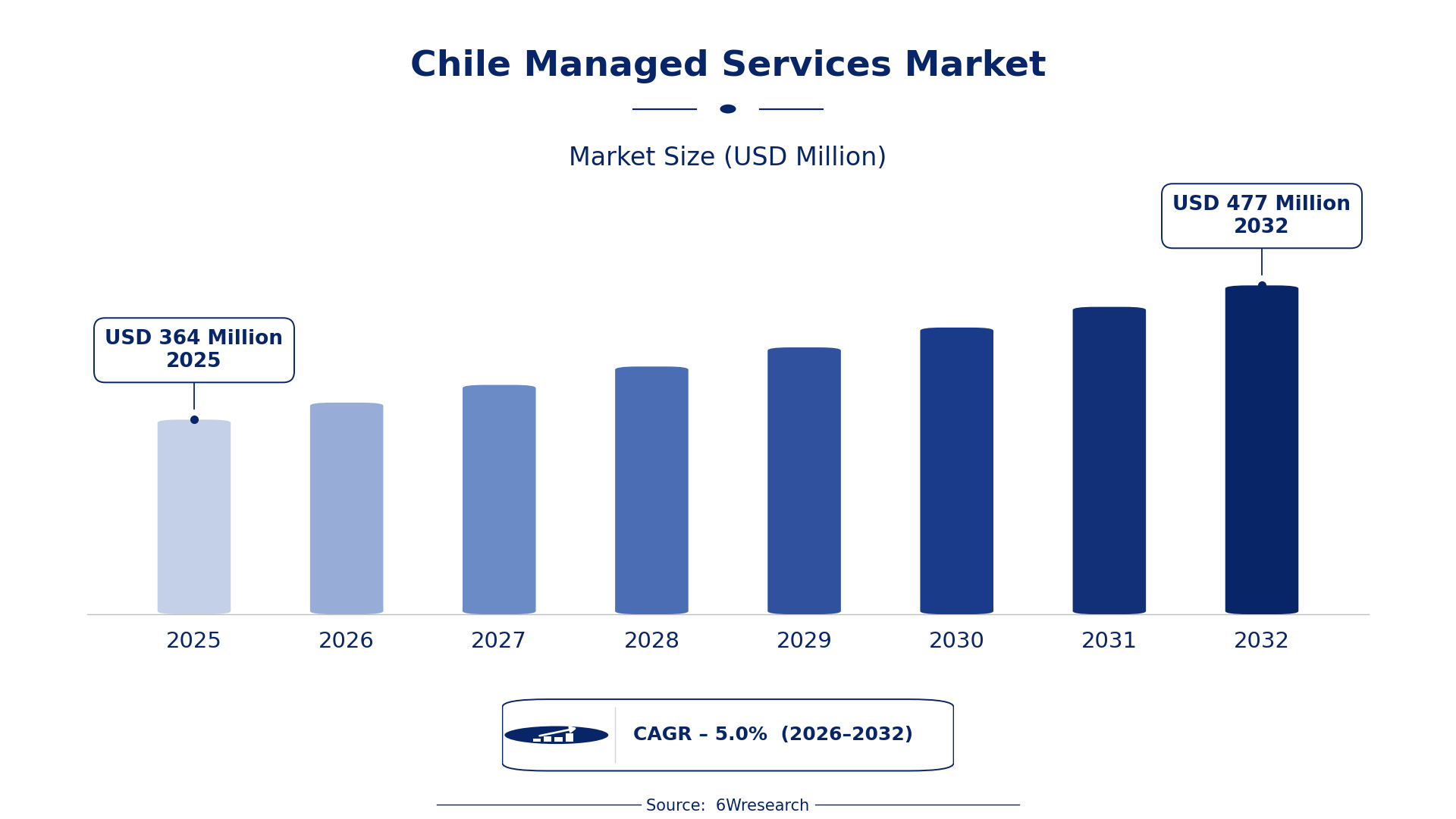
The Chile Managed Services Market was estimated at USD 364 Million in 2025 and is projected to reach USD 477 Million by 2032, growing at a CAGR of 5.0% from 2026 to 2032.
Chile Managed Services Market Synopsis
In Chile, the demand for managed services is largely fueled by the growing shift towards cloud computing. Businesses recognize the need for specialized support in managing complex IT environments, leading to a surge in partnerships with managed services providers.
As organizations continue their digital transformation journeys, they seek solutions that enhance efficiency and security. This trend is reflected in the increasing adoption of cybersecurity services, data management, and comprehensive IT support offerings.
Chile Managed Services Market Year-wise Growth Rate and Key Drivers
This graph illustrates the annual growth rates of the Chile Managed Services Market from 2021 to 2032, highlighting a steady upward trajectory and projected expansion over the forecast period.
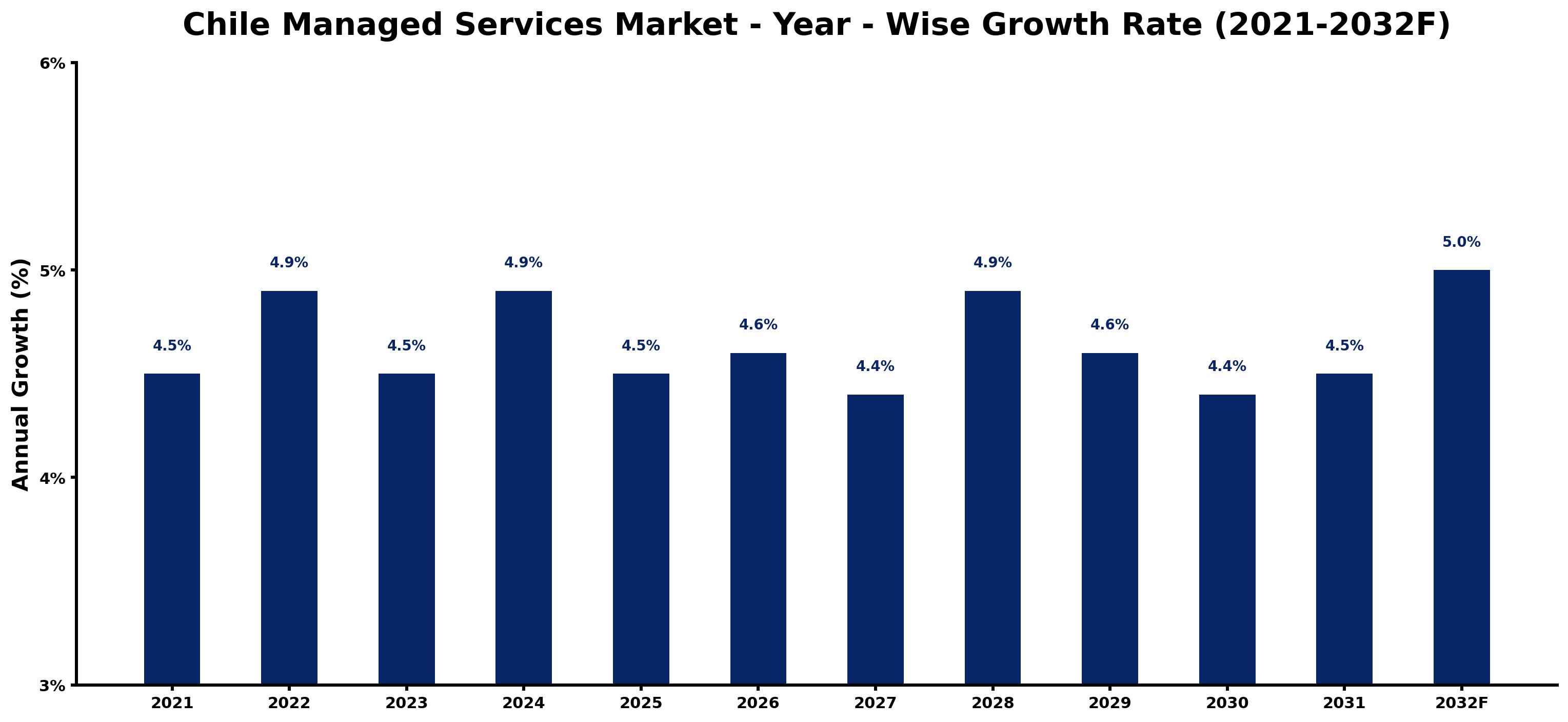
The table below presents the year‑wise growth rates along with the key drivers influencing the market
| Year | Growth Rate | Major Drivers |
| 2021 | 4.5% | Government digitalization initiative expanding IT service needs. |
| 2022 | 4.9% | Rising SME reliance on outsourced IT management solutions. |
| 2023 | 4.5% | Increased remote work trends boosting managed service demand. |
| 2024 | 4.9% | Chilean fintech growth necessitating advanced IT support services. |
| 2025 | 4.5% | Education sector digital transformation driving managed service investments. |
| 2026 | 4.6% | Healthcare digital records adoption increasing IT management requirements. |
| 2027 | 4.4% | Local businesses enhancing cybersecurity frameworks via managed services. |
| 2028 | 4.9% | Telecom sector upgrades elevating demand for managed IT solutions. |
| 2029 | 4.6% | Government incentives for tech startups boosting managed service uptake. |
| 2030 | 4.4% | Regulatory pressures driving compliance-focused managed service adoption. |
| 2031 | 4.5% | Smart farming initiatives requiring specialized IT service support. |
| 2032 | 5.0% | Increased investments in green technology necessitating IT management. |
Note: Market size estimations and growth projections presented in this report are based on 6Wresearch's proprietary forecasting methodology, utilizing the latest available industry data, government publications, and primary research inputs.
Chile Managed Services Market Key Takeaways
Below are some of the specific key takeaways from the market, including:
- The market is benefiting from the rapid adoption of cloud services and digital transformation efforts across various sectors.
- Cybersecurity concerns are driving demand for managed security services as organizations prioritize data protection.
- There is a notable shift towards automation and AI technologies in service delivery, enhancing operational efficiency.
- Pricing pressures from increasing competition are pushing providers to innovate and differentiate their offerings.
- Local and international players are actively competing for market share, creating a dynamic competitive environment.
Evaluation of Restraints in Chile Managed Services Market
Despite its growth potential, the Chile Managed Services Market faces several challenges. Competition is intensifying, resulting in pricing pressures that can affect profitability for providers. on top of that, there is a continuous need for investment in advanced technologies, which can be a barrier for some companies. The persistent shortage of skilled IT professionals also hampers service delivery quality. Regulatory hurdles, particularly in sectors dealing with sensitive data, add another layer of complexity that providers must navigate.
Chile Managed Services Market Trends
Emerging trends in the Chile Managed Services Market are heavily influenced by technological advancements and changing business needs. The integration of AI and automation is becoming commonplace, allowing providers to offer enhanced service efficiency and proactive management solutions. Additionally, businesses are increasingly prioritizing compliance and data security, leading to a higher demand for managed services that address these critical areas. The rise of remote work has also catalyzed the need for comprehensive IT management services.
Chile Managed Services Market Opportunities
Significant growth opportunities exist within the Chile Managed Services Market, particularly in areas like managed cloud services and cybersecurity solutions. As organizations aim to optimize their IT operations, there is potential for service providers to introduce innovative, value-added services. The convergence of IoT and managed services presents a unique opportunity to cater to industries looking for integrated solutions. on top of that, the emphasis on compliance opens avenues for specialized consulting and support services.
Government Initiatives in the Chile Managed Services Market
The Chilean government plays a crucial role in shaping the Managed Services Market through various initiatives aimed at fostering technological advancement and regulatory compliance. By promoting digital transformation strategies and encouraging public-private partnerships, the government seeks to create a conducive environment for market growth. These efforts are essential as businesses look for reliable frameworks to guide their managed service engagements.
- A recently completed initiative involved the launch of the National Digital Strategy, aimed at enhancing digital capabilities across various sectors.
- Currently underway is a program focused on improving data protection regulations to ensure compliance and security for businesses handling sensitive information.
- Planned initiatives include a public-private partnership expected to expand broadband access, facilitating better managed service delivery across the country.
- A regulatory framework introduced in 2025 mandating transparency in billing practices is set to impact service provider-client relationships positively.
- The government is also actively promoting AI integration in public services, which is likely to spill over into the managed services sector.
Future Insights of the Chile Managed Services Market
Looking ahead, the Chile Managed Services Market is positioned for continued growth. The increasing adoption of cloud-based services will remain a driving force, as businesses seek to enhance operational efficiency. With digital transformation remaining a priority, demand for managed services that provide security, analytics, and IT support will likely expand. Providers who invest in innovative technologies and maintain strong client relationships will be well-placed to capture the emerging opportunities.
Chile Managed Services Market Latest Developments
In the past year, the Chile Managed Services Market has seen several noteworthy developments that reflect the dynamic nature of the industry. Companies are increasingly launching new service offerings and enhancing existing ones to meet evolving customer needs. Collaboration among service providers and technology vendors is on the rise, aimed at delivering comprehensive solutions.
- A major technology vendor announced the rollout of a new suite of managed security services aimed at small to medium enterprises, which began in early 2025.
- In Q2 2025, a leading regional operator initiated an upgrade of its data management services to incorporate AI-driven analytics capabilities.
- Currently ongoing is a partnership between multiple service providers focused on enhancing network monitoring solutions to better support remote work environments.
- Plans are in place for a new disaster recovery service expected to launch by mid-2026, aimed at improving business continuity for various sectors.
- In early 2025, a significant investment in cloud infrastructure was announced, aimed at bolstering managed cloud service offerings across Chile.
Chile Managed Services Market - Key Attractiveness of the Report
- 10 Years of Market Numbers
- Historical Data Starting from 2022 to 2025
- Base Year: 2025
- Forecast Data until 2032
- Key Performance Indicators Impacting the Market
- Major Upcoming Developments and Projects
Key Highlights of the Report:
- Chile Managed Services Market Outlook
- Market Size of Chile Managed Services Market, 2025
- Forecast of Chile Managed Services Market, 2032
- Historical Data and Forecast of Chile Managed Services Revenues & Volume for the Period 2022-2032F
- Chile Managed Services Market Trend Evolution
- Chile Managed Services Market Drivers and Challenges
- Chile Managed Services Price Trends
- Chile Managed Services Porter's Five Forces
- Chile Managed Services Industry Life Cycle
- Historical Data and Forecast of Chile Managed Services Market Revenues & Volume By Service Type for the Period 2022-2032F
- Historical Data and Forecast of Chile Managed Services Market Revenues & Volume By Managed Security Services for the Period 2022-2032F
- Historical Data and Forecast of Chile Managed Services Market Revenues & Volume By Managed Network Services for the Period 2022-2032F
- Historical Data and Forecast of Chile Managed Services Market Revenues & Volume By Managed Data Center and IT Infrastructure Services for the Period 2022-2032F
- Historical Data and Forecast of Chile Managed Services Market Revenues & Volume By Managed Communication and Collaboration Services for the Period 2022-2032F
- Historical Data and Forecast of Chile Managed Services Market Revenues & Volume By Managed Mobility Services for the Period 2022-2032F
- Historical Data and Forecast of Chile Managed Services Market Revenues & Volume By Managed Information Services for the Period 2022-2032F
- Historical Data and Forecast of Chile Managed Services Market Revenues & Volume By Deployment Type for the Period 2022-2032F
- Historical Data and Forecast of Chile Managed Services Market Revenues & Volume By Cloud for the Period 2022-2032F
- Historical Data and Forecast of Chile Managed Services Market Revenues & Volume By On-Premises for the Period 2022-2032F
- Historical Data and Forecast of Chile Managed Services Market Revenues & Volume By Organization Size for the Period 2022-2032F
- Historical Data and Forecast of Chile Managed Services Market Revenues & Volume By Small and Medium-sized Enterprises (SMEs) for the Period 2022-2032F
- Historical Data and Forecast of Chile Managed Services Market Revenues & Volume By Large Enterprises for the Period 2022-2032F
- Historical Data and Forecast of Chile Managed Services Market Revenues & Volume By Vertical for the Period 2022-2032F
- Historical Data and Forecast of Chile Managed Services Market Revenues & Volume By BFSI for the Period 2022-2032F
- Historical Data and Forecast of Chile Managed Services Market Revenues & Volume By IT and Telecom for the Period 2022-2032F
- Historical Data and Forecast of Chile Managed Services Market Revenues & Volume By Retail and Consumer Goods for the Period 2022-2032F
- Historical Data and Forecast of Chile Managed Services Market Revenues & Volume By Manufacturing for the Period 2022-2032F
- Historical Data and Forecast of Chile Managed Services Market Revenues & Volume By Government for the Period 2022-2032F
- Historical Data and Forecast of Chile Managed Services Market Revenues & Volume By Healthcare and Life Sciences for the Period 2022-2032F
- Historical Data and Forecast of Chile Managed Services Market Revenues & Volume By Energy and Utilities for the Period 2022-2032F
- Historical Data and Forecast of Chile Managed Services Market Revenues & Volume By Media and Entertainment for the Period 2022-2032F
- Chile Managed Services Import Export Trade Statistics
- Market Opportunity Assessment By Service Type
- Market Opportunity Assessment By Deployment Type
- Market Opportunity Assessment By Organization Size
- Market Opportunity Assessment By Vertical
- Chile Managed Services Top Companies Market Share
- Chile Managed Services Competitive Benchmarking By Technical and Operational Parameters
- Chile Managed Services Company Profiles
- Chile Managed Services Key Strategic Recommendations






































