China Ad Targeting AI Market Size & Growth Rate
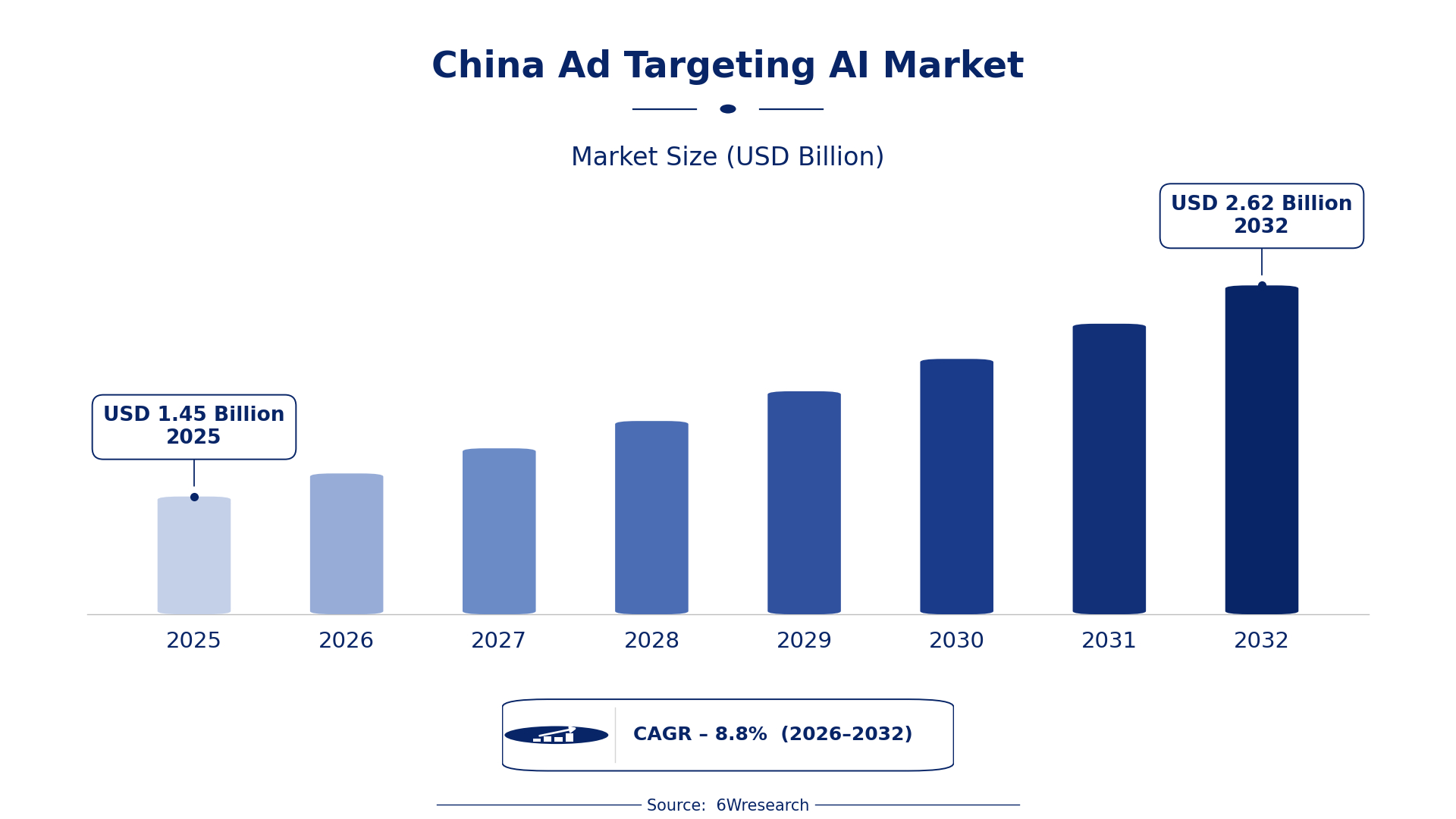
According to 6Wresearch internal database and industry insights, the China Ad Targeting AI Market was valued at USD 1.45 billion in 2025 and is projected to reach USD 2.62 billion by 2032, growing at a CAGR of approximately 8.8% during 2026–2032.
China Ad Targeting AI Market Highlights
| Report Metric | Details |
| Report Name | China Ad Targeting AI Market |
| Market Size 2025 | USD 1.45 billion |
| Market Size 2032 | USD 2.62 billion |
| Absolute Growth 2025–2032 | USD 1.17 billion |
| CAGR 2026–2032 | 8.8% |
| Peak Annual Growth | 10.8% in 2028 |
| Forecast Period | 2026–2032 |
| Historical Data | 2022–2025 |
| Base Year | 2025 |
| Leading Technology Type, 2025 | Machine Learning-Based (33% share) |
| Leading Deployment Mode, 2025 | Cloud (53% share) |
| Leading Distribution Channel, 2025 | SaaS Platforms (47% share) |
| Leading End User Segment, 2025 | Digital Advertisers (46% share) |
| Leading Application Area, 2025 | Behavioral Targeting (46% share) |
| Fastest-Growing Technology Type | Predictive Analytics (10.1% CAGR) |
| Fastest-Growing Deployment Mode | Hybrid (10.4% CAGR) |
| Fastest-Growing End User Segment | E-commerce Companies (10.3% CAGR) |
| Fastest-Growing Application Area | Campaign Optimization (10.5% CAGR) |
| Growing Sector | E-commerce |
| Key End Users | Digital Advertisers, E-commerce Companies, Marketing Agencies, AdTech Vendors |
China Ad Targeting AI Market Year-wise Growth Rate and Key Drivers (2022–2032)
This graph illustrates the annual growth rates of the market from 2022 to 2032, highlighting a steady upward trajectory and projected market expansion over the forecast period.
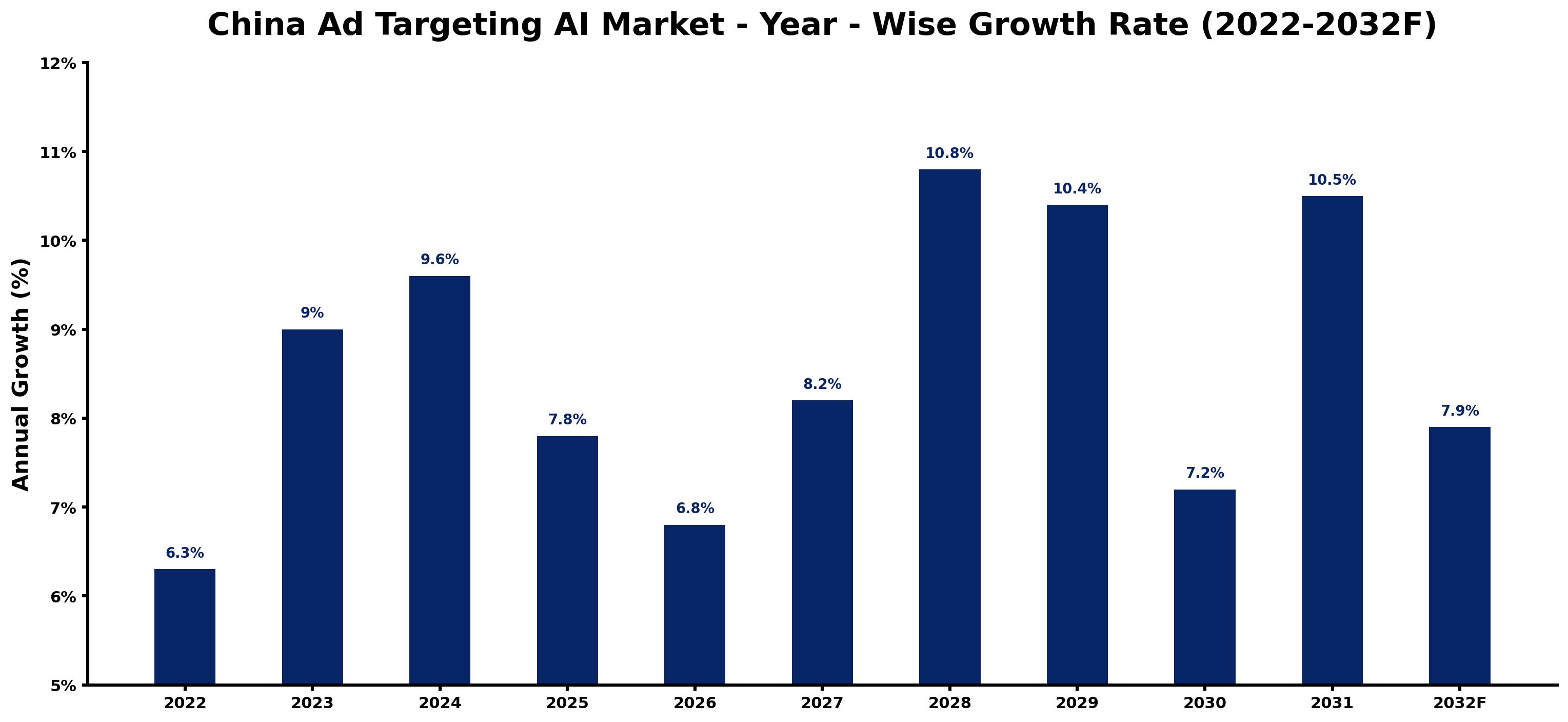
Annual growth estimates for each year appear below with the principal reason behind them, explaining the shifts that set the pace of the market.
| Year | Estimated Annual Growth (%) | Market Rationale |
| 2022 | 6.3 | The digital advertising market showed strong activity, driven by a growing user base. |
| 2023 | 9.0 | Adoption of AI technologies accelerated as more companies sought competitive advantages. |
| 2024 | 9.6 | Increased investment in digital marketing strategies boosted demand for AI solutions. |
| 2025 | 7.8 | Growth slowed as companies adjusted to new technologies and market conditions. |
| 2026 | 6.8 | Demand is expected to remain steady as the AI Innovation Action Plan is implemented. |
| 2027 | 8.2 | A resurgence in e-commerce activity is projected to spur renewed interest in targeted advertising. |
| 2028 | 10.8 | The market is expected to peak as AI technologies become integral to advertising strategies. |
| 2029 | 10.4 | Growth will slow slightly as companies focus on optimising existing AI systems. |
| 2030 | 7.2 | Market expansion is projected to continue but at a slower pace due to intensified competition. |
| 2031 | 10.5 | A renewed focus on innovation will lead to higher growth rates in AI adoption. |
| 2032 | 7.9 | Growth is expected to moderate again as the market stabilises, reflecting maturity in technology. |
Note: Market size estimations and growth projections presented in this report are based on 6Wresearch's proprietary forecasting methodology, utilizing the latest available industry data, government publications, and primary research inputs.
China Ad Targeting AI Market Synopsis
Ad Targeting AI in China is a technology that optimises advertising by targeting specific audiences based on their behaviour. It utilises algorithms and data analysis to improve ad relevance and conversion rates. The China Ad Targeting AI Market is expanding due to the booming digital advertising sector, which reached approximately 1 trillion yuan in 2022. Demand arises from over 1 billion internet users and the growing e-commerce sector, projected to expand with over 800 million users. This growth is driven by initiatives like the AI Innovation Action Plan, which promotes AI applications in advertising.
Market Dynamics Impact Analysis (2026–2032)
| Factor | Type | Impact | Primary Segment Affected |
| Growing user base of over 1 billion internet users driving demand for targeted advertising. | Driver | High | Digital Advertisers |
| Increased investment in AI technologies to enhance advertising effectiveness. | Driver | High | E-commerce Companies |
| The e-commerce sector's rapid growth creates a need for advanced advertising solutions. | Opportunity | High | E-commerce Companies |
| The Shanghai region's development as a hub for digital marketing offers investment potential. | Opportunity | Medium | Digital Advertisers |
| Regulatory compliance costs can burden smaller advertising firms. | Restraint | High | Marketing Agencies |
| High competition among advertisers may limit profit margins. | Restraint | Medium | AdTech Vendors |
| Limited access to advanced AI technologies can hinder market growth. | Challenge | High | Digital Advertisers |
| The need for continuous innovation can strain resources for many firms. | Challenge | Medium | E-commerce Companies |
Evaluation of Drivers in China Ad Targeting AI Market (2026–2032)
Below mentioned are some major drivers and their influence on market dynamics.
| Drivers | Primary Segment Affected | Why It Matters (Evidence) |
| Increased internet penetration drives demand for targeted advertising solutions. | Digital Advertisers | The number of internet users in China exceeded 1 billion in 2023. |
| Growing e-commerce sector necessitates advanced advertising strategies. | E-commerce Companies | The e-commerce sector is projected to grow, with a user base of over 800 million. |
| Investment in AI technologies improves advertising effectiveness. | Marketing Agencies | AI-driven personalized ads have shown to improve conversion rates by over 30%. |
| AI Innovation Action Plan promotes AI applications in advertising. | AdTech Vendors | The Ministry of Industry and Information Technology launched the 'AI Innovation Action Plan' in 2021. |
| Increased adoption of machine learning enhances ad targeting capabilities. | Digital Advertisers | The use of machine learning in advertising is expected to increase as more companies adopt AI technologies. |
Market growth in China for Ad Targeting AI rests on expanding end-use demand, increased investment in AI technologies, and the rapid growth of the e-commerce sector. The digital advertising market reached approximately 1 trillion yuan in 2022, driven by over 1 billion internet users. E-commerce companies are increasingly adopting AI solutions to improve customer engagement. The AI Innovation Action Plan, launched in 2021, promotes the integration of AI in advertising, further boosting demand. AI-driven personalized ads have improved conversion rates by over 30%, encouraging advertisers to invest in these technologies. The Shanghai region is emerging as a hub for digital marketing and advertising technology development, further supporting this growth.
Evaluation of Restraints in China Ad Targeting AI Market
The following restraints limit how fast demand can grow.
| Market Restraint | Primary Segment Affected | Why It Matters (Evidence) |
| Compliance with regulatory standards increases operational costs for smaller firms. | Marketing Agencies | Regulatory compliance costs can burden smaller advertising firms, limiting their competitiveness. |
| Intense competition among advertisers can squeeze profit margins. | AdTech Vendors | High competition among advertisers may limit profit margins, affecting investment in new technologies. |
| Limited access to advanced AI technologies can hinder market growth. | Digital Advertisers | Smaller companies may struggle to access the latest AI technologies, impacting their effectiveness. |
| High costs of AI implementation may deter smaller businesses. | E-commerce Companies | The initial investment required for AI technologies can be prohibitive for smaller e-commerce firms. |
| Market saturation may slow down growth rates as competition increases. | Digital Advertisers | As the market matures, growth rates may stabilise, reflecting increased competition. |
China Ad Targeting AI Market Challenges
In China, regulatory hurdles related to the National Standards for AI can delay project approvals by up to six months, hindering advertisers from launching timely campaigns. Limited access to quality data sources compels advertisers to invest heavily in data acquisition, raising operational costs by 20%. Competition intensifies as a 15% rise in AI adoption among advertisers in 2023 pressures smaller firms to vie for market share, often leading to reduced profitability. Shortages of skilled AI developers create bottlenecks, resulting in project delays that inflate costs and limit the implementation of advanced targeting solutions for advertisers.
Trends in the China Ad Targeting AI Market
Several trends are reshaping the China Ad Targeting AI Market; the most important are set out below.
- Shift Towards Machine Learning-Based Advertising: In 2023, the adoption of machine learning in advertising surged, with AI-driven personalised ads improving conversion rates by over 30%. This shift enables advertisers to better target audiences and optimise campaigns.
- E-commerce Companies Embracing AI Solutions: Since 2022, e-commerce companies have increasingly embraced AI technologies, with a projected user base exceeding 800 million. This trend boosts customer engagement and drives sales through targeted advertising.
- Growth of Cloud-Based Deployment Models: Beginning in 2022, cloud-based solutions for Ad Targeting AI gained momentum, with Cloud accounting for 53% of deployment modes by 2025. This shift facilitates scalable and efficient data management.
- Emergence of Predictive Analytics in Advertising: The rise of predictive analytics has been notable since 2023, with a CAGR of 10.1% expected through 2032. This trend empowers advertisers to forecast consumer behaviour and optimise ad performance.
Investment Opportunities in the China Ad Targeting AI Market
Some of the investment opportunities in the China Ad Targeting AI Market are mentioned below.
- Gap in AI Adoption Among Smaller Firms: With 15% of advertisers still not utilising AI in 2023, there is an opportunity to provide tailored solutions to these firms, particularly in regions like Shanghai where digital marketing is thriving.
- Timing for Investment in AI Technologies: As the Chinese government allocated 10 billion yuan for AI development in 2023, now presents an opportune moment for investors to enter the market, especially targeting digital advertisers requiring advanced solutions.
- Focus on E-commerce Growth: Given the e-commerce sector's anticipated growth, there is a strong opportunity to supply AI solutions tailored for this market, particularly in major hubs like Beijing, where demand is escalating rapidly.
- Investment in AI Startups: With substantial funding allocated for AI research and development, investors can explore partnerships with AI startups in Beijing, tapping into the growing interest in advertising technologies.
Government Initiatives in the China Ad Targeting AI Market
The 'Guidelines for Promoting the Development of AI' issued by the State Council in 2020 emphasise innovation in AI technologies, including advertising applications. This framework supports the integration of AI across various sectors, improving advertising efficiency. The 'Digital Economy Development Strategy' initiated by the National Development and Reform Commission in 2022 further encourages AI integration in digital marketing, providing a structured approach to development. The 'AI Innovation Action Plan' launched by the Ministry of Industry and Information Technology in 2021 aims to advance AI technology applications across various sectors, including advertising, by promoting research and development. In 2023, the Chinese government allocated 5 billion yuan to support AI initiatives, including applications in the advertising industry.
The National Development and Reform Commission oversees funding for AI initiatives. In 2023, the agency allocated 5 billion yuan to support AI research and development, including applications in the advertising industry. The agency also monitors compliance with national standards, ensuring that AI technologies meet regulatory requirements. This oversight allows producers and buyers to confidently adopt AI solutions, knowing they comply with established guidelines. The Ministry of Industry and Information Technology also plays a crucial role in approving AI projects, facilitating smoother integration of these technologies into the advertising sector.
Future Insight of the China Ad Targeting AI Market
By 2032, the China Ad Targeting AI market will undergo substantial transformations, driven by the AI Innovation Action Plan that streamlines the integration of advanced algorithms into advertising strategies. The e-commerce sector, with a user base surpassing 800 million, will fuel demand for targeted advertising solutions, enhancing customer engagement. Increased funding for AI startups in the Beijing region will spur innovation, resulting in new tools that improve ad relevance. As machine learning adoption rises, advertisers can expect considerable increases in conversion rates, prompting shifts in their marketing strategies.
Market Segmentation Analysis
The analysis below covers each segmentation, its leading category in 2025 and its fastest-growing category through 2032.
By Technology Type – Machine Learning-Based Dominated, Predictive Analytics Expected to Grow Fastest
According to Ravi Bhandari, Research Head at 6Wresearch, Machine Learning-Based accounted for a 33% market share by technology type in 2025. Machine Learning-Based technology holds the largest share in the China Ad Targeting AI Market because it is essential for analysing vast amounts of user data and optimising ad placements effectively. This technology is particularly crucial for advertisers looking to enhance engagement in a market with over 1 billion internet users. Predictive Analytics is set to record the highest CAGR in this split, 10.1% over 2026–2032. Predictive Analytics is experiencing rapid growth as it effectively forecasts consumer behaviour and ad performance, allowing advertisers to tailor their strategies. The increasing adoption of advanced technologies highlights the need for predictive insights to refine marketing efforts, ensuring relevance and efficiency. Suppliers should focus on developing predictive analytics tools to meet the growing demand from advertisers seeking to optimise their campaigns.
By Deployment Mode – Cloud Dominated, Hybrid Expected to Grow Fastest
With a 53% revenue share in 2025, Cloud was the largest deployment mode category. Cloud deployment leads the market by offering scalable solutions that are vital for efficiently processing large volumes of data. This mode is especially advantageous for companies aiming to enhance their advertising capabilities without incurring heavy infrastructure costs. Over 2026–2032, Hybrid is expected to post the fastest growth, at a CAGR of 10.4%. Hybrid deployment is gaining momentum as it combines the benefits of both cloud and on-premise solutions, providing greater flexibility for advertisers. As businesses increasingly seek tailored options, the hybrid model is becoming more appealing for its adaptability to diverse needs. Buyers may benefit from exploring hybrid solutions to optimise their advertising strategies while maintaining control over their data management.
By Distribution Channel – SaaS Platforms Dominated and Is Expected to Record the Fastest Growth
In 2025, SaaS Platforms led the distribution channel split with a 47% share. SaaS Platforms dominate the distribution channel segment due to their widespread adoption, offering ease of access and seamless integration for advertisers. This model effectively addresses the growing need for efficient ad targeting solutions in a highly competitive digital environment. The same category are also set to grow fastest, at a CAGR of 10.8% during 2026–2032. SaaS Platforms are also the fastest-growing channel, as their convenience and scalability continue to attract more users. The ongoing shift towards cloud-based solutions ensures that SaaS remains a central component of the distribution landscape, driving further growth. Suppliers should enhance their SaaS offerings to capture the increasing market share among digital advertisers looking for efficient solutions.
By End User Segment – Digital Advertisers Dominated, E-commerce Companies Expected to Grow Fastest
The largest end user segment category in 2025 was Digital Advertisers, with a 46% share of total revenue. Digital Advertisers hold the largest share of the end user segment, utilising AI to maximise campaign effectiveness in a fast-paced market. Their dependence on data-driven strategies highlights the importance of targeted advertising in achieving marketing objectives. The quickest growth will come from E-commerce Companies, forecast to expand at a CAGR of 10.3% between 2026 and 2032. E-commerce Companies are the fastest-growing segment, driven by their need for AI to create personalised shopping experiences for over 800 million users. As the e-commerce sector continues to expand, the demand for tailored advertising solutions is expected to rise. Suppliers must tailor their offerings to meet the specific needs of e-commerce companies to capitalise on this growth opportunity.
By Application Area – Behavioral Targeting Dominated, Campaign Optimization Expected to Grow Fastest
Behavioral Targeting took a 46% share of application area in 2025, more than any other category. Behavioral Targeting is the leading application area as it forms the foundation of ad targeting strategies based on user behaviour. This approach is crucial for advertisers aiming to deliver relevant content and significantly improve engagement rates. Campaign Optimization is set to record the highest CAGR in this split, 10.5% over 2026–2032. Campaign Optimization is the fastest-growing area, driven by advertisers' increasing need to refine their strategies based on performance metrics. The continuous demand for improved advertising effectiveness is propelling this growth, making it essential for success in the market. Buyers should invest in campaign optimisation tools to enhance their advertising strategies and achieve superior results.
Key Attractiveness of the Report
- 10 Years of Market Numbers
- Historical Data Starting from 2022 to 2025
- Base Year 2025
- Forecast Data until 2032
- Key Performance Indicators Impacting the Market
- Major Upcoming Developments and Projects
Key Highlights of the Report:
- China Ad Targeting AI Market Outlook
- Market Size of China Ad Targeting AI Market, 2025
- Forecast of China Ad Targeting AI Market, 2032
- Historical Data and Forecast of China Ad Targeting AI Revenues & Volume for the Period 2022 - 2032F
- China Ad Targeting AI Market Trend Evolution
- China Ad Targeting AI Market Drivers and Challenges
- China Ad Targeting AI Price Trends
- China Ad Targeting AI Porter's Five Forces
- China Ad Targeting AI Industry Life Cycle
- Historical Data and Forecast of China Ad Targeting AI Market Revenues & Volume By Technology Type for the Period 2022 - 2032F
- Historical Data and Forecast of China Ad Targeting AI Market Revenues & Volume By Machine Learning-Based for the Period 2022 - 2032F
- Historical Data and Forecast of China Ad Targeting AI Market Revenues & Volume By Contextual AI for the Period 2022 - 2032F
- Historical Data and Forecast of China Ad Targeting AI Market Revenues & Volume By Predictive Analytics for the Period 2022 - 2032F
- Historical Data and Forecast of China Ad Targeting AI Market Revenues & Volume By NLP-based Systems for the Period 2022 - 2032F
- Historical Data and Forecast of China Ad Targeting AI Market Revenues & Volume By Real-Time Bidding AI for the Period 2022 - 2032F
- Historical Data and Forecast of China Ad Targeting AI Market Revenues & Volume By Deployment Mode for the Period 2022 - 2032F
- Historical Data and Forecast of China Ad Targeting AI Market Revenues & Volume By Cloud for the Period 2022 - 2032F
- Historical Data and Forecast of China Ad Targeting AI Market Revenues & Volume By On-Premise for the Period 2022 - 2032F
- Historical Data and Forecast of China Ad Targeting AI Market Revenues & Volume By Hybrid for the Period 2022 - 2032F
- Historical Data and Forecast of China Ad Targeting AI Market Revenues & Volume By Cloud for the Period 2022 - 2032F
- Historical Data and Forecast of China Ad Targeting AI Market Revenues & Volume By Cloud for the Period 2022 - 2032F
- Historical Data and Forecast of China Ad Targeting AI Market Revenues & Volume By Distribution Channel for the Period 2022 - 2032F
- Historical Data and Forecast of China Ad Targeting AI Market Revenues & Volume By SaaS Platforms for the Period 2022 - 2032F
- Historical Data and Forecast of China Ad Targeting AI Market Revenues & Volume By Direct Sales for the Period 2022 - 2032F
- Historical Data and Forecast of China Ad Targeting AI Market Revenues & Volume By Marketing Agencies for the Period 2022 - 2032F
- Historical Data and Forecast of China Ad Targeting AI Market Revenues & Volume By Online Subscriptions for the Period 2022 - 2032F
- Historical Data and Forecast of China Ad Targeting AI Market Revenues & Volume By AdTech Vendors for the Period 2022 - 2032F
- Historical Data and Forecast of China Ad Targeting AI Market Revenues & Volume By End User Segment for the Period 2022 - 2032F
- Historical Data and Forecast of China Ad Targeting AI Market Revenues & Volume By Digital Advertisers for the Period 2022 - 2032F
- Historical Data and Forecast of China Ad Targeting AI Market Revenues & Volume By E-commerce Companies for the Period 2022 - 2032F
- Historical Data and Forecast of China Ad Targeting AI Market Revenues & Volume By Media Agencies for the Period 2022 - 2032F
- Historical Data and Forecast of China Ad Targeting AI Market Revenues & Volume By Social Media Platforms for the Period 2022 - 2032F
- Historical Data and Forecast of China Ad Targeting AI Market Revenues & Volume By Streaming Services for the Period 2022 - 2032F
- Historical Data and Forecast of China Ad Targeting AI Market Revenues & Volume By Application Area for the Period 2022 - 2032F
- Historical Data and Forecast of China Ad Targeting AI Market Revenues & Volume By Behavioral Targeting for the Period 2022 - 2032F
- Historical Data and Forecast of China Ad Targeting AI Market Revenues & Volume By Personalized Ads for the Period 2022 - 2032F
- Historical Data and Forecast of China Ad Targeting AI Market Revenues & Volume By Audience Segmentation for the Period 2022 - 2032F
- Historical Data and Forecast of China Ad Targeting AI Market Revenues & Volume By Sentiment Analysis for the Period 2022 - 2032F
- Historical Data and Forecast of China Ad Targeting AI Market Revenues & Volume By Campaign Optimization for the Period 2022 - 2032F
- China Ad Targeting AI Import Export Trade Statistics
- Market Opportunity Assessment By Technology Type
- Market Opportunity Assessment By Deployment Mode
- Market Opportunity Assessment By Distribution Channel
- Market Opportunity Assessment By End User Segment
- Market Opportunity Assessment By Application Area
- China Ad Targeting AI Top Companies Market Share
- China Ad Targeting AI Competitive Benchmarking By Technical and Operational Parameters
- China Ad Targeting AI Company Profiles
- China Ad Targeting AI Key Strategic Recommendations
Market Covered
Segments analysed in this report are listed below.
By Technology Type
- Machine Learning-Based
- Contextual AI
- Predictive Analytics
- NLP-based Systems
- Real-Time Bidding AI
By Deployment Mode
- Cloud
- On-Premise
- Hybrid
By Distribution Channel
- SaaS Platforms
- Direct Sales
- Marketing Agencies
- Online Subscriptions
- AdTech Vendors
By End User Segment
- Digital Advertisers
- E-commerce Companies
- Media Agencies
- Social Media Platforms
- Streaming Services
By Application Area
- Behavioral Targeting
- Personalized Ads
- Audience Segmentation
- Sentiment Analysis
- Campaign Optimization































