China Adaptive Lighting Control Market Size & Growth Rate
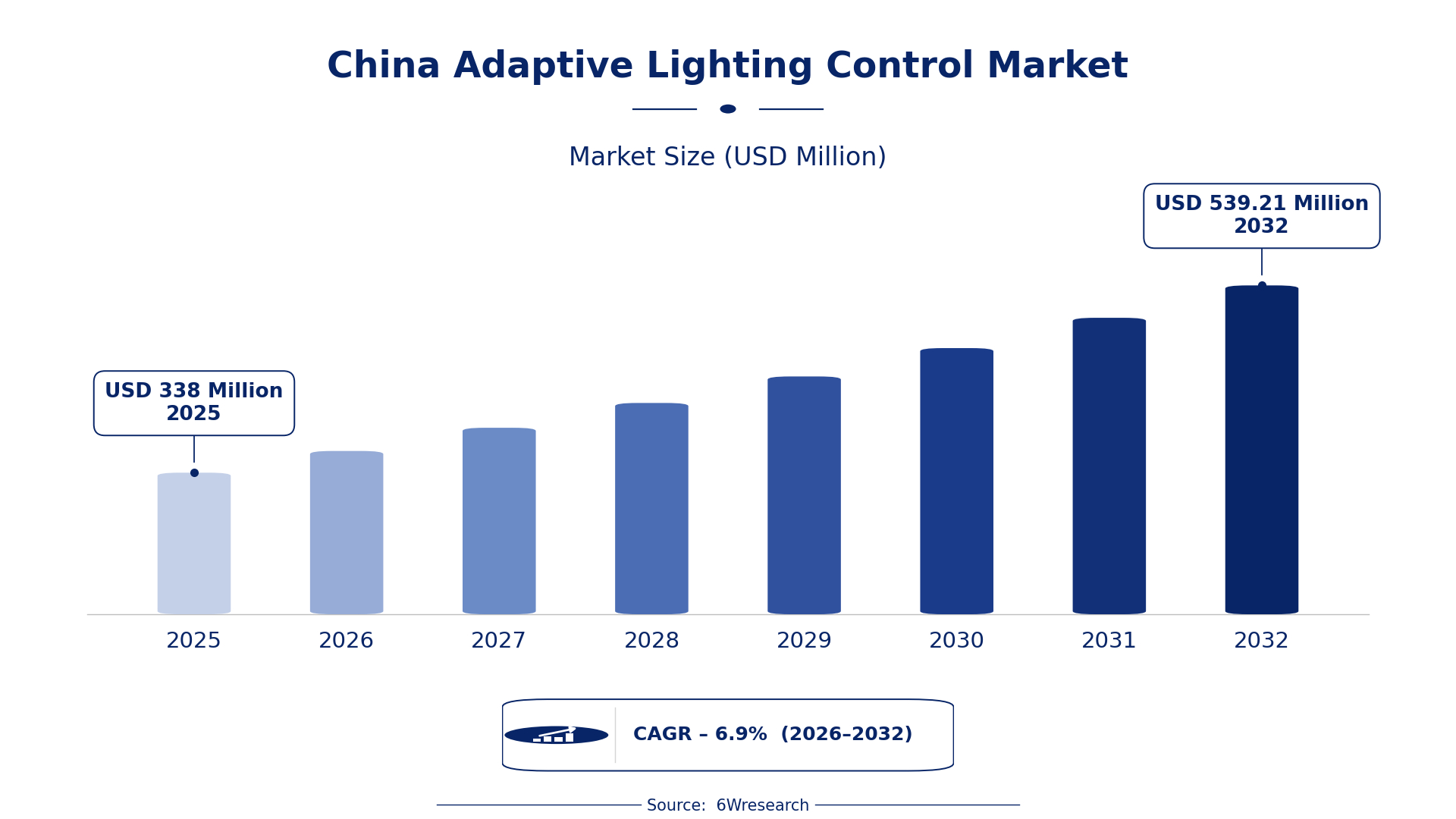
According to 6Wresearch internal database and industry insights, the China Adaptive Lighting Control Market was valued at USD 338.0 million in 2025 and is projected to reach USD 539.21 million by 2032, growing at a CAGR of approximately 6.9% during 2026–2032.
China Adaptive Lighting Control Market Highlights
| Report Metric | Details |
| Report Name | China Adaptive Lighting Control Market |
| Market Size 2025 | USD 338.0 million |
| Market Size 2032 | USD 539.21 million |
| Absolute Growth 2025–2032 | USD 201.21 million |
| CAGR 2026–2032 | 6.9% |
| Peak Annual Growth | 9.5% in 2026 |
| Forecast Period | 2026–2032 |
| Historical Data | 2022–2025 |
| Base Year | 2025 |
| Leading Control Type, 2025 | DALI Control Systems (38% share) |
| Leading Application Area, 2025 | Smart Homes (40% share) |
| Leading Distribution Channel, 2025 | Electrical Distributors (42% share) |
| Leading Lighting Technology, 2025 | LED (42% share) |
| Leading End User Segment, 2025 | Corporate Offices (40% share) |
| Fastest-Growing Control Type | Smart Wireless Control (8.8% CAGR) |
| Fastest-Growing Distribution Channel | Smart Home Integrators (8.4% CAGR) |
| Fastest-Growing Lighting Technology | Smart Bulbs (9.5% CAGR) |
| Fastest-Growing End User Segment | Schools and Colleges (9.1% CAGR) |
| Growing Sector | Smart Homes |
| Key End Users | Residential Buildings, Corporate Offices, Educational Institutes, Industrial Facilities |
China Adaptive Lighting Control Market Year-wise Growth Rate and Key Drivers (2022–2032)
This graph illustrates the annual growth rates of the market from 2022 to 2032, highlighting a steady upward trajectory and projected market expansion over the forecast period.
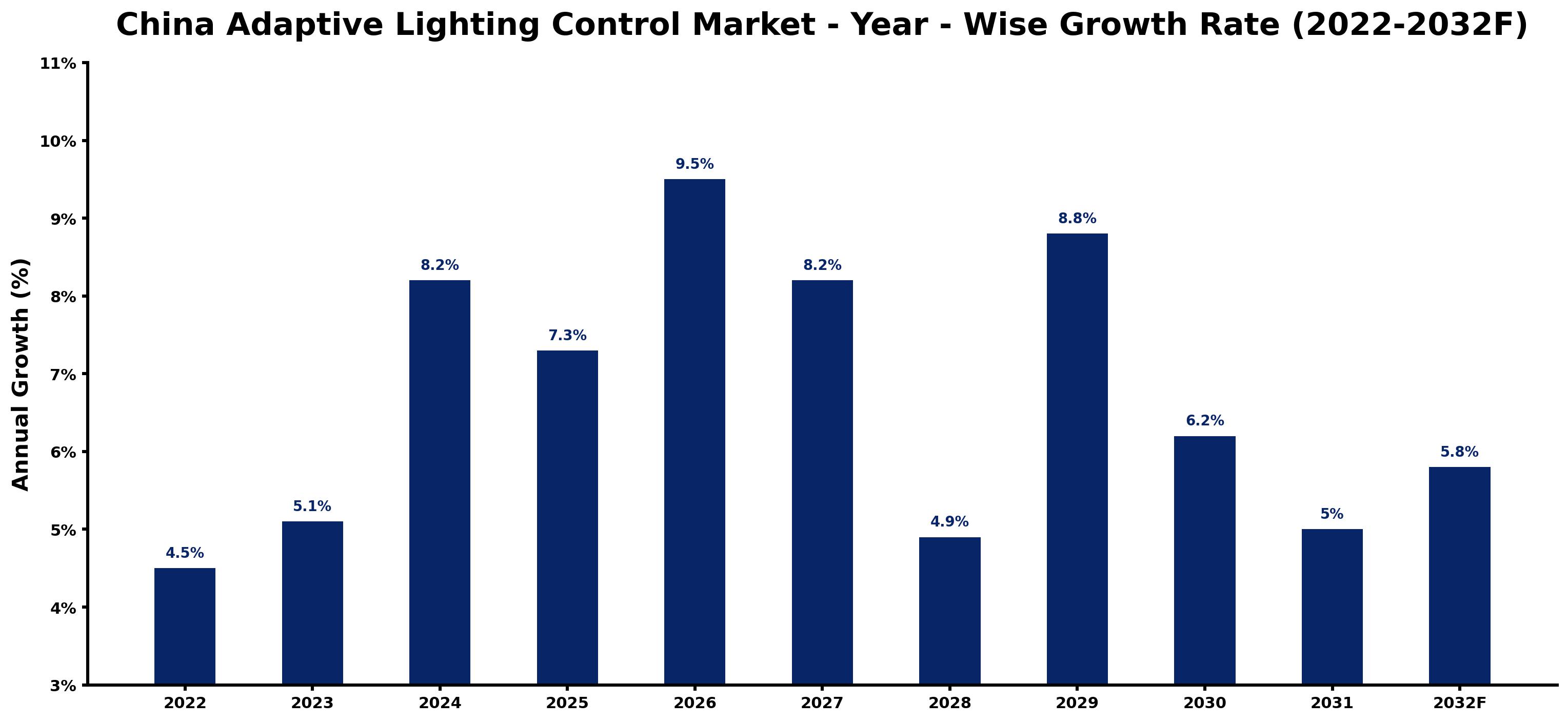
The table below sets out the estimated growth rate for each year and the main factor behind it.
| Year | Estimated Annual Growth (%) | Market Rationale |
| 2022 | 4.5 | The market showed steady growth with increasing interest in energy-efficient solutions under the Smart Lighting Development Plan. |
| 2023 | 5.1 | Demand for adaptive lighting control systems grew faster due to rising urbanisation and the Smart Lighting Initiative. |
| 2024 | 8.2 | The introduction of new energy-efficient standards propelled market expansion, particularly in commercial buildings. |
| 2025 | 7.3 | Growth slowed slightly as the market adjusted to previous rapid increases and competition intensified. |
| 2026 | 9.5 | The peak growth year saw investments in smart lighting technologies driven by the Urban Smart Lighting Program. |
| 2027 | 8.2 | Demand continued to rise but at a slower pace as market maturity set in and new standards were adopted. |
| 2028 | 4.9 | Growth decelerated further as competition intensified in the adaptive lighting sector and awareness increased. |
| 2029 | 8.8 | The market rebounded with renewed interest in energy savings and smart technologies as urban areas expanded. |
| 2030 | 6.2 | Growth slowed again as the market began to stabilise after rapid changes and regulatory compliance increased. |
| 2031 | 5.0 | A further slowdown occurred as the market reached a more mature phase with established technologies. |
| 2032 | 5.8 | Demand is projected to rise again with new urban development initiatives and continued government support. |
Note: Market size estimations and growth projections presented in this report are based on 6Wresearch's proprietary forecasting methodology, utilizing the latest available industry data, government publications, and primary research inputs.
China Adaptive Lighting Control Market Synopsis
Adaptive Lighting Control refers to systems that adjust illumination based on occupancy and daylight availability in China. These systems improve energy efficiency, user comfort, and safety across various environments. The China Adaptive Lighting Control Market is expanding due to urbanisation, the push for energy-efficient technologies, and government initiatives promoting smart lighting solutions. The LED market reached 50 billion USD in 2022, indicating strong demand. The National Energy Administration's 'Smart Lighting Initiative' is driving new investments in urban areas.
Market Dynamics Impact Analysis (2026–2032)
| Factor | Type | Impact | Primary Segment Affected |
| Rising urbanisation increases the need for energy-efficient lighting solutions. | Driver | High | Smart Homes |
| The growing emphasis on energy savings drives demand for adaptive lighting systems. | Driver | High | Corporate Offices |
| The rapid expansion of urban areas creates opportunities for new installations. | Opportunity | High | Office Buildings |
| The push for smart city initiatives opens avenues for adaptive lighting integration. | Opportunity | High | Retail Outlets |
| High initial costs of installation can deter potential buyers. | Restraint | Medium | Residential Buildings |
| Limited awareness of benefits slows adoption in certain sectors. | Restraint | Medium | Educational Institutes |
| Supply chain disruptions can delay project timelines and increase costs. | Challenge | High | Industrial Facilities |
| Regulatory approvals can be lengthy, affecting project initiation. | Challenge | Medium | Commercial Spaces |
Evaluation of Drivers in China Adaptive Lighting Control Market (2026–2032)
The main growth drivers and the segments they affect most are set out below.
| Drivers | Primary Segment Affected | Why It Matters (Evidence) |
| Increased investment in smart technologies drives demand for adaptive lighting. | Smart Wireless Control | The Guangdong province is a major hub for adaptive lighting technology development, stimulating innovation. |
| Corporate sustainability initiatives encourage energy-efficient lighting solutions. | Corporate Offices | The average energy savings from adaptive lighting in commercial spaces is estimated at 30-50%, prompting adoption. |
| Government support for energy-efficient technologies boosts market growth. | DALI Control Systems | The Ministry of Housing and Urban-Rural Development promotes energy-efficient lighting solutions under the 13th Five-Year Plan. |
| Rising energy costs motivate businesses to adopt adaptive lighting systems. | Motion-Sensor Based | The adoption of smart lighting technologies in office buildings is expected to increase by 25% by 2025. |
| Technological advancements in LED lighting improve product offerings. | LED | The LED market in China reached 50 billion USD, highlighting the importance of adaptive lighting as a segment. |
The average energy savings from adaptive lighting in commercial spaces is estimated at 30-50%, prompting many businesses to adopt these solutions. By 2025, the adoption of smart lighting technologies in office buildings is projected to increase by 25%, indicating a shift towards more sustainable practices across multiple sectors. The rapid expansion of the Guangdong province as a technology hub also drives demand for advanced systems.
Evaluation of Restraints in China Adaptive Lighting Control Market
The main factors holding the market back are set out below.
| Market Restraint | Primary Segment Affected | Why It Matters (Evidence) |
| High initial costs of installation can deter potential buyers. | Residential Buildings | The average installation cost for adaptive lighting systems can exceed standard options by 20%. |
| Limited awareness of benefits slows adoption in certain sectors. | Educational Institutes | Many schools lack information on energy savings and improved learning environments, leading to lower adoption rates. |
| Supply chain disruptions can delay project timelines and increase costs. | Industrial Facilities | Recent global supply chain issues have affected the availability of components, causing delays in installations. |
| Regulatory approvals can be lengthy, affecting project initiation. | Commercial Spaces | Complex approval processes for new technologies can delay implementation by several months. |
| Competition from traditional lighting solutions limits market penetration. | Office Buildings | Many businesses still rely on conventional lighting due to familiarity and perceived lower costs. |
China Adaptive Lighting Control Market Challenges
Supply chain issues in the China Adaptive Lighting Control Market hinder timely access to essential components, delaying project completions by as much as six months for urban developers. Buyers encounter difficulties due to a lack of understanding about the advantages of adaptive lighting, resulting in a 40% lower adoption rate compared to traditional options. Regulatory updates from the China National Standards Institute impose costly compliance requirements on suppliers, causing production expenses to rise by 15%. High initial investments deter buyers, with upfront costs for adaptive systems averaging 20% more than conventional lighting, limiting market expansion.
Trends in the China Adaptive Lighting Control Market
Several trends are reshaping the China Adaptive Lighting Control Market; the most important are set out below.
- Shift in Focus to Smart Homes: The trend towards Smart Homes is gaining momentum as consumers seek energy-efficient solutions. In 2022, Smart Homes accounted for 40% of the application area in adaptive lighting, reflecting this shift.
- Transition from Conventional to LED Technologies: Urban areas are increasingly adopting LED technologies for adaptive lighting. The LED segment reached a 42% market share in 2025, indicating a clear transition from traditional systems.
- Emergence of Smart City Initiatives: Smart city initiatives are integrating adaptive lighting into urban planning, improving public safety and energy efficiency. The Shanghai Smart City Plan includes provisions for smart lighting systems, aiming to reduce energy consumption by 20%.
- Growing Demand for Motion-Sensor Systems: Motion-sensor-based lighting control systems are becoming more popular in urban residential areas. The market for these systems is projected to grow rapidly, reflecting a shift towards energy-efficient solutions.
Investment Opportunities in the China Adaptive Lighting Control Market
Several openings in the China Adaptive Lighting Control Market merit attention from investors.
- Timing for Smart Lighting Investments: Investing in adaptive lighting solutions is timely as urban areas expand. The Guangdong province serves as a major hub for technology development, presenting opportunities for partnerships in smart lighting.
- Supply of Smart Wireless Control Systems: There is a rising demand for Smart Wireless Control systems in residential projects. Collaborating with Smart Home Integrators can facilitate market entry and expansion into this segment.
- Entry into Educational Institutions: With growing awareness of energy efficiency, educational institutions are seeking adaptive lighting solutions. Establishing partnerships with schools can open new avenues for supply and growth.
- Focus on Corporate Sustainability: The push for corporate sustainability creates opportunities for adaptive lighting in office buildings. Engaging with Corporate Offices can lead to substantial contract opportunities and long-term partnerships.
Government Initiatives in the China Adaptive Lighting Control Market
The Ministry of Industry and Information Technology launched the 'Smart Lighting Development Plan' in 2021 to promote adaptive lighting technologies focusing on energy efficiency. This initiative aims to increase the adoption of advanced lighting solutions across various sectors. Following this, the National Development and Reform Commission's 'Green Building Action Plan' encourages the adoption of adaptive lighting in new constructions, aiming for a 20% reduction in energy consumption by 2025. These measures collectively support the growth of the adaptive lighting control market in China, facilitating compliance with modern standards and improving energy efficiency in urban areas.
The China National Standards Institute is responsible for updating and enforcing the 'National Standards for Energy-Efficient Lighting Products', which includes adaptive lighting systems. This ensures compliance with energy efficiency benchmarks and promotes better product offerings. Additionally, the Ministry of Housing and Urban-Rural Development initiated the 'Urban Smart Lighting Program' in 2023, which funds projects aimed at improving public safety and reducing energy use in cities. These programs are vital for promoting adaptive lighting technologies and supporting buyers in implementing these systems.
Future Insight of the China Adaptive Lighting Control Market
The China Adaptive Lighting Control Market will experience notable advancements by 2032, driven by strategic initiatives and technological progress. The Smart Lighting Initiative from the National Energy Administration aims to improve energy efficiency, encouraging widespread adoption in urban environments. The Guangdong province's focus on advancing adaptive lighting technology will yield tailored solutions for diverse applications. By 2025, the integration of smart lighting technologies in urban residential areas is expected to increase significantly, reflecting a broader shift towards energy-efficient practices.
Market Segmentation Analysis
Each segment group is reviewed below, with the leader by share and the fastest grower by CAGR.
By Control Type – DALI Control Systems Dominated, Smart Wireless Control Expected to Grow Fastest
According to Ravi Bhandari, Research Head at 6Wresearch, in 2025, DALI Control Systems led the control type split with a 38% share. DALI Control Systems dominate the market due to their widespread implementation in over 30% of new commercial buildings, ensuring efficient centralized lighting control. This established usage highlights their reliability in enhancing energy efficiency and user comfort in urban environments. Over 2026–2032, Smart Wireless Control is expected to post the fastest growth, at a CAGR of 8.8%. Smart Wireless Control is experiencing rapid growth as urban residents increasingly prefer remote and automated lighting management solutions. The surge in smart home technology adoption, with a projected increase in smart lighting technologies in office buildings by 25% by 2025, is a major factor behind this trend. Suppliers should focus on developing advanced wireless solutions to meet the rising demand for adaptive lighting control.
By Application Area – Smart Homes Dominated and Is Expected to Record the Fastest Growth
Smart Homes held a 40% share of the China Adaptive Lighting Control Market by application area in 2025. Smart Homes hold the largest share as they seamlessly integrate adaptive lighting with home automation systems, providing energy efficiency and user comfort. This integration is increasingly appealing to homeowners looking to modernise their living spaces. Its lead should widen, with a projected CAGR of 8.6% during 2026–2032, the highest in this split. Smart Homes are also the fastest-growing segment, driven by the rising adoption of smart technologies in residential settings. The convergence of energy efficiency and convenience is making this application area particularly attractive. This trend indicates that suppliers should prioritise innovations that cater to smart home integration.
By Distribution Channel – Electrical Distributors Dominated, Smart Home Integrators Expected to Grow Fastest
The largest distribution channel category in 2025 was Electrical Distributors, with a 42% share of total revenue. Electrical Distributors lead the market by supplying adaptive lighting products directly to end users, ensuring accessibility and availability across various regions. Their established networks facilitate the distribution of these essential technologies. The quickest growth will come from Smart Home Integrators, forecast to expand at a CAGR of 8.4% between 2026 and 2032. Smart Home Integrators are the fastest-growing channel as they provide tailored solutions for residential projects, meeting the specific needs of homeowners. This channel's growth reflects the increasing complexity and demand for smart home systems. Suppliers must strengthen partnerships with integrators to tap into the expanding smart home market.
By Lighting Technology – LED Dominated, Smart Bulbs Expected to Grow Fastest
With a 42% revenue share in 2025, LED was the largest lighting technology category. LED technology leads the adaptive lighting market due to its energy efficiency and long lifespan, making it ideal for various applications. Its extensive use in adaptive lighting systems highlights its crucial role in achieving energy-saving objectives across sectors. Smart Bulbs are set to record the highest CAGR in this split, 9.5% over 2026–2032. Smart Bulbs are rapidly gaining popularity, especially in residential settings, as they offer easy installation and user-friendly features. This growth aligns with the broader consumer trend towards personalised and adaptable lighting solutions that enhance comfort and convenience. Manufacturers should prioritise advancements in smart bulb technologies to tap into the growing consumer interest in adaptive lighting.
By End User Segment – Corporate Offices Dominated, Schools and Colleges Expected to Grow Fastest
Corporate Offices took a 40% share of end user segment in 2025, more than any other category. Corporate Offices hold the largest market share by utilising adaptive lighting systems to achieve significant energy savings and improve workplace environments. Their substantial investment in energy-efficient solutions reinforces their dominant position in the adaptive lighting market. Over 2026–2032, Schools and Colleges are expected to post the fastest growth, at a CAGR of 9.1%. Schools and Colleges are the fastest-growing end user segment, as adaptive lighting greatly enhances learning environments and supports educational objectives. The increasing emphasis on improving educational facilities is driving this swift adoption of adaptive lighting technologies. This trend suggests that suppliers should tailor their offerings to specifically address the needs of educational institutions.
Key Attractiveness of the Report
- 10 Years of Market Numbers
- Historical Data Starting from 2022 to 2025
- Base Year 2025
- Forecast Data until 2032
- Key Performance Indicators Impacting the Market
- Major Upcoming Developments and Projects
Key Highlights of the Report:
- China Adaptive Lighting Control Market Outlook
- Market Size of China Adaptive Lighting Control Market, 2025
- Forecast of China Adaptive Lighting Control Market, 2032
- Historical Data and Forecast of China Adaptive Lighting Control Revenues & Volume for the Period 2022 - 2032F
- China Adaptive Lighting Control Market Trend Evolution
- China Adaptive Lighting Control Market Drivers and Challenges
- China Adaptive Lighting Control Price Trends
- China Adaptive Lighting Control Porter's Five Forces
- China Adaptive Lighting Control Industry Life Cycle
- Historical Data and Forecast of China Adaptive Lighting Control Market Revenues & Volume By Control Type for the Period 2022 - 2032F
- Historical Data and Forecast of China Adaptive Lighting Control Market Revenues & Volume By DALI Control Systems for the Period 2022 - 2032F
- Historical Data and Forecast of China Adaptive Lighting Control Market Revenues & Volume By Motion-Sensor Based for the Period 2022 - 2032F
- Historical Data and Forecast of China Adaptive Lighting Control Market Revenues & Volume By Timer-Based Systems for the Period 2022 - 2032F
- Historical Data and Forecast of China Adaptive Lighting Control Market Revenues & Volume By Smart Wireless Control for the Period 2022 - 2032F
- Historical Data and Forecast of China Adaptive Lighting Control Market Revenues & Volume By Daylight Responsive for the Period 2022 - 2032F
- Historical Data and Forecast of China Adaptive Lighting Control Market Revenues & Volume By Application Area for the Period 2022 - 2032F
- Historical Data and Forecast of China Adaptive Lighting Control Market Revenues & Volume By Smart Homes for the Period 2022 - 2032F
- Historical Data and Forecast of China Adaptive Lighting Control Market Revenues & Volume By Office Buildings for the Period 2022 - 2032F
- Historical Data and Forecast of China Adaptive Lighting Control Market Revenues & Volume By Industrial Facilities for the Period 2022 - 2032F
- Historical Data and Forecast of China Adaptive Lighting Control Market Revenues & Volume By Retail Outlets for the Period 2022 - 2032F
- Historical Data and Forecast of China Adaptive Lighting Control Market Revenues & Volume By Educational Institutes for the Period 2022 - 2032F
- Historical Data and Forecast of China Adaptive Lighting Control Market Revenues & Volume By Distribution Channel for the Period 2022 - 2032F
- Historical Data and Forecast of China Adaptive Lighting Control Market Revenues & Volume By OEMs for the Period 2022 - 2032F
- Historical Data and Forecast of China Adaptive Lighting Control Market Revenues & Volume By Electrical Distributors for the Period 2022 - 2032F
- Historical Data and Forecast of China Adaptive Lighting Control Market Revenues & Volume By Online Stores for the Period 2022 - 2032F
- Historical Data and Forecast of China Adaptive Lighting Control Market Revenues & Volume By Smart Home Integrators for the Period 2022 - 2032F
- Historical Data and Forecast of China Adaptive Lighting Control Market Revenues & Volume By B2B Contracts for the Period 2022 - 2032F
- Historical Data and Forecast of China Adaptive Lighting Control Market Revenues & Volume By Lighting Technology for the Period 2022 - 2032F
- Historical Data and Forecast of China Adaptive Lighting Control Market Revenues & Volume By LED for the Period 2022 - 2032F
- Historical Data and Forecast of China Adaptive Lighting Control Market Revenues & Volume By Halogen for the Period 2022 - 2032F
- Historical Data and Forecast of China Adaptive Lighting Control Market Revenues & Volume By CFL for the Period 2022 - 2032F
- Historical Data and Forecast of China Adaptive Lighting Control Market Revenues & Volume By Smart Bulbs for the Period 2022 - 2032F
- Historical Data and Forecast of China Adaptive Lighting Control Market Revenues & Volume By Fluorescent for the Period 2022 - 2032F
- Historical Data and Forecast of China Adaptive Lighting Control Market Revenues & Volume By End User Segment for the Period 2022 - 2032F
- Historical Data and Forecast of China Adaptive Lighting Control Market Revenues & Volume By Residential Buildings for the Period 2022 - 2032F
- Historical Data and Forecast of China Adaptive Lighting Control Market Revenues & Volume By Corporate Offices for the Period 2022 - 2032F
- Historical Data and Forecast of China Adaptive Lighting Control Market Revenues & Volume By Manufacturing Plants for the Period 2022 - 2032F
- Historical Data and Forecast of China Adaptive Lighting Control Market Revenues & Volume By Commercial Spaces for the Period 2022 - 2032F
- Historical Data and Forecast of China Adaptive Lighting Control Market Revenues & Volume By Schools and Colleges for the Period 2022 - 2032F
- China Adaptive Lighting Control Import Export Trade Statistics
- Market Opportunity Assessment By Control Type
- Market Opportunity Assessment By Application Area
- Market Opportunity Assessment By Distribution Channel
- Market Opportunity Assessment By Lighting Technology
- Market Opportunity Assessment By End User Segment
- China Adaptive Lighting Control Top Companies Market Share
- China Adaptive Lighting Control Competitive Benchmarking By Technical and Operational Parameters
- China Adaptive Lighting Control Company Profiles
- China Adaptive Lighting Control Key Strategic Recommendations
Market Covered
The report offers an extensive study of the following market segments.
By Control Type
- DALI Control Systems
- Motion-Sensor Based
- Timer-Based Systems
- Smart Wireless Control
- Daylight Responsive
By Application Area
- Smart Homes
- Office Buildings
- Industrial Facilities
- Retail Outlets
- Educational Institutes
By Distribution Channel
- OEMs
- Electrical Distributors
- Online Stores
- Smart Home Integrators
- B2B Contracts
By Lighting Technology
- LED
- Halogen
- CFL
- Smart Bulbs
- Fluorescent
By End User Segment
- Residential Buildings
- Corporate Offices
- Manufacturing Plants
- Commercial Spaces
- Schools and Colleges































