China ADAS Sensor Integration Market Size & Growth Rate
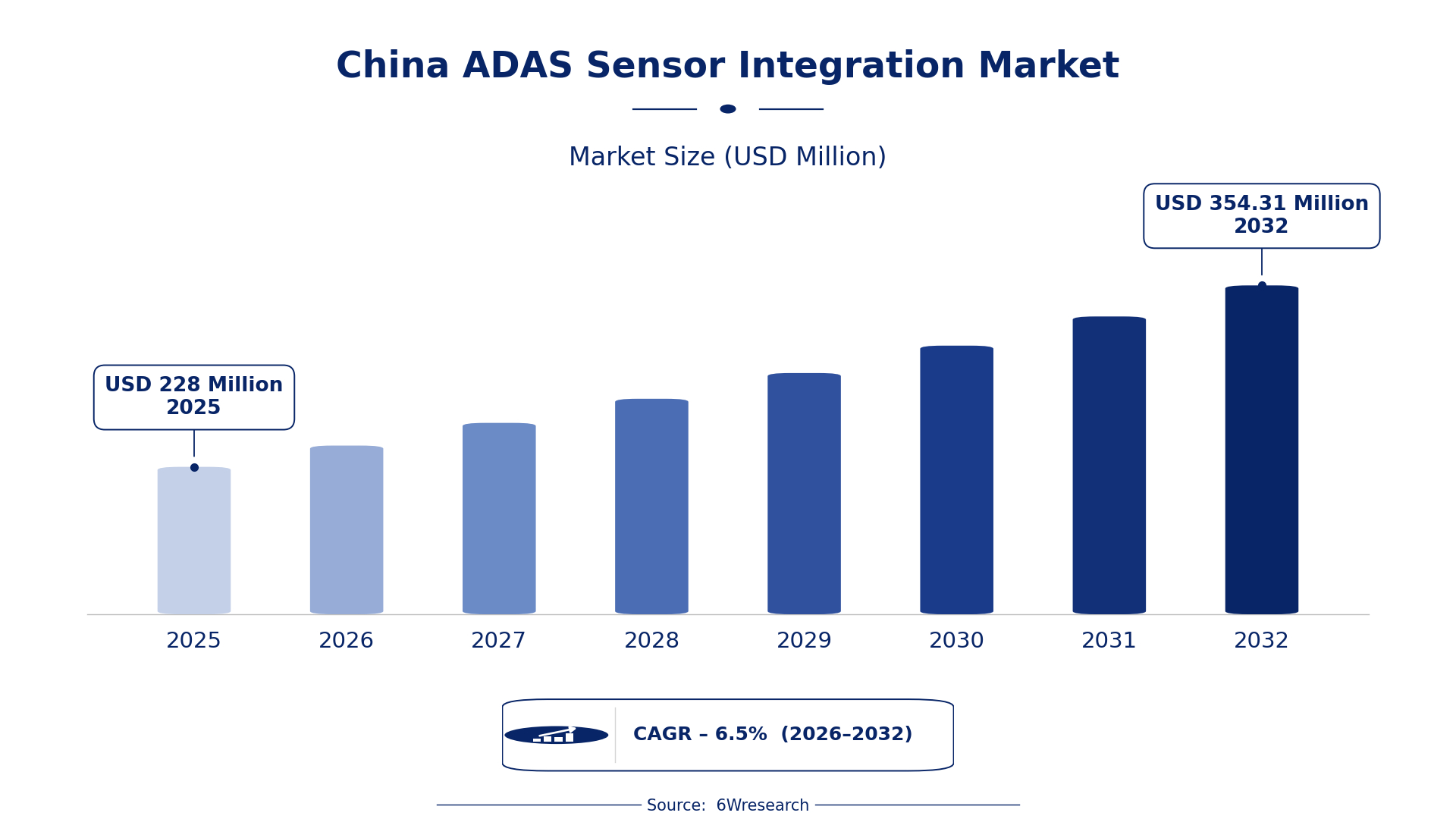
According to 6Wresearch internal database and industry insights, the China ADAS Sensor Integration Market was valued at USD 228.0 million in 2025 and is projected to reach USD 354.31 million by 2032, growing at a CAGR of approximately 6.5% during 2026–2032.
China ADAS Sensor Integration Market Highlights
| Report Metric | Details |
| Report Name | China ADAS Sensor Integration Market |
| Market Size 2025 | USD 228.0 million |
| Market Size 2032 | USD 354.31 million |
| Absolute Growth 2025–2032 | USD 126.31 million |
| CAGR 2026–2032 | 6.5% |
| Peak Annual Growth | 8.4% in 2028 |
| Forecast Period | 2026–2032 |
| Historical Data | 2022–2025 |
| Base Year | 2025 |
| Leading Integration Method, 2025 | Centralized Fusion (38% share) |
| Leading Sensor Type, 2025 | Radar + Lidar (42% share) |
| Leading Distribution Channel, 2025 | OEMs (51% share) |
| Leading End User, 2025 | ADAS Platform Makers (51% share) |
| Fastest-Growing Integration Method | AI-Enhanced Integration (8.3% CAGR) |
| Fastest-Growing Sensor Type | Camera + Ultrasonic (8.7% CAGR) |
| Fastest-Growing End User | Luxury Vehicle Makers (8.7% CAGR) |
| Growing Sector | Automotive |
| Key End Users | ADAS Platform Makers, Luxury Vehicle Makers, EV Startups, Commercial Fleets |
China ADAS Sensor Integration Market Year-wise Growth Rate and Key Drivers (2022–2032)
This graph illustrates the annual growth rates of the market from 2022 to 2032, highlighting a steady upward trajectory and projected market expansion over the forecast period.
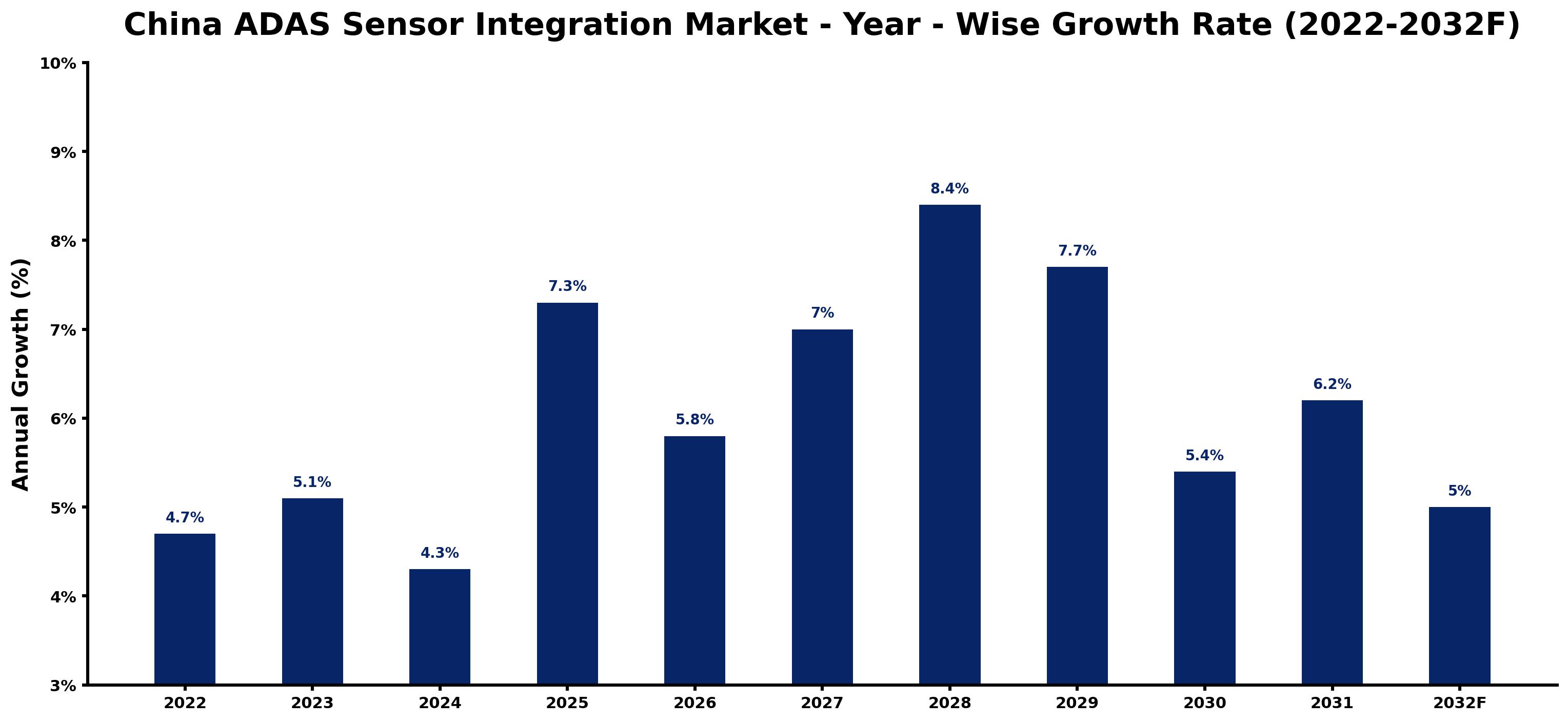
Annual growth estimates for each year appear below with the principal reason behind them, explaining the shifts that set the pace of the market.
| Year | Estimated Annual Growth (%) | Market Rationale |
| 2022 | 4.7 | The market experienced steady growth, driven by increasing vehicle production and technology adoption. |
| 2023 | 5.1 | Demand for safety features in vehicles rose due to consumer awareness and regulatory support. |
| 2024 | 4.3 | A slight slowdown occurred due to evolving consumer preferences and regulatory adjustments. |
| 2025 | 7.3 | The market rebounded strongly, supported by advancements in ADAS technologies and increased vehicle integration. |
| 2026 | 5.8 | Growth is expected to slow as manufacturers face challenges in component supply and integration complexity. |
| 2027 | 7.0 | Demand is projected to surge again as luxury vehicle makers expand their ADAS offerings to meet consumer expectations. |
| 2028 | 8.4 | The market is expected to peak with rapid advancements in AI-driven integration and increased adoption rates. |
| 2029 | 7.7 | A slowdown is anticipated as market maturity begins to set in, impacting growth rates. |
| 2030 | 5.4 | Continued growth is expected, driven by the increasing number of electric vehicles featuring ADAS. |
| 2031 | 6.2 | The market is projected to experience a resurgence as new regulations promote enhanced safety features in vehicles. |
| 2032 | 5.0 | Growth is expected to slow as the market stabilises, reflecting a mature phase of ADAS integration. |
Note: Market size estimations and growth projections presented in this report are based on 6Wresearch's proprietary forecasting methodology, utilizing the latest available industry data, government publications, and primary research inputs.
China ADAS Sensor Integration Market Synopsis
The China ADAS Sensor Integration Market combines various sensors to improve vehicle safety and automation. This technology integrates data from cameras, radars, and lidars for applications like collision avoidance and lane keeping. The market is expanding due to rising demand from the automotive sector, particularly electric vehicles and luxury cars. In 2023, over 50% of new luxury vehicles were equipped with ADAS features, driven by consumer safety awareness and technological advancements. The Beijing-Tianjin-Hebei region is a key hub for automotive innovation, further boosting growth.
Market Dynamics Impact Analysis (2026–2032)
| Factor | Type | Impact | Primary Segment Affected |
| Rising vehicle production in China is driving demand for advanced safety features. | Driver | High | ADAS Platform Makers |
| The increasing adoption of electric vehicles is creating a significant market for ADAS technologies. | Driver | High | EV Startups |
| The shift towards AI-enhanced integration presents opportunities for innovative solutions. | Opportunity | High | AI-Enhanced Integration |
| Growing interest in retrofitting ADAS in existing vehicles opens new market avenues. | Opportunity | Medium | ADAS Platform Makers |
| Challenges in supply chain management can hinder timely production of ADAS components. | Restraint | High | Centralized Fusion |
| The complexity of integrating multiple sensor types may limit widespread adoption. | Restraint | Medium | Modular Integration |
| The ADAS Sensor Integration Market in China faces regulatory hurdles that can delay product approvals. | Challenge | High | Centralized Fusion |
| Competition among suppliers can lead to price pressures, affecting profitability. | Challenge | Medium | Centralized Fusion |
Evaluation of Drivers in China ADAS Sensor Integration Market (2026–2032)
The main growth drivers and the segments they affect most are set out below.
| Drivers | Primary Segment Affected | Why It Matters (Evidence) |
| Increased vehicle production rates drive demand for ADAS technologies. | ADAS Platform Makers | In 2022, China's automotive market produced over 25 million vehicles, boosting ADAS integration. |
| The rise of electric vehicles is creating a strong demand for advanced safety features. | EV Startups | As of 2023, the number of registered electric vehicles in China reached 10 million. |
| The implementation of national standards improves the performance and reliability of ADAS. | Centralized Fusion | The GB/T 32960-2016 standard regulates ADAS performance, ensuring quality and safety. |
| Growing consumer awareness of vehicle safety is pushing manufacturers to adopt ADAS. | Luxury Vehicle Makers | Over 50% of new luxury vehicles in China are equipped with ADAS features as of 2023. |
| Technological advancements in AI are improving ADAS functionalities and decision-making. | AI-Enhanced Integration | The Ministry of Science and Technology announced funding for AI-driven ADAS technologies in 2023. |
Market growth for ADAS Sensor Integration in China is underpinned by rising vehicle production, increasing adoption of electric vehicles, and advancements in technology. In 2022, the automotive market produced over 25 million vehicles, which significantly boosted demand for safety technologies. The number of registered electric vehicles reached 10 million in 2023, creating a strong market for advanced safety features. The implementation of the GB/T 32960-2016 standard ensures quality, further driving integration. Funding for AI-driven technologies supports innovation and improves decision-making capabilities in real-time driving scenarios, enhancing overall vehicle safety.
Evaluation of Restraints in China ADAS Sensor Integration Market
The following restraints limit how fast demand can grow.
| Market Restraint | Primary Segment Affected | Why It Matters (Evidence) |
| Supply chain disruptions can delay the availability of essential ADAS components. | Centralized Fusion | In 2022, global supply chain issues impacted the timely production of automotive parts. |
| Integration complexity may hinder the adoption of modular systems in vehicles. | Modular Integration | The challenges of configuring multiple sensor types can slow down implementation. |
| Regulatory hurdles can delay product approvals and hinder market entry. | Centralized Fusion | Compliance with national standards like GB/T 32960-2016 can extend approval timelines. |
| High development costs associated with advanced ADAS technologies can limit investment. | AI-Enhanced Integration | The funding required for AI research and development can be substantial. |
| Limited consumer awareness of ADAS benefits may restrict market growth. | ADAS Platform Makers | Despite advancements, many consumers remain unaware of the advantages of ADAS features. |
China ADAS Sensor Integration Market Challenges
Buyers in the China ADAS Sensor Integration market face supply chain disruptions due to reliance on specific sensor imports, which can delay production timelines by up to three months. This dependency increases costs for manufacturers, who are experiencing logistics expenses approximately 15% higher than in previous years. Regulatory compliance presents another hurdle, as stringent national standards necessitate extensive testing, resulting in additional costs that strain budgets for automotive producers. Furthermore, buyers encounter limited options for retrofitting ADAS features, inflating upgrade prices and hindering adoption in the aftermarket segment.
Trends in the China ADAS Sensor Integration Market
The trends below show where the China ADAS Sensor Integration Market is heading.
- Increase in AI-Driven ADAS Features: In 2023, the Ministry of Science and Technology announced funding for AI-driven ADAS technologies, reflecting a shift towards smarter vehicle systems. This trend is expected to improve decision-making in real-time driving scenarios, with implications for manufacturers as they innovate.
- Growing Adoption of ADAS in Electric Vehicles: The number of registered electric vehicles in China reached 10 million in 2023, highlighting a trend where EVs increasingly feature advanced ADAS. This shift supports the demand for safety technologies among environmentally conscious consumers.
- Expansion of ADAS in Luxury Vehicles: As of 2023, over 50% of new luxury vehicles in China are equipped with ADAS features, indicating a trend towards improved safety and automation in high-end cars. This development is reshaping consumer expectations in the luxury segment.
- Retrofitting ADAS in Existing Vehicles: China's automotive aftermarket is projected to grow, with ADAS retrofitting becoming more common. This trend reflects the increasing demand for safety features in older vehicle models, presenting new opportunities for suppliers.
Investment Opportunities in the China ADAS Sensor Integration Market
Below are the investment opportunities with the strongest case in the China ADAS Sensor Integration Market.
- Supply of AI-Driven ADAS Technologies: The growing interest in AI-driven ADAS technologies presents an opportunity for suppliers to innovate. With government funding supporting such projects, now is the time for partnerships with research institutions to enhance product offerings.
- Retrofitting Services for Existing Vehicles: The automotive aftermarket is expanding, creating demand for retrofitting ADAS in older vehicles. This opportunity is particularly relevant for commercial fleets looking to improve safety features and operational efficiency.
- Investment in Luxury Vehicle ADAS Integration: As luxury vehicle makers increasingly adopt advanced ADAS, suppliers should focus on high-quality components. The Guangdong province is a key region for this investment, offering potential for local partnerships to enhance product offerings.
- Development of Comprehensive Sensor Arrays: The demand for comprehensive sensor arrays is rising as vehicles require improved environmental awareness. Collaborating with ADAS platform makers can facilitate entry into this growing market and enhance competitive advantage.
Government Initiatives in the China ADAS Sensor Integration Market
The 'New Energy Vehicle Industry Development Plan (2021-2035)' by the Ministry of Industry and Information Technology promotes ADAS integration in electric vehicles. This plan aims to ensure that new electric vehicles are equipped with advanced ADAS features, improving safety and efficiency. Additionally, the 'National Intelligent Vehicle Innovation and Development Strategy' approved by the State Council in 2022 focuses on enhancing safety through ADAS technologies, providing a framework for manufacturers to follow. The 'Smart Transportation Development Plan' initiated by the Ministry of Transport in 2023 further emphasises the role of ADAS in improving road safety, guiding investments in related technologies.
The National Development and Reform Commission funds projects aimed at advancing ADAS technology in domestic vehicles. This agency plays a key role in approving initiatives that support the integration of advanced safety features. The Ministry of Science and Technology's funding program announced in 2023 supports research in AI-driven ADAS technologies, allowing manufacturers to enhance their product offerings. Furthermore, the China Automotive Technology and Research Center provides guidelines for ADAS testing and evaluation, ensuring compliance with national standards.
Future Insight of the China ADAS Sensor Integration Market
Several forward-looking factors should support the China ADAS Sensor Integration market over the coming years. The 'Smart Vehicle Innovation and Development Strategy' is set to accelerate ADAS integration across the automotive sector, improving safety features significantly. By 2025, over 50% of new luxury vehicles are projected to incorporate advanced ADAS technologies, aligning with consumer demand for enhanced vehicle safety. Increased funding from the National Development and Reform Commission for domestic projects will further stimulate technological advancements in the industry.
Market Segmentation Analysis
The report offers a comprehensive study of the following market segments and their leading categories in the market.
By Integration Method – Centralized Fusion Dominated, AI-Enhanced Integration Expected to Grow Fastest
According to Ravi Bhandari, Research Head at 6Wresearch, Centralized Fusion took a 38% share of integration method in 2025, more than any other category. Centralized Fusion holds the largest share as it effectively integrates multiple sensor inputs, ensuring comprehensive data analysis crucial for vehicle safety. This method is particularly vital in the Beijing-Tianjin-Hebei region, known for its automotive innovation and development. Over 2026–2032, AI-Enhanced Integration is expected to post the fastest growth, at a CAGR of 8.3%. AI-Enhanced Integration is experiencing rapid growth due to its ability to improve decision-making processes in complex driving situations, which is essential for urban environments. This method's effectiveness in enhancing safety features is driving its increased adoption among manufacturers. Suppliers should prioritise the development of integration methods to satisfy the rising demand for comprehensive safety solutions in vehicles.
By Sensor Type – Radar + Lidar Dominated, Camera + Ultrasonic Expected to Grow Fastest
In 2025, Radar + Lidar led the sensor type split with a 42% share. Radar + Lidar commands the largest share as these sensors are essential for accurate distance measurement and obstacle detection, critical for safety in vehicles. Their widespread use in over 50% of new luxury vehicles in China underscores their importance in the market. Camera + Ultrasonic is projected to grow fastest, at a CAGR of 8.7% during 2026–2032. Camera + Ultrasonic is the fastest-growing segment, primarily due to their common application in parking assistance and low-speed maneuvers, which are increasingly demanded by consumers. The rise in urban vehicle usage drives this growth as more drivers seek advanced parking solutions. Manufacturers should prioritise the development of camera and ultrasonic technologies to capture the growing demand in the automotive sector.
By Distribution Channel – OEMs Dominated and Is Expected to Record the Fastest Growth
The largest distribution channel category in 2025 was OEMs, with a 51% share of total revenue. OEMs dominate the distribution channel, holding the largest share as they are the primary manufacturers integrating ADAS technologies into new vehicles. Their established relationships with automotive suppliers ensure a steady flow of advanced systems into the market. The same category are also set to grow fastest, at a CAGR of 7.8% during 2026–2032. OEMs are also the fastest-growing channel, benefiting from the increasing production of vehicles equipped with ADAS features. As the automotive market expands, OEMs will continue to lead in integrating these technologies. Suppliers must strengthen partnerships with OEMs to align with the growing trend of ADAS integration in vehicles.
By End User – ADAS Platform Makers Dominated, Luxury Vehicle Makers Expected to Grow Fastest
ADAS Platform Makers held a 51% share of the China ADAS Sensor Integration Market by end user in 2025. ADAS Platform Makers command the largest market share as they develop the software and systems that effectively utilise sensor data, making them essential for the functionality of ADAS. Their significance is highlighted by the growing number of electric vehicles equipped with advanced systems. The quickest growth will come from Luxury Vehicle Makers, forecast to expand at a CAGR of 8.7% between 2026 and 2032. Luxury Vehicle Makers represent the fastest-growing segment, motivated by their commitment to integrating advanced ADAS features that enhance vehicle appeal and safety. The rising consumer preference for luxury vehicles equipped with cutting-edge safety technologies is driving this growth. Suppliers should align their products with the requirements of luxury vehicle manufacturers to take advantage of the increasing demand for advanced ADAS features.
Key Attractiveness of the Report
- 10 Years of Market Numbers
- Historical Data Starting from 2022 to 2025
- Base Year 2025
- Forecast Data until 2032
- Key Performance Indicators Impacting the Market
- Major Upcoming Developments and Projects
Key Highlights of the Report:
- China ADAS Sensor Integration Market Outlook
- Market Size of China ADAS Sensor Integration Market, 2025
- Forecast of China ADAS Sensor Integration Market, 2032
- Historical Data and Forecast of China ADAS Sensor Integration Revenues & Volume for the Period 2022 - 2032F
- China ADAS Sensor Integration Market Trend Evolution
- China ADAS Sensor Integration Market Drivers and Challenges
- China ADAS Sensor Integration Price Trends
- China ADAS Sensor Integration Porter's Five Forces
- China ADAS Sensor Integration Industry Life Cycle
- Historical Data and Forecast of China ADAS Sensor Integration Market Revenues & Volume By Integration Method for the Period 2022 - 2032F
- Historical Data and Forecast of China ADAS Sensor Integration Market Revenues & Volume By Centralized Fusion for the Period 2022 - 2032F
- Historical Data and Forecast of China ADAS Sensor Integration Market Revenues & Volume By Modular Integration for the Period 2022 - 2032F
- Historical Data and Forecast of China ADAS Sensor Integration Market Revenues & Volume By Edge-Level Processing for the Period 2022 - 2032F
- Historical Data and Forecast of China ADAS Sensor Integration Market Revenues & Volume By AI-Enhanced Integration for the Period 2022 - 2032F
- Historical Data and Forecast of China ADAS Sensor Integration Market Revenues & Volume By Sensor Type for the Period 2022 - 2032F
- Historical Data and Forecast of China ADAS Sensor Integration Market Revenues & Volume By Radar + Lidar for the Period 2022 - 2032F
- Historical Data and Forecast of China ADAS Sensor Integration Market Revenues & Volume By Camera + Ultrasonic for the Period 2022 - 2032F
- Historical Data and Forecast of China ADAS Sensor Integration Market Revenues & Volume By Infrared Sensors for the Period 2022 - 2032F
- Historical Data and Forecast of China ADAS Sensor Integration Market Revenues & Volume By Sensor Arrays for the Period 2022 - 2032F
- Historical Data and Forecast of China ADAS Sensor Integration Market Revenues & Volume By Distribution Channel for the Period 2022 - 2032F
- Historical Data and Forecast of China ADAS Sensor Integration Market Revenues & Volume By OEMs for the Period 2022 - 2032F
- Historical Data and Forecast of China ADAS Sensor Integration Market Revenues & Volume By Tier 1 Suppliers for the Period 2022 - 2032F
- Historical Data and Forecast of China ADAS Sensor Integration Market Revenues & Volume By Online Distributors for the Period 2022 - 2032F
- Historical Data and Forecast of China ADAS Sensor Integration Market Revenues & Volume By Direct Sales for the Period 2022 - 2032F
- Historical Data and Forecast of China ADAS Sensor Integration Market Revenues & Volume By End User for the Period 2022 - 2032F
- Historical Data and Forecast of China ADAS Sensor Integration Market Revenues & Volume By ADAS Platform Makers for the Period 2022 - 2032F
- Historical Data and Forecast of China ADAS Sensor Integration Market Revenues & Volume By Commercial Fleets for the Period 2022 - 2032F
- Historical Data and Forecast of China ADAS Sensor Integration Market Revenues & Volume By EV Startups for the Period 2022 - 2032F
- Historical Data and Forecast of China ADAS Sensor Integration Market Revenues & Volume By Luxury Vehicle Makers for the Period 2022 - 2032F
- China ADAS Sensor Integration Import Export Trade Statistics
- Market Opportunity Assessment By Integration Method
- Market Opportunity Assessment By Sensor Type
- Market Opportunity Assessment By Distribution Channel
- Market Opportunity Assessment By End User
- China ADAS Sensor Integration Top Companies Market Share
- China ADAS Sensor Integration Competitive Benchmarking By Technical and Operational Parameters
- China ADAS Sensor Integration Company Profiles
- China ADAS Sensor Integration Key Strategic Recommendations
Market Covered
The report offers an extensive study of the following market segments.
By Integration Method
- Centralized Fusion
- Modular Integration
- Edge-Level Processing
- AI-Enhanced Integration
By Sensor Type
- Radar + Lidar
- Camera + Ultrasonic
- Infrared Sensors
- Sensor Arrays
By Distribution Channel
- OEMs
- Tier 1 Suppliers
- Online Distributors
- Direct Sales
By End User
- ADAS Platform Makers
- Commercial Fleets
- EV Startups
- Luxury Vehicle Makers































