China Additive Electronics Manufacturing Market Size & Growth Rate
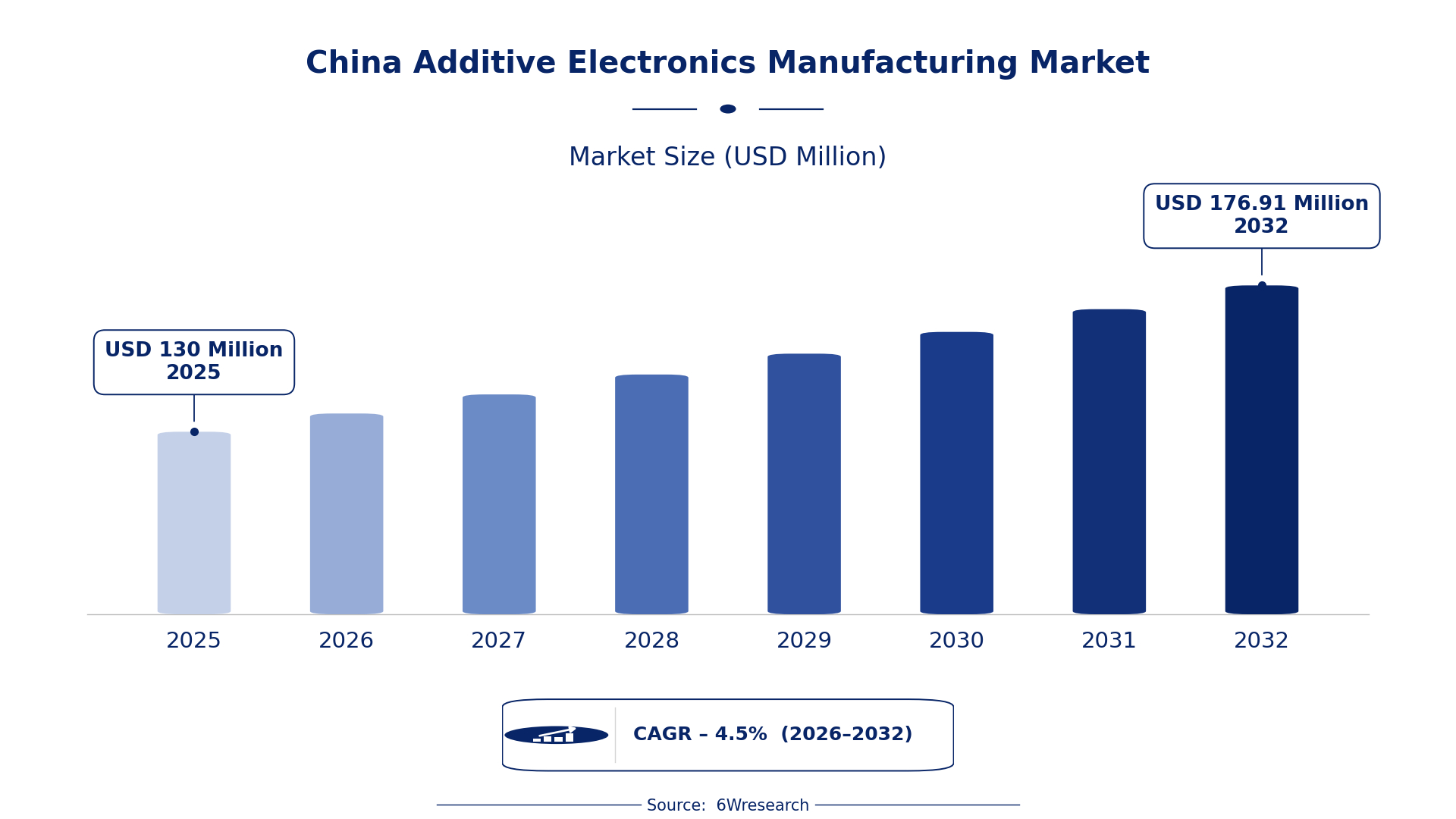
According to 6Wresearch internal database and industry insights, the China Additive Electronics Manufacturing Market was valued at USD 130.0 million in 2025 and is projected to reach USD 176.91 million by 2032, growing at a CAGR of approximately 4.5% during 2026–2032.
China Additive Electronics Manufacturing Market Highlights
| Report Metric | Details |
| Report Name | China Additive Electronics Manufacturing Market |
| Market Size 2025 | USD 130.0 million |
| Market Size 2032 | USD 176.91 million |
| Absolute Growth 2025–2032 | USD 46.91 million |
| CAGR 2026–2032 | 4.5% |
| Peak Annual Growth | 6.2% in 2026 |
| Forecast Period | 2026–2032 |
| Historical Data | 2022–2025 |
| Base Year | 2025 |
| Leading Product Type, 2025 | Inkjet Printing for PCBs (44% share) |
| Leading Distribution Channel, 2025 | Direct Sales (40% share) |
| Leading End User, 2025 | Consumer Electronics (45% share) |
| Fastest-Growing Product Type | 3D Printed Sensors (6.1% CAGR) |
| Fastest-Growing Distribution Channel | OEM Partnerships (6.6% CAGR) |
| Fastest-Growing End User | Wearable Devices (5.5% CAGR) |
| Growing Sector | Wearable Devices |
| Key End Users | Consumer Electronics, Telecommunication, Wearable Devices, Automotive Sector |
China Additive Electronics Manufacturing Market Year-wise Growth Rate and Key Drivers (2022–2032)
This graph illustrates the annual growth rates of the market from 2022 to 2032, highlighting a steady upward trajectory and projected market expansion over the forecast period.
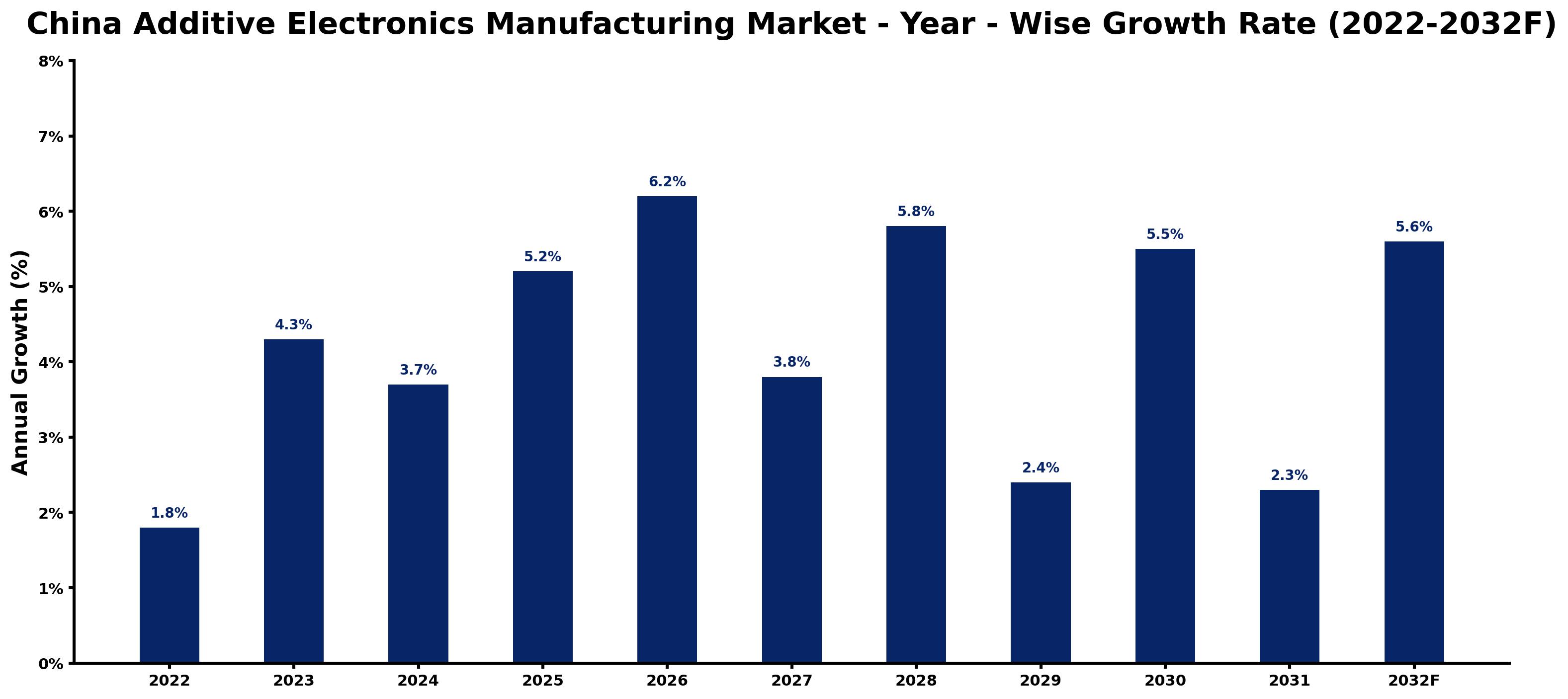
Year by year, the estimates below pair each growth rate with the development that shaped it.
| Year | Estimated Annual Growth (%) | Market Rationale |
| 2022 | 1.8 | The market experienced steady growth due to demand from the electronics sector, particularly in circuit board production. |
| 2023 | 4.3 | Growth accelerated as smartphone production surged, increasing the need for advanced manufacturing methods. |
| 2024 | 3.7 | The market growth slowed slightly as manufacturers adapted to emerging technologies in production. |
| 2025 | 5.2 | Demand surged as the electronics manufacturing sector reached a value of 3 trillion yuan, driving further investments. |
| 2026 | 6.2 | The market peaked in growth, driven by the 'Smart Manufacturing 2025' initiative promoting advanced technologies. |
| 2027 | 3.8 | Growth decelerated as companies faced challenges in scaling up additive manufacturing technologies effectively. |
| 2028 | 5.8 | A rebound in growth occurred as investments in wearable devices increased, boosting custom electronics production. |
| 2029 | 2.4 | The market growth slowed again as competition intensified among manufacturers in the sector. |
| 2030 | 5.5 | Growth resumed as demand for advanced manufacturing technologies rose, particularly in consumer electronics. |
| 2031 | 2.3 | The market experienced a slowdown as companies adapted to evolving industry standards and practices. |
| 2032 | 5.6 | Growth accelerated again as the adoption of additive manufacturing technologies expanded across various sectors. |
Note: Market size estimations and growth projections presented in this report are based on 6Wresearch's proprietary forecasting methodology, utilizing the latest available industry data, government publications, and primary research inputs.
China Additive Electronics Manufacturing Market Synopsis
The China Additive Electronics Manufacturing Market involves advanced techniques for creating electronic components through additive processes like 3D printing. This market is primarily used in producing circuit boards, sensors, and antennas. The sector is expanding due to strong domestic demand and the ongoing 'Smart Manufacturing 2025' initiative, which promotes innovative manufacturing methods. By 2025, the electronics manufacturing sector is projected to reach a value of 3 trillion yuan, further driving demand for additive manufacturing solutions.
Market Dynamics Impact Analysis (2026–2032)
| Factor | Type | Impact | Primary Segment Affected |
| Growing demand for custom sensor production drives the need for 3D Printed Sensors. | Driver | High | 3D Printed Sensors |
| The rise in smartphone production increases the demand for Inkjet Printing for PCBs. | Driver | High | Inkjet Printing for PCBs |
| Expansion in the wearable devices market presents opportunities for additive manufacturing. | Opportunity | High | Wearable Devices |
| The integration of additive manufacturing in OEM Partnerships enhances production capabilities. | Opportunity | High | OEM Partnerships |
| The complexity of additive manufacturing processes can hinder widespread adoption. | Restraint | High | Aerosol Jet Printing |
| Limited awareness of additive manufacturing benefits restricts market growth. | Restraint | Medium | Antenna Printing |
| The high initial investment for advanced equipment remains a barrier for new entrants. | Challenge | High | 3D Printed Sensors |
| Supply chain disruptions can delay the availability of essential materials for production. | Challenge | Medium | Inkjet Printing for PCBs |
Evaluation of Drivers in China Additive Electronics Manufacturing Market (2026–2032)
Key forces behind demand, with the segment each one moves most, are listed below.
| Drivers | Primary Segment Affected | Why It Matters (Evidence) |
| Increased smartphone production drives demand for PCB manufacturing. | Inkjet Printing for PCBs | In 2022, over 1.5 billion smartphones were produced, leading to higher PCB manufacturing needs. |
| The growth of the wearable devices market increases the need for custom electronics. | 3D Printed Sensors | In 2022, the production of wearable devices reached 300 million units, boosting sensor demand. |
| The 'Smart Manufacturing 2025' initiative promotes advanced manufacturing technologies. | Aerosol Jet Printing | This initiative supports the integration of advanced techniques, increasing the adoption of additive manufacturing processes. |
| Rising demand for telecommunications devices drives antenna manufacturing. | Antenna Printing | As the telecommunications sector expands, the need for advanced antennas increases, driving production. |
| OEM Partnerships improve production capabilities and integration of additive methods. | OEM Partnerships | These collaborations facilitate the use of additive manufacturing in larger systems, improving overall production efficiency. |
In 2022, over 1.5 billion smartphones were produced, leading to higher PCB manufacturing requirements. The production of wearable devices reached 300 million units in the same year, boosting demand for custom sensors. The expansion of the telecommunications sector drives the need for advanced antennas, increasing demand for additive manufacturing solutions.
Evaluation of Restraints in China Additive Electronics Manufacturing Market
The table below lists the restraints and the evidence behind each.
| Market Restraint | Primary Segment Affected | Why It Matters (Evidence) |
| Complexity of additive manufacturing processes can hinder widespread adoption. | Aerosol Jet Printing | Many manufacturers struggle to implement these advanced techniques effectively, limiting their production capabilities. |
| Limited awareness of additive manufacturing benefits restricts market growth. | Antenna Printing | Manufacturers may not fully understand how additive methods can improve production efficiency. |
| High initial investment for advanced equipment remains a barrier for new entrants. | 3D Printed Sensors | The cost of necessary technology can deter smaller companies from entering the market, limiting competition. |
| Supply chain disruptions can delay the availability of essential materials for production. | Inkjet Printing for PCBs | Manufacturers rely on specific materials that may face sourcing challenges, affecting production timelines. |
| Regulatory hurdles can complicate the approval process for new technologies. | Aerosol Jet Printing | Compliance with standards can slow down the introduction of innovative methods, impacting market entry. |
China Additive Electronics Manufacturing Market Challenges
The China Additive Electronics Manufacturing market still has to solve a few problems, and the first is high production costs. Advanced materials and technologies inflate prices by up to 20%, burdening buyers who seek cost-effective solutions. Intense competition among manufacturers leads to aggressive price wars, squeezing profit margins for suppliers and forcing them to compromise on quality. Supply chain disruptions in sourcing raw materials can delay production timelines by several weeks, impacting delivery schedules for buyers reliant on timely product launches. A shortage of skilled workers in additive manufacturing techniques limits producers' ability to scale operations effectively, which stifles overall market growth.
Trends in the China Additive Electronics Manufacturing Market
Several trends are reshaping the China Additive Electronics Manufacturing Market; the most important are set out below.
- Shift towards Custom Electronics Production: Consumer Electronics manufacturers are increasingly adopting additive manufacturing for custom products. In 2022, the production of wearable devices reached 300 million units, indicating a strong demand for tailored solutions.
- Transition to Advanced Manufacturing Standards: The China Electronics Standardization Association is developing standards for additive manufacturing processes. This initiative aims to improve quality assurance in production, benefiting manufacturers across the sector.
- Emergence of 3D Printed Sensors: The use of 3D Printed Sensors is gaining traction in various applications. The market for these sensors is projected to grow at a CAGR of 6.1% from 2026 to 2032, reflecting strong growth potential.
- Prioritisation of Sustainable Manufacturing Practices: There is a growing emphasis on sustainability in electronics manufacturing. The 'Digital Economy Development Plan' aims to integrate sustainable practices, promoting eco-friendly production methods.
Investment Opportunities in the China Additive Electronics Manufacturing Market
Below are the investment opportunities with the strongest case in the China Additive Electronics Manufacturing Market.
- Consumer Electronics Manufacturers Seeking Custom Solutions: With the production of wearable devices reaching 300 million units in 2022, there is a strong demand for custom electronics. Suppliers can tap into this market by forming partnerships with local manufacturers.
- Supply of Advanced Additive Manufacturing Equipment: The demand for advanced equipment is on the rise as manufacturers adopt new technologies. Investing in high-quality 3D printers and materials can address the needs of OEM Partnerships in the electronics sector.
- Joint Ventures in Guangdong Province: Guangdong province serves as a major hub for electronics manufacturing. Establishing joint ventures with local firms can provide access to this growing market and enhance production capabilities.
- Approval for Innovative Manufacturing Technologies: The National Development and Reform Commission backs the development of 3D printing technologies. Companies can pursue funding and approvals for innovative projects to refine their manufacturing processes.
Government Initiatives in the China Additive Electronics Manufacturing Market
In 2021, the Ministry of Industry and Information Technology launched the '14th Five-Year Plan for the Development of the Electronic Information Industry' to promote innovation in manufacturing technologies. This plan aims to integrate advanced technologies, including additive manufacturing, into the electronics sector, driving advancements in production methods. The 'Made in China 2025' initiative further emphasizes the importance of additive manufacturing in achieving advanced capabilities, supporting the industry.
The National Development and Reform Commission oversees various funding programs to promote 3D printing technologies. In 2023, the government allocated 5 billion yuan for the advancement of semiconductor manufacturing technologies, which includes additive manufacturing. The Ministry of Science and Technology initiated the 'National Key R&D Program' in 2020 to support research in additive manufacturing technologies with a budget of 1 billion yuan. These initiatives provide critical funding and resources for companies looking to innovate and improve their production capabilities.
Future Insight of the China Additive Electronics Manufacturing Market
The China Additive Electronics Manufacturing market is set for transformation by 2032, driven by the Smart Manufacturing 2025 initiative. This government programme will encourage the adoption of advanced technologies, streamlining production processes and enhancing efficiency. With the electronics sector projected to reach a value of 3 trillion yuan by 2025, suppliers will be motivated to embrace modern manufacturing methods. The China Electronics Standardization Association's efforts to establish standards for additive processes will improve consistency and quality, ultimately benefiting both buyers and suppliers.
Market Segmentation Analysis
Each segment group is reviewed below, with the leader by share and the fastest grower by CAGR.
By Product Type – Inkjet Printing for PCBs Dominated, 3D Printed Sensors Expected to Grow Fastest
According to Ravi Bhandari, Research Head at 6Wresearch, with a 44% revenue share in 2025, Inkjet Printing for PCBs was the largest product type category. Inkjet Printing for PCBs holds the largest share due to its critical role in producing high-precision printed circuit boards, essential for a variety of electronic devices. This method is predominantly utilised in Guangdong, a key electronics manufacturing hub, where many factories depend on it. 3D Printed Sensors are projected to grow fastest, at a CAGR of 6.1% during 2026–2032. 3D Printed Sensors is the fastest-growing segment, fuelled by the increasing demand for custom sensor production, especially in the wearable device market, which saw 300 million units produced in 2022. As Inkjet Printing for PCBs maintains its lead, its established market presence will help it further widen its gap. Suppliers should prioritise advancements in PCB inkjet printing while capitalising on opportunities in the rapidly expanding sensor market.
By Distribution Channel – Direct Sales Dominated, OEM Partnerships Expected to Grow Fastest
Direct Sales held a 40% share of the China Additive Electronics Manufacturing Market by distribution channel in 2025. Direct Sales commands the largest share as it serves as the primary channel for manufacturers to connect directly with clients, ensuring tailored solutions for their additive manufacturing needs. This approach is particularly effective in regions with high electronics production, such as Guangdong, where direct engagement is essential. Over 2026–2032, OEM Partnerships are expected to post the fastest growth, at a CAGR of 6.6%. OEM Partnerships are the fastest-growing distribution channel, as they play a vital role in integrating additive manufacturing technologies into larger systems, catering to manufacturers seeking comprehensive solutions. The strength of Direct Sales will continue to uphold its dominance while OEM Partnerships gain momentum. Buyers should explore OEM partnerships to enhance their manufacturing capabilities while suppliers must refine their direct sales strategies.
By End User – Consumer Electronics Dominated, Wearable Devices Expected to Grow Fastest
Consumer Electronics accounted for a 45% market share by end user in 2025. Consumer Electronics represents the largest share of the end-user market for additive manufactured components, driven by the high demand for innovative electronics like smartphones and other devices. This sector's robust growth is underscored by China's production of over 1.5 billion smartphones in 2022, emphasising its importance. The quickest growth will come from Wearable Devices, forecast to expand at a CAGR of 5.5% between 2026 and 2032. Wearable Devices is the fastest-growing end-user segment, with production reaching 300 million units in 2022, highlighting the rising need for custom electronics through additive methods. The strong position of Consumer Electronics will further reinforce its market share as it continues to innovate. Suppliers should focus on meeting the needs of the consumer electronics sector while also tapping into the growing market for wearable devices.
Key Attractiveness of the Report
- 10 Years of Market Numbers
- Historical Data Starting from 2022 to 2025
- Base Year 2025
- Forecast Data until 2032
- Key Performance Indicators Impacting the Market
- Major Upcoming Developments and Projects
Key Highlights of the Report:
- China Additive Electronics Manufacturing Market Outlook
- Market Size of China Additive Electronics Manufacturing Market, 2025
- Forecast of China Additive Electronics Manufacturing Market, 2032
- Historical Data and Forecast of China Additive Electronics Manufacturing Revenues & Volume for the Period 2022 - 2032F
- China Additive Electronics Manufacturing Market Trend Evolution
- China Additive Electronics Manufacturing Market Drivers and Challenges
- China Additive Electronics Manufacturing Price Trends
- China Additive Electronics Manufacturing Porter's Five Forces
- China Additive Electronics Manufacturing Industry Life Cycle
- Historical Data and Forecast of China Additive Electronics Manufacturing Market Revenues & Volume By Product Type for the Period 2022 - 2032F
- Historical Data and Forecast of China Additive Electronics Manufacturing Market Revenues & Volume By Inkjet Printing for PCBs for the Period 2022 - 2032F
- Historical Data and Forecast of China Additive Electronics Manufacturing Market Revenues & Volume By Aerosol Jet Printing for the Period 2022 - 2032F
- Historical Data and Forecast of China Additive Electronics Manufacturing Market Revenues & Volume By 3D Printed Sensors for the Period 2022 - 2032F
- Historical Data and Forecast of China Additive Electronics Manufacturing Market Revenues & Volume By Antenna Printing for the Period 2022 - 2032F
- Historical Data and Forecast of China Additive Electronics Manufacturing Market Revenues & Volume By Distribution Channel for the Period 2022 - 2032F
- Historical Data and Forecast of China Additive Electronics Manufacturing Market Revenues & Volume By Direct Sales for the Period 2022 - 2032F
- Historical Data and Forecast of China Additive Electronics Manufacturing Market Revenues & Volume By Online Platforms for the Period 2022 - 2032F
- Historical Data and Forecast of China Additive Electronics Manufacturing Market Revenues & Volume By Industrial Suppliers for the Period 2022 - 2032F
- Historical Data and Forecast of China Additive Electronics Manufacturing Market Revenues & Volume By OEM Partnerships for the Period 2022 - 2032F
- Historical Data and Forecast of China Additive Electronics Manufacturing Market Revenues & Volume By End User for the Period 2022 - 2032F
- Historical Data and Forecast of China Additive Electronics Manufacturing Market Revenues & Volume By Consumer Electronics for the Period 2022 - 2032F
- Historical Data and Forecast of China Additive Electronics Manufacturing Market Revenues & Volume By Wearable Devices for the Period 2022 - 2032F
- Historical Data and Forecast of China Additive Electronics Manufacturing Market Revenues & Volume By Automotive Sector for the Period 2022 - 2032F
- Historical Data and Forecast of China Additive Electronics Manufacturing Market Revenues & Volume By Telecommunication for the Period 2022 - 2032F
- China Additive Electronics Manufacturing Import Export Trade Statistics
- Market Opportunity Assessment By Product Type
- Market Opportunity Assessment By Distribution Channel
- Market Opportunity Assessment By End User
- China Additive Electronics Manufacturing Top Companies Market Share
- China Additive Electronics Manufacturing Competitive Benchmarking By Technical and Operational Parameters
- China Additive Electronics Manufacturing Company Profiles
- China Additive Electronics Manufacturing Key Strategic Recommendations
Market Covered
Segments analysed in this report are listed below.
By Product Type
- Inkjet Printing for PCBs
- Aerosol Jet Printing
- 3D Printed Sensors
- Antenna Printing
By Distribution Channel
- Direct Sales
- Online Platforms
- Industrial Suppliers
- OEM Partnerships
By End User
- Consumer Electronics
- Wearable Devices
- Automotive Sector
- Telecommunication































