China Additive Manufacturing Powders Market Size & Growth Rate
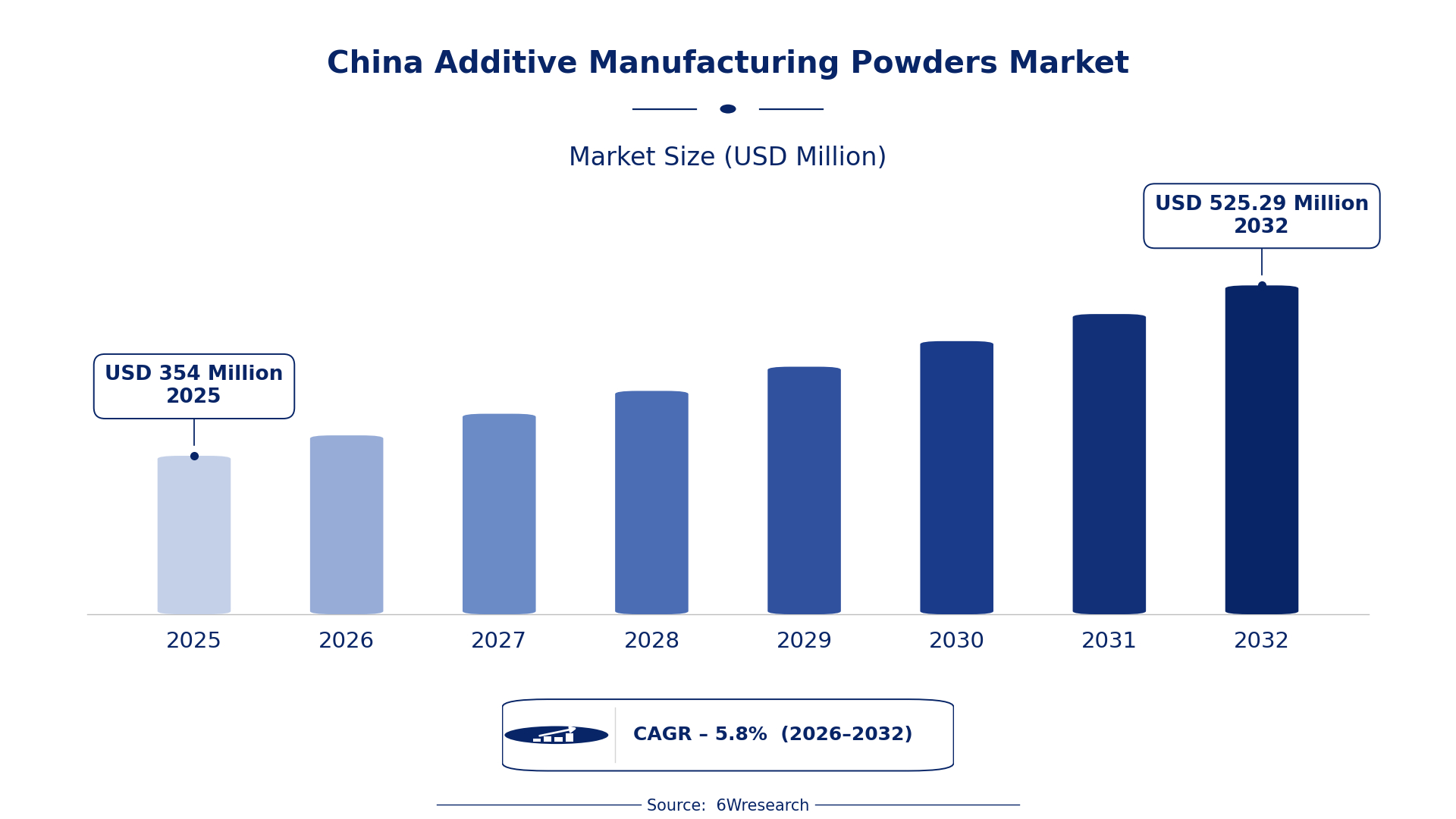
According to 6Wresearch internal database and industry insights, the China Additive Manufacturing Powders Market was valued at USD 354.0 million in 2025 and is projected to reach USD 525.29 million by 2032, growing at a CAGR of approximately 5.8% during 2026–2032.
China Additive Manufacturing Powders Market Highlights
| Report Metric | Details |
| Report Name | China Additive Manufacturing Powders Market |
| Market Size 2025 | USD 354.0 million |
| Market Size 2032 | USD 525.29 million |
| Absolute Growth 2025–2032 | USD 171.29 million |
| CAGR 2026–2032 | 5.8% |
| Peak Annual Growth | 8.3% in 2028 |
| Forecast Period | 2026–2032 |
| Historical Data | 2022–2025 |
| Base Year | 2025 |
| Leading Product Type, 2025 | Titanium Powders (40% share) |
| Leading Distribution Channel, 2025 | Direct Sales (37% share) |
| Leading End User, 2025 | Aerospace Components (44% share) |
| Fastest-Growing Product Type | Aluminum Powders (8.3% CAGR) |
| Fastest-Growing Distribution Channel | OEM Contracts (8.4% CAGR) |
| Fastest-Growing End User | Medical Devices (7.5% CAGR) |
| Growing Sector | Aerospace Components |
| Key End Users | Aerospace, Automotive, Medical Devices, OEMs |
China Additive Manufacturing Powders Market Year-wise Growth Rate and Key Drivers (2022–2032)
This graph illustrates the annual growth rates of the market from 2022 to 2032, highlighting a steady upward trajectory and projected market expansion over the forecast period.
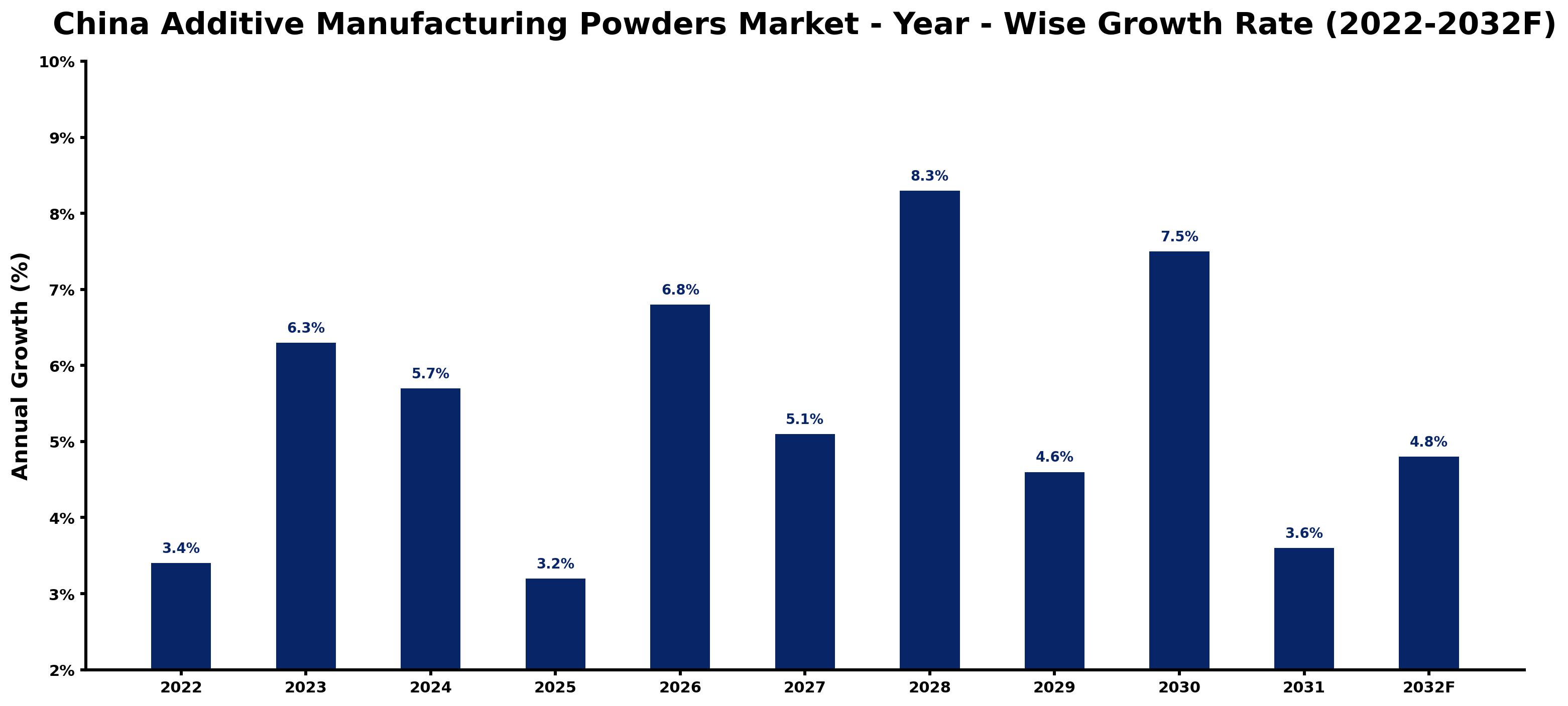
Annual growth estimates for each year appear below with the principal reason behind them, explaining the shifts that set the pace of the market.
| Year | Estimated Annual Growth (%) | Market Rationale |
| 2022 | 3.4 | The market experienced steady growth as local manufacturers increased production capacity. |
| 2023 | 6.3 | Growth accelerated due to heightened activity in the aerospace sector, driving powder demand. |
| 2024 | 5.7 | Demand growth slowed as the aerospace sector faced temporary project delays. |
| 2025 | 3.2 | The market continued to grow, albeit at a slower pace, as automotive demand stabilised. |
| 2026 | 6.8 | A resurgence in aerospace investment boosted growth as new projects were initiated. |
| 2027 | 5.1 | Growth moderated due to supply chain challenges impacting powder availability. |
| 2028 | 8.3 | The market peaked as aerospace and automotive sectors expanded rapidly, increasing demand. |
| 2029 | 4.6 | Growth slowed as the market adjusted to the peak demand levels seen in 2028. |
| 2030 | 7.5 | Aerospace technology investments spurred renewed interest in additive manufacturing applications. |
| 2031 | 3.6 | Growth decelerated as the market began to stabilise after a period of rapid expansion. |
| 2032 | 4.8 | Demand is projected to rise again as new applications in medical devices gain traction. |
Note: Market size estimations and growth projections presented in this report are based on 6Wresearch's proprietary forecasting methodology, utilizing the latest available industry data, government publications, and primary research inputs.
China Additive Manufacturing Powders Market Synopsis
Additive Manufacturing Powders in China are fine metal powders essential for 3D printing processes, produced mainly through atomization or mechanical milling. These powders are vital for creating complex geometries in industries such as aerospace and automotive. The China Additive Manufacturing Powders Market is expanding due to investments in aerospace technology and a focus on lightweight components in automotive manufacturing. With the aerospace sector projected to grow by 15% annually, demand for these powders is expected to rise substantially. Local manufacturers are driving this growth while some reliance on imports persists for specialized applications.
Market Dynamics Impact Analysis (2026–2032)
| Factor | Type | Impact | Primary Segment Affected |
| Increased aerospace investments drive demand for high-quality titanium powders. | Driver | High | Titanium Powders |
| The automotive industry's shift towards lightweight components enhances aluminum powder demand. | Driver | High | Aluminum Powders |
| Growing medical device applications present opportunities for stainless steel powders. | Opportunity | High | Stainless Steel Powders |
| Expansion of OEM contracts creates new supply chain opportunities for manufacturers. | Opportunity | Medium | OEM Contracts |
| Supply chain disruptions can limit the availability of essential powders. | Restraint | High | Titanium Powders |
| High production costs may deter new entrants in the additive manufacturing sector. | Restraint | Medium | Aluminum Powders |
| The Additive Manufacturing Powders market in China faces challenges related to regulatory compliance. | Challenge | High | Titanium Powders |
| Technological integration issues hinder the adoption of advanced manufacturing techniques. | Challenge | Medium | Titanium Powders |
Evaluation of Drivers in China Additive Manufacturing Powders Market (2026–2032)
The main growth drivers and the segments they affect most are set out below.
| Drivers | Primary Segment Affected | Why It Matters (Evidence) |
| Increased investment in aerospace technology boosts demand for titanium powders. | Titanium Powders | China's investment in aerospace technology reached $50 billion in 2023, driving higher purchases. |
| The automotive industry's focus on lightweighting drives aluminum powder usage. | Aluminum Powders | The automotive sector, as the largest consumer of aluminum powders, drives demand for lightweight components to improve fuel efficiency. |
| Rising medical device applications increase stainless steel powder requirements. | Stainless Steel Powders | The growing population of over 1.4 billion in China drives substantial demand for medical devices. |
| Expansion of OEM contracts secures long-term supply agreements for manufacturers. | OEM Contracts | Long-term agreements provide stability and predictability, encouraging manufacturers to invest in additive manufacturing. |
| The installed base of 3D printers supports increased powder demand. | Titanium Powders | With over 200,000 units installed in 2023, the demand for additive manufacturing powders is projected to rise. |
Growth in the Additive Manufacturing Powders market in China comes from increased investment in aerospace technology, the automotive industry's focus on lightweighting, and rising medical device applications. In 2023, China's investment in aerospace technology reached $50 billion, driving higher purchases of titanium powders. The automotive sector, as the largest consumer of aluminum powders, drives demand for lightweight components to improve fuel efficiency. The installed base of 3D printers exceeded 200,000 units in 2023, supporting increased powder demand across various applications. This combination of factors creates a favourable environment for additive manufacturing powders in China, enhancing opportunities for local suppliers.
Evaluation of Restraints in China Additive Manufacturing Powders Market
Below mentioned are some major restraints and their influence on market dynamics.
| Market Restraint | Primary Segment Affected | Why It Matters (Evidence) |
| Supply chain disruptions can limit the availability of essential powders. | Titanium Powders | In 2022, supply chain challenges affected the timely delivery of titanium powders to manufacturers. |
| High production costs may deter new entrants in the additive manufacturing sector. | Aluminum Powders | The cost of producing aluminum powders remains high, limiting competitive pricing for new suppliers. |
| Regulatory compliance issues can delay product approvals for manufacturers. | Titanium Powders | New standards established by the State Administration for Market Regulation in 2022 require thorough testing. |
| Limited awareness of additive manufacturing benefits restricts market growth. | Stainless Steel Powders | Many potential users in traditional industries remain unaware of the advantages of additive manufacturing. |
| Integration of advanced technologies can be challenging for manufacturers. | Stainless Steel Powders | Many manufacturers face difficulties in adopting new technologies within existing production processes. |
China Additive Manufacturing Powders Market Challenges
The China Additive Manufacturing Powders Market encounters several practical problems, starting with technology limitations. Many local manufacturers depend on outdated production methods, leading to inconsistent powder quality that raises costs for buyers in the aerospace sector. A skills gap exists, as a shortage of trained professionals in advanced manufacturing processes delays product development for suppliers. Compliance with ISO/ASTM 52900 standards imposes regulatory challenges, slowing market entry for new players and increasing costs. Supply chain disruptions frequently arise, as reliance on imported specialized powders can lead to delays and heightened expenses for producers.
Trends in the China Additive Manufacturing Powders Market
Below mentioned are some of the trends shaping the China Additive Manufacturing Powders Market growth.
- Shift from Traditional to Additive Manufacturing in Aerospace: Guangdong province is experiencing a shift as aerospace manufacturers adopt additive manufacturing techniques. In 2022, over 10,000 tons of titanium powders were produced, illustrating this transition.
- Transition from Metal to Composite Powders in Automotive: The automotive sector is increasingly incorporating composite powders for lightweight components. Since 2022, this shift has been evident as manufacturers seek to improve fuel efficiency and performance.
- Emergence of Medical Devices as a Key Application Area: The medical device sector is rapidly adopting additive manufacturing, with demand for stainless steel powders rising. In 2023, the population of over 1.4 billion in China significantly impacted powder usage.
- Growth of Online Platforms for Powder Distribution: Online platforms are becoming a growing channel for additive manufacturing powders. In 2023, this distribution method accounted for a notable percentage of sales, reflecting changing buyer preferences.
Investment Opportunities in the China Additive Manufacturing Powders Market
Investors looking at the China Additive Manufacturing Powders Market should consider the following areas.
- Investment in Aerospace Facilities in Guangdong: Guangdong province is a major hub for additive manufacturing, presenting opportunities for investment in aerospace facilities. The expected growth in aerospace technology will drive demand for titanium powders.
- Partnerships with OEMs for Long-term Supply Agreements: Now is an ideal time for manufacturers to form partnerships with OEMs to secure long-term supply agreements. This strategy can provide stability and predictability in powder demand.
- Focus on Medical Device Applications: With the growing population, there is an opportunity to supply powders for medical devices. Targeting hospitals and clinics can facilitate market entry and establish a strong presence.
- Expansion of R&D in Additive Manufacturing: Investment in R&D for additive manufacturing technologies is essential now. The National Development and Reform Commission's 'Additive Manufacturing Innovation Action Plan' aims to stimulate innovation in this sector.
Government Initiatives in the China Additive Manufacturing Powders Market
The '14th Five-Year Plan for Advanced Manufacturing' launched by the Ministry of Industry and Information Technology in 2021 aims to enhance additive manufacturing capabilities. This plan outlines strategic goals for improving production processes and encouraging innovation in the sector. Additionally, the 'Additive Manufacturing Innovation Action Plan' initiated in 2022 by the National Development and Reform Commission focuses on research and development, allocating resources to support advancements in additive manufacturing technologies. This initiative is expected to elevate the overall market by improving the quality and safety of additive manufacturing powders through new standards.
In 2023, the Ministry of Science and Technology approved a budget of $30 million for additive manufacturing research projects, supporting innovation and development in this field. The State Administration for Market Regulation established new standards for additive manufacturing materials in 2022, ensuring safety and quality. These measures assist manufacturers in complying with regulations while enhancing product offerings. Furthermore, local manufacturers are encouraged to engage in government-funded projects, boosting their capabilities and competitiveness in the market.
Future Insight of the China Additive Manufacturing Powders Market
By 2032, the China Additive Manufacturing Powders Market will undergo substantial transformations, primarily driven by advancements in production technology. The National Development and Reform Commission's 'Additive Manufacturing Industry Development Plan' will encourage innovation, enhancing local suppliers' capabilities. With the installed base of 3D printers exceeding 200,000 units, demand for high-quality powders will rise. The aerospace sector is projected to grow by 15% annually, creating new opportunities for buyers and suppliers in the market.
Market Segmentation Analysis
The analysis below covers each segmentation, its leading category in 2025 and its fastest-growing category through 2032.
By Product Type – Titanium Powders Dominated, Aluminum Powders Expected to Grow Fastest
According to Ravi Bhandari, Research Head at 6Wresearch, Titanium Powders held a 40% share of the China Additive Manufacturing Powders Market by product type in 2025. Titanium Powders dominate the China Additive Manufacturing Powders Market because they are vital for aerospace and medical applications, where their high strength-to-weight ratio is indispensable. The aerospace sector's projected annual growth of 15% further amplifies the demand for these high-performance powders. The quickest growth will come from Aluminum Powders, forecast to expand at a CAGR of 8.3% between 2026 and 2032. Aluminum Powders are experiencing rapid growth as the automotive industry increasingly emphasises lightweight components to enhance fuel efficiency. This shift towards reducing vehicle weight is a significant factor driving the surge in demand for aluminum powders. Suppliers should focus on expanding their aluminium powder offerings to meet the automotive sector's increasing demands.
By Distribution Channel – Direct Sales Dominated, OEM Contracts Expected to Grow Fastest
The largest distribution channel category in 2025 was Direct Sales, with a 37% share of total revenue. Direct Sales lead the market as they facilitate manufacturers in establishing strong relationships with industrial clients, ensuring that tailored solutions meet specific requirements. This method is particularly effective in industries like aerospace and automotive, where direct engagement is essential for success. OEM Contracts are projected to grow fastest, at a CAGR of 8.4% during 2026–2032. OEM Contracts are rapidly gaining traction as they offer manufacturers long-term supply agreements, ensuring a consistent demand for additive manufacturing powders. This trend is especially significant in aerospace, where reliability is crucial for operational efficiency. Buyers should consider forming OEM contracts to secure a reliable supply of high-quality powders.
By End User – Aerospace Components Dominated, Medical Devices Expected to Grow Fastest
In 2025, Aerospace Components led the end user split with a 44% share. Aerospace Components account for the largest market share due to the sector's growing dependence on additive manufacturing for producing complex geometries and lightweight structures. The anticipated expansion of the aerospace industry in China significantly drives this trend. Over 2026–2032, Medical Devices are expected to post the fastest growth, at a CAGR of 7.5%. Medical Devices are the fastest-growing segment, fuelled by the increasing demand for custom implants and surgical tools, alongside advancements in healthcare technology. The rising population and evolving healthcare needs in China are pivotal factors propelling this growth. Suppliers should seek opportunities in the medical device sector to leverage this expanding market.
Key Attractiveness of the Report
- 10 Years of Market Numbers
- Historical Data Starting from 2022 to 2025
- Base Year 2025
- Forecast Data until 2032
- Key Performance Indicators Impacting the Market
- Major Upcoming Developments and Projects
Key Highlights of the Report:
- China Additive Manufacturing Powders Market Outlook
- Market Size of China Additive Manufacturing Powders Market, 2025
- Forecast of China Additive Manufacturing Powders Market, 2032
- Historical Data and Forecast of China Additive Manufacturing Powders Revenues & Volume for the Period 2022 - 2032F
- China Additive Manufacturing Powders Market Trend Evolution
- China Additive Manufacturing Powders Market Drivers and Challenges
- China Additive Manufacturing Powders Price Trends
- China Additive Manufacturing Powders Porter's Five Forces
- China Additive Manufacturing Powders Industry Life Cycle
- Historical Data and Forecast of China Additive Manufacturing Powders Market Revenues & Volume By Product Type for the Period 2022 - 2032F
- Historical Data and Forecast of China Additive Manufacturing Powders Market Revenues & Volume By Titanium Powders for the Period 2022 - 2032F
- Historical Data and Forecast of China Additive Manufacturing Powders Market Revenues & Volume By Aluminum Powders for the Period 2022 - 2032F
- Historical Data and Forecast of China Additive Manufacturing Powders Market Revenues & Volume By Stainless Steel Powders for the Period 2022 - 2032F
- Historical Data and Forecast of China Additive Manufacturing Powders Market Revenues & Volume By Nickel-Based Powders for the Period 2022 - 2032F
- Historical Data and Forecast of China Additive Manufacturing Powders Market Revenues & Volume By Distribution Channel for the Period 2022 - 2032F
- Historical Data and Forecast of China Additive Manufacturing Powders Market Revenues & Volume By Direct Sales for the Period 2022 - 2032F
- Historical Data and Forecast of China Additive Manufacturing Powders Market Revenues & Volume By Industrial Suppliers for the Period 2022 - 2032F
- Historical Data and Forecast of China Additive Manufacturing Powders Market Revenues & Volume By Online Platforms for the Period 2022 - 2032F
- Historical Data and Forecast of China Additive Manufacturing Powders Market Revenues & Volume By OEM Contracts for the Period 2022 - 2032F
- Historical Data and Forecast of China Additive Manufacturing Powders Market Revenues & Volume By End User for the Period 2022 - 2032F
- Historical Data and Forecast of China Additive Manufacturing Powders Market Revenues & Volume By Aerospace Components for the Period 2022 - 2032F
- Historical Data and Forecast of China Additive Manufacturing Powders Market Revenues & Volume By Automotive Engines for the Period 2022 - 2032F
- Historical Data and Forecast of China Additive Manufacturing Powders Market Revenues & Volume By Medical Devices for the Period 2022 - 2032F
- Historical Data and Forecast of China Additive Manufacturing Powders Market Revenues & Volume By Oil & Gas Equipment for the Period 2022 - 2032F
- China Additive Manufacturing Powders Import Export Trade Statistics
- Market Opportunity Assessment By Product Type
- Market Opportunity Assessment By Distribution Channel
- Market Opportunity Assessment By End User
- China Additive Manufacturing Powders Top Companies Market Share
- China Additive Manufacturing Powders Competitive Benchmarking By Technical and Operational Parameters
- China Additive Manufacturing Powders Company Profiles
- China Additive Manufacturing Powders Key Strategic Recommendations
Market Covered
Segments analysed in this report are listed below.
By Product Type
- Titanium Powders
- Aluminum Powders
- Stainless Steel Powders
- Nickel-Based Powders
By Distribution Channel
- Direct Sales
- Industrial Suppliers
- Online Platforms
- OEM Contracts
By End User
- Aerospace Components
- Automotive Engines
- Medical Devices
- Oil & Gas Equipment































