China ADMET Prediction AI Market Size & Growth Rate
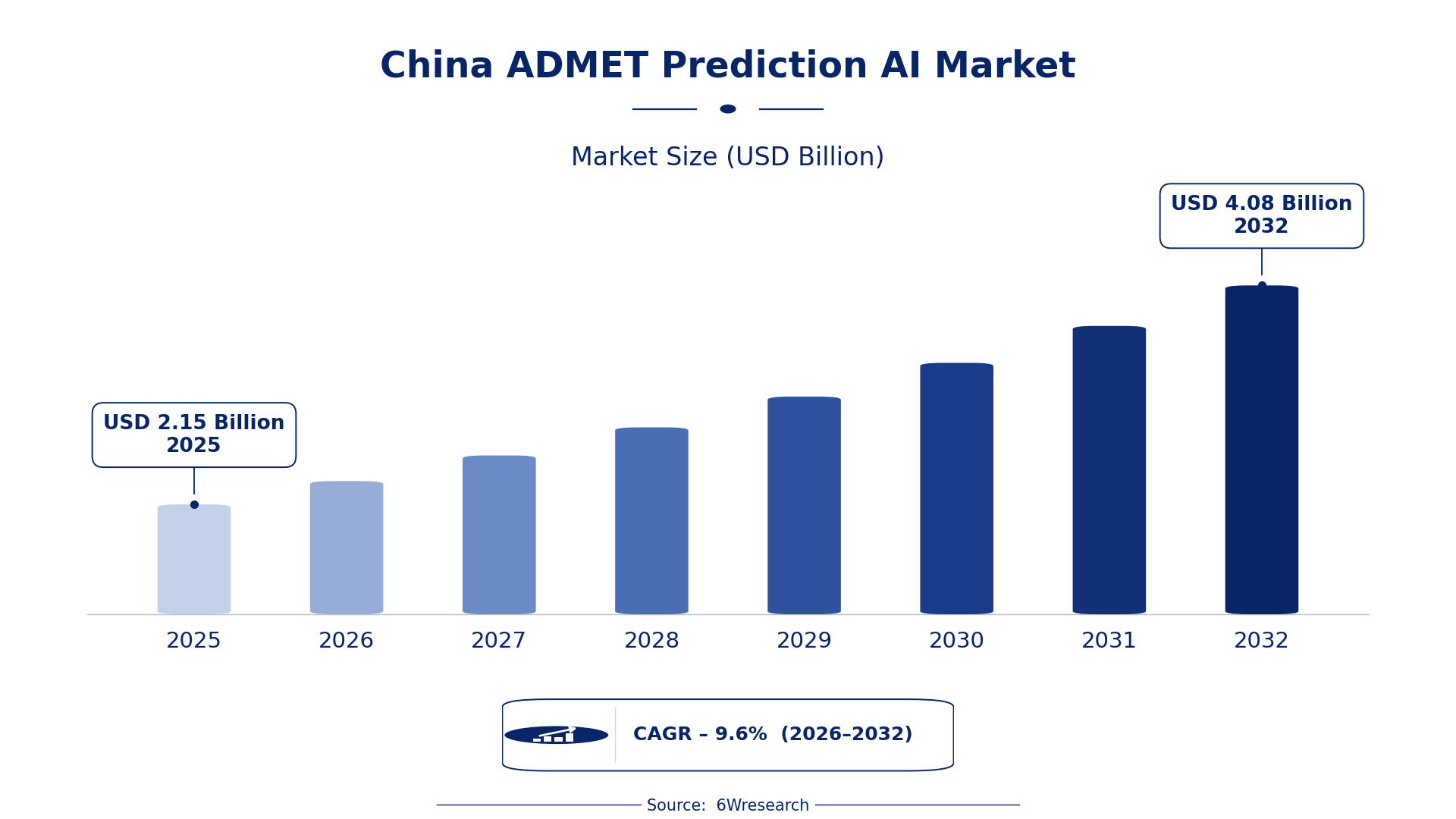
According to 6Wresearch internal database and industry insights, the China ADMET Prediction AI Market was valued at USD 2.15 billion in 2025 and is projected to reach USD 4.08 billion by 2032, growing at a CAGR of approximately 9.6% during 2026–2032.
China ADMET Prediction AI Market Highlights
| Report Metric | Details |
| Report Name | China ADMET Prediction AI Market |
| Market Size 2025 | USD 2.15 billion |
| Market Size 2032 | USD 4.08 billion |
| Absolute Growth 2025–2032 | USD 1.93 billion |
| CAGR 2026–2032 | 9.6% |
| Peak Annual Growth | 12.1% in 2028 |
| Forecast Period | 2026–2032 |
| Historical Data | 2022–2025 |
| Base Year | 2025 |
| Leading Product Type, 2025 | In Silico Tools (45% share) |
| Leading Application Area, 2025 | Drug Discovery (52% share) |
| Leading Technology Type, 2025 | Machine Learning (43% share) |
| Leading Deployment Mode, 2025 | Cloud-based (43% share) |
| Leading End User, 2025 | Pharmaceutical Companies (51% share) |
| Fastest-Growing Product Type | Predictive Modeling (12.2% CAGR) |
| Fastest-Growing Application Area | Toxicity Prediction (12.0% CAGR) |
| Fastest-Growing Technology Type | Deep Learning (12.0% CAGR) |
| Fastest-Growing Deployment Mode | SaaS (11.9% CAGR) |
| Fastest-Growing End User | Biotech Firms (11.0% CAGR) |
| Growing Sector | pharmaceutical |
| Key End Users | Pharmaceutical Companies, Biotech Firms, Research Laboratories, Contract Research Organizations |
China ADMET Prediction AI Market Year-wise Growth Rate and Key Drivers (2022–2032)
This graph illustrates the annual growth rates of the market from 2022 to 2032, highlighting a steady upward trajectory and projected market expansion over the forecast period.
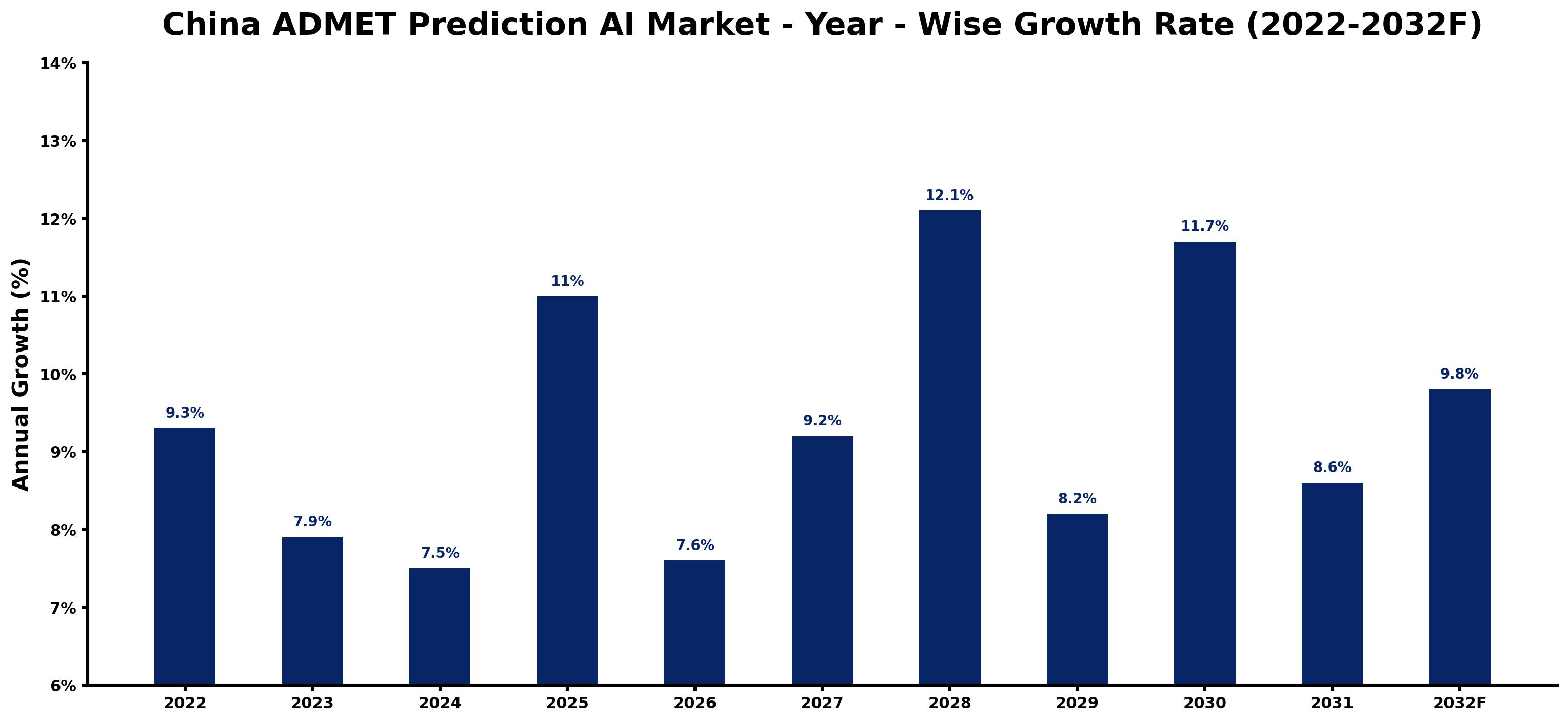
The table below sets out the estimated growth rate for each year and the main factor behind it.
| Year | Estimated Annual Growth (%) | Market Rationale |
| 2022 | 9.3 | The market experienced solid growth due to increased R&D investments in pharmaceuticals. |
| 2023 | 7.9 | Investment in drug development slowed slightly, impacting growth rates. |
| 2024 | 7.5 | Continued investment in AI technologies kept the market expanding, albeit at a slower pace. |
| 2025 | 11.0 | A surge in drug discovery activities led to notable growth acceleration. |
| 2026 | 7.6 | Growth is expected to slow as companies adjust to regulatory changes in AI applications. |
| 2027 | 9.2 | Demand is projected to rise again as pharmaceutical companies embrace advanced predictive tools. |
| 2028 | 12.1 | Peak growth will be driven by heightened investment in AI for drug development. |
| 2029 | 8.2 | A slight slowdown is expected as the market stabilises after rapid growth. |
| 2030 | 11.7 | Renewed interest in AI technologies will boost growth rates once more. |
| 2031 | 8.6 | The market is projected to face a slowdown as companies consolidate their positions. |
| 2032 | 9.8 | Growth is expected to rise again as new technologies are adopted. |
Note: Market size estimations and growth projections presented in this report are based on 6Wresearch's proprietary forecasting methodology, utilizing the latest available industry data, government publications, and primary research inputs.
China ADMET Prediction AI Market Synopsis
ADMET Prediction AI in China encompasses sophisticated computational tools that forecast drug absorption, distribution, metabolism, excretion, and toxicity. These tools enhance efficiency in drug discovery, primarily benefiting the pharmaceutical and biotechnology sectors. The China ADMET Prediction AI Market is growing due to substantial investments in R&D, with the pharmaceutical market valued at around $155 billion in 2022. A surge in demand from domestic pharmaceutical companies and research institutions propels this growth, bolstered by initiatives like the National Key R&D Program initiated in 2021.
Market Dynamics Impact Analysis (2026–2032)
| Factor | Type | Impact | Primary Segment Affected |
| Increased R&D investment in pharmaceuticals drives demand for predictive tools. | Driver | High | Drug Discovery |
| The rise of biotechnology firms enhances the need for advanced predictive modeling. | Driver | High | Predictive Modeling |
| Growing focus on drug safety creates opportunities for toxicity prediction tools. | Opportunity | High | Toxicity Prediction |
| The push for AI integration in healthcare opens avenues for innovative solutions. | Opportunity | High | AI Algorithms |
| Regulatory hurdles can delay the approval of new AI tools in drug development. | Restraint | Medium | Machine Learning |
| Limited awareness of AI capabilities among smaller firms restricts market growth. | Restraint | Medium | Biotech Firms |
| Talent shortages in AI and data science impact development timelines. | Challenge | High | Pharmaceutical Companies |
| High costs associated with AI technology adoption can deter investment. | Challenge | Medium | Research Laboratories |
Evaluation of Drivers in China ADMET Prediction AI Market (2026–2032)
The table below links each growth driver to the segment it affects and the evidence for it.
| Drivers | Primary Segment Affected | Why It Matters (Evidence) |
| Increased R&D spending in pharmaceuticals boosts demand for predictive tools. | Drug Discovery | China's pharmaceutical market was valued at approximately $155 billion in 2022. |
| The rise of biotech firms increases the need for advanced predictive modeling. | Predictive Modeling | Over 400 biotech firms are actively engaged in drug discovery in China. |
| Growing focus on drug safety creates opportunities for toxicity prediction tools. | Toxicity Prediction | The average population exposure to new drugs in China is around 30% annually. |
| The push for AI integration in healthcare opens avenues for innovative solutions. | AI Algorithms | The Ministry of Science and Technology launched the 'National Key R&D Program' in 2021. |
| Cloud-based deployment allows easy access to predictive tools for users. | Cloud-based | Cloud-based solutions accounted for 43% of the deployment mode in 2025. |
The ADMET Prediction AI market in China is expanding as demand from pharmaceutical companies rises alongside increasing R&D investments. In 2023, the China National Pharmaceutical Industry Information Center reported a 10% rise in R&D investment, leading to more acquisitions of predictive tools. The presence of over 400 biotech firms fuels the need for advanced modelling solutions. With an average population exposure to new drugs of about 30% annually, there is a growing demand for toxicity prediction tools. Cloud-based deployment facilitates easy access to essential resources, allowing firms to streamline their operations.
Evaluation of Restraints in China ADMET Prediction AI Market
Below mentioned are some major restraints and their influence on market dynamics.
| Market Restraint | Primary Segment Affected | Why It Matters (Evidence) |
| Regulatory hurdles can delay the approval of new AI tools in drug development. | Machine Learning | The State Administration for Market Regulation updated guidelines in 2023, affecting approval timelines. |
| Limited awareness of AI capabilities among smaller firms restricts market growth. | Biotech Firms | Many smaller firms lack the resources to invest in advanced AI technologies, hindering adoption. |
| High costs associated with AI technology adoption can deter investment. | Research Laboratories | Budget constraints limit the ability of labs to invest in new technologies, impacting progress. |
| Talent shortages in AI and data science impact development timelines. | Pharmaceutical Companies | The demand for skilled professionals in AI exceeds the available talent pool, delaying projects. |
| Complex integration processes can slow down the implementation of new tools. | Predictive Modeling | Many firms face challenges in aligning new technologies with existing systems, causing delays. |
China ADMET Prediction AI Market Challenges
The China ADMET Prediction AI market encounters several practical challenges, beginning with high integration costs for buyers. In 2022, the pharmaceutical market was valued at approximately $155 billion, yet many domestic companies find it difficult to invest in advanced AI tools, which can extend their drug development timelines by up to 18 months. A shortage of skilled professionals presents another hurdle, as over 400 biotech firms compete for a limited talent pool trained in AI, increasing recruitment costs and prolonging hiring processes. Technology adoption is slow; despite updated guidelines from the China Food and Drug Administration, many firms lack the necessary infrastructure to implement AI effectively, which limits their competitiveness. Intense competition exists, with the 'Made in China 2025' initiative accelerating advancements, making it challenging for smaller firms to maintain their market presence.
Trends in the China ADMET Prediction AI Market
Buyers and suppliers in the China ADMET Prediction AI Market are adjusting to the following trends.
- Shift Towards AI-Driven Drug Discovery: China is increasingly adopting AI-driven approaches in drug discovery, with over 400 biotech firms actively engaged. In 2023, the National Key R&D Program allocated $500 million to support AI technologies, improving efficiency for pharmaceutical companies.
- Growing Adoption of Cloud-Based Solutions: In 2025, cloud-based deployment accounted for 43% of the ADMET Prediction AI market. This trend is driven by the need for flexible access to tools, enabling pharmaceutical companies to streamline their drug development processes.
- Increased Focus on Toxicity Prediction: The emphasis on drug safety has led to a rise in toxicity prediction tools. In 2023, the average population exposure to new drugs in China was around 30%, highlighting the need for effective safety assessments.
- Expansion of AI Integration in Healthcare: The 'AI in Healthcare Development Plan' launched in 2021 has spurred AI integration in drug discovery. This initiative aims to improve the capabilities of pharmaceutical companies, promoting effective solutions in the market.
Investment Opportunities in the China ADMET Prediction AI Market
Below are the investment opportunities with the strongest case in the China ADMET Prediction AI Market.
- Investment in Predictive Modeling Tools: The growing demand for predictive modeling tools presents an opportunity for investment. With over 400 biotech firms in China, suppliers can enter through partnerships with local firms to improve drug development capabilities.
- Supply of AI Algorithms: The increasing focus on AI technologies creates a demand for advanced AI algorithms. By targeting pharmaceutical companies, suppliers can provide tailored solutions that meet specific drug development needs.
- Development of Toxicity Prediction Solutions: The emphasis on drug safety creates a timely opportunity for developing toxicity prediction solutions. With the average population exposure to new drugs at 30%, suppliers can cater to pharmaceutical companies seeking effective safety assessments.
- Cloud-Based Deployment Solutions: The rise of cloud-based solutions offers a chance for suppliers to provide flexible access to predictive tools. By partnering with research laboratories, companies can facilitate easier integration of these technologies.
Government Initiatives in the China ADMET Prediction AI Market
In 2021, the National Health Commission launched the 'AI in Healthcare Development Plan', promoting AI applications in drug discovery and patient care. This initiative establishes a structured framework for integrating AI technologies into healthcare, ensuring compliance with safety standards and improving efficiency in drug development processes. In 2022, the Ministry of Science and Technology initiated the 'National Key R&D Program' with a budget of $500 million, focusing on AI technologies in drug development. This program supports pharmaceutical companies by funding research projects that incorporate AI, thus accelerating the development and approval of new drug candidates.
The Ministry of Industry and Information Technology's 'AI for Health Program' established in 2023 supports AI integration in healthcare sectors, providing funding for projects. The State Administration for Market Regulation oversees the implementation of updated guidelines for AI in drug development, streamlining approval processes for AI-based tools. These measures enable pharmaceutical companies to adopt AI technologies more effectively, improving their research and development capabilities. With these frameworks in place, buyers can anticipate improved access to AI tools and resources.
Future Insight of the China ADMET Prediction AI Market
By 2032, buyers and suppliers in the China ADMET Prediction AI market can expect substantial changes driven by government initiatives and increased investment in biotechnology. The National Key R&D Program will promote AI integration in healthcare, streamlining drug development processes. The government has allocated $1 billion for biotechnology innovation projects, encouraging the introduction of new methodologies. With the '14th Five-Year Plan' prioritising AI technologies in healthcare, collaboration among stakeholders will improve, leading to more efficient and inventive solutions in drug discovery.
Market Segmentation Analysis
The analysis below covers each segmentation, its leading category in 2025 and its fastest-growing category through 2032.
By Product Type – In Silico Tools Dominated, Predictive Modeling Expected to Grow Fastest
According to Ravi Bhandari, Research Head at 6Wresearch, in 2025, In Silico Tools led the product type split with a 45% share. In Silico Tools dominate the China ADMET Prediction AI market due to their critical role in the initial screening of drug candidates, essential for pharmaceutical companies. The reliance on these tools is evident with over 400 biotech firms actively engaged in drug discovery, showcasing their importance. Predictive Modeling is projected to grow fastest, at a CAGR of 12.2% during 2026–2032. Predictive Modeling is witnessing rapid growth as it is increasingly utilised to forecast drug behaviour in biological systems, a necessity for effective drug development. The 10% increase in R&D investment in 2023 highlights a strong commitment to enhancing predictive capabilities in this area. Suppliers should enhance their in silico offerings to cater to the growing demand from pharmaceutical firms.
By Application Area – Drug Discovery Dominated, Toxicity Prediction Expected to Grow Fastest
With a 52% revenue share in 2025, Drug Discovery was the largest application area category. Drug Discovery holds the largest share as it is the core application for developing new therapeutics, making it indispensable for pharmaceutical companies. The robust R&D investment in China's pharmaceutical market underscores the significance of this segment in driving innovation. Over 2026–2032, Toxicity Prediction is expected to post the fastest growth, at a CAGR of 12.0%. Toxicity Prediction is the fastest-growing area, propelled by the urgent need to assess the safety of compounds prior to clinical trials. The updated guidelines for AI in drug development in 2023 reflect a heightened focus on safety assessments, driving this segment's growth. Buyers must prioritise tools that improve toxicity prediction to ensure compliance and safety in drug development.
By Technology Type – Machine Learning Dominated, Deep Learning Expected to Grow Fastest
The largest technology type category in 2025 was Machine Learning, with a 43% share of total revenue. Machine Learning leads the market share as it is the fundamental technology driving predictions in ADMET Prediction AI, crucial for pharmaceutical applications. Its widespread adoption among over 1,000 registered research laboratories highlights its central role in drug development processes. The quickest growth will come from Deep Learning, forecast to expand at a CAGR of 12.0% between 2026 and 2032. Deep Learning is rapidly expanding due to its capability to enhance the accuracy of predictive models, which is vital for successful drug development. The integration of advanced algorithms is becoming a standard expectation in the industry, further driving demand for this technology. Suppliers should invest in deep learning capabilities to remain competitive and meet the evolving demands of pharmaceutical companies.
By Deployment Mode – Cloud-based Dominated, SaaS Expected to Grow Fastest
Cloud-based took a 43% share of deployment mode in 2025, more than any other category. Cloud-based deployment holds the largest market share because it facilitates remote access to tools and data, which is essential for collaboration among pharmaceutical teams. This accessibility is particularly important given the scale of China's pharmaceutical market. SaaS are set to record the highest CAGR in this split, 11.9% over 2026–2032. SaaS is the fastest-growing deployment mode, offering flexible access to predictive tools that align with the dynamic needs of biotech firms. The increasing number of biotech firms seeking agile solutions is propelling this growth. Buyers should consider SaaS options for greater flexibility and scalability in their drug development processes.
By End User – Pharmaceutical Companies Dominated, Biotech Firms Expected to Grow Fastest
Pharmaceutical Companies accounted for a 51% market share by end user in 2025. Pharmaceutical Companies represent the largest share of the market as they are the primary users of ADMET tools, driving demand for efficient drug development solutions. The treatment of 1.4 billion patients annually in hospitals highlights the critical need for effective therapeutics in this sector. Biotech Firms are projected to grow fastest, at a CAGR of 11.0% during 2026–2032. Biotech Firms are the fastest-growing end user, heavily relying on ADMET tools for innovative drug development in a competitive landscape. Their increasing focus on novel therapies is propelling this segment's growth, indicating a shift in market dynamics. Suppliers should tailor their offerings to meet the specific needs of biotech firms, which are rapidly becoming key players in the drug development arena.
Key Attractiveness of the Report
- 10 Years of Market Numbers
- Historical Data Starting from 2022 to 2025
- Base Year 2025
- Forecast Data until 2032
- Key Performance Indicators Impacting the Market
- Major Upcoming Developments and Projects
Key Highlights of the Report:
- China ADMET Prediction AI Market Outlook
- Market Size of China ADMET Prediction AI Market, 2025
- Forecast of China ADMET Prediction AI Market, 2032
- Historical Data and Forecast of China ADMET Prediction AI Revenues & Volume for the Period 2022 - 2032F
- China ADMET Prediction AI Market Trend Evolution
- China ADMET Prediction AI Market Drivers and Challenges
- China ADMET Prediction AI Price Trends
- China ADMET Prediction AI Porter's Five Forces
- China ADMET Prediction AI Industry Life Cycle
- Historical Data and Forecast of China ADMET Prediction AI Market Revenues & Volume By Product Type for the Period 2022 - 2032F
- Historical Data and Forecast of China ADMET Prediction AI Market Revenues & Volume By In Silico Tools for the Period 2022 - 2032F
- Historical Data and Forecast of China ADMET Prediction AI Market Revenues & Volume By Predictive Modeling for the Period 2022 - 2032F
- Historical Data and Forecast of China ADMET Prediction AI Market Revenues & Volume By Simulation Platforms for the Period 2022 - 2032F
- Historical Data and Forecast of China ADMET Prediction AI Market Revenues & Volume By Data Integration Tools for the Period 2022 - 2032F
- Historical Data and Forecast of China ADMET Prediction AI Market Revenues & Volume By Application Area for the Period 2022 - 2032F
- Historical Data and Forecast of China ADMET Prediction AI Market Revenues & Volume By Drug Discovery for the Period 2022 - 2032F
- Historical Data and Forecast of China ADMET Prediction AI Market Revenues & Volume By Toxicity Prediction for the Period 2022 - 2032F
- Historical Data and Forecast of China ADMET Prediction AI Market Revenues & Volume By Pharmacokinetics for the Period 2022 - 2032F
- Historical Data and Forecast of China ADMET Prediction AI Market Revenues & Volume By ADME Testing for the Period 2022 - 2032F
- Historical Data and Forecast of China ADMET Prediction AI Market Revenues & Volume By Technology Type for the Period 2022 - 2032F
- Historical Data and Forecast of China ADMET Prediction AI Market Revenues & Volume By Machine Learning for the Period 2022 - 2032F
- Historical Data and Forecast of China ADMET Prediction AI Market Revenues & Volume By Deep Learning for the Period 2022 - 2032F
- Historical Data and Forecast of China ADMET Prediction AI Market Revenues & Volume By Neural Networks for the Period 2022 - 2032F
- Historical Data and Forecast of China ADMET Prediction AI Market Revenues & Volume By AI Algorithms for the Period 2022 - 2032F
- Historical Data and Forecast of China ADMET Prediction AI Market Revenues & Volume By Deployment Mode for the Period 2022 - 2032F
- Historical Data and Forecast of China ADMET Prediction AI Market Revenues & Volume By Cloud-based for the Period 2022 - 2032F
- Historical Data and Forecast of China ADMET Prediction AI Market Revenues & Volume By On-Premise for the Period 2022 - 2032F
- Historical Data and Forecast of China ADMET Prediction AI Market Revenues & Volume By SaaS for the Period 2022 - 2032F
- Historical Data and Forecast of China ADMET Prediction AI Market Revenues & Volume By Hybrid for the Period 2022 - 2032F
- Historical Data and Forecast of China ADMET Prediction AI Market Revenues & Volume By End User for the Period 2022 - 2032F
- Historical Data and Forecast of China ADMET Prediction AI Market Revenues & Volume By Pharmaceutical Companies for the Period 2022 - 2032F
- Historical Data and Forecast of China ADMET Prediction AI Market Revenues & Volume By Biotech Firms for the Period 2022 - 2032F
- Historical Data and Forecast of China ADMET Prediction AI Market Revenues & Volume By Research Laboratories for the Period 2022 - 2032F
- Historical Data and Forecast of China ADMET Prediction AI Market Revenues & Volume By Contract Research Organizations for the Period 2022 - 2032F
- China ADMET Prediction AI Import Export Trade Statistics
- Market Opportunity Assessment By Product Type
- Market Opportunity Assessment By Application Area
- Market Opportunity Assessment By Technology Type
- Market Opportunity Assessment By Deployment Mode
- Market Opportunity Assessment By End User
- China ADMET Prediction AI Top Companies Market Share
- China ADMET Prediction AI Competitive Benchmarking By Technical and Operational Parameters
- China ADMET Prediction AI Company Profiles
- China ADMET Prediction AI Key Strategic Recommendations
Market Covered
The report offers an extensive study of the following market segments.
By Product Type
- In Silico Tools
- Predictive Modeling
- Simulation Platforms
- Data Integration Tools
By Application Area
- Drug Discovery
- Toxicity Prediction
- Pharmacokinetics
- ADME Testing
By Technology Type
- Machine Learning
- Deep Learning
- Neural Networks
- AI Algorithms
By Deployment Mode
- Cloud-based
- On-Premise
- SaaS
- Hybrid
By End User
- Pharmaceutical Companies
- Biotech Firms
- Research Laboratories
- Contract Research Organizations































