China Administrative Automation AI Market Size & Growth Rate
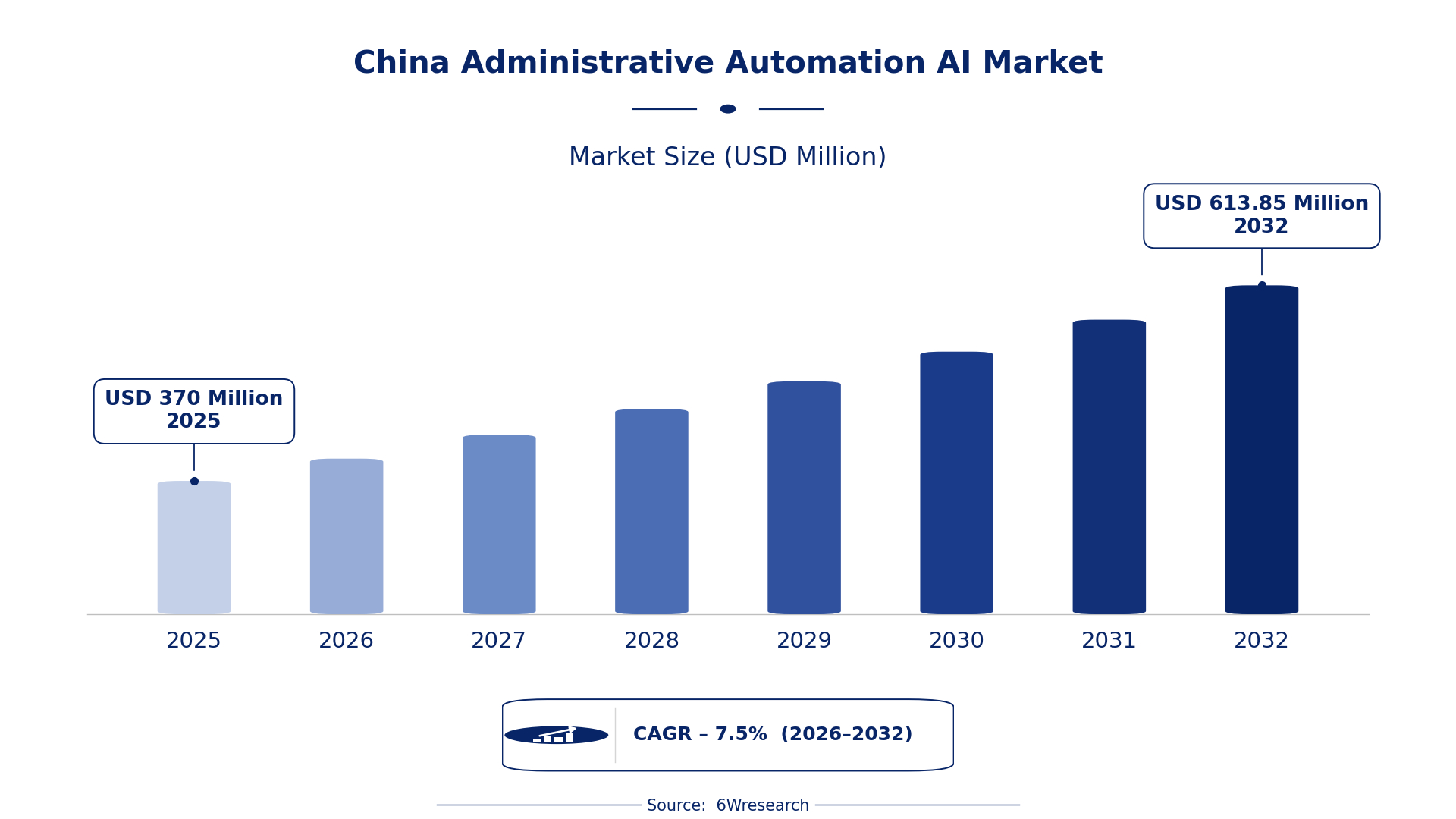
According to 6Wresearch internal database and industry insights, the China Administrative Automation AI Market was valued at USD 370.0 million in 2025 and is projected to reach USD 613.85 million by 2032, growing at a CAGR of approximately 7.5% during 2026–2032.
China Administrative Automation AI Market Highlights
| Report Metric | Details |
| Report Name | China Administrative Automation AI Market |
| Market Size 2025 | USD 370.0 million |
| Market Size 2032 | USD 613.85 million |
| Absolute Growth 2025–2032 | USD 243.85 million |
| CAGR 2026–2032 | 7.5% |
| Peak Annual Growth | 9.3% in 2032 |
| Forecast Period | 2026–2032 |
| Historical Data | 2022–2025 |
| Base Year | 2025 |
| Leading Product Type, 2025 | Workflow Automation (41% share) |
| Leading Application Area, 2025 | HR & Payroll (41% share) |
| Leading Deployment Mode, 2025 | Cloud (44% share) |
| Leading Technology Type, 2025 | Machine Learning (40% share) |
| Leading End User, 2025 | Financial Institutions (40% share) |
| Fastest-Growing Product Type | Robotic Process Automation (9.8% CAGR) |
| Fastest-Growing Application Area | Invoice Processing (10.0% CAGR) |
| Fastest-Growing Deployment Mode | SaaS (9.5% CAGR) |
| Fastest-Growing End User | Insurance Companies (9.4% CAGR) |
| Growing Sector | Financial Services |
| Key End Users | Financial Institutions, Legal Firms, Insurance Companies, Banks |
China Administrative Automation AI Market Year-wise Growth Rate and Key Drivers (2022–2032)
This graph illustrates the annual growth rates of the market from 2022 to 2032, highlighting a steady upward trajectory and projected market expansion over the forecast period.
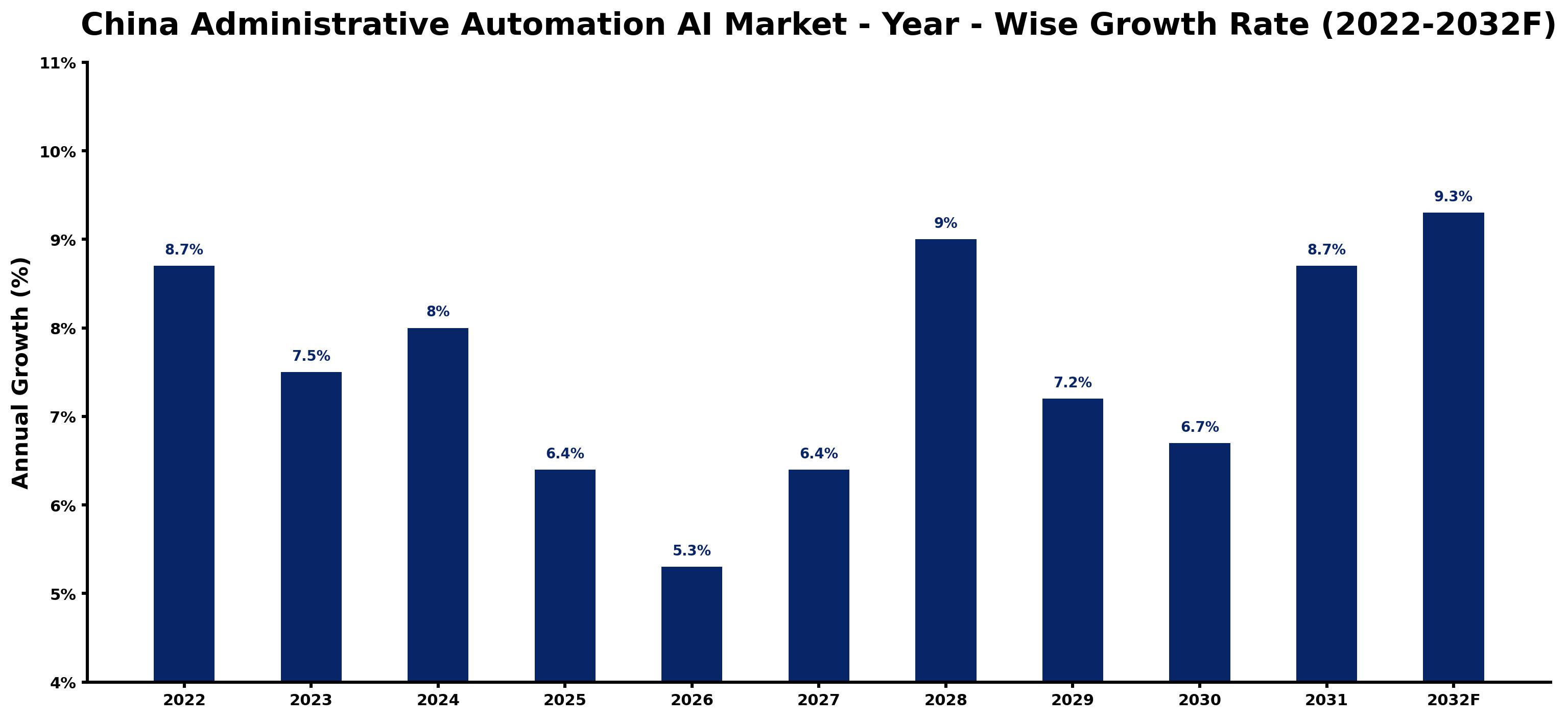
The following table presents the estimated annual growth rate for each year together with the principal factor influencing market performance.
| Year | Estimated Annual Growth (%) | Market Rationale |
| 2022 | 8.7 | The market experienced strong adoption of automation technologies across various sectors. |
| 2023 | 7.5 | Growth slowed due to increased scrutiny on AI implementations and compliance requirements. |
| 2024 | 8.0 | Demand rose as more companies sought efficiency through automation solutions. |
| 2025 | 6.4 | Growth decelerated as companies faced challenges in integrating new technologies. |
| 2026 | 5.3 | The market continued to grow, albeit at a slower pace due to regulatory adjustments. |
| 2027 | 6.4 | Demand increased as businesses began to prioritise automation for operational efficiency. |
| 2028 | 9.0 | Growth accelerated as technological advancements improved automation capabilities. |
| 2029 | 7.2 | The market experienced a slowdown as companies reassessed their automation strategies. |
| 2030 | 6.7 | Growth slowed as organisations focused on optimising existing automation systems. |
| 2031 | 8.7 | Demand surged as financial institutions expanded their automation efforts. |
| 2032 | 9.3 | The market will peak as AI technologies become integral to administrative processes. |
Note: Market size estimations and growth projections presented in this report are based on 6Wresearch's proprietary forecasting methodology, utilizing the latest available industry data, government publications, and primary research inputs.
China Administrative Automation AI Market Synopsis
Administrative Automation AI in China refers to technologies that streamline and automate administrative tasks through artificial intelligence. These technologies enhance efficiency in workflows, manage documents, and automate repetitive tasks. The China Administrative Automation AI Market is growing due to increasing demand from sectors such as finance, legal, and insurance. The National AI Development Plan launched in 2021 promotes AI technologies, driving further investment and adoption. With a population exceeding 1.4 billion, the demand for automation solutions continues to rise.
Market Dynamics Impact Analysis (2026–2032)
| Factor | Type | Impact | Primary Segment Affected |
| Increased demand for workflow automation in financial institutions enhances efficiency and reduces operational costs. | Driver | High | Workflow Automation |
| The rise of robotic process automation in insurance companies improves claims management efficiency. | Driver | High | Robotic Process Automation |
| The growing need for document management solutions in urban legal firms presents opportunities for new providers. | Opportunity | High | Document Management |
| The shift towards cloud-based solutions allows for scalable automation tools in various sectors. | Opportunity | High | Cloud |
| Integration challenges with existing systems can hinder the adoption of new AI technologies. | Restraint | High | Robotic Process Automation |
| Compliance with evolving AI regulations can slow down implementation timelines for businesses. | Restraint | High | Document Management |
| Administrative Automation AI in China faces significant regulatory hurdles that complicate implementation. | Challenge | High | Virtual Assistants |
| The rapid pace of technological change can outstrip the ability of firms to adapt their processes. | Challenge | Medium | HR & Payroll |
Evaluation of Drivers in China Administrative Automation AI Market (2026–2032)
Below mentioned are some major drivers and their influence on market dynamics.
| Drivers | Primary Segment Affected | Why It Matters (Evidence) |
| Increased investment in AI technologies by financial institutions drives workflow automation. | Workflow Automation | In 2023, the Chinese AI market reached a valuation of approximately 1 trillion yuan, driving demand. |
| The adoption of robotic process automation in insurance companies streamlines claims processing. | Robotic Process Automation | Robotic Process Automation is increasingly used in insurance companies for claims management. |
| Growing demand for document management solutions in legal firms improves operational efficiency. | Document Management | Document management solutions are essential for legal firms in urban areas like Beijing and Shanghai. |
| The preference for SaaS deployment among enterprises boosts cloud-based automation solutions. | Cloud | SaaS deployment is preferred by 70% of enterprises for its flexibility and cost-effectiveness. |
| The need for compliance reporting drives demand for automated solutions across various sectors. | Compliance Reporting | The AI Standards Committee was established in 2020 to develop national standards for AI applications. |
Expansion of the Administrative Automation AI market in China is backed by increased investment in AI technologies, particularly from financial institutions seeking to improve workflow automation. In 2023, the Chinese AI market reached a valuation of approximately 1 trillion yuan, driving demand for solutions that streamline processes. The adoption of robotic process automation in insurance companies is streamlining claims processing, allowing for faster service delivery. Document management solutions are essential for legal firms in urban areas, improving efficiency. The preference for SaaS deployment among enterprises boosts cloud-based automation solutions, facilitating wider adoption.
Evaluation of Restraints in China Administrative Automation AI Market
Below mentioned are some major restraints and their influence on market dynamics.
| Market Restraint | Primary Segment Affected | Why It Matters (Evidence) |
| Integration challenges with existing systems can hinder the adoption of new AI technologies. | Robotic Process Automation | Many companies struggle to integrate robotic process automation into their legacy systems, delaying implementation. |
| Compliance with evolving AI regulations can slow down implementation timelines for businesses. | Document Management | Legal firms must navigate complex regulations, which can extend project timelines and increase costs. |
| High initial investment costs for AI technologies can deter smaller firms from adopting automation solutions. | Virtual Assistants | The average annual salary of HR professionals in China is around 100,000 yuan, highlighting the need for cost-effective solutions. |
| Limited availability of skilled professionals in AI can restrict market growth and innovation. | HR & Payroll | The AI Talent Development Program aims to train 500,000 AI professionals by 2025, but current shortages persist. |
| Concerns over data privacy and security can impede the adoption of AI solutions in sensitive sectors. | Compliance Reporting | Financial institutions face strict regulations regarding data handling, affecting their willingness to adopt new technologies. |
China Administrative Automation AI Market Challenges
The China Administrative Automation AI market confronts a notable skills shortage, as many professionals lack the expertise needed to implement AI technologies effectively. This issue exists due to the rapid evolution of AI, which outpaces educational programs, causing delays for producers in rolling out new solutions. Intense competition from international firms further complicates matters, as local companies struggle to maintain their market position, resulting in potential revenue losses for domestic buyers. Regulatory challenges from the Ministry of Industry and Information Technology can hinder innovation, delaying product launches and limiting buyers' access to essential automation tools.
Trends in the China Administrative Automation AI Market
Below mentioned are some of the trends shaping the China Administrative Automation AI Market growth.
- Shift from Traditional to Automated Document Management: Legal firms in urban areas are increasingly adopting automated document management solutions to improve efficiency. In 2023, the market for document management systems grew by 15%, reflecting this trend.
- Transition from On-Premise to Cloud Solutions: The preference for cloud-based solutions is rising among enterprises, with 70% opting for SaaS deployment due to its flexibility. This shift is reshaping how businesses approach administrative automation.
- Financial Institutions Prioritising AI for Compliance: In 2023, financial institutions are increasingly integrating AI technologies to improve compliance reporting. The National Standards for AI were updated to ensure these applications meet safety requirements.
- Robotic Process Automation Gaining Traction in Insurance: Insurance companies are rapidly adopting robotic process automation for claims management, with a growth rate of 9.8% projected for this segment by 2032.
Investment Opportunities in the China Administrative Automation AI Market
Some of the investment opportunities in the China Administrative Automation AI Market are mentioned below.
- Urban Legal Firms Seeking Document Management Solutions: Legal firms in urban centres are actively pursuing advanced document management solutions, with a market size of approximately 1 trillion yuan in 2023. Suppliers can enter by collaborating with local firms.
- Financial Institutions Expanding Automation Efforts: Financial institutions are investing heavily in administrative automation, driven by the need for efficiency. The National AI Development Plan supports these initiatives, creating opportunities for technology providers.
- Insurance Companies Adopting Robotic Process Automation: Insurance companies are increasingly adopting robotic process automation, with a growth rate of 9.8% projected for 2026-2032. Suppliers can target this sector with tailored solutions.
- Growing Demand for AI Talent Development: The AI Talent Development Program aims to train 500,000 AI professionals by 2025, creating opportunities for educational institutions and training providers to meet this demand.
Government Initiatives in the China Administrative Automation AI Market
The National AI Development Plan, issued by the State Council in 2021, aims to position China as a global AI leader by 2030, focusing on innovation and application. This plan encourages investment in AI technologies across various sectors, promoting the adoption of administrative automation solutions. The AI Technology Innovation Action Plan, released in 2021, further supports AI integration in key industries with a budget of 30 billion yuan, facilitating the development of administrative automation AI. The AI Standards Committee, established in 2020, develops national standards for AI applications, ensuring compliance and safety. In 2023, the National Standards for AI were updated, providing a framework for businesses to follow when implementing AI technologies.
The Ministry of Industry and Information Technology oversees AI development initiatives, approving funding for various projects aimed at improving AI capabilities. The AI Standards Committee develops national standards for AI applications, ensuring compliance and safety. In 2023, the National Standards for AI were updated, providing a framework for businesses to follow when implementing AI technologies. The AI Innovation Action Plan promotes AI integration in key industries, creating opportunities for buyers to adopt advanced solutions.
Future Insight of the China Administrative Automation AI Market
Several forward-looking factors should support the China Administrative Automation AI market over the coming years. The National AI Development Plan aims to integrate AI across various sectors, promoting efficiency and productivity. By 2025, the government plans to invest an additional 50 billion yuan in research and development, which will stimulate technological advancements. Increased adoption of automation solutions will provide new opportunities for suppliers, while the establishment of national standards by the AI Standards Committee will improve compliance and build buyer trust. These developments will create a more vibrant market for both buyers and suppliers.
Market Segmentation Analysis
The report offers a comprehensive study of the following market segments and their leading categories in the market.
By Product Type – Workflow Automation Dominated, Robotic Process Automation Expected to Grow Fastest
According to Ravi Bhandari, Research Head at 6Wresearch, in 2025, Workflow Automation led the product type split with a 41% share. Workflow Automation captures the largest share due to its extensive application in the financial sector, particularly among banks that depend on these solutions to optimise their operations. This segment is crucial for automating complex workflows, which is essential for maintaining competitiveness in the market. Robotic Process Automation is set to record the highest CAGR in this split, 9.8% over 2026–2032. Robotic Process Automation is experiencing rapid growth as it effectively meets the demand for efficiency in routine tasks, particularly in insurance companies handling claims. The heightened emphasis on reducing human error is propelling this segment's growth trajectory. Suppliers should focus on refining their workflow automation solutions to meet the increasing market demand.
By Application Area – HR & Payroll Dominated, Invoice Processing Expected to Grow Fastest
With a 41% revenue share in 2025, HR & Payroll was the largest application area category. HR & Payroll leads the market share as it automates essential functions like payroll processing, which is vital for organisations managing large workforces. The increasing average salary of HR professionals in China underscores the necessity for efficient payroll solutions. Over 2026–2032, Invoice Processing is expected to post the fastest growth, at a CAGR of 10.0%. Invoice Processing is the fastest-growing area due to its ability to streamline invoice handling and approvals, which is critical for financial efficiency in businesses. The push for quicker processing times is driving this segment's growth. Suppliers should prioritise developing advanced invoice processing solutions to capture this growing market.
By Deployment Mode – Cloud Dominated, SaaS Expected to Grow Fastest
The largest deployment mode category in 2025 was Cloud, with a 44% share of total revenue. Cloud deployment leads the market share due to its ability to provide scalable access to automation tools, appealing to businesses that require flexibility. This model is particularly attractive for enterprises aiming to lower infrastructure costs while improving operational efficiency. The quickest growth will come from SaaS, forecast to expand at a CAGR of 9.5% between 2026 and 2032. SaaS is experiencing swift growth as it offers software solutions on a subscription basis, making it an economical choice for many businesses. The growing preference for flexible, on-demand solutions is fuelling this segment's rise. This trend indicates that suppliers need to improve their SaaS offerings to better align with market demands.
By Technology Type – Machine Learning Dominated and Is Expected to Record the Fastest Growth
Machine Learning took a 40% share of technology type in 2025, more than any other category. Machine Learning leads the market share as it allows systems to learn from data, making it essential for various applications in administrative automation. This technology is foundational for many AI solutions, driving its widespread adoption across sectors. Machine Learning is also forecast to expand faster than any other category, at a CAGR of 8.9% over 2026–2032. Machine Learning is also the fastest-growing technology type, as its capabilities are increasingly recognised for improving automation processes. The continuous advancements in this field will likely expand its lead further. Suppliers need to invest in Machine Learning technologies to maintain competitiveness in the market.
By End User – Financial Institutions Dominated, Insurance Companies Expected to Grow Fastest
Financial Institutions held a 40% share of the China Administrative Automation AI Market by end user in 2025. Financial Institutions dominate the market share as they leverage automation for critical functions such as risk assessment and compliance. Their ongoing need for efficiency and accuracy in operations establishes them as a key player in the administrative automation market. Insurance Companies are set to record the highest CAGR in this split, 9.4% over 2026–2032. Insurance Companies represent the fastest-growing end user, employing automation for claims processing and underwriting to enhance operational efficiency. The rising complexity of claims management drives the need for advanced solutions in this sector. This creates a valuable opportunity for suppliers to tailor their offerings specifically for the insurance industry.
Key Attractiveness of the Report
- 10 Years of Market Numbers
- Historical Data Starting from 2022 to 2025
- Base Year 2025
- Forecast Data until 2032
- Key Performance Indicators Impacting the Market
- Major Upcoming Developments and Projects
Key Highlights of the Report:
- China Administrative Automation AI Market Outlook
- Market Size of China Administrative Automation AI Market, 2025
- Forecast of China Administrative Automation AI Market, 2032
- Historical Data and Forecast of China Administrative Automation AI Revenues & Volume for the Period 2022 - 2032F
- China Administrative Automation AI Market Trend Evolution
- China Administrative Automation AI Market Drivers and Challenges
- China Administrative Automation AI Price Trends
- China Administrative Automation AI Porter's Five Forces
- China Administrative Automation AI Industry Life Cycle
- Historical Data and Forecast of China Administrative Automation AI Market Revenues & Volume By Product Type for the Period 2022 - 2032F
- Historical Data and Forecast of China Administrative Automation AI Market Revenues & Volume By Workflow Automation for the Period 2022 - 2032F
- Historical Data and Forecast of China Administrative Automation AI Market Revenues & Volume By Robotic Process Automation for the Period 2022 - 2032F
- Historical Data and Forecast of China Administrative Automation AI Market Revenues & Volume By Document Management for the Period 2022 - 2032F
- Historical Data and Forecast of China Administrative Automation AI Market Revenues & Volume By Virtual Assistants for the Period 2022 - 2032F
- Historical Data and Forecast of China Administrative Automation AI Market Revenues & Volume By Application Area for the Period 2022 - 2032F
- Historical Data and Forecast of China Administrative Automation AI Market Revenues & Volume By HR & Payroll for the Period 2022 - 2032F
- Historical Data and Forecast of China Administrative Automation AI Market Revenues & Volume By Invoice Processing for the Period 2022 - 2032F
- Historical Data and Forecast of China Administrative Automation AI Market Revenues & Volume By Compliance Reporting for the Period 2022 - 2032F
- Historical Data and Forecast of China Administrative Automation AI Market Revenues & Volume By Meeting Scheduling for the Period 2022 - 2032F
- Historical Data and Forecast of China Administrative Automation AI Market Revenues & Volume By Deployment Mode for the Period 2022 - 2032F
- Historical Data and Forecast of China Administrative Automation AI Market Revenues & Volume By Cloud for the Period 2022 - 2032F
- Historical Data and Forecast of China Administrative Automation AI Market Revenues & Volume By On-Premise for the Period 2022 - 2032F
- Historical Data and Forecast of China Administrative Automation AI Market Revenues & Volume By SaaS for the Period 2022 - 2032F
- Historical Data and Forecast of China Administrative Automation AI Market Revenues & Volume By Hybrid for the Period 2022 - 2032F
- Historical Data and Forecast of China Administrative Automation AI Market Revenues & Volume By Technology Type for the Period 2022 - 2032F
- Historical Data and Forecast of China Administrative Automation AI Market Revenues & Volume By NLP for the Period 2022 - 2032F
- Historical Data and Forecast of China Administrative Automation AI Market Revenues & Volume By Machine Learning for the Period 2022 - 2032F
- Historical Data and Forecast of China Administrative Automation AI Market Revenues & Volume By AI Algorithms for the Period 2022 - 2032F
- Historical Data and Forecast of China Administrative Automation AI Market Revenues & Volume By Deep Learning for the Period 2022 - 2032F
- Historical Data and Forecast of China Administrative Automation AI Market Revenues & Volume By End User for the Period 2022 - 2032F
- Historical Data and Forecast of China Administrative Automation AI Market Revenues & Volume By Legal Firms for the Period 2022 - 2032F
- Historical Data and Forecast of China Administrative Automation AI Market Revenues & Volume By Financial Institutions for the Period 2022 - 2032F
- Historical Data and Forecast of China Administrative Automation AI Market Revenues & Volume By Banks for the Period 2022 - 2032F
- Historical Data and Forecast of China Administrative Automation AI Market Revenues & Volume By Insurance Companies for the Period 2022 - 2032F
- China Administrative Automation AI Import Export Trade Statistics
- Market Opportunity Assessment By Product Type
- Market Opportunity Assessment By Application Area
- Market Opportunity Assessment By Deployment Mode
- Market Opportunity Assessment By Technology Type
- Market Opportunity Assessment By End User
- China Administrative Automation AI Top Companies Market Share
- China Administrative Automation AI Competitive Benchmarking By Technical and Operational Parameters
- China Administrative Automation AI Company Profiles
- China Administrative Automation AI Key Strategic Recommendations
Market Covered
Segments analysed in this report are listed below.
By Product Type
- Workflow Automation
- Robotic Process Automation
- Document Management
- Virtual Assistants
By Application Area
- HR & Payroll
- Invoice Processing
- Compliance Reporting
- Meeting Scheduling
By Deployment Mode
- Cloud
- On-Premise
- SaaS
- Hybrid
By Technology Type
- NLP
- Machine Learning
- AI Algorithms
- Deep Learning
By End User
- Legal Firms
- Financial Institutions
- Banks
- Insurance Companies































