China Advanced Materials for Aerospace Market Size & Growth Rate
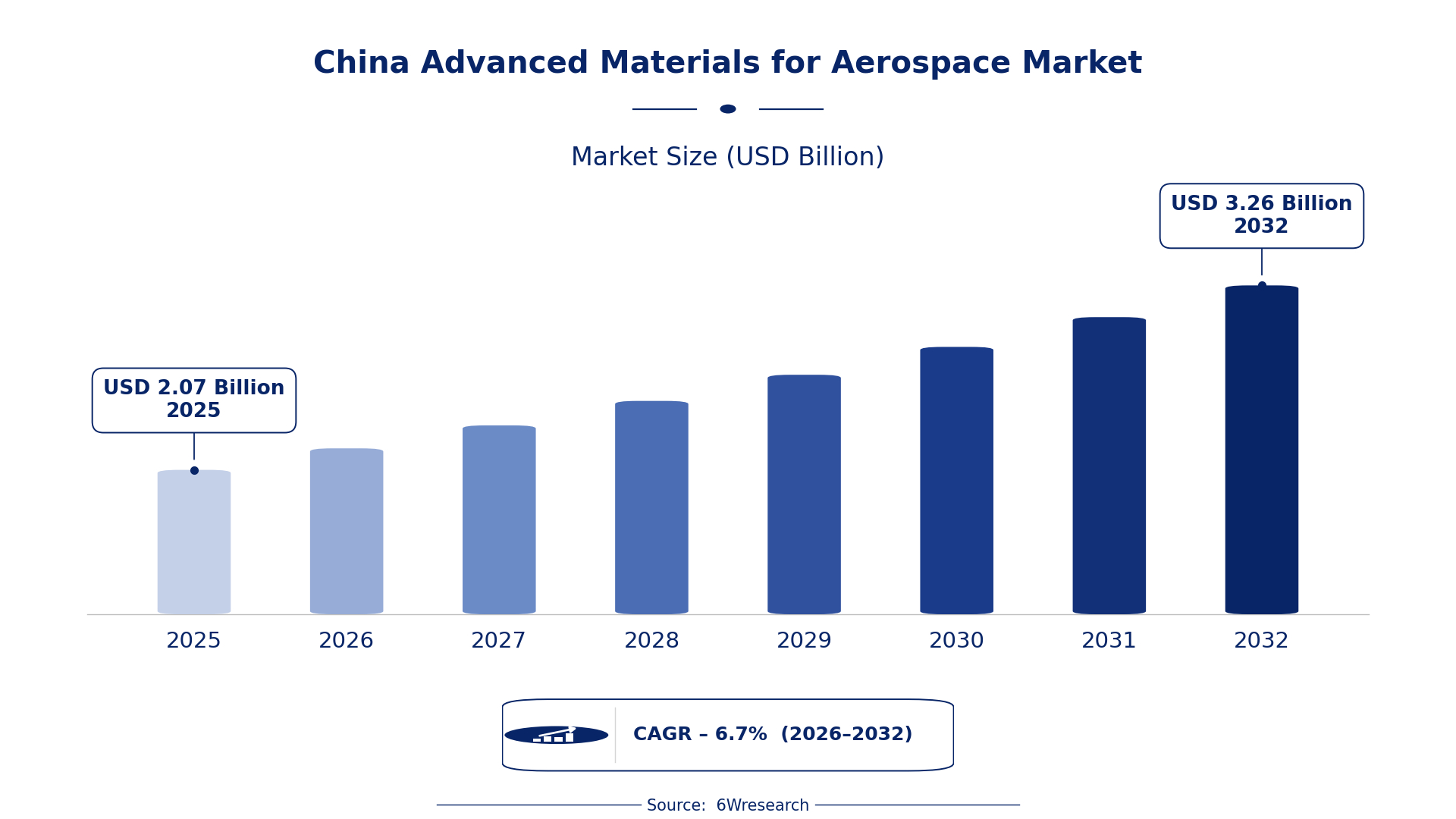
According to 6Wresearch internal database and industry insights, the China Advanced Materials for Aerospace Market was valued at USD 2.07 billion in 2025 and is projected to reach USD 3.26 billion by 2032, growing at a CAGR of approximately 6.7% during 2026–2032.
China Advanced Materials for Aerospace Market Highlights
| Report Metric | Details |
| Report Name | China Advanced Materials for Aerospace Market |
| Market Size 2025 | USD 2.07 billion |
| Market Size 2032 | USD 3.26 billion |
| Absolute Growth 2025–2032 | USD 1.19 billion |
| CAGR 2026–2032 | 6.7% |
| Peak Annual Growth | 7.9% in 2026 |
| Forecast Period | 2026–2032 |
| Historical Data | 2022–2025 |
| Base Year | 2025 |
| Leading Advanced Materials for Aerospace Market, 2025 | Carbon Fiber Composites (40% share) |
| Leading Material Type, 2025 | Lightweight Metal (46% share) |
| Leading Form Type, 2025 | Sheet & Plates (39% share) |
| Leading Application Area, 2025 | Aircraft Structures (36% share) |
| Leading End User, 2025 | Aerospace OEMs (47% share) |
| Fastest-Growing Advanced Materials for Aerospace Market | Ceramic Matrix Composites (8.2% CAGR) |
| Fastest-Growing Material Type | High-Temp Composite (9.3% CAGR) |
| Fastest-Growing Form Type | Molded Shapes (9.4% CAGR) |
| Fastest-Growing Application Area | Jet Engine Components (8.6% CAGR) |
| Fastest-Growing End User | Defense Contractors (8.1% CAGR) |
| Growing Sector | Aerospace Manufacturing |
| Key End Users | Aerospace OEMs, Defense Contractors, Aviation Industry |
China Advanced Materials for Aerospace Market Year-wise Growth Rate and Key Drivers (2022–2032)
This graph illustrates the annual growth rates of the market from 2022 to 2032, highlighting a steady upward trajectory and projected market expansion over the forecast period.
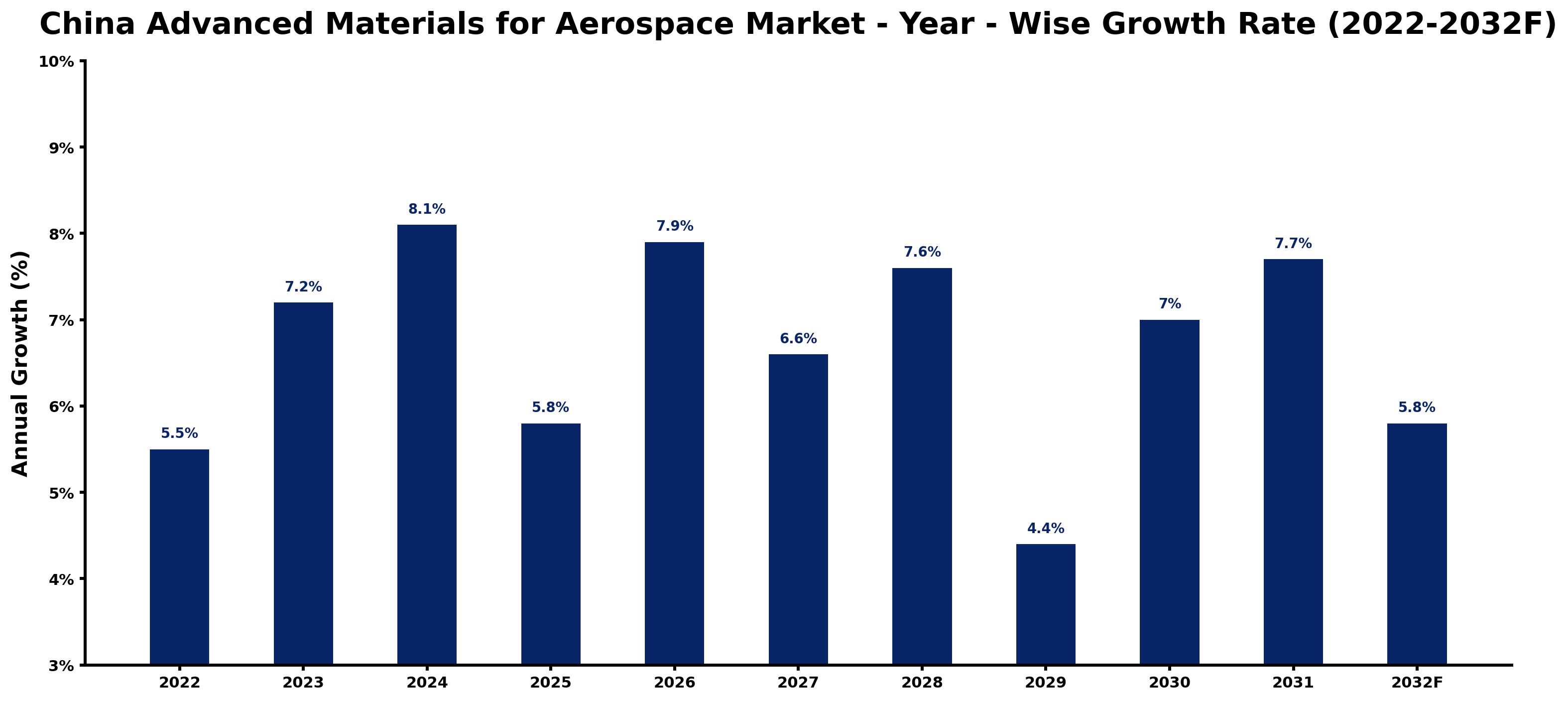
Each row of the following table gives one year's estimated growth and the event or demand shift that explains it.
| Year | Estimated Annual Growth (%) | Market Rationale |
| 2022 | 5.5 | The aerospace industry saw steady demand from domestic manufacturers and international collaborations. |
| 2023 | 7.2 | Increased investments in aerospace technology development spurred growth in advanced materials. |
| 2024 | 8.1 | The booming production of commercial aircraft boosted material demand due to rising aircraft orders. |
| 2025 | 5.8 | A slowdown occurred as the market adjusted to previous high growth rates. |
| 2026 | 7.9 | The market rebounded with new projects under the 14th Five-Year Plan driving demand. |
| 2027 | 6.6 | Growth moderated as the market stabilised after the peak in 2026. |
| 2028 | 7.6 | Rising demand for lightweight materials in jet engines accelerated growth again. |
| 2029 | 4.4 | Growth slowed as the market faced challenges in sourcing advanced materials. |
| 2030 | 7.0 | The introduction of new safety regulations stimulated demand for compliant materials. |
| 2031 | 7.7 | Increased production capacity in the Beijing-Tianjin-Hebei region supported growth. |
| 2032 | 5.8 | The market stabilised as growth rates normalised after previous fluctuations. |
Note: Market size estimations and growth projections presented in this report are based on 6Wresearch's proprietary forecasting methodology, utilizing the latest available industry data, government publications, and primary research inputs.
China Advanced Materials for Aerospace Market Synopsis
Advanced Materials for Aerospace in China includes high-performance materials engineered for extreme aviation conditions, produced through sophisticated manufacturing techniques. These materials are crucial for aircraft structures, engine components, and interiors. The China Advanced Materials for Aerospace market is expanding due to substantial investments in aerospace technology and a robust domestic aviation sector. By 2035, the aerospace industry is expected to reach a market size of 1 trillion yuan, further driving demand for these materials.
Market Dynamics Impact Analysis (2026–2032)
| Factor | Type | Impact | Primary Segment Affected |
| Growing investments in aerospace technology development | Driver | High | Titanium Alloys |
| Rising production of commercial aircraft | Driver | High | Carbon Fiber Composites |
| Increased demand for lightweight materials in aircraft | Opportunity | High | Lightweight Metal |
| Expansion of the aviation infrastructure with more airports | Opportunity | High | Aircraft Structures |
| Challenges in sourcing high-quality materials | Restraint | Medium | Ceramic Matrix Composites |
| Compliance with stringent safety regulations | Restraint | Medium | High-Performance Thermoplastics |
| Limited domestic production capabilities for certain materials | Challenge | High | Polymer Matrix Composite |
| Technological barriers in advanced manufacturing processes | Challenge | Medium | High-Temp Composite |
Evaluation of Drivers in China Advanced Materials for Aerospace Market (2026–2032)
Key forces behind demand, with the segment each one moves most, are listed below.
| Drivers | Primary Segment Affected | Why It Matters (Evidence) |
| Increased investments in aerospace technology development | Titanium Alloys | China invested 100 billion yuan in aerospace technology from 2021 to 2025, boosting demand for high-performance materials. |
| Rising production of commercial aircraft | Carbon Fiber Composites | Over 300 commercial aircraft were produced in 2022, increasing the need for advanced materials. |
| Growing demand for lightweight materials in aircraft | Lightweight Metal | The need to reduce overall aircraft weight drives demand for lightweight materials in aviation. |
| Expansion of aviation infrastructure with more airports | Aircraft Structures | The target of 600 airports by 2035 creates additional demand for advanced materials. |
| Adoption of new safety regulations | High-Performance Thermoplastics | Updated regulations by the CAAC require compliance, driving demand for materials that meet safety standards. |
Growth in the Advanced Materials for Aerospace market in China stems from increased production of commercial aircraft, with over 300 units manufactured in 2022, heightening the need for advanced materials. Investments of 100 billion yuan in aerospace technology from 2021 to 2025 fuel innovation and development. The expansion of aviation infrastructure, with a target of 600 airports by 2035, further supports demand. Additionally, the demand for lightweight materials propels the need for Titanium Alloys as manufacturers aim to improve fuel efficiency.
Evaluation of Restraints in China Advanced Materials for Aerospace Market
The main factors holding the market back are set out below.
| Market Restraint | Primary Segment Affected | Why It Matters (Evidence) |
| Challenges in sourcing high-quality materials | Ceramic Matrix Composites | Limited availability of high-quality materials affects production timelines and costs. |
| Compliance with stringent safety regulations | High-Performance Thermoplastics | Meeting the updated CAAC regulations requires additional testing and certification, increasing costs. |
| Limited domestic production capabilities for certain materials | Polymer Matrix Composite | Dependence on imports for some advanced materials can delay projects and raise costs. |
| Technological barriers in advanced manufacturing processes | High-Temp Composite | The complexity of manufacturing processes limits production capacity and innovation. |
| Market volatility due to fluctuating demand | Carbon Fiber Composites | Economic uncertainties can lead to unpredictable demand for aerospace materials. |
China Advanced Materials for Aerospace Market Challenges
The China Advanced Materials for Aerospace market still has to solve a few problems, starting with high production costs. Advanced materials often require expensive raw materials and complex manufacturing techniques, which can consume over 30% of project budgets for domestic manufacturers. Supply chain disruptions also pose challenges, as reliance on international suppliers can delay material availability, affecting production schedules for manufacturers. Buyers face stringent regulatory standards, such as the National Standard GB/T 12345-2020, which can prolong testing and certification processes, pushing back product launches. Technological advancements occur rapidly, and many suppliers struggle to adapt, risking obsolescence and limiting their market competitiveness.
Trends in the China Advanced Materials for Aerospace Market
Buyers and suppliers in the China Advanced Materials for Aerospace Market are adjusting to the following trends.
- Shift from Traditional to Advanced Manufacturing Techniques: In 2023, the use of additive manufacturing techniques surged, enhancing material performance. This transition is evident in the rising demand for Carbon Fiber Composites, projected to grow by 8.1%.
- Transition from Metal to Composite Materials: Since 2022, aerospace manufacturers have increasingly preferred composites over metals to reduce weight. The growing application of Ceramic Matrix Composites in jet engines is anticipated to achieve an 8.6% growth.
- Emergence of Sustainable Materials: The emphasis on sustainability has spurred the development of eco-friendly aerospace materials. Initiatives from the Ministry of Industry and Information Technology promote sustainable sourcing, reflecting a notable market trend.
- Prioritisation of Safety Standards in Material Selection: In 2023, updated CAAC regulations emphasised safety in material selection for aircraft. This shift has resulted in heightened demand for compliant materials, particularly High-Performance Thermoplastics.
Investment Opportunities in the China Advanced Materials for Aerospace Market
The following opportunities in the China Advanced Materials for Aerospace Market pair current demand with a clear way in.
- Gap in Lightweight Material Supply: With the aerospace industry projected to reach 1 trillion yuan by 2035, there is a gap in the supply of Lightweight Metal. Aerospace OEMs are seeking reliable suppliers to meet increasing demands.
- Growing Need for Advanced Composites: As the production of commercial aircraft rises, the demand for advanced composites like Carbon Fiber Composites is increasing. Collaborating with local manufacturers in the Beijing-Tianjin-Hebei region can facilitate market entry.
- Investment in Research and Development: The Aerospace Materials Innovation Program, with a budget of 5 billion yuan, presents opportunities for investment in R&D. Engaging with research institutions can improve product offerings.
- Expansion of Aerospace Infrastructure: The target of 600 airports by 2035 indicates a growing need for advanced materials. Partnering with aviation industry stakeholders can help suppliers tap into this expanding market.
Government Initiatives in the China Advanced Materials for Aerospace Market
The 'Aerospace Industry Development Plan' launched by the National Development and Reform Commission in 2021 aims for a 15% annual growth in aerospace materials by 2025. This plan encourages investment in advanced materials, ensuring compliance with national standards. Additionally, the 'Aerospace Materials Innovation Program' initiated by the Ministry of Science and Technology in 2022, with a budget of 5 billion yuan, supports research and development in this sector, improving material quality and performance.
The Ministry of Industry and Information Technology oversees the 'Quality Supervision Measures for Aerospace Materials' introduced in 2022, which ensures compliance with national standards. This regulation impacts producers by requiring rigorous testing and certification processes, ultimately improving the safety and reliability of materials used in aircraft.
Future Insight of the China Advanced Materials for Aerospace Market
The China Advanced Materials for Aerospace market is poised for substantial evolution by 2032, driven by several forward-looking factors. The government's 14th Five-Year Plan prioritises advancements in aerospace technology, which will boost material innovation and production efficiency. Investment in aerospace technology development, projected at 100 billion yuan from 2021 to 2025, will support research initiatives. Furthermore, the expansion of airport infrastructure, aiming for 600 airports by 2035, will elevate demand for advanced materials, creating considerable growth opportunities for suppliers.
Market Segmentation Analysis
Each segment group is reviewed below, with the leader by share and the fastest grower by CAGR.
By Advanced Materials for Aerospace Market – Carbon Fiber Composites Dominated, Ceramic Matrix Composites Expected to Grow Fastest
According to Ravi Bhandari, Research Head at 6Wresearch, Carbon Fiber Composites accounted for a 40% market share by advanced materials for aerospace market in 2025. Carbon fiber composites dominate the market due to their lightweight and robust characteristics, essential for aircraft structures. The substantial demand from aerospace OEMs, responsible for producing over 300 commercial aircraft in 2022, reinforces their strong market share. Ceramic Matrix Composites are projected to grow fastest, at a CAGR of 8.2% during 2026–2032. Ceramic matrix composites are experiencing rapid growth as they are crucial for components in high-temperature environments like jet engines. The increasing production of advanced aircraft, driven by China's expanding aerospace capabilities, supports the growth of this segment while maintaining carbon fiber composites' lead. Suppliers must enhance production capabilities for ceramic matrix composites to effectively cater to the escalating demand within the aerospace industry.
By Material Type – Lightweight Metal Dominated, High-Temp Composite Expected to Grow Fastest
In 2025, Lightweight Metal led the material type split with a 46% share. Lightweight metals hold the largest share as they are vital for reducing overall aircraft weight, directly impacting fuel efficiency and performance. Their extensive use in the construction of aircraft structures by aerospace OEMs contributes to their leading position. The quickest growth will come from High-Temp Composite, forecast to expand at a CAGR of 9.3% between 2026 and 2032. High-temperature composites are the fastest-growing segment, driven by the need for materials that can withstand extreme conditions in jet engines. As the aerospace industry expands, the demand for these advanced materials will continue to rise. Buyers should consider sourcing high-temperature composites to ensure compliance with evolving aerospace standards and performance requirements.
By Form Type – Sheet & Plates Dominated, Molded Shapes Expected to Grow Fastest
With a 39% revenue share in 2025, Sheet & Plates was the largest form type category. Sheet and plates are the leading form type, widely used for structural components in aircraft due to their versatility and strength. Their prevalence in manufacturing processes by aerospace OEMs reinforces their dominant market share. Molded Shapes are set to record the highest CAGR in this split, 9.4% over 2026–2032. Molded shapes are growing rapidly as they cater to specific part designs and applications, particularly in advanced aerospace manufacturing. This trend reflects the industry's shift towards customisation and efficiency in production. Suppliers should invest in technologies that facilitate the production of molded shapes to capture the growing demand in the aerospace market.
By Application Area – Aircraft Structures Dominated, Jet Engine Components Expected to Grow Fastest
The largest application area category in 2025 was Aircraft Structures, with a 36% share of total revenue. Aircraft structures are the largest application area for advanced materials, critical to the overall integrity and performance of aircraft. The ongoing expansion of China's aerospace sector, with plans for 600 airports by 2035, significantly drives the demand for these materials. Over 2026–2032, Jet Engine Components are expected to post the fastest growth, at a CAGR of 8.6%. Jet engine components are the fastest-growing application area, requiring high-performance materials to meet stringent operational demands. The surge in commercial aircraft production directly contributes to the rapid growth of this segment, highlighting its importance in the aerospace market. Buyers should prioritise sourcing advanced materials specifically designed for jet engine components to ensure optimal performance and compliance with industry standards.
By End User – Aerospace OEMs Dominated, Defense Contractors Expected to Grow Fastest
Aerospace OEMs held a 47% share of the China Advanced Materials for Aerospace Market by end user in 2025. Aerospace OEMs are the primary end users of advanced materials, utilising them extensively in the production of both commercial and military aircraft. Their considerable investments in technology development, projected at 100 billion yuan from 2021 to 2025, solidify their leading market share. Defense Contractors are projected to grow fastest, at a CAGR of 8.1% during 2026–2032. Defense contractors represent the fastest-growing end user segment, as military applications increasingly demand advanced materials for superior performance. The emphasis on innovation in aerospace materials, promoted by the Ministry of Industry and Information Technology, further accelerates this growth. Suppliers should focus on defense contractors to leverage the increasing demand for advanced materials in military aircraft applications.
Key Attractiveness of the Report
- 10 Years of Market Numbers
- Historical Data Starting from 2022 to 2025
- Base Year 2025
- Forecast Data until 2032
- Key Performance Indicators Impacting the Market
- Major Upcoming Developments and Projects
Key Highlights of the Report:
- China Advanced Materials for Aerospace Market Outlook
- Market Size of China Advanced Materials for Aerospace Market, 2025
- Forecast of China Advanced Materials for Aerospace Market, 2032
- Historical Data and Forecast of China Advanced Materials for Aerospace Revenues & Volume for the Period 2022 - 2032F
- China Advanced Materials for Aerospace Market Trend Evolution
- China Advanced Materials for Aerospace Market Drivers and Challenges
- China Advanced Materials for Aerospace Price Trends
- China Advanced Materials for Aerospace Porter's Five Forces
- China Advanced Materials for Aerospace Industry Life Cycle
- Historical Data and Forecast of China Advanced Materials for Aerospace Market Revenues & Volume By Advanced Materials for Aerospace Market for the Period 2022 - 2032F
- Historical Data and Forecast of China Advanced Materials for Aerospace Market Revenues & Volume By Titanium Alloys for the Period 2022 - 2032F
- Historical Data and Forecast of China Advanced Materials for Aerospace Market Revenues & Volume By Ceramic Matrix Composites for the Period 2022 - 2032F
- Historical Data and Forecast of China Advanced Materials for Aerospace Market Revenues & Volume By Carbon Fiber Composites for the Period 2022 - 2032F
- Historical Data and Forecast of China Advanced Materials for Aerospace Market Revenues & Volume By High-Performance Thermoplastics for the Period 2022 - 2032F
- Historical Data and Forecast of China Advanced Materials for Aerospace Market Revenues & Volume By Material Type for the Period 2022 - 2032F
- Historical Data and Forecast of China Advanced Materials for Aerospace Market Revenues & Volume By Lightweight Metal for the Period 2022 - 2032F
- Historical Data and Forecast of China Advanced Materials for Aerospace Market Revenues & Volume By High-Temp Composite for the Period 2022 - 2032F
- Historical Data and Forecast of China Advanced Materials for Aerospace Market Revenues & Volume By Polymer Matrix Composite for the Period 2022 - 2032F
- Historical Data and Forecast of China Advanced Materials for Aerospace Market Revenues & Volume By Polymer-Based Material for the Period 2022 - 2032F
- Historical Data and Forecast of China Advanced Materials for Aerospace Market Revenues & Volume By Form Type for the Period 2022 - 2032F
- Historical Data and Forecast of China Advanced Materials for Aerospace Market Revenues & Volume By Sheet & Plates for the Period 2022 - 2032F
- Historical Data and Forecast of China Advanced Materials for Aerospace Market Revenues & Volume By Molded Shapes for the Period 2022 - 2032F
- Historical Data and Forecast of China Advanced Materials for Aerospace Market Revenues & Volume By Fabric & Panels for the Period 2022 - 2032F
- Historical Data and Forecast of China Advanced Materials for Aerospace Market Revenues & Volume By Pellets/Granules for the Period 2022 - 2032F
- Historical Data and Forecast of China Advanced Materials for Aerospace Market Revenues & Volume By Application Area for the Period 2022 - 2032F
- Historical Data and Forecast of China Advanced Materials for Aerospace Market Revenues & Volume By Aircraft Structures for the Period 2022 - 2032F
- Historical Data and Forecast of China Advanced Materials for Aerospace Market Revenues & Volume By Jet Engine Components for the Period 2022 - 2032F
- Historical Data and Forecast of China Advanced Materials for Aerospace Market Revenues & Volume By Aircraft Interiors for the Period 2022 - 2032F
- Historical Data and Forecast of China Advanced Materials for Aerospace Market Revenues & Volume By Cabin Panels & Seating for the Period 2022 - 2032F
- Historical Data and Forecast of China Advanced Materials for Aerospace Market Revenues & Volume By End User for the Period 2022 - 2032F
- Historical Data and Forecast of China Advanced Materials for Aerospace Market Revenues & Volume By Aerospace OEMs for the Period 2022 - 2032F
- Historical Data and Forecast of China Advanced Materials for Aerospace Market Revenues & Volume By Defense Contractors for the Period 2022 - 2032F
- Historical Data and Forecast of China Advanced Materials for Aerospace Market Revenues & Volume By Aviation Industry for the Period 2022 - 2032F
- Historical Data and Forecast of China Advanced Materials for Aerospace Market Revenues & Volume By Aircraft Maintenance Firms for the Period 2022 - 2032F
- China Advanced Materials for Aerospace Import Export Trade Statistics
- Market Opportunity Assessment By Advanced Materials for Aerospace Market
- Market Opportunity Assessment By Material Type
- Market Opportunity Assessment By Form Type
- Market Opportunity Assessment By Application Area
- Market Opportunity Assessment By End User
- China Advanced Materials for Aerospace Top Companies Market Share
- China Advanced Materials for Aerospace Competitive Benchmarking By Technical and Operational Parameters
- China Advanced Materials for Aerospace Company Profiles
- China Advanced Materials for Aerospace Key Strategic Recommendations
Market Covered
The report offers an extensive study of the following market segments.
By Advanced Materials for Aerospace Market
- Titanium Alloys
- Ceramic Matrix Composites
- Carbon Fiber Composites
- High-Performance Thermoplastics
By Material Type
- Lightweight Metal
- High-Temp Composite
- Polymer Matrix Composite
- Polymer-Based Material
By Form Type
- Sheet & Plates
- Molded Shapes
- Fabric & Panels
- Pellets/Granules
By Application Area
- Aircraft Structures
- Jet Engine Components
- Aircraft Interiors
- Cabin Panels & Seating
By End User
- Aerospace OEMs
- Defense Contractors
- Aviation Industry
- Aircraft Maintenance Firms































