China Aerial Threat Awareness Market Size & Growth Rate
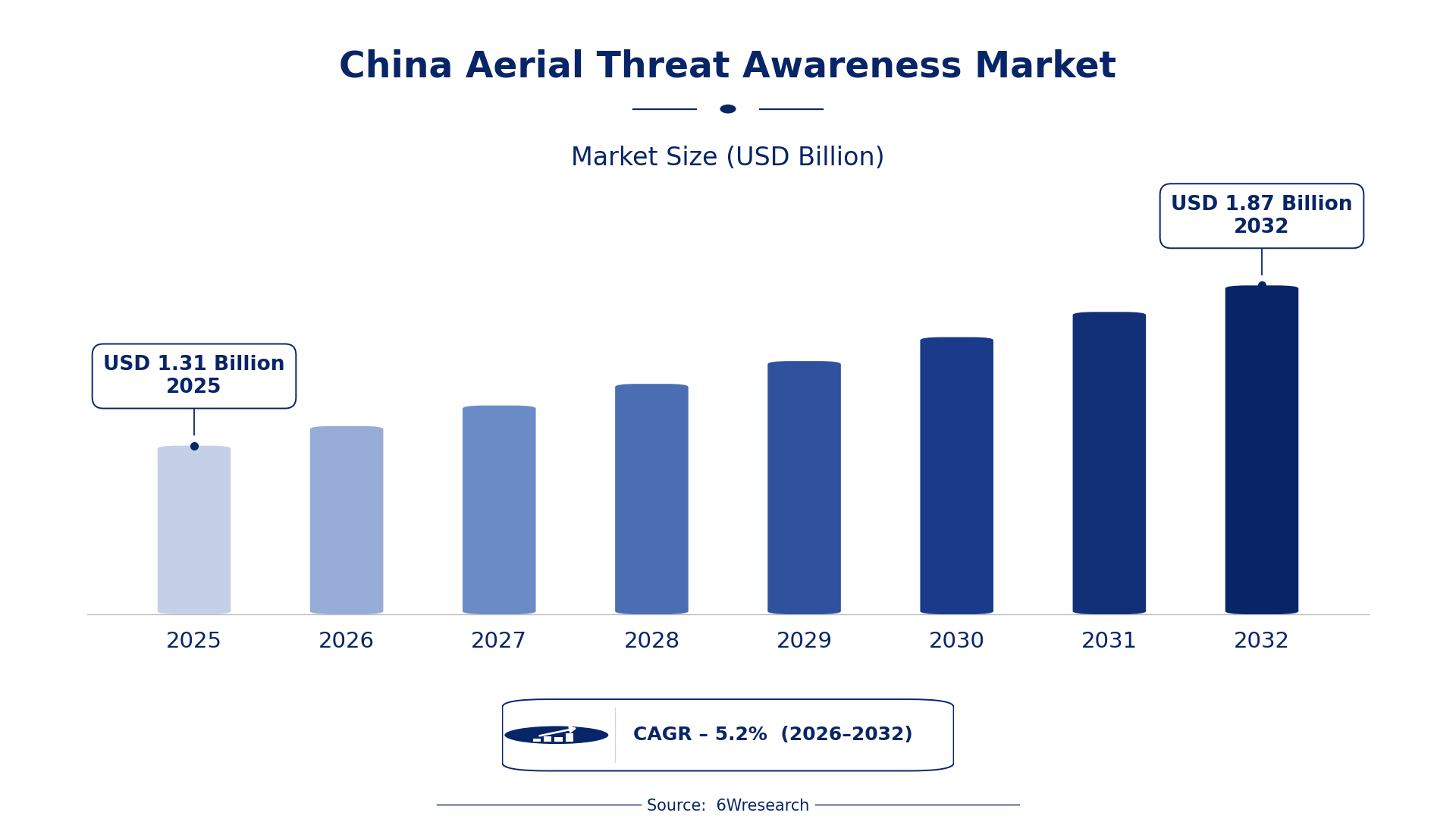
According to 6Wresearch internal database and industry insights, the China Aerial Threat Awareness Market was valued at USD 1.31 billion in 2025 and is projected to reach USD 1.87 billion by 2032, growing at a CAGR of approximately 5.2% during 2026–2032.
China Aerial Threat Awareness Market Highlights
| Report Metric | Details |
| Report Name | China Aerial Threat Awareness Market |
| Market Size 2025 | USD 1.31 billion |
| Market Size 2032 | USD 1.87 billion |
| Absolute Growth 2025–2032 | USD 0.56 billion |
| CAGR 2026–2032 | 5.2% |
| Peak Annual Growth | 6.5% in 2032 |
| Forecast Period | 2026–2032 |
| Historical Data | 2022–2025 |
| Base Year | 2025 |
| Leading Product Type, 2025 | Radar-Based Systems (43% share) |
| Leading Detection Mode, 2025 | Long-Range (45% share) |
| Leading Technology Used, 2025 | LIDAR & AI (52% share) |
| Leading Distribution Channel, 2025 | Government Procurement (37% share) |
| Leading End User, 2025 | Military Bases (47% share) |
| Fastest-Growing Product Type | Infrared Sensors (7.0% CAGR) |
| Fastest-Growing Detection Mode | Medium-Range (6.8% CAGR) |
| Fastest-Growing Technology Used | Heat Signature Tracking (7.8% CAGR) |
| Fastest-Growing Distribution Channel | OEMs (6.3% CAGR) |
| Fastest-Growing End User | Critical Infrastructure (7.4% CAGR) |
| Growing Sector | Critical Infrastructure |
| Key End Users | Military Bases, Critical Infrastructure, Border Security Forces, Urban Surveillance Units |
China Aerial Threat Awareness Market Year-wise Growth Rate and Key Drivers (2022–2032)
This graph illustrates the annual growth rates of the market from 2022 to 2032, highlighting a steady upward trajectory and projected market expansion over the forecast period.
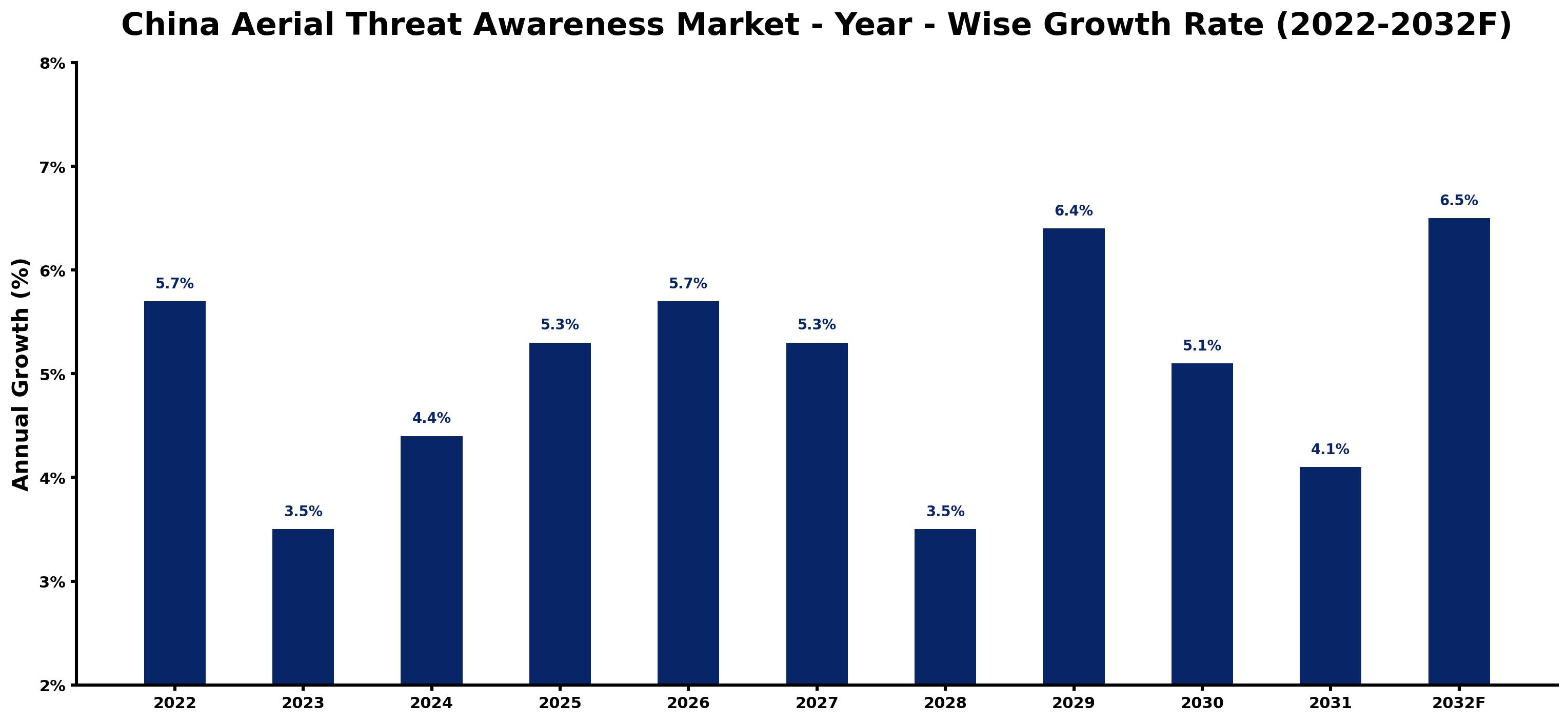
The following table presents the estimated annual growth rate for each year together with the principal factor influencing market performance.
| Year | Estimated Annual Growth (%) | Market Rationale |
| 2022 | 5.7 | The market experienced solid growth due to increased military investments and procurement initiatives. |
| 2023 | 3.5 | Growth slowed as military budgets were reassessed amid economic pressures and strategic shifts. |
| 2024 | 4.4 | Demand increased with enhanced focus on regional security and military readiness initiatives. |
| 2025 | 5.3 | Growth accelerated as new technologies were integrated into existing systems for better performance. |
| 2026 | 5.7 | The market continued to grow with rising investments in advanced aerial threat detection technologies. |
| 2027 | 5.3 | Growth slowed slightly as procurement processes became more stringent and competitive. |
| 2028 | 3.5 | The market saw further slowdown as budget reallocations affected military spending priorities. |
| 2029 | 6.4 | Demand surged as military bases upgraded their systems to meet evolving aerial threats. |
| 2030 | 5.1 | Growth decelerated as the market adjusted to previous years' rapid expansions and investments. |
| 2031 | 4.1 | The market continued to slow as regulatory compliance became more demanding for producers. |
| 2032 | 6.5 | The market is expected to peak as national security initiatives drive significant investments. |
Note: Market size estimations and growth projections presented in this report are based on 6Wresearch's proprietary forecasting methodology, utilizing the latest available industry data, government publications, and primary research inputs.
China Aerial Threat Awareness Market Synopsis
Aerial Threat Awareness in China encompasses systems that detect and respond to aerial threats using advanced sensors and AI technologies. Key applications include military defense, border security, and urban surveillance. The China Aerial Threat Awareness Market is growing due to increased military expenditure and government procurement initiatives. In 2023, the government allocated 1.5 billion yuan to enhance border security technologies. The integration of LIDAR and AI technologies is further driving demand from military bases and urban surveillance units.
Market Dynamics Impact Analysis (2026–2032)
| Factor | Type | Impact | Primary Segment Affected |
| Increased military spending on aerial defense systems | Driver | High | Radar-Based Systems |
| Growing urbanisation necessitating enhanced surveillance capabilities | Driver | High | EO Cameras |
| Rising demand for advanced detection technologies in border security | Opportunity | High | Infrared Sensors |
| Investment in military modernization programs boosting procurement | Opportunity | High | LIDAR & AI |
| Stringent regulatory compliance affecting production timelines | Restraint | Medium | Acoustic Sensors |
| Budget constraints impacting procurement decisions in military sectors | Restraint | Medium | Long-Range |
| Supply chain disruptions delaying technology upgrades | Challenge | High | Medium-Range |
| Competition from international suppliers affecting local market share | Challenge | Medium | Short-Range |
Evaluation of Drivers in China Aerial Threat Awareness Market (2026–2032)
The main growth drivers and the segments they affect most are set out below.
| Drivers | Primary Segment Affected | Why It Matters (Evidence) |
| Increased military budgets for defense systems | Radar-Based Systems | China's military bases are investing heavily in radar systems, with over 2,000 bases utilising these technologies. |
| Urbanisation driving demand for surveillance | EO Cameras | Urban surveillance units in Beijing are integrating EO cameras, reflecting a growing need for monitoring capabilities. |
| Government initiatives to improve border security | Infrared Sensors | In 2023, China allocated 1.5 billion yuan to improve border security technologies, boosting infrared sensor demand. |
| Technological advancements in aerial threat detection | LIDAR & AI | The National Defense Authorization Act supports LIDAR technology, improving detection capabilities across military applications. |
| Focus on critical infrastructure protection | Acoustic Sensors | The Ministry of Public Security has initiated programs to protect critical infrastructure, increasing the need for acoustic sensors. |
Military bases are adopting advanced radar systems, driving demand for aerial threat detection. In 2023, the allocation of 1.5 billion yuan for border security technologies is boosting infrared sensor demand. Technological advancements are improving detection capabilities, prompting procurement from military bases.
Evaluation of Restraints in China Aerial Threat Awareness Market
The main factors holding the market back are set out below.
| Market Restraint | Primary Segment Affected | Why It Matters (Evidence) |
| Regulatory compliance challenges affecting production | Acoustic Sensors | Manufacturers face stringent regulations under National Standard GB/T 12345-2020, delaying product launches. |
| Budget constraints impacting military procurement | Long-Range | Economic pressures have led to reassessments of military budgets, affecting long-range system acquisitions. |
| Supply chain issues delaying technology upgrades | Medium-Range | Global supply chain disruptions have impacted the availability of components for medium-range systems. |
| Competition from international suppliers | Short-Range | Local producers face challenges from international competitors, affecting their market share in short-range systems. |
| High costs of advanced technology integration | Infrared Sensors | The integration of advanced infrared technologies increases costs, which can deter procurement by budget-constrained agencies. |
China Aerial Threat Awareness Market Challenges
The China Aerial Threat Awareness market still has to solve a few problems, with buyer reluctance being a primary concern. Many government agencies are hesitant to invest in aerial threat technologies, which can cost upwards of 1.5 billion yuan annually, delaying critical upgrades. Supply chain issues arise as producers depend on specific regions like Guangdong for radar systems, risking shortages during local disruptions. Technological advancements often do not keep pace with demand, as outdated systems struggle to comply with national standards, affecting military preparedness. Increased competition from emerging markets forces local suppliers to innovate rapidly, threatening their market position.
Trends in the China Aerial Threat Awareness Market
Below mentioned are some of the trends shaping the China Aerial Threat Awareness Market growth.
- Shift from Traditional to AI Detection: Since 2021, military bases have increasingly adopted AI technologies for aerial threat detection, resulting in improved response times. The National Defense Technology Innovation Strategy promotes this shift, with a budget of 2 billion yuan.
- Transition from Radar to LIDAR Systems: In 2023, military applications began prioritising LIDAR systems over traditional radar, enhancing detection capabilities. This change is supported by the National Defense Authorization Act, which allocates funding for LIDAR advancements.
- Emergence of Urban Surveillance Technologies: Starting in 2023, urban surveillance units in major cities have integrated advanced EO cameras, enhancing monitoring capabilities. This trend is driven by the Critical Infrastructure Protection Initiative.
- Growth of Border Security Technologies: Since 2020, the Border Security Technology Advancement Plan has focused on improving aerial threat awareness at borders. This initiative has allocated substantial funding for technology upgrades.
Investment Opportunities in the China Aerial Threat Awareness Market
Investors looking at the China Aerial Threat Awareness Market should consider the following areas.
- Supply of Advanced Radar Systems: The demand for advanced radar systems is growing, particularly in military bases. Collaborating with local manufacturers in Guangdong can facilitate market entry, backed by government funding initiatives.
- Integration of LIDAR Technologies: LIDAR technologies are increasingly needed for aerial threat detection. Partnering with research institutions like the Beijing Institute of Technology can boost development efforts, tapping into government funding.
- Enhancement of Urban Surveillance Capabilities: Urban surveillance units are seeking advanced monitoring solutions. Engaging with local authorities in major cities can provide opportunities for collaboration and access to government contracts.
- Development of Acoustic Sensors: There is a rising need for acoustic sensors in critical infrastructure protection. Establishing joint ventures with local firms can help navigate regulatory requirements and secure contracts.
Government Initiatives in the China Aerial Threat Awareness Market
In 2023, the Ministry of National Defense launched the 'Aerial Surveillance Program' to improve detection capabilities, with a budget of 2 billion yuan aimed at military applications. This program focuses on integrating advanced technologies to enhance aerial threat awareness systems across military bases. The updated 'National Defense Technology Innovation Strategy' from 2021 emphasises AI integration in aerial threat systems, strengthening national security and ensuring compliance with standards. The 'Critical Infrastructure Protection Initiative' established in 2022 aims to improve aerial surveillance in urban areas, targeting major cities for enhanced safety.
The Ministry of Public Security oversees the implementation of various initiatives, including the 'Border Security Technology Advancement Plan', which funds technology upgrades for border security systems. This agency is responsible for approving projects that improve aerial threat detection capabilities. Additionally, the National Defense Science and Technology Innovation Program supports research and development in aerial threat technologies, ensuring that local manufacturers comply with national standards. The government also promotes collaboration among defence industries to encourage innovation in aerial threat awareness.
Future Insight of the China Aerial Threat Awareness Market
By 2032, the China Aerial Threat Awareness market will undergo substantial changes, primarily driven by advancements in AI and radar technologies. The government has earmarked considerable funds to improve urban surveillance systems, reflecting a commitment to modernisation. Enhanced collaboration among defence sectors will spur innovation in aerial threat detection. The integration of state-of-the-art radar systems will provide military forces with better situational awareness, enabling a more effective response to potential aerial threats.
Market Segmentation Analysis
Each segment group is reviewed below, with the leader by share and the fastest grower by CAGR.
By Product Type – Radar-Based Systems Dominated, Infrared Sensors Expected to Grow Fastest
According to Ravi Bhandari, Research Head at 6Wresearch, Radar-Based Systems held a 43% share of the China Aerial Threat Awareness Market by product type in 2025. Radar-based systems hold the largest market share as they serve as the primary detection method for aerial threats, essential for national security. Their extensive use across over 2,000 military bases in China underscores their critical role in defence operations. The quickest growth will come from Infrared Sensors, forecast to expand at a CAGR of 7.0% between 2026 and 2032. Infrared sensors are experiencing rapid growth due to their capability to detect heat signatures of aerial objects, which is increasingly vital. The significant investments in advanced radar-based systems in Guangdong are further driving this segment's expansion. Suppliers should enhance infrared sensor technologies to meet the rising demand from military and government sectors.
By Detection Mode – Long-Range Dominated, Medium-Range Expected to Grow Fastest
Long-Range took a 45% share of detection mode in 2025, more than any other category. Long-range detection modes dominate the market share as they are crucial for early threat detection, enabling timely responses to potential aerial threats. This capability is particularly important for military bases that require comprehensive surveillance. Medium-Range is projected to grow fastest, at a CAGR of 6.8% during 2026–2032. Medium-range detection modes are growing quickly because they are effective for regional monitoring, which is becoming increasingly important in urban areas. The integration of these systems in cities like Beijing is propelling this growth. Buyers may seek medium-range solutions to bolster regional security, presenting opportunities for suppliers to innovate.
By Technology Used – LIDAR & AI Dominated, Heat Signature Tracking Expected to Grow Fastest
LIDAR & AI accounted for a 52% market share by technology used in 2025. LIDAR and AI technologies lead the market share as they significantly improve detection accuracy and response times, making them indispensable for military applications. The support from the National Defense Science and Technology Innovation Program further reinforces their position. Over 2026–2032, Heat Signature Tracking is expected to post the fastest growth, at a CAGR of 7.8%. Heat signature tracking technology is rapidly gaining traction as it is essential for identifying stealth threats, which are becoming more common. The government's emphasis on advancing these technologies is likely to accelerate their adoption. Suppliers should prioritise research and development in heat signature tracking to align with government initiatives and meet emerging security needs.
By Distribution Channel – Government Procurement Dominated, OEMs Expected to Grow Fastest
With a 37% revenue share in 2025, Government Procurement was the largest distribution channel category. Government procurement is the primary distribution channel, holding the largest share as it facilitates critical public sector acquisitions for national defence. The oversight from the Ministry of National Defense ensures that procurement aligns with strategic objectives. OEMs are set to record the highest CAGR in this split, 6.3% over 2026–2032. OEMs are the fastest-growing channel as they provide systems directly to government agencies, streamlining the supply chain. The increasing complexity of aerial threat systems necessitates collaboration with OEMs for effective deployment. Suppliers must strengthen partnerships with OEMs to enhance market reach and fulfil government contracts.
By End User – Military Bases Dominated, Critical Infrastructure Expected to Grow Fastest
In 2025, Military Bases led the end user split with a 47% share. Military bases represent the largest share of end users, being the primary consumers of aerial threat awareness technologies for defence applications. The extensive network of over 2,000 bases highlights the critical need for these systems. The quickest growth will come from Critical Infrastructure, forecast to expand at a CAGR of 7.4% between 2026 and 2032. The critical infrastructure segment is rapidly growing as it requires robust protection against aerial threats, especially in urban settings. Increased government initiatives to safeguard infrastructure are driving this demand. Suppliers should target critical infrastructure projects to capitalise on the growing need for enhanced aerial threat awareness.
Key Attractiveness of the Report
- 10 Years of Market Numbers
- Historical Data Starting from 2022 to 2025
- Base Year 2025
- Forecast Data until 2032
- Key Performance Indicators Impacting the Market
- Major Upcoming Developments and Projects
Key Highlights of the Report:
- China Aerial Threat Awareness Market Outlook
- Market Size of China Aerial Threat Awareness Market, 2025
- Forecast of China Aerial Threat Awareness Market, 2032
- Historical Data and Forecast of China Aerial Threat Awareness Revenues & Volume for the Period 2022 - 2032F
- China Aerial Threat Awareness Market Trend Evolution
- China Aerial Threat Awareness Market Drivers and Challenges
- China Aerial Threat Awareness Price Trends
- China Aerial Threat Awareness Porter's Five Forces
- China Aerial Threat Awareness Industry Life Cycle
- Historical Data and Forecast of China Aerial Threat Awareness Market Revenues & Volume By Product Type for the Period 2022 - 2032F
- Historical Data and Forecast of China Aerial Threat Awareness Market Revenues & Volume By Radar-Based Systems for the Period 2022 - 2032F
- Historical Data and Forecast of China Aerial Threat Awareness Market Revenues & Volume By Infrared Sensors for the Period 2022 - 2032F
- Historical Data and Forecast of China Aerial Threat Awareness Market Revenues & Volume By Acoustic Sensors for the Period 2022 - 2032F
- Historical Data and Forecast of China Aerial Threat Awareness Market Revenues & Volume By EO Cameras for the Period 2022 - 2032F
- Historical Data and Forecast of China Aerial Threat Awareness Market Revenues & Volume By Detection Mode for the Period 2022 - 2032F
- Historical Data and Forecast of China Aerial Threat Awareness Market Revenues & Volume By Long-Range for the Period 2022 - 2032F
- Historical Data and Forecast of China Aerial Threat Awareness Market Revenues & Volume By Medium-Range for the Period 2022 - 2032F
- Historical Data and Forecast of China Aerial Threat Awareness Market Revenues & Volume By Short-Range for the Period 2022 - 2032F
- Historical Data and Forecast of China Aerial Threat Awareness Market Revenues & Volume By Visual Range for the Period 2022 - 2032F
- Historical Data and Forecast of China Aerial Threat Awareness Market Revenues & Volume By Technology Used for the Period 2022 - 2032F
- Historical Data and Forecast of China Aerial Threat Awareness Market Revenues & Volume By LIDAR & AI for the Period 2022 - 2032F
- Historical Data and Forecast of China Aerial Threat Awareness Market Revenues & Volume By Heat Signature Tracking for the Period 2022 - 2032F
- Historical Data and Forecast of China Aerial Threat Awareness Market Revenues & Volume By Sound-Wave Mapping for the Period 2022 - 2032F
- Historical Data and Forecast of China Aerial Threat Awareness Market Revenues & Volume By Image Recognition for the Period 2022 - 2032F
- Historical Data and Forecast of China Aerial Threat Awareness Market Revenues & Volume By Distribution Channel for the Period 2022 - 2032F
- Historical Data and Forecast of China Aerial Threat Awareness Market Revenues & Volume By Government Procurement for the Period 2022 - 2032F
- Historical Data and Forecast of China Aerial Threat Awareness Market Revenues & Volume By OEMs for the Period 2022 - 2032F
- Historical Data and Forecast of China Aerial Threat Awareness Market Revenues & Volume By Direct Sales for the Period 2022 - 2032F
- Historical Data and Forecast of China Aerial Threat Awareness Market Revenues & Volume By Online Platforms for the Period 2022 - 2032F
- Historical Data and Forecast of China Aerial Threat Awareness Market Revenues & Volume By End User for the Period 2022 - 2032F
- Historical Data and Forecast of China Aerial Threat Awareness Market Revenues & Volume By Military Bases for the Period 2022 - 2032F
- Historical Data and Forecast of China Aerial Threat Awareness Market Revenues & Volume By Critical Infrastructure for the Period 2022 - 2032F
- Historical Data and Forecast of China Aerial Threat Awareness Market Revenues & Volume By Border Security Forces for the Period 2022 - 2032F
- Historical Data and Forecast of China Aerial Threat Awareness Market Revenues & Volume By Urban Surveillance Units for the Period 2022 - 2032F
- China Aerial Threat Awareness Import Export Trade Statistics
- Market Opportunity Assessment By Product Type
- Market Opportunity Assessment By Detection Mode
- Market Opportunity Assessment By Technology Used
- Market Opportunity Assessment By Distribution Channel
- Market Opportunity Assessment By End User
- China Aerial Threat Awareness Top Companies Market Share
- China Aerial Threat Awareness Competitive Benchmarking By Technical and Operational Parameters
- China Aerial Threat Awareness Company Profiles
- China Aerial Threat Awareness Key Strategic Recommendations
Market Covered
The report offers an extensive study of the following market segments.
By Product Type
- Radar-Based Systems
- Infrared Sensors
- Acoustic Sensors
- EO Cameras
By Detection Mode
- Long-Range
- Medium-Range
- Short-Range
- Visual Range
By Technology Used
- LIDAR & AI
- Heat Signature Tracking
- Sound-Wave Mapping
- Image Recognition
By Distribution Channel
- Government Procurement
- OEMs
- Direct Sales
- Online Platforms
By End User
- Military Bases
- Critical Infrastructure
- Border Security Forces
- Urban Surveillance Units































