China Aerospace Aerodynamics Market Size & Growth Rate
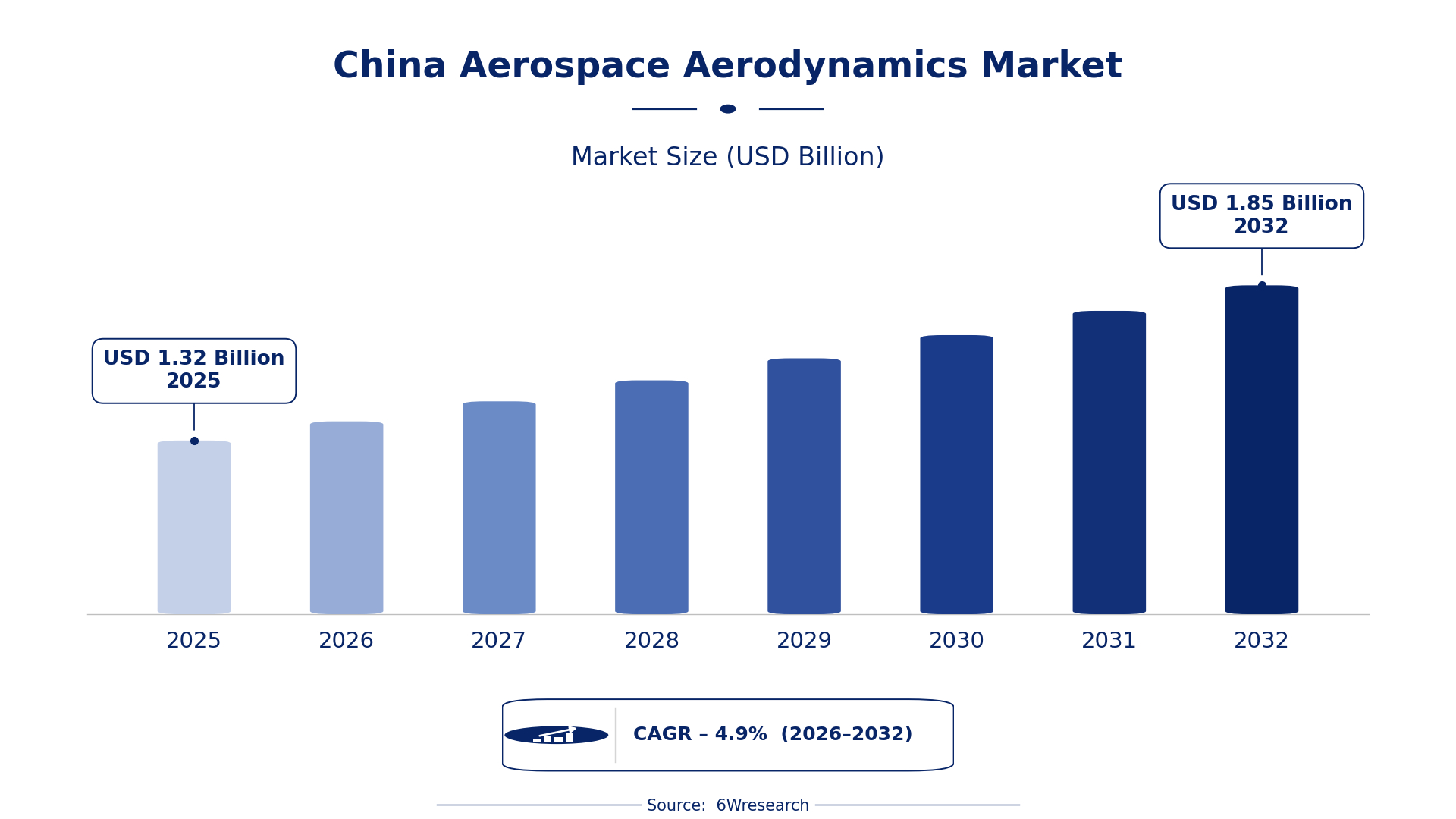
According to 6Wresearch internal database and industry insights, the China Aerospace Aerodynamics Market was valued at USD 1.32 billion in 2025 and is projected to reach USD 1.85 billion by 2032, growing at a CAGR of approximately 4.9% during 2026–2032.
China Aerospace Aerodynamics Market Highlights
| Report Metric | Details |
| Report Name | China Aerospace Aerodynamics Market |
| Market Size 2025 | USD 1.32 billion |
| Market Size 2032 | USD 1.85 billion |
| Absolute Growth 2025–2032 | USD 0.53 billion |
| CAGR 2026–2032 | 4.9% |
| Peak Annual Growth | 6.7% in 2032 |
| Forecast Period | 2026–2032 |
| Historical Data | 2022–2025 |
| Base Year | 2025 |
| Leading Product Type, 2025 | Winglets (42% share) |
| Leading Technology Type, 2025 | Lift Enhancement Tech (37% share) |
| Leading Distribution Channel, 2025 | OEMs (40% share) |
| Leading End User, 2025 | Aircraft Manufacturers (43% share) |
| Fastest-Growing Product Type | Blended Wing Designs (6.9% CAGR) |
| Fastest-Growing Distribution Channel | Government Contracts (6.2% CAGR) |
| Fastest-Growing End User | Aerospace R&D Centers (6.7% CAGR) |
| Growing Sector | Aerospace Manufacturing |
| Key End Users | Aircraft Manufacturers, Defense Contractors, Aerospace R&D Centers, Commercial Airlines |
China Aerospace Aerodynamics Market Year-wise Growth Rate and Key Drivers (2022–2032)
This graph illustrates the annual growth rates of the market from 2022 to 2032, highlighting a steady upward trajectory and projected market expansion over the forecast period.
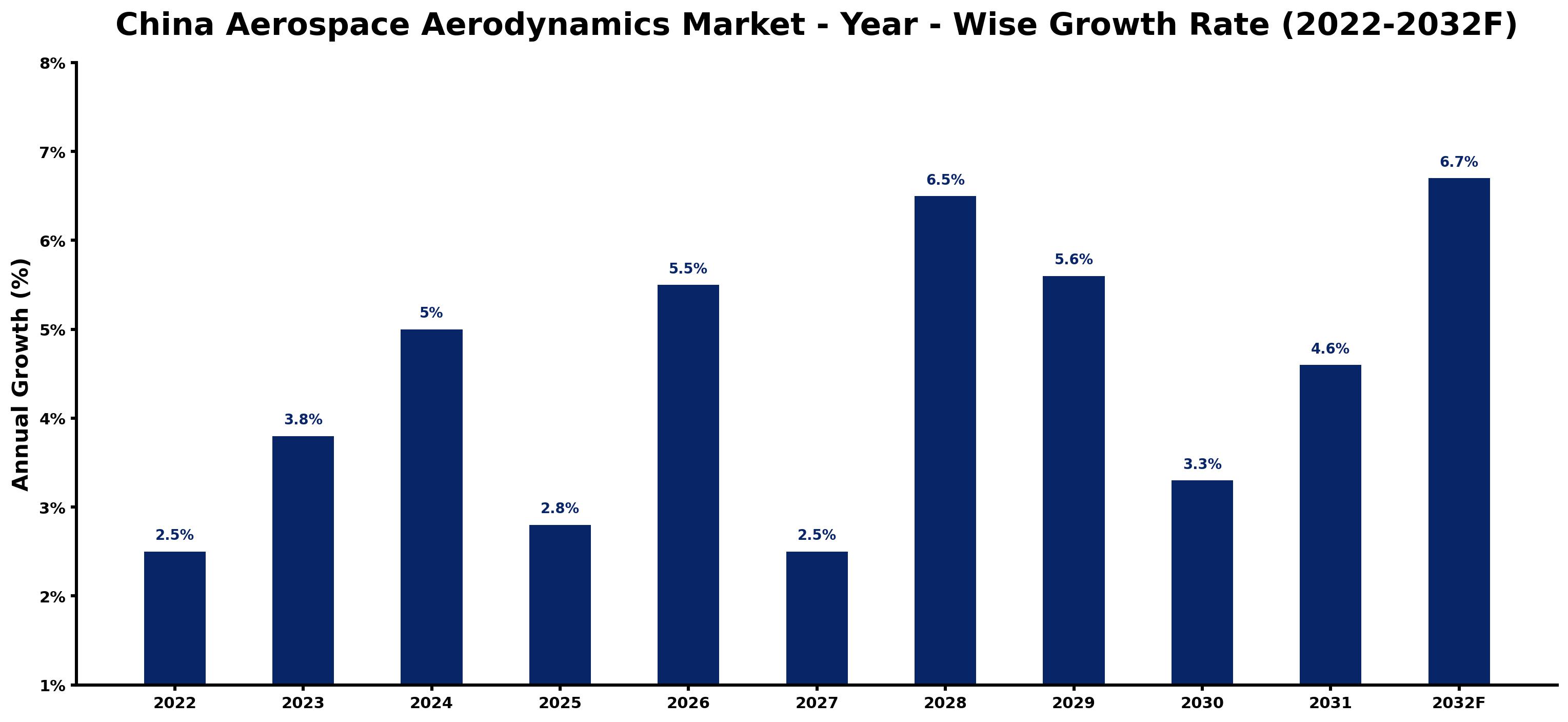
Below, each year's estimated growth is shown next to the factor that most influenced it.
| Year | Estimated Annual Growth (%) | Market Rationale |
| 2022 | 2.5 | The market experienced steady growth, reflecting ongoing investments in aerospace R&D initiatives. |
| 2023 | 3.8 | Increased funding for domestic aircraft manufacturers contributed to faster growth than the previous year. |
| 2024 | 5.0 | The adoption of advanced aerodynamic designs led to further acceleration in market growth. |
| 2025 | 2.8 | Growth slowed as investments stabilised, but demand from aircraft manufacturers remained strong. |
| 2026 | 5.5 | The market is expected to rebound with renewed investments in aerodynamic technologies and R&D initiatives. |
| 2027 | 2.5 | Growth is projected to slow again as the market adjusts to previous high investment levels. |
| 2028 | 6.5 | A surge in demand for blended wing designs is expected to drive faster growth in the market. |
| 2029 | 5.6 | Market growth will slow as the focus shifts to optimising existing technologies. |
| 2030 | 3.3 | The market is projected to experience a slowdown as investment patterns begin to normalise. |
| 2031 | 4.6 | Growth is expected to pick up again due to increased demand from aerospace R&D centres. |
| 2032 | 6.7 | The market will peak as advancements in aerodynamics technologies reach new heights. |
Note: Market size estimations and growth projections presented in this report are based on 6Wresearch's proprietary forecasting methodology, utilizing the latest available industry data, government publications, and primary research inputs.
China Aerospace Aerodynamics Market Synopsis
The China Aerospace Aerodynamics Market encompasses the study of air interaction with aircraft, utilising advanced computational fluid dynamics and wind tunnel testing. This field optimises aircraft performance, enhances fuel efficiency, and improves safety. The market is growing due to significant demand from domestic aircraft manufacturers and defense contractors. Investment in R&D initiatives, such as the 2021-2025 National Aerospace Development Plan, is further driving this growth. The ongoing development of new aircraft models, including blended wing designs, contributes to the market's expansion.
Market Dynamics Impact Analysis (2026–2032)
| Factor | Type | Impact | Primary Segment Affected |
| Investment in R&D initiatives for aerodynamic technologies | Driver | High | Lift Enhancement Tech |
| Growing demand from domestic aircraft manufacturers for advanced aerodynamic solutions | Driver | High | Blended Wing Designs |
| Emerging opportunities in the defense sector for advanced aerodynamic technologies | Opportunity | High | Vortex Generators |
| Increased focus on international collaboration for aerospace technology advancements | Opportunity | Medium | Aerodynamic Fairings |
| High costs associated with R&D for new aerodynamic technologies | Restraint | High | Drag Reduction Design |
| Limited access to cutting-edge aerodynamic testing facilities | Restraint | Medium | Flow Control Devices |
| Shortage of skilled professionals in aerospace aerodynamics | Challenge | High | Lift Enhancement Tech |
| Regulatory hurdles in the approval process for new aerodynamic designs | Challenge | Medium | OEMs |
Evaluation of Drivers in China Aerospace Aerodynamics Market (2026–2032)
Below mentioned are some major drivers and their influence on market dynamics.
| Drivers | Primary Segment Affected | Why It Matters (Evidence) |
| Increased investment in aerospace R&D initiatives | Lift Enhancement Tech | In 2022, China invested 50 billion RMB in aerospace R&D initiatives, driving demand for advanced aerodynamic technologies. |
| Growing domestic aircraft manufacturers' demand for efficiency | Drag Reduction Design | Increased collaboration between research institutions and industry facilitates knowledge transfer and boosts demand. |
| Rising defense budget allocations for aerospace technology | Blended Wing Designs | The 2023 defense budget includes significant funding for aerodynamic advancements, increasing demand from defense contractors. |
| Adoption of advanced aerodynamic designs in new aircraft | Aerodynamic Fairings | The ongoing development of the C919 aircraft highlights the need for improved aerodynamic solutions. |
| Support from government initiatives for R&D | Vortex Generators | The 'Aerospace Innovation Initiative' promotes collaboration, enhancing R&D capabilities in aerodynamic technologies. |
Expansion of the Aerospace Aerodynamics market in China is backed by increased investment in aerospace R&D and rising demand from domestic manufacturers. The presence of over 20 major aircraft manufacturers in regions like Beijing and Shanghai drives the adoption of innovative designs, particularly blended wing configurations. The rising defense budget for 2023 includes substantial allocations for aerodynamic advancements, further boosting demand. Collaborations between universities and aerospace firms are fostering innovation, supporting the growth of the market.
Evaluation of Restraints in China Aerospace Aerodynamics Market
The main factors holding the market back are set out below.
| Market Restraint | Primary Segment Affected | Why It Matters (Evidence) |
| High costs associated with R&D for new aerodynamic technologies | Drag Reduction Design | Economic uncertainties can lead to reduced funding for R&D initiatives, impacting project viability. |
| Limited access to advanced aerodynamic testing facilities | Flow Control Devices | The shortage of state-of-the-art testing facilities can delay product development and increase costs. |
| Regulatory hurdles in the approval process for new aerodynamic designs | OEMs | Stringent regulations can prolong the time required for new products to enter the market. |
| Shortage of skilled professionals in aerospace aerodynamics | Lift Enhancement Tech | The rapid pace of innovation outstrips training efforts, delaying project timelines for producers. |
| Economic fluctuations affecting investment levels | Blended Wing Designs | Market volatility can lead to uncertainty in funding for new aerodynamic projects. |
China Aerospace Aerodynamics Market Challenges
Buyers in the China Aerospace Aerodynamics Market encounter high R&D costs, with 50 billion RMB invested in 2022, straining budgets for smaller manufacturers. Competition intensifies among over 20 major aircraft producers, as the race for advanced aerodynamic technologies raises operational expenses. A shortage of skilled professionals exists, with over 1 million workers in the sector, yet rapid innovation outpaces training, resulting in project delays for producers. Supply chain disruptions also present challenges; reliance on specific suppliers for aerodynamic components can lead to increased costs and delays, affecting delivery schedules for manufacturers.
Trends in the China Aerospace Aerodynamics Market
Several trends are reshaping the China Aerospace Aerodynamics Market; the most important are set out below.
- Shift Towards Blended Wing Designs: Aircraft manufacturers are increasingly adopting blended wing designs for improved fuel efficiency, with over 20 major manufacturers in China embracing this trend. This shift leads to enhanced overall aircraft performance.
- Increased Collaboration in Aerospace R&D: In 2023, the government launched the 'Aerospace Innovation Initiative' to invest 100 billion RMB in R&D, promoting collaboration between universities and aerospace firms. This initiative drives innovation in aerodynamic technologies.
- Growing Demand for Advanced Aerodynamic Solutions: The ongoing development of the C919 aircraft highlights the demand for advanced aerodynamic solutions, with significant investments directed towards improving its design. This trend indicates a broader industry shift towards efficiency.
- Focus on Regulatory Compliance: The Civil Aviation Administration of China has introduced new regulations to streamline the approval process for aerodynamic design innovations. This focus on compliance facilitates faster market entry for new technologies.
Investment Opportunities in the China Aerospace Aerodynamics Market
Below are the investment opportunities with the strongest case in the China Aerospace Aerodynamics Market.
- Investment in Aerospace R&D Facilities: The Tianjin Free Trade Zone presents an opportunity to invest in aerospace R&D facilities, with a budget of 30 billion RMB allocated for small and medium-sized enterprises. Collaborating with local partners can facilitate market entry.
- Supply of Advanced Aerodynamic Components: With China's defence budget for 2023 including significant allocations for aerospace technology enhancements, there is a growing need for advanced aerodynamic components. Suppliers can enter this market by establishing partnerships with defence contractors.
- Development of Innovative Aerodynamic Technologies: The National Aerospace Development Plan aims to enhance domestic capabilities, creating opportunities for firms to develop innovative aerodynamic technologies. Engaging with aerospace R&D centres can facilitate collaboration.
- Expansion of Aerodynamic Testing Facilities: The increasing demand for aerodynamic testing facilities indicates a gap in the market. Investing in state-of-the-art facilities can attract partnerships with major aircraft manufacturers.
Government Initiatives in the China Aerospace Aerodynamics Market
The 'Aerospace Innovation Initiative' launched by the Ministry of Industry and Information Technology in 2023 aims to invest 100 billion RMB in R&D for aerodynamic technologies. This measure encourages innovation and supports the development of advanced aerodynamic solutions for the aerospace sector. The initiative fosters collaboration between industry players and research institutions, strengthening overall capabilities in aerodynamics. Additionally, the 2021 update of the 'National Aerospace Development Plan' focuses on enhancing domestic capabilities in aerodynamics, funding various projects aimed at improving technology and innovation in the sector.
In 2021, the National Development and Reform Commission updated the 'National Aerospace Development Plan', focusing on enhancing domestic capabilities in aerodynamics. This plan includes funding for various projects aimed at improving technology and innovation in the sector. The Civil Aviation Administration of China also introduced new regulations to streamline the approval process for aerodynamic design innovations, facilitating faster market entry for new technologies. The 2022 'Aerospace Industry Revitalization Program' aims to support small and medium-sized enterprises in the aerospace sector with a budget of 30 billion RMB.
Future Insight of the China Aerospace Aerodynamics Market
By 2032, buyers and suppliers in the China Aerospace Aerodynamics Market can expect significant advancements driven by the 2023 Aerospace Innovation Initiative, which promotes R&D collaboration. The National Aerospace Development Plan will enhance domestic capabilities, fostering partnerships between universities and firms. With a 15% increase in aerospace exports last year, international collaboration is set to expand, creating new opportunities for suppliers. The ongoing development of the C919 aircraft will showcase advancements in aerodynamic technologies, establishing new standards for performance and efficiency.
Market Segmentation Analysis
The report offers a comprehensive study of the following market segments and their leading categories in the market.
By Product Type – Winglets Dominated, Blended Wing Designs Expected to Grow Fastest
According to Ravi Bhandari, Research Head at 6Wresearch, the largest product type category in 2025 was Winglets, with a 42% share of total revenue. Winglets hold the largest market share in the China Aerospace Aerodynamics Market due to their essential role in reducing drag and enhancing fuel efficiency for aircraft. As a result, major manufacturers in key regions like Beijing and Shanghai are increasingly integrating winglets into their designs to comply with national standards. Blended Wing Designs are set to record the highest CAGR in this split, 6.9% over 2026–2032. Blended wing designs are rapidly gaining popularity, primarily due to their integral role in modern aircraft performance, as evidenced by advancements in the C919 aircraft. The 2021-2025 National Aerospace Development Plan actively promotes the adoption of these advanced aerodynamic technologies, ensuring continued growth in this segment. Suppliers should focus on developing innovative winglet designs to meet the rising demand from aircraft manufacturers.
By Technology Type – Lift Enhancement Tech Dominated and Is Expected to Record the Fastest Growth
Lift Enhancement Tech accounted for a 37% market share by technology type in 2025. Lift enhancement technology leads the market share because it is vital for increasing lift and overall efficiency in aircraft. This technology is widely employed by China's aerospace workforce, which consists of over 1 million professionals dedicated to engineering and manufacturing. Lift Enhancement Tech is also forecast to expand faster than any other category, at a CAGR of 6.6% over 2026–2032. The growth of lift enhancement technology is propelled by its critical importance in improving aircraft performance and fuel efficiency, making it a focal point in ongoing R&D efforts. The government's investment of 50 billion RMB in aerospace R&D initiatives in 2022 significantly supports the expansion of this segment. Buyers should seek suppliers who specialise in lift enhancement technologies to ensure optimal aircraft performance.
By Distribution Channel – OEMs Dominated, Government Contracts Expected to Grow Fastest
In 2025, OEMs led the distribution channel split with a 40% share. OEMs dominate the distribution channel segment as they are the primary source for manufacturing and supplying aerodynamic components to the aerospace sector. Their established relationships with major aircraft manufacturers in China facilitate a consistent flow of products that meet national standards. Over 2026–2032, Government Contracts are expected to post the fastest growth, at a CAGR of 6.2%. Government contracts represent the fastest-growing distribution channel, serving as a significant source of funding for aerospace projects related to defence. The Chinese government's focus on enhancing aerospace technology through substantial budget allocations in 2023 is driving this growth. Suppliers should pursue partnerships with government entities to access lucrative contracts available for aerospace projects.
By End User – Aircraft Manufacturers Dominated, Aerospace R&D Centers Expected to Grow Fastest
Aircraft Manufacturers held a 43% share of the China Aerospace Aerodynamics Market by end user in 2025. Aircraft manufacturers are the largest end users of aerodynamics solutions, requiring advanced technologies to optimise aircraft performance and comply with national standards. The presence of over 20 major aircraft manufacturers in China solidifies this segment's dominant market share. The quickest growth will come from Aerospace R&D Centers, forecast to expand at a CAGR of 6.7% between 2026 and 2032. Aerospace R&D centers are experiencing the fastest growth as they focus on innovative aerodynamic research, supported by government initiatives like the Aerospace Innovation Initiative launched in 2023. This emphasis on research and development is crucial for advancing aerodynamic technologies. Suppliers should align their offerings with the needs of aerospace R&D centers to capitalise on the increasing emphasis on innovation in aerodynamics.
Key Attractiveness of the Report
- 10 Years of Market Numbers
- Historical Data Starting from 2022 to 2025
- Base Year 2025
- Forecast Data until 2032
- Key Performance Indicators Impacting the Market
- Major Upcoming Developments and Projects
Key Highlights of the Report:
- China Aerospace Aerodynamics Market Outlook
- Market Size of China Aerospace Aerodynamics Market, 2025
- Forecast of China Aerospace Aerodynamics Market, 2032
- Historical Data and Forecast of China Aerospace Aerodynamics Revenues & Volume for the Period 2022 - 2032F
- China Aerospace Aerodynamics Market Trend Evolution
- China Aerospace Aerodynamics Market Drivers and Challenges
- China Aerospace Aerodynamics Price Trends
- China Aerospace Aerodynamics Porter's Five Forces
- China Aerospace Aerodynamics Industry Life Cycle
- Historical Data and Forecast of China Aerospace Aerodynamics Market Revenues & Volume By Product Type for the Period 2022 - 2032F
- Historical Data and Forecast of China Aerospace Aerodynamics Market Revenues & Volume By Winglets for the Period 2022 - 2032F
- Historical Data and Forecast of China Aerospace Aerodynamics Market Revenues & Volume By Vortex Generators for the Period 2022 - 2032F
- Historical Data and Forecast of China Aerospace Aerodynamics Market Revenues & Volume By Aerodynamic Fairings for the Period 2022 - 2032F
- Historical Data and Forecast of China Aerospace Aerodynamics Market Revenues & Volume By Blended Wing Designs for the Period 2022 - 2032F
- Historical Data and Forecast of China Aerospace Aerodynamics Market Revenues & Volume By Technology Type for the Period 2022 - 2032F
- Historical Data and Forecast of China Aerospace Aerodynamics Market Revenues & Volume By Passive Systems for the Period 2022 - 2032F
- Historical Data and Forecast of China Aerospace Aerodynamics Market Revenues & Volume By Flow Control Devices for the Period 2022 - 2032F
- Historical Data and Forecast of China Aerospace Aerodynamics Market Revenues & Volume By Drag Reduction Design for the Period 2022 - 2032F
- Historical Data and Forecast of China Aerospace Aerodynamics Market Revenues & Volume By Lift Enhancement Tech for the Period 2022 - 2032F
- Historical Data and Forecast of China Aerospace Aerodynamics Market Revenues & Volume By Distribution Channel for the Period 2022 - 2032F
- Historical Data and Forecast of China Aerospace Aerodynamics Market Revenues & Volume By OEMs for the Period 2022 - 2032F
- Historical Data and Forecast of China Aerospace Aerodynamics Market Revenues & Volume By Direct Sales for the Period 2022 - 2032F
- Historical Data and Forecast of China Aerospace Aerodynamics Market Revenues & Volume By Government Contracts for the Period 2022 - 2032F
- Historical Data and Forecast of China Aerospace Aerodynamics Market Revenues & Volume By Engineering Firms for the Period 2022 - 2032F
- Historical Data and Forecast of China Aerospace Aerodynamics Market Revenues & Volume By End User for the Period 2022 - 2032F
- Historical Data and Forecast of China Aerospace Aerodynamics Market Revenues & Volume By Aircraft Manufacturers for the Period 2022 - 2032F
- Historical Data and Forecast of China Aerospace Aerodynamics Market Revenues & Volume By Commercial Airlines for the Period 2022 - 2032F
- Historical Data and Forecast of China Aerospace Aerodynamics Market Revenues & Volume By Defense Contractors for the Period 2022 - 2032F
- Historical Data and Forecast of China Aerospace Aerodynamics Market Revenues & Volume By Aerospace R&D Centers for the Period 2022 - 2032F
- China Aerospace Aerodynamics Import Export Trade Statistics
- Market Opportunity Assessment By Product Type
- Market Opportunity Assessment By Technology Type
- Market Opportunity Assessment By Distribution Channel
- Market Opportunity Assessment By End User
- China Aerospace Aerodynamics Top Companies Market Share
- China Aerospace Aerodynamics Competitive Benchmarking By Technical and Operational Parameters
- China Aerospace Aerodynamics Company Profiles
- China Aerospace Aerodynamics Key Strategic Recommendations
Market Covered
This report examines the market across the segments below.
By Product Type
- Winglets
- Vortex Generators
- Aerodynamic Fairings
- Blended Wing Designs
By Technology Type
- Passive Systems
- Flow Control Devices
- Drag Reduction Design
- Lift Enhancement Tech
By Distribution Channel
- OEMs
- Direct Sales
- Government Contracts
- Engineering Firms
By End User
- Aircraft Manufacturers
- Commercial Airlines
- Defense Contractors
- Aerospace R&D Centers































