China Aerospace Alloys Market Size & Growth Rate
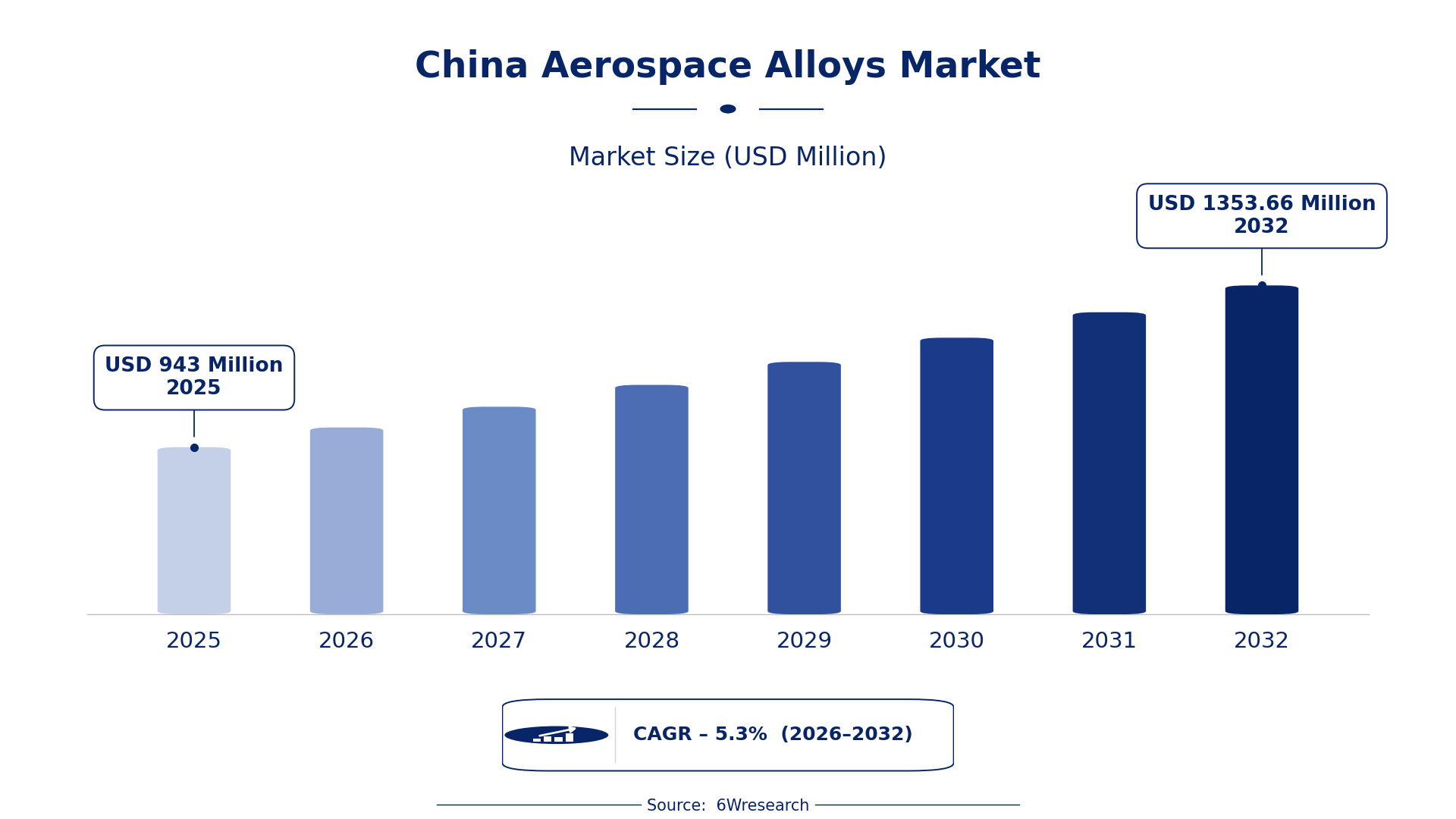
According to 6Wresearch internal database and industry insights, the China Aerospace Alloys Market was valued at USD 943.0 million in 2025 and is projected to reach USD 1,353.66 million by 2032, growing at a CAGR of approximately 5.3% during 2026–2032.
China Aerospace Alloys Market Highlights
| Report Metric | Details |
| Report Name | China Aerospace Alloys Market |
| Market Size 2025 | USD 943.0 million |
| Market Size 2032 | USD 1,353.66 million |
| Absolute Growth 2025–2032 | USD 410.66 million |
| CAGR 2026–2032 | 5.3% |
| Peak Annual Growth | 7.5% in 2026 |
| Forecast Period | 2026–2032 |
| Historical Data | 2022–2025 |
| Base Year | 2025 |
| Leading Alloy Type, 2025 | Aluminum Alloys (49% share) |
| Leading Material Base, 2025 | Aluminum-Based (37% share) |
| Leading Distribution Channel, 2025 | OEMs (43% share) |
| Leading End User, 2025 | Aircraft Manufacturers (43% share) |
| Fastest-Growing Alloy Type | Titanium Alloys (7.7% CAGR) |
| Fastest-Growing Material Base | Titanium-Based (6.4% CAGR) |
| Fastest-Growing Distribution Channel | Industrial Suppliers (7.7% CAGR) |
| Fastest-Growing End User | Jet Engine OEMs (7.4% CAGR) |
| Growing Sector | Aerospace Manufacturing |
| Key End Users | Aircraft Manufacturers, Jet Engine OEMs, Spacecraft Component Makers, Commercial Aviation |
China Aerospace Alloys Market Year-wise Growth Rate and Key Drivers (2022–2032)
This graph illustrates the annual growth rates of the market from 2022 to 2032, highlighting a steady upward trajectory and projected market expansion over the forecast period.
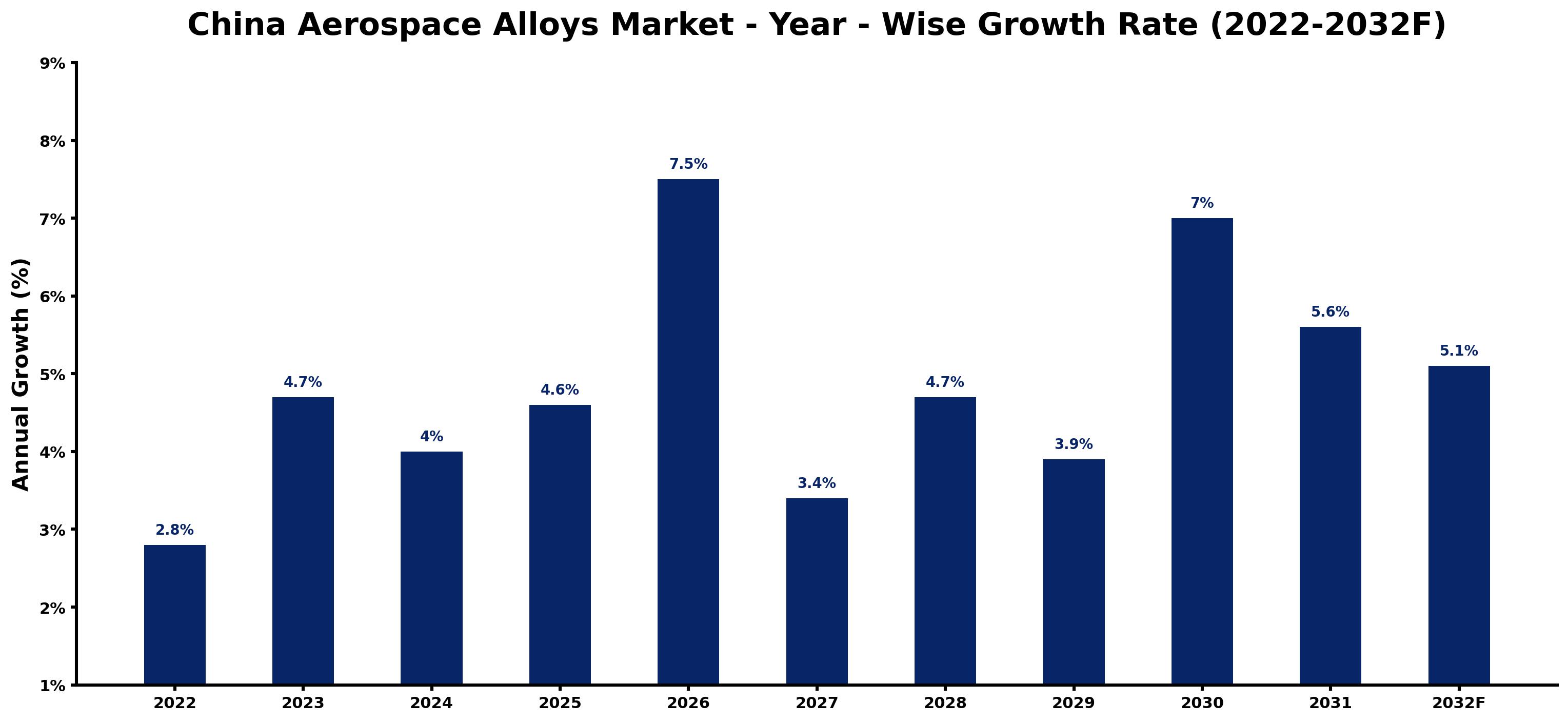
Each row of the following table gives one year's estimated growth and the event or demand shift that explains it.
| Year | Estimated Annual Growth (%) | Market Rationale |
| 2022 | 2.8 | The market experienced steady growth, reflecting increasing domestic aerospace activity. |
| 2023 | 4.7 | Demand surged due to the production of over 300 commercial aircraft that year. |
| 2024 | 4.0 | Growth slowed slightly as manufacturers adjusted to supply chain challenges. |
| 2025 | 4.6 | A recovery in growth occurred as investments in aerospace technology intensified. |
| 2026 | 7.5 | The peak growth was driven by the 'Made in China 2025' initiative boosting production. |
| 2027 | 3.4 | A slowdown followed as the market stabilised after the rapid growth phase. |
| 2028 | 4.7 | Growth resumed as demand from jet engine OEMs increased significantly. |
| 2029 | 3.9 | Market growth slowed again due to temporary supply constraints in raw materials. |
| 2030 | 7.0 | A resurgence in growth was noted as new aerospace projects gained momentum. |
| 2031 | 5.6 | The market saw slower growth as demand stabilised following previous peaks. |
| 2032 | 5.1 | Growth continued to moderate as the market matured and competition increased. |
Note: Market size estimations and growth projections presented in this report are based on 6Wresearch's proprietary forecasting methodology, utilizing the latest available industry data, government publications, and primary research inputs.
China Aerospace Alloys Market Synopsis
Aerospace Alloys in China includes specialized materials used in the aerospace sector, primarily titanium, aluminum, nickel, and magnesium. These alloys are produced through casting, forging, and machining to achieve optimal strength and lightweight characteristics. The China Aerospace Alloys Market is expanding due to strong domestic demand from aircraft manufacturers and ongoing investments in aerospace technology. The aerospace industry is projected to reach a value of $1 trillion by 2035, further increasing the need for high-performance alloys.
Market Dynamics Impact Analysis (2026–2032)
| Factor | Type | Impact | Primary Segment Affected |
| Increasing domestic production of aircraft and spacecraft components | Driver | High | Aluminum Alloys |
| Rising demand for high-performance alloys in jet engines | Driver | High | Titanium Alloys |
| Investment in aerospace manufacturing capabilities | Opportunity | High | Aluminum Alloys |
| Growing need for lightweight materials in commercial aviation | Opportunity | Medium | Aluminum Alloys |
| Supply chain disruptions affecting raw material availability | Restraint | High | Titanium Alloys |
| Regulatory compliance costs for alloy specifications | Restraint | Medium | Aluminum Alloys |
| High production costs for advanced aerospace alloys | Challenge | High | Nickel Alloys |
| Delays in certification processes for new materials | Challenge | Medium | Titanium Alloys |
Evaluation of Drivers in China Aerospace Alloys Market (2026–2032)
The main growth drivers and the segments they affect most are set out below.
| Drivers | Primary Segment Affected | Why It Matters (Evidence) |
| Growing domestic demand for commercial aircraft | Aluminum Alloys | This demand is reflected in the production of over 300 aircraft in 2022. |
| Investment in aerospace technology and infrastructure | Titanium Alloys | The 'Made in China 2025' initiative aims to boost manufacturing capabilities. |
| Rising air travel demand from the population | Aluminum Alloys | China's population of approximately 1.4 billion fuels the need for more aircraft. |
| Increased focus on reducing aircraft weight | Titanium Alloys | The aerospace industry seeks lightweight materials to improve fuel efficiency. |
| Expansion of the jet engine manufacturing sector | Nickel Alloys | Jet engine OEMs require high-performance alloys for engine components. |
Market growth for Aerospace Alloys in China is underpinned by rising domestic demand from aircraft manufacturers and substantial investments in aerospace technology. The production of over 300 commercial aircraft in 2022 has driven the need for high-quality alloys, particularly aluminum and titanium. The growing population of approximately 1.4 billion people is contributing to higher air travel demand, further supporting market expansion. The focus on reducing aircraft weight for improved fuel efficiency is pushing demand for lightweight materials, with jet engine OEMs increasingly seeking advanced alloys.
Evaluation of Restraints in China Aerospace Alloys Market
The key brakes on demand, and where they bite hardest, are shown below.
| Market Restraint | Primary Segment Affected | Why It Matters (Evidence) |
| Supply chain disruptions impacting raw material availability | Titanium Alloys | These disruptions have led to increased lead times and costs for manufacturers. |
| High production costs associated with advanced alloys | Nickel Alloys | The complexity of manufacturing nickel alloys raises overall production expenses. |
| Regulatory compliance costs for aerospace materials | Aluminum Alloys | Manufacturers must invest in testing and certification to meet national standards. |
| Limited availability of skilled workforce in aerospace manufacturing | Titanium Alloys | A shortage of qualified personnel can delay production timelines. |
| Market fluctuations in raw material prices | Aluminum Alloys | Volatility in the prices of aluminum affects manufacturing budgets. |
China Aerospace Alloys Market Challenges
Fierce competition in the China Aerospace Alloys Market drives prices down, squeezing profit margins for producers and limiting their ability to invest in innovation. Producers also face a skills shortage; the rapid growth of the aerospace sector has outpaced the availability of qualified engineers, leading to production delays that can extend up to six months. Regulatory challenges arise as the Civil Aviation Administration of China enforces stringent compliance standards, which can prolong product approval timelines and result in lost market opportunities for producers. Additionally, rising raw material costs, increasing by approximately 15%, compel manufacturers to raise prices, impacting buyers directly.
Trends in the China Aerospace Alloys Market
The trends below show where the China Aerospace Alloys Market is heading.
- Shift from Traditional to Advanced Alloys: Since 2023, manufacturers have increasingly adopted advanced alloys for improved performance, particularly in jet engines. This shift is highlighted by the growing demand for titanium alloys, projected to have a CAGR of 7.7% through 2032.
- Increased Focus on Sustainability: Starting in 2023, the aerospace sector is prioritising sustainable materials, with a notable rise in the use of aluminum alloys due to their recyclability. This trend aligns with the industry's goal of reducing carbon emissions.
- Expansion of Domestic Manufacturing Facilities: In 2023, China saw a rise in the establishment of new aerospace manufacturing facilities, particularly in Shanghai and Beijing, to meet growing demand. This expansion is essential for achieving the national target of increasing production by 30% by 2025.
- Emergence of New Aerospace Standards: The introduction of the National Standard for Aerospace Materials in 2021 has led to stricter guidelines for alloy specifications, impacting production processes and ensuring higher quality in aerospace components.
Investment Opportunities in the China Aerospace Alloys Market
Several openings in the China Aerospace Alloys Market merit attention from investors.
- Investment in Aerospace Manufacturing Facilities: With China's aerospace industry projected to reach $1 trillion by 2035, there is an opportunity for investment in new manufacturing facilities, particularly in regions like Beijing, to meet rising demand.
- Supply of Lightweight Aerospace Alloys: The growing need for lightweight materials presents an opportunity to supply aluminum and titanium alloys. Aircraft manufacturers are increasingly seeking these materials to enhance fuel efficiency.
- Development of Advanced Alloy Technologies: Investment in R&D for advanced alloys is essential now, as manufacturers are looking for high-performance materials. Jet Engine OEMs are key buyers in this segment.
- Partnerships with Local Manufacturers: Collaborating with local manufacturers in regions like Shanghai can facilitate entry into the market, especially as demand for aerospace alloys continues to rise.
Government Initiatives in the China Aerospace Alloys Market
The 'Made in China 2025' initiative, launched by the Ministry of Industry and Information Technology in 2017, aims to strengthen domestic aerospace manufacturing capabilities. This initiative focuses on increasing the production of aerospace components, targeting a 30% rise by 2025. Additionally, the 'National Aerospace Industry Development Plan' by the State Council in 2020 supports this goal by promoting innovation and investment in the aerospace sector, which directly impacts the demand for aerospace alloys. The Civil Aviation Development Plan, initiated by the CAAC in 2021, further aims to improve safety and efficiency in the aviation sector, influencing alloy specifications and production standards.
The National Defense Science and Technology Industry Administration (NDSTIA) plays a key role in funding aerospace innovation projects. The Aerospace Industry Innovation Fund, established in 2022, allocates $500 million to support research and development in aerospace technologies. This funding is crucial for advancing the capabilities of aerospace alloys, ensuring that manufacturers can meet the evolving demands of the industry.
Future Insight of the China Aerospace Alloys Market
The China Aerospace Alloys Market is set to evolve by 2032, primarily influenced by the 'Made in China 2025' initiative, which aims to enhance domestic manufacturing capabilities. The C919 program is expected to drive demand for aerospace alloys as the installed base of commercial aircraft surpasses 3,000 units. Technological advancements in casting and forging will improve material performance while reducing waste. Increased investment in aerospace technology and infrastructure will facilitate collaboration between suppliers and buyers, creating a more integrated market.
Market Segmentation Analysis
The analysis below covers each segmentation, its leading category in 2025 and its fastest-growing category through 2032.
By Alloy Type – Aluminum Alloys Dominated, Titanium Alloys Expected to Grow Fastest
According to Ravi Bhandari, Research Head at 6Wresearch, the largest alloy type category in 2025 was Aluminum Alloys, with a 49% share of total revenue. Aluminum alloys hold the largest share in the China Aerospace Alloys Market due to their widespread application in aircraft structures, where lightweight and corrosion resistance are crucial. The installed base of over 3,000 commercial aircraft in China heavily relies on aluminum for constructing airframes. Titanium Alloys are set to record the highest CAGR in this split, 7.7% over 2026–2032. Titanium alloys are experiencing rapid growth as they are increasingly used in aircraft and spacecraft for their exceptional strength-to-weight ratio, which is essential for optimal performance. The C919 program, aimed at developing a large passenger aircraft by 2025, will significantly drive the demand for titanium alloys. This trend indicates that suppliers should focus on enhancing their offerings of aluminum and titanium alloys to align with the aerospace industry's growing needs.
By Material Base – Aluminum-Based Dominated, Titanium-Based Expected to Grow Fastest
With a 37% revenue share in 2025, Aluminum-Based was the largest material base category. Aluminum-based materials lead the China Aerospace Alloys Market primarily due to their vital role in commercial aircraft production, where minimising weight is essential. The production of over 300 commercial aircraft in 2022 underscores the reliance on aluminum for these critical applications. Over 2026–2032, Titanium-Based is expected to post the fastest growth, at a CAGR of 6.4%. Titanium-based materials are witnessing swift growth as they are essential for high-performance aerospace applications that require durability and strength. The push for advanced aerospace technology under initiatives like 'Made in China 2025' is expected to further accelerate this demand. Suppliers must adapt their strategies to ensure a consistent supply of both aluminum and titanium-based materials to capitalise on the expanding aerospace market.
By Distribution Channel – OEMs Dominated, Industrial Suppliers Expected to Grow Fastest
OEMs took a 43% share of distribution channel in 2025, more than any other category. OEMs are the primary purchasers of aerospace alloys, as they require these materials for manufacturing aircraft and components. Their crucial position in the supply chain allows them to maintain a dominant share in the distribution of aerospace alloys. The quickest growth will come from Industrial Suppliers, forecast to expand at a CAGR of 7.7% between 2026 and 2032. Industrial suppliers are experiencing the fastest growth as they provide essential materials to OEMs and manufacturers, thereby facilitating the supply chain. As the aerospace industry in China expands, the demand for industrial suppliers to deliver aerospace alloys will significantly increase. This shift presents a growing opportunity for suppliers to strengthen partnerships with industrial suppliers to enhance distribution efficiency.
By End User – Aircraft Manufacturers Dominated, Jet Engine OEMs Expected to Grow Fastest
In 2025, Aircraft Manufacturers led the end user split with a 43% share. Aircraft manufacturers represent the largest user group for aerospace alloys, as they are directly involved in the production of aircraft where these materials are essential. Their substantial demand for alloys is reflected in the ongoing production of commercial aircraft in China. Jet Engine OEMs are projected to grow fastest, at a CAGR of 7.4% during 2026–2032. Jet engine OEMs are the fastest-growing user group, driven by the need for high-performance alloys in engine components. As the aerospace sector pushes for more efficient and powerful engines, the demand from jet engine manufacturers will continue to rise. This suggests that suppliers should prioritise their offerings to aircraft manufacturers and jet engine OEMs to align with market demands.
Key Attractiveness of the Report
- 10 Years of Market Numbers
- Historical Data Starting from 2022 to 2025
- Base Year 2025
- Forecast Data until 2032
- Key Performance Indicators Impacting the Market
- Major Upcoming Developments and Projects
Key Highlights of the Report:
- China Aerospace Alloys Market Outlook
- Market Size of China Aerospace Alloys Market, 2025
- Forecast of China Aerospace Alloys Market, 2032
- Historical Data and Forecast of China Aerospace Alloys Revenues & Volume for the Period 2022 - 2032F
- China Aerospace Alloys Market Trend Evolution
- China Aerospace Alloys Market Drivers and Challenges
- China Aerospace Alloys Price Trends
- China Aerospace Alloys Porter's Five Forces
- China Aerospace Alloys Industry Life Cycle
- Historical Data and Forecast of China Aerospace Alloys Market Revenues & Volume By Alloy Type for the Period 2022 - 2032F
- Historical Data and Forecast of China Aerospace Alloys Market Revenues & Volume By Titanium Alloys for the Period 2022 - 2032F
- Historical Data and Forecast of China Aerospace Alloys Market Revenues & Volume By Aluminum Alloys for the Period 2022 - 2032F
- Historical Data and Forecast of China Aerospace Alloys Market Revenues & Volume By Nickel Alloys for the Period 2022 - 2032F
- Historical Data and Forecast of China Aerospace Alloys Market Revenues & Volume By Magnesium Alloys for the Period 2022 - 2032F
- Historical Data and Forecast of China Aerospace Alloys Market Revenues & Volume By Material Base for the Period 2022 - 2032F
- Historical Data and Forecast of China Aerospace Alloys Market Revenues & Volume By Titanium-Based for the Period 2022 - 2032F
- Historical Data and Forecast of China Aerospace Alloys Market Revenues & Volume By Aluminum-Based for the Period 2022 - 2032F
- Historical Data and Forecast of China Aerospace Alloys Market Revenues & Volume By Nickel-Based for the Period 2022 - 2032F
- Historical Data and Forecast of China Aerospace Alloys Market Revenues & Volume By Magnesium-Based for the Period 2022 - 2032F
- Historical Data and Forecast of China Aerospace Alloys Market Revenues & Volume By Distribution Channel for the Period 2022 - 2032F
- Historical Data and Forecast of China Aerospace Alloys Market Revenues & Volume By OEMs for the Period 2022 - 2032F
- Historical Data and Forecast of China Aerospace Alloys Market Revenues & Volume By Industrial Suppliers for the Period 2022 - 2032F
- Historical Data and Forecast of China Aerospace Alloys Market Revenues & Volume By Direct Sales for the Period 2022 - 2032F
- Historical Data and Forecast of China Aerospace Alloys Market Revenues & Volume By Specialty Stores for the Period 2022 - 2032F
- Historical Data and Forecast of China Aerospace Alloys Market Revenues & Volume By End User for the Period 2022 - 2032F
- Historical Data and Forecast of China Aerospace Alloys Market Revenues & Volume By Aircraft Manufacturers for the Period 2022 - 2032F
- Historical Data and Forecast of China Aerospace Alloys Market Revenues & Volume By Commercial Aviation for the Period 2022 - 2032F
- Historical Data and Forecast of China Aerospace Alloys Market Revenues & Volume By Jet Engine OEMs for the Period 2022 - 2032F
- Historical Data and Forecast of China Aerospace Alloys Market Revenues & Volume By Spacecraft Component Makers for the Period 2022 - 2032F
- China Aerospace Alloys Import Export Trade Statistics
- Market Opportunity Assessment By Alloy Type
- Market Opportunity Assessment By Material Base
- Market Opportunity Assessment By Distribution Channel
- Market Opportunity Assessment By End User
- China Aerospace Alloys Top Companies Market Share
- China Aerospace Alloys Competitive Benchmarking By Technical and Operational Parameters
- China Aerospace Alloys Company Profiles
- China Aerospace Alloys Key Strategic Recommendations
Market Covered
Segments analysed in this report are listed below.
By Alloy Type
- Titanium Alloys
- Aluminum Alloys
- Nickel Alloys
- Magnesium Alloys
By Material Base
- Titanium-Based
- Aluminum-Based
- Nickel-Based
- Magnesium-Based
By Distribution Channel
- OEMs
- Industrial Suppliers
- Direct Sales
- Specialty Stores
By End User
- Aircraft Manufacturers
- Commercial Aviation
- Jet Engine OEMs
- Spacecraft Component Makers































