China Aerospace Assembly Hardware Market Size & Growth Rate
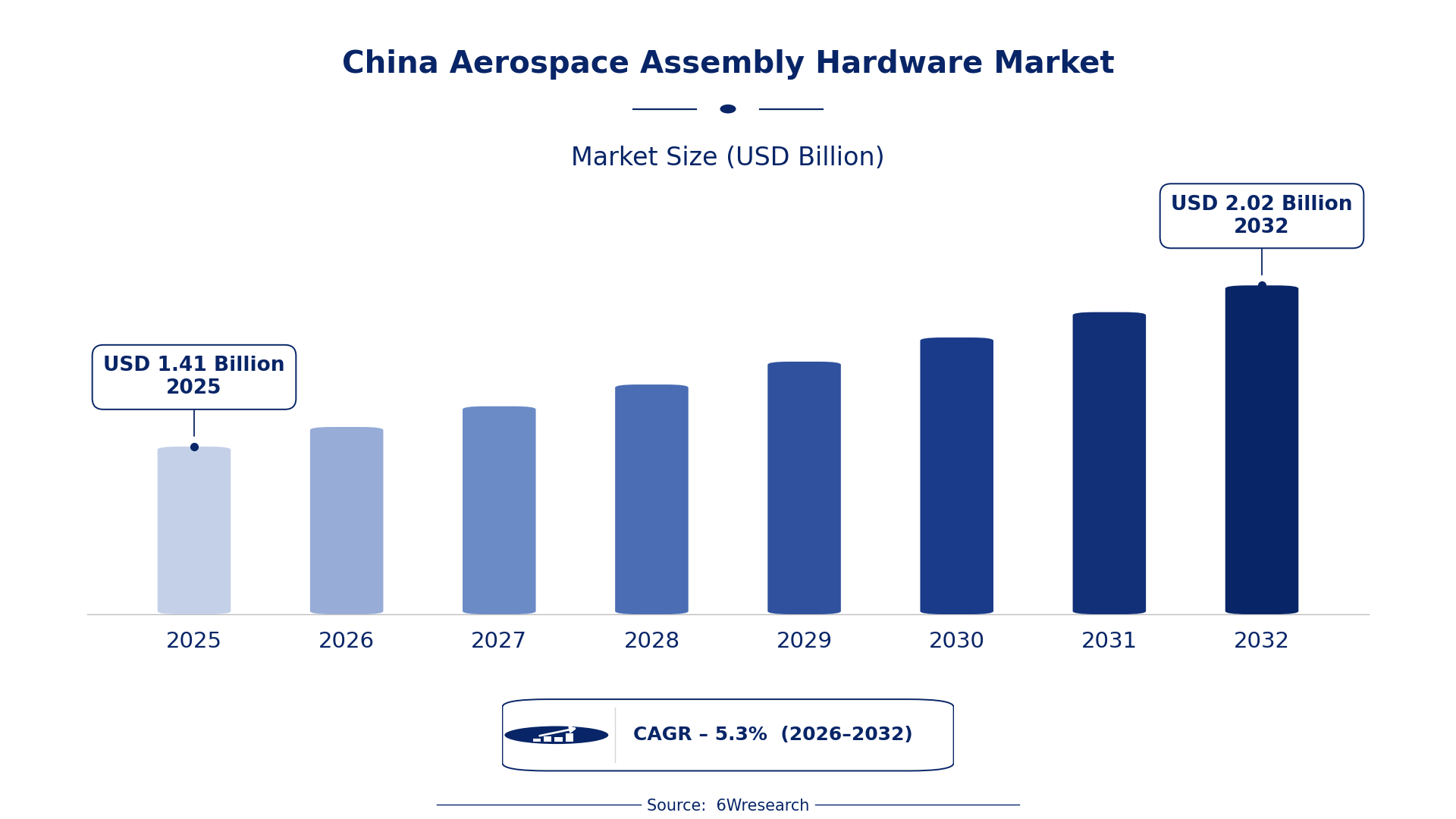
According to 6Wresearch internal database and industry insights, the China Aerospace Assembly Hardware Market was valued at USD 1.41 billion in 2025 and is projected to reach USD 2.02 billion by 2032, growing at a CAGR of approximately 5.3% during 2026–2032.
China Aerospace Assembly Hardware Market Highlights
| Report Metric | Details |
| Report Name | China Aerospace Assembly Hardware Market |
| Market Size 2025 | USD 1.41 billion |
| Market Size 2032 | USD 2.02 billion |
| Absolute Growth 2025–2032 | USD 0.61 billion |
| CAGR 2026–2032 | 5.3% |
| Peak Annual Growth | 7.4% in 2026 |
| Forecast Period | 2026–2032 |
| Historical Data | 2022–2025 |
| Base Year | 2025 |
| Leading Hardware Type, 2025 | Fasteners (47% share) |
| Leading Material Type, 2025 | Aluminum (39% share) |
| Leading Distribution Channel, 2025 | OEMs (50% share) |
| Leading End User, 2025 | Aircraft Assemblers (50% share) |
| Fastest-Growing Hardware Type | Rivets (7.3% CAGR) |
| Fastest-Growing Material Type | Titanium (6.9% CAGR) |
| Fastest-Growing End User | Aerospace Manufacturing Units (6.9% CAGR) |
| Growing Sector | Aerospace Manufacturing Units |
| Key End Users | 3-4 buyer categories, comma separated, no company names (never empty) |
China Aerospace Assembly Hardware Market Year-wise Growth Rate and Key Drivers (2022–2032)
This graph illustrates the annual growth rates of the market from 2022 to 2032, highlighting a steady upward trajectory and projected market expansion over the forecast period.
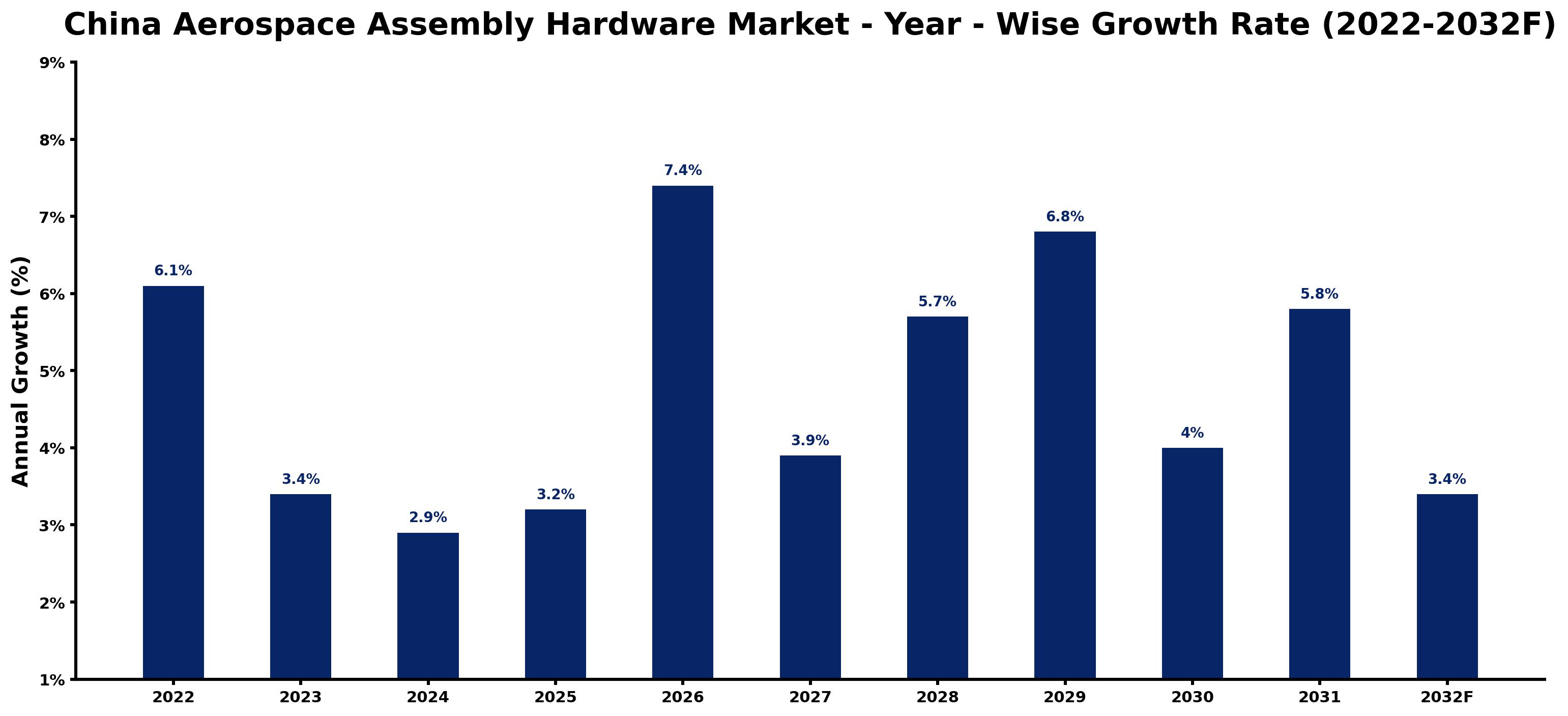
The table below sets out the estimated growth rate for each year and the main factor behind it.
| Year | Estimated Annual Growth (%) | Market Rationale |
| 2022 | 6.1 | Demand surged due to increased aircraft production and a growing domestic aviation market. |
| 2023 | 3.4 | Growth slowed as manufacturers adjusted to supply chain challenges and fluctuating material costs. |
| 2024 | 2.9 | Market expansion continued but at a reduced pace amid ongoing global economic uncertainties. |
| 2025 | 3.2 | Demand rebounded with a rise in aircraft assemblers ramping up production capabilities. |
| 2026 | 7.4 | Growth accelerated as new aerospace standards and innovations drove hardware requirements. |
| 2027 | 3.9 | Market growth slowed as manufacturers faced challenges in sourcing high-quality materials. |
| 2028 | 5.7 | Demand increased with advancements in aerospace technologies and production efficiencies. |
| 2029 | 6.8 | Growth continued as aircraft assemblers expanded operations to meet rising global demand. |
| 2030 | 4.0 | Market growth slowed due to tightening regulations affecting production timelines. |
| 2031 | 5.8 | Demand rose again as the aerospace sector adapted to new market conditions. |
| 2032 | 3.4 | Growth decelerated as the Aerospace Manufacturing Development Plan's effects stabilised after years of rapid expansion. |
Note: Market size estimations and growth projections presented in this report are based on 6Wresearch's proprietary forecasting methodology, utilizing the latest available industry data, government publications, and primary research inputs.
China Aerospace Assembly Hardware Market Synopsis
Aerospace Assembly Hardware Market in China includes components such as fasteners, rivets, and clamps, which are crucial for aircraft assembly and maintenance. These components are produced through precision engineering processes and are important for the expanding domestic aviation sector. The market is growing due to rising aircraft production rates and strong demand from maintenance, repair, and overhaul facilities. With over 300 commercial aircraft produced in 2022, the market is poised for substantial growth, presenting ample opportunities.
Market Dynamics Impact Analysis (2026–2032)
| Factor | Type | Impact | Primary Segment Affected |
| Increasing aircraft production rates | Driver | High | Fasteners |
| Rising demand from MRO facilities | Driver | High | Rivets |
| Growing need for high-strength materials | Opportunity | High | Titanium |
| Expansion of aerospace manufacturing hubs | Opportunity | Medium | Aerospace Manufacturing Units |
| Supply chain disruptions affecting material availability | Restraint | High | Clamps |
| Fluctuating costs of raw materials | Restraint | Medium | Pins & Bushings |
| Regulatory changes impacting production timelines | Challenge | High | Fasteners |
| Challenges in meeting international safety standards | Challenge | Medium | Rivets |
Evaluation of Drivers in China Aerospace Assembly Hardware Market (2026–2032)
The factors lifting demand, and the evidence behind each, are summarised below.
| Drivers | Primary Segment Affected | Why It Matters (Evidence) |
| Surge in aircraft production | Fasteners | Over 300 commercial aircraft were produced in 2022, driving demand for fasteners essential for assembly. |
| Growth in MRO activities | Rivets | The aerospace MRO market is projected to reach $20 billion by 2025, increasing demand for rivets. |
| Focus on lightweight materials | Titanium | Demand for titanium is rising as it is preferred for high-strength applications in evolving aircraft designs. |
| Development of aerospace manufacturing hubs | Aerospace Manufacturing Units | The Beijing-Tianjin-Hebei region is a major hub, enhancing local production capabilities and demand. |
| Regulatory support for innovation | Clamps | The Aerospace Manufacturing Development Plan aims to boost local production capabilities, increasing demand for clamps. |
Market growth in China for Aerospace Assembly Hardware rests on rising aircraft production, increasing MRO activities, and a focus on lightweight materials. In 2022, over 300 commercial aircraft were produced, driving demand for essential fasteners. The emphasis on high-strength materials like titanium is growing as aircraft designs evolve. The Beijing-Tianjin-Hebei region serves as a major manufacturing hub, strengthening local production capabilities and further driving demand for assembly hardware.
Evaluation of Restraints in China Aerospace Assembly Hardware Market
Below mentioned are some major restraints and their influence on market dynamics.
| Market Restraint | Primary Segment Affected | Why It Matters (Evidence) |
| Supply chain disruptions | Clamps | Manufacturers face delays in sourcing materials, impacting production timelines and increasing costs. |
| Fluctuating raw material costs | Pins & Bushings | Rising prices for key materials affect profitability and purchasing decisions for manufacturers. |
| Regulatory changes | Fasteners | New regulations can lead to longer certification processes, delaying product availability. |
| Challenges in meeting safety standards | Rivets | Manufacturers must invest in compliance, which can slow down production and increase costs. |
| Limited access to advanced technologies | Clamps | Some producers struggle with adopting new technologies, impacting their competitiveness in the market. |
China Aerospace Assembly Hardware Market Challenges
Buyers in the China Aerospace Assembly Hardware Market face a critical skills shortage, as the rapid growth of the aerospace sector has outpaced the training of qualified engineers and technicians. This issue exists because educational institutions have not sufficiently adapted their programmes to meet industry demands, resulting in delays that can extend production timelines by several months for manufacturers. Technology adoption remains slow due to the high costs of advanced manufacturing processes, which can increase assembly hardware prices by up to 15% for producers. Regulatory compliance with the CAAC's stringent standards requires constant updates, raising operational costs for suppliers by approximately 10%, which ultimately impacts pricing for buyers.
Trends in the China Aerospace Assembly Hardware Market
Four trends stand out in the China Aerospace Assembly Hardware Market.
- Shift to Advanced Materials in Aerospace: China is increasingly adopting advanced materials like titanium for aerospace assembly hardware, driven by the demand for lightweight and high-strength components. The Aerospace Manufacturing Development Plan aims to enhance local production capabilities, targeting a market size of $1 trillion by 2035.
- Growing Focus on MRO Services: MRO facilities are expanding in China, reflecting a rising need for aircraft maintenance and repair. The aerospace MRO market is projected to reach $20 billion by 2025, highlighting opportunities for hardware suppliers.
- Expansion of Aerospace Manufacturing Hubs: The Beijing-Tianjin-Hebei region is emerging as a key aerospace manufacturing hub, attracting investments and talent. This area is expected to play a significant role in the aerospace sector, with over 1 million people employed in related fields.
- Regulatory Enhancements for Safety: New regulations from the CAAC are streamlining certification processes for aerospace hardware manufacturers, improving safety and reliability. The National Standard GB/T 12345-2020 outlines specifications for aerospace fasteners, enhancing product quality.
Investment Opportunities in the China Aerospace Assembly Hardware Market
Some of the investment opportunities in the China Aerospace Assembly Hardware Market are mentioned below.
- Aircraft Assemblers Seeking High-Strength Components: Aircraft assemblers are increasingly looking for high-strength components like titanium fasteners to improve aircraft performance. The market for titanium is projected to grow as designs evolve.
- Supply Chain Partnerships for MRO Facilities: MRO facilities are in need of reliable suppliers for assembly hardware, presenting opportunities for partnerships. The aerospace MRO market is expected to reach $20 billion by 2025, indicating a growing demand.
- Investment in Aerospace Manufacturing Hubs: Investment in aerospace manufacturing hubs like the Beijing-Tianjin-Hebei region is essential for suppliers. This area is expected to see significant growth, supported by local government initiatives.
- Certification Support for Aerospace Hardware: Manufacturers can benefit from government support in navigating certification processes for aerospace hardware. The CAAC's updated regulations improve safety and reliability, encouraging investment.
Government Initiatives in the China Aerospace Assembly Hardware Market
The 'Aerospace Industry Development Plan' launched in 2021 by the Ministry of Industry and Information Technology aims to increase domestic production by 30% by 2025. This initiative encourages local manufacturers to enhance their capabilities and meet rising demand. Additionally, the 'Aerospace Equipment Manufacturing Support Scheme' approved in 2022 provides subsidies for R&D in assembly hardware, promoting innovation and competitiveness in the sector.
In 2023, the State Administration for Market Regulation updated standards for aerospace components to improve safety and reliability. The National Standard GB/T 12345-2020 outlines specifications for aerospace fasteners, enhancing product quality and compliance for manufacturers.
Future Insight of the China Aerospace Assembly Hardware Market
The China Aerospace Assembly Hardware Market is set to evolve significantly by 2032, driven by key initiatives and developments. The 'Aerospace Manufacturing Development Plan' will strengthen local production capabilities, reducing dependency on foreign imports. The introduction of the National Standard GB/T 12345-2020 will standardise specifications, improving product quality and safety. These changes will create a more streamlined and competitive environment for both buyers and suppliers.
Market Segmentation Analysis
The analysis below covers each segmentation, its leading category in 2025 and its fastest-growing category through 2032.
By Hardware Type – Fasteners Dominated, Rivets Expected to Grow Fastest
According to Ravi Bhandari, Research Head at 6Wresearch, in 2025, Fasteners led the hardware type split with a 47% share. Fasteners command a substantial market share as they are vital for securing components during aircraft assembly processes. With over 300 commercial aircraft produced in 2022, the demand for these components has surged among manufacturers. Rivets are set to record the highest CAGR in this split, 7.3% over 2026–2032. Rivets are experiencing swift growth due to their critical role in joining materials in airframes, particularly as automation in production increases. The Aerospace Manufacturing Development Plan is set to further boost rivet demand by enhancing production capabilities. Suppliers should prioritise the development of fastener and rivet solutions to align with the escalating production needs of aircraft manufacturers.
By Material Type – Aluminum Dominated, Titanium Expected to Grow Fastest
The largest material type category in 2025 was Aluminum, with a 39% share of total revenue. Aluminum holds the largest market share owing to its lightweight characteristics and extensive application in aircraft structures, making it a preferred material among manufacturers. The rapid expansion of the aerospace sector in China has solidified aluminum's importance in the industry. Titanium is projected to grow fastest, at a CAGR of 6.9% during 2026–2032. Titanium is witnessing the fastest growth due to its exceptional strength-to-weight ratio, making it ideal for critical aerospace applications. As aircraft production rates rise, the demand for titanium components is anticipated to increase significantly. Buyers should consider sourcing more titanium components to enhance the performance and safety of their aerospace products.
By Distribution Channel – OEMs Dominated and Is Expected to Record the Fastest Growth
OEMs held a 50% share of the China Aerospace Assembly Hardware Market by distribution channel in 2025. OEMs lead the market share as they are the primary buyers of aerospace assembly hardware, requiring these components for aircraft production. Their established relationships with manufacturers ensure a steady demand for hardware. Its lead should widen, with a projected CAGR of 6.9% during 2026–2032, the highest in this split. OEMs are also the fastest-growing distribution channel due to the increasing number of aircraft being assembled. As production ramps up, OEMs will continue to expand their procurement of assembly hardware. Suppliers should strengthen partnerships with OEMs to secure long-term contracts and ensure consistent sales.
By End User – Aircraft Assemblers Dominated, Aerospace Manufacturing Units Expected to Grow Fastest
With a 50% revenue share in 2025, Aircraft Assemblers was the largest end user category. Aircraft Assemblers lead the market share as they are the primary users of aerospace assembly hardware in the manufacturing process. The significant growth in aircraft production directly drives their demand for various components. The quickest growth will come from Aerospace Manufacturing Units, forecast to expand at a CAGR of 6.9% between 2026 and 2032. Aerospace Manufacturing Units are rapidly expanding as they produce a wide range of components essential for aircraft assembly. The increasing complexity of aircraft designs necessitates a higher volume of parts from these units. Suppliers must customise their offerings to cater to the specific requirements of both aircraft assemblers and aerospace manufacturing units.
Key Attractiveness of the Report
- 10 Years of Market Numbers
- Historical Data Starting from 2022 to 2025
- Base Year 2025
- Forecast Data until 2032
- Key Performance Indicators Impacting the Market
- Major Upcoming Developments and Projects
Key Highlights of the Report:
- China Aerospace Assembly Hardware Market Outlook
- Market Size of China Aerospace Assembly Hardware Market, 2025
- Forecast of China Aerospace Assembly Hardware Market, 2032
- Historical Data and Forecast of China Aerospace Assembly Hardware Revenues & Volume for the Period 2022 - 2032F
- China Aerospace Assembly Hardware Market Trend Evolution
- China Aerospace Assembly Hardware Market Drivers and Challenges
- China Aerospace Assembly Hardware Price Trends
- China Aerospace Assembly Hardware Porter's Five Forces
- China Aerospace Assembly Hardware Industry Life Cycle
- Historical Data and Forecast of China Aerospace Assembly Hardware Market Revenues & Volume By Hardware Type for the Period 2022 - 2032F
- Historical Data and Forecast of China Aerospace Assembly Hardware Market Revenues & Volume By Fasteners for the Period 2022 - 2032F
- Historical Data and Forecast of China Aerospace Assembly Hardware Market Revenues & Volume By Rivets for the Period 2022 - 2032F
- Historical Data and Forecast of China Aerospace Assembly Hardware Market Revenues & Volume By Clamps for the Period 2022 - 2032F
- Historical Data and Forecast of China Aerospace Assembly Hardware Market Revenues & Volume By Pins & Bushings for the Period 2022 - 2032F
- Historical Data and Forecast of China Aerospace Assembly Hardware Market Revenues & Volume By Material Type for the Period 2022 - 2032F
- Historical Data and Forecast of China Aerospace Assembly Hardware Market Revenues & Volume By Stainless Steel for the Period 2022 - 2032F
- Historical Data and Forecast of China Aerospace Assembly Hardware Market Revenues & Volume By Aluminum for the Period 2022 - 2032F
- Historical Data and Forecast of China Aerospace Assembly Hardware Market Revenues & Volume By Titanium for the Period 2022 - 2032F
- Historical Data and Forecast of China Aerospace Assembly Hardware Market Revenues & Volume By Alloy Steel for the Period 2022 - 2032F
- Historical Data and Forecast of China Aerospace Assembly Hardware Market Revenues & Volume By Distribution Channel for the Period 2022 - 2032F
- Historical Data and Forecast of China Aerospace Assembly Hardware Market Revenues & Volume By Industrial Suppliers for the Period 2022 - 2032F
- Historical Data and Forecast of China Aerospace Assembly Hardware Market Revenues & Volume By Direct Sales for the Period 2022 - 2032F
- Historical Data and Forecast of China Aerospace Assembly Hardware Market Revenues & Volume By OEMs for the Period 2022 - 2032F
- Historical Data and Forecast of China Aerospace Assembly Hardware Market Revenues & Volume By Online Platforms for the Period 2022 - 2032F
- Historical Data and Forecast of China Aerospace Assembly Hardware Market Revenues & Volume By End User for the Period 2022 - 2032F
- Historical Data and Forecast of China Aerospace Assembly Hardware Market Revenues & Volume By MRO Facilities for the Period 2022 - 2032F
- Historical Data and Forecast of China Aerospace Assembly Hardware Market Revenues & Volume By Aircraft Assemblers for the Period 2022 - 2032F
- Historical Data and Forecast of China Aerospace Assembly Hardware Market Revenues & Volume By Aerospace Manufacturing Units for the Period 2022 - 2032F
- Historical Data and Forecast of China Aerospace Assembly Hardware Market Revenues & Volume By Engine Manufacturers for the Period 2022 - 2032F
- China Aerospace Assembly Hardware Import Export Trade Statistics
- Market Opportunity Assessment By Hardware Type
- Market Opportunity Assessment By Material Type
- Market Opportunity Assessment By Distribution Channel
- Market Opportunity Assessment By End User
- China Aerospace Assembly Hardware Top Companies Market Share
- China Aerospace Assembly Hardware Competitive Benchmarking By Technical and Operational Parameters
- China Aerospace Assembly Hardware Company Profiles
- China Aerospace Assembly Hardware Key Strategic Recommendations
Market Covered
The report offers an extensive study of the following market segments.
By Hardware Type
- Fasteners
- Rivets
- Clamps
- Pins & Bushings
By Material Type
- Stainless Steel
- Aluminum
- Titanium
- Alloy Steel
By Distribution Channel
- Industrial Suppliers
- Direct Sales
- OEMs
- Online Platforms
By End User
- MRO Facilities
- Aircraft Assemblers
- Aerospace Manufacturing Units
- Engine Manufacturers































