China Aerospace Cybersecurity Market Size & Growth Rate
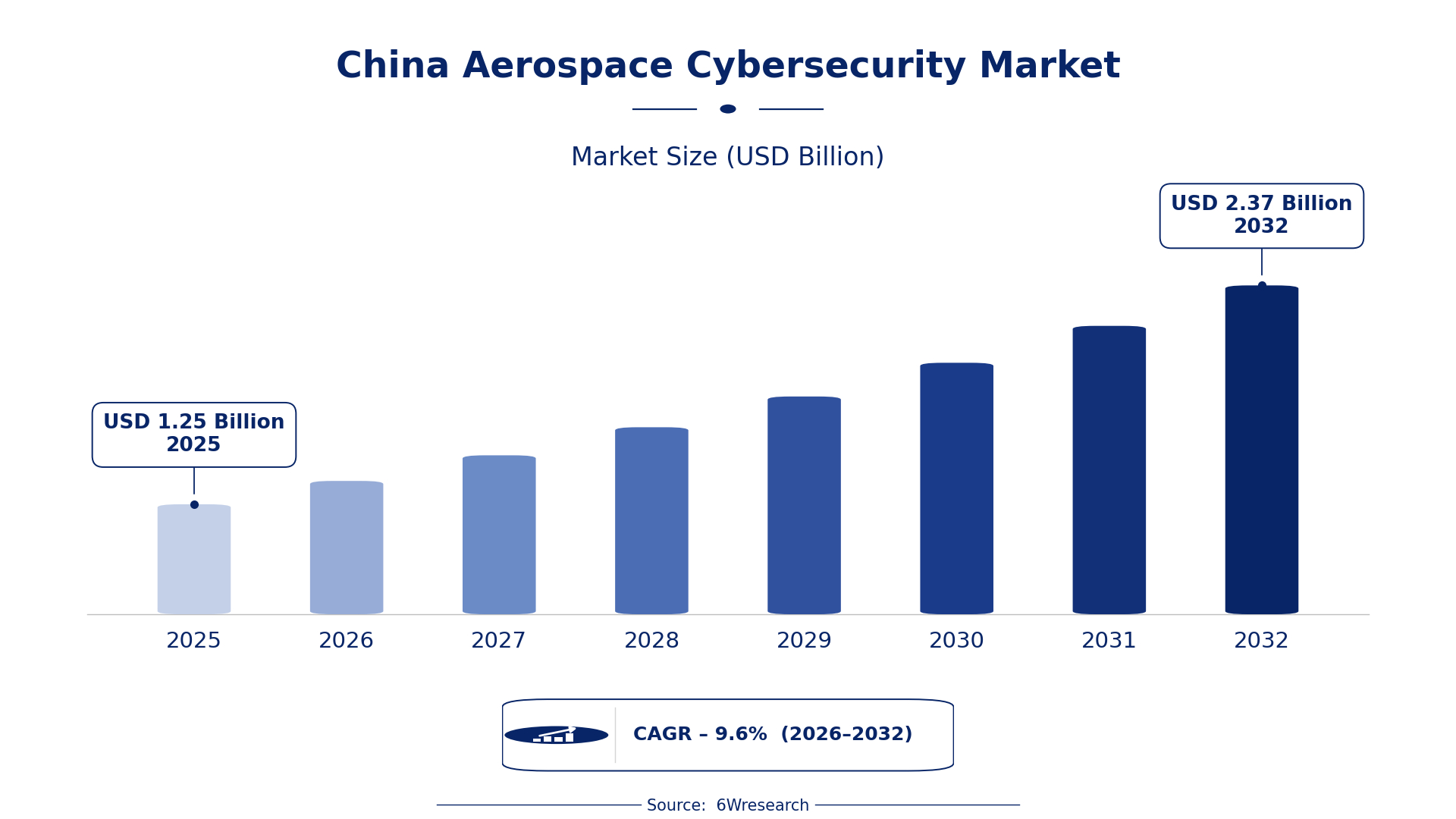
According to 6Wresearch internal database and industry insights, the China Aerospace Cybersecurity Market was valued at USD 1.25 billion in 2025 and is projected to reach USD 2.37 billion by 2032, growing at a CAGR of approximately 9.6% during 2026–2032.
China Aerospace Cybersecurity Market Highlights
| Report Metric | Details |
| Report Name | China Aerospace Cybersecurity Market |
| Market Size 2025 | USD 1.25 billion |
| Market Size 2032 | USD 2.37 billion |
| Absolute Growth 2025–2032 | USD 1.12 billion |
| CAGR 2026–2032 | 9.6% |
| Peak Annual Growth | 11.4% in 2030 |
| Forecast Period | 2026–2032 |
| Historical Data | 2022–2025 |
| Base Year | 2025 |
| Leading Security Type, 2025 | Embedded System Security (39% share) |
| Leading Threat Type, 2025 | Malware/Ransomware (43% share) |
| Leading Solution Deployment, 2025 | Cloud-Based (44% share) |
| Leading Distribution Channel, 2025 | Government Contracts (38% share) |
| Leading End User, 2025 | Military Aerospace Units (49% share) |
| Fastest-Growing Security Type | AI-Powered Security Tools (12.2% CAGR) |
| Fastest-Growing Threat Type | Anomaly Detection (10.8% CAGR) |
| Fastest-Growing Distribution Channel | Direct Sales (11.2% CAGR) |
| Fastest-Growing End User | Space Operations Agencies (10.9% CAGR) |
| Growing Sector | Military Aerospace |
| Key End Users | Military Aerospace Units, Space Operations Agencies, Satellite Control Centers, Aircraft OEMs |
China Aerospace Cybersecurity Market Year-wise Growth Rate and Key Drivers (2022–2032)
This graph illustrates the annual growth rates of the market from 2022 to 2032, highlighting a steady upward trajectory and projected market expansion over the forecast period.
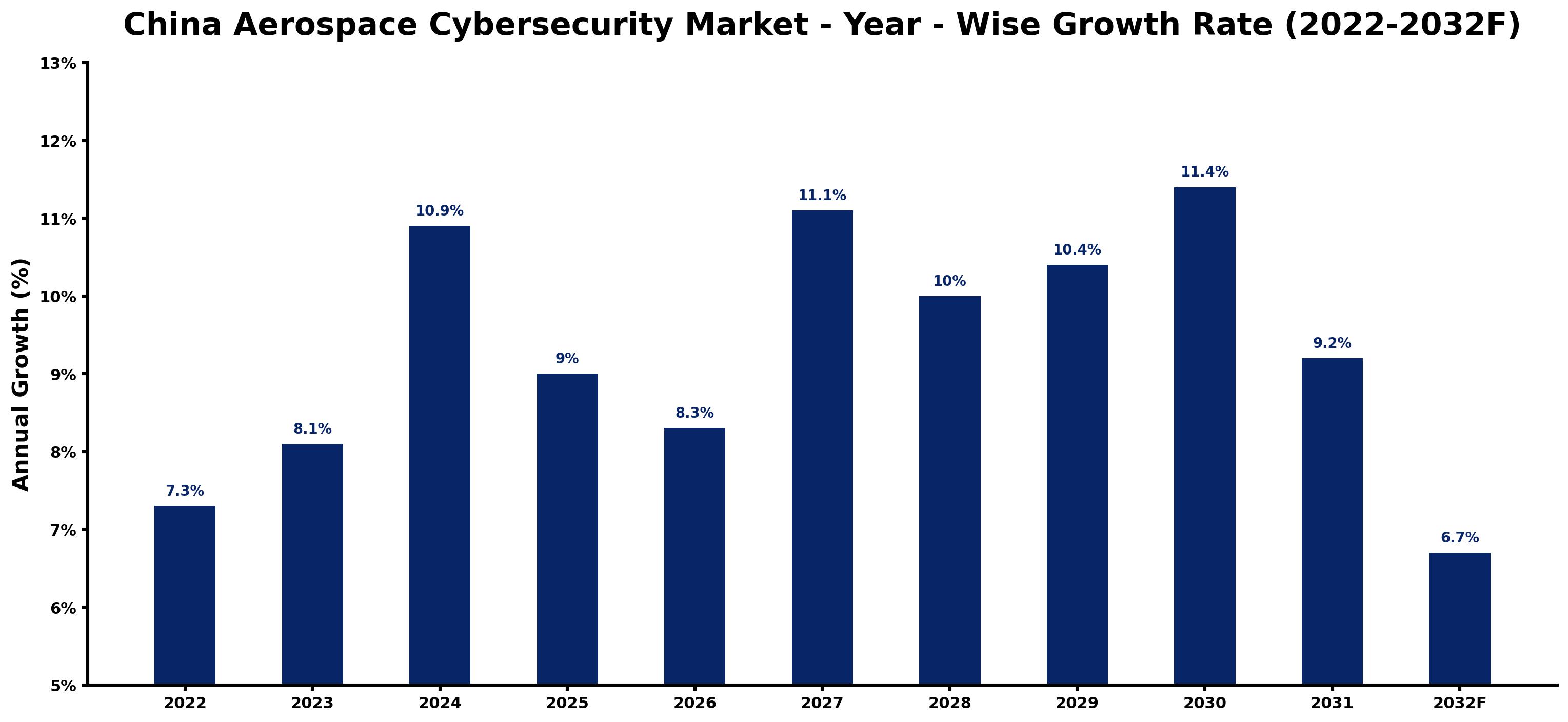
Year by year, the estimates below pair each growth rate with the development that shaped it.
| Year | Estimated Annual Growth (%) | Market Rationale |
| 2022 | 7.3 | The market experienced steady demand as investments in aerospace cybersecurity increased. |
| 2023 | 8.1 | Growth accelerated due to the launch of the National Aerospace Cybersecurity Strategy. |
| 2024 | 10.9 | The market saw a peak in growth driven by rising threats and security needs. |
| 2025 | 9.0 | A slight slowdown occurred as the market adjusted to new regulations and standards. |
| 2026 | 8.3 | Growth continued to slow as companies adapted to evolving cybersecurity protocols. |
| 2027 | 11.1 | Demand surged again as military aerospace units enhanced their cybersecurity measures. |
| 2028 | 10.0 | A slowdown in growth was noted as the market stabilised after rapid expansion. |
| 2029 | 10.4 | Growth picked up pace as more organisations adopted AI-powered security tools. |
| 2030 | 11.4 | The market peaked with significant investments in satellite cybersecurity capabilities. |
| 2031 | 9.2 | A slowdown occurred as the market began to mature and face increasing competition. |
| 2032 | 6.7 | Growth continued to decelerate as the market reached a more stable phase. |
Note: Market size estimations and growth projections presented in this report are based on 6Wresearch's proprietary forecasting methodology, utilizing the latest available industry data, government publications, and primary research inputs.
China Aerospace Cybersecurity Market Synopsis
Aerospace Cybersecurity in China involves protecting aircraft and space systems from cyber threats through various technologies. Factors such as the National Aerospace Cybersecurity Strategy and rising threats in military aerospace operations are propelling growth. The need for secure satellite communications and ground control systems further fuels demand for robust cybersecurity solutions. As the aerospace industry expands, the focus on cybersecurity becomes increasingly critical.
Market Dynamics Impact Analysis (2026–2032)
| Factor | Type | Impact | Primary Segment Affected |
| Increasing investments in AI-powered security tools enhance threat detection capabilities. | Driver | High | AI-Powered Security Tools |
| The launch of the National Aerospace Cybersecurity Strategy boosts national security initiatives. | Driver | High | Embedded System Security |
| Growing demand for cybersecurity solutions in military aerospace units creates new market opportunities. | Opportunity | High | Military Aerospace Units |
| The rising number of operational satellites necessitates enhanced cybersecurity measures. | Opportunity | High | Satellite Cybersecurity |
| Compliance with stringent regulations increases operational costs for producers. | Restraint | Medium | Ground Station Security |
| Limited awareness among smaller aerospace firms hinders market expansion. | Restraint | Medium | AI-Powered Security Tools |
| Buyers face challenges in integrating new technologies into existing systems. | Challenge | High | Embedded System Security |
| Suppliers struggle with the high costs associated with developing advanced cybersecurity solutions. | Challenge | High | Satellite Cybersecurity |
Evaluation of Drivers in China Aerospace Cybersecurity Market (2026–2032)
The table below links each growth driver to the segment it affects and the evidence for it.
| Drivers | Primary Segment Affected | Why It Matters (Evidence) |
| Rising investments in AI technologies improve threat detection and response. | AI-Powered Security Tools | The Ministry of Defense's initiative integrates AI into military aerospace cybersecurity measures. |
| The National Aerospace Cybersecurity Strategy strengthens national security protocols. | Embedded System Security | This strategy supports the development of cybersecurity frameworks across aerospace systems. |
| Increasing military budgets lead to higher spending on cybersecurity solutions. | Military Aerospace Units | The Ministry of Defense allocated funds to improve cybersecurity in military operations. |
| The growing number of satellites increases demand for cybersecurity measures. | Satellite Cybersecurity | China has over 100 operational satellites requiring protection against cyber threats. |
| Government contracts remain a significant source of revenue for cybersecurity firms. | Government Contracts | Government projects in aerospace cybersecurity continue to expand, driving demand for solutions. |
Market growth in China for Aerospace Cybersecurity rests on rising investments in AI technologies, increasing military budgets, and the launch of the National Aerospace Cybersecurity Strategy. The integration of AI into military aerospace cybersecurity measures improves threat detection capabilities. With over 100 operational satellites, the demand for satellite cybersecurity solutions is critical. The aerospace industry is projected to reach a market size of $1 trillion by 2040, further fuelling the need for effective cybersecurity solutions.
Evaluation of Restraints in China Aerospace Cybersecurity Market
The main factors holding the market back are set out below.
| Market Restraint | Primary Segment Affected | Why It Matters (Evidence) |
| Compliance with stringent regulations increases operational costs for producers. | Ground Station Security | The Cybersecurity Law mandates strict compliance, raising costs for companies in this sector. |
| Limited awareness among smaller aerospace firms hinders market expansion. | AI-Powered Security Tools | Many smaller firms lack the resources to invest in necessary cybersecurity measures. |
| Integration challenges with existing systems can delay implementation of new solutions. | Embedded System Security | Buyers face difficulties in adapting new technologies to legacy systems. |
| High development costs for advanced cybersecurity solutions limit market entry. | Satellite Cybersecurity | Suppliers must invest heavily in R&D to meet evolving cybersecurity demands. |
| Market maturity leads to increased competition among suppliers. | Government Contracts | As more firms enter the market, profit margins for existing players may decrease. |
China Aerospace Cybersecurity Market Challenges
Buyers and suppliers in China's aerospace cybersecurity sector face considerable supply chain disruptions, particularly due to dependence on a limited number of local manufacturers for essential cybersecurity technologies. This reliance can result in project delays, as demonstrated by the recent launch of the National Aerospace Cybersecurity Strategy, which requires prompt implementation. A shortage of skilled professionals worsens these challenges; despite a $500 million government budget for 2023, training programs will take years to produce qualified experts. Many companies also struggle to incorporate advanced security technologies, leaving satellite operations exposed to cyber threats, which can jeopardise mission success for military and commercial buyers.
Trends in the China Aerospace Cybersecurity Market
Buyers and suppliers in the China Aerospace Cybersecurity Market are adjusting to the following trends.
- Growing Focus on Satellite Cybersecurity: Space Operations Agencies are prioritising satellite cybersecurity to protect over 100 operational satellites. The National Space Administration's 2020 program promotes collaboration, strengthening cybersecurity capabilities in this critical area.
- Increased Investment in Embedded System Security: Aerospace manufacturers are investing more in embedded system security to safeguard aircraft operations. The sector is projected to capture 39% of the market share by 2025, reflecting its importance.
- Shift towards AI-Powered Security Tools: Military Aerospace Units are increasingly adopting AI-powered security tools for improved threat detection. In 2023, this segment saw a growth rate of 12.2%, reflecting the demand for advanced cybersecurity solutions.
- Expansion of Government Contracts in Cybersecurity: The Beijing-Tianjin-Hebei region is witnessing a surge in government contracts for cybersecurity solutions. In 2023, government allocations reached $500 million, indicating a strong commitment to enhancing national security.
Investment Opportunities in the China Aerospace Cybersecurity Market
Some of the investment opportunities in the China Aerospace Cybersecurity Market are mentioned below.
- Joint Ventures for Cybersecurity Solutions: Partnerships between local firms and international partners can strengthen cybersecurity capabilities. Government contracts in the Beijing-Tianjin-Hebei region offer entry points for collaboration and innovation.
- Growing Demand from Military Aerospace Units: Military Aerospace Units are increasingly seeking advanced cybersecurity solutions. The Ministry of Defense's 2022 initiative highlights the need for investment in AI technologies, creating opportunities for suppliers.
- Investment in Cloud-Based Solutions: The growing trend towards cloud-based cybersecurity solutions presents opportunities. As this segment is expected to grow, suppliers can target government contracts to enter the market.
- Enhancing Ground Station Security: The demand for ground station security is rising due to regulatory pressures. With a budget of $500 million allocated for cybersecurity initiatives, suppliers can invest in compliance solutions.
Government Initiatives in the China Aerospace Cybersecurity Market
The National Aerospace Cybersecurity Strategy was launched by the Ministry of Industry and Information Technology in 2023, aiming to enhance national security in aerospace systems. This measure adds to the existing Cybersecurity Law of 2017, which mandates stringent security measures for critical industries. Together, these laws ensure that producers and buyers comply with international standards, fostering a secure aerospace environment. The strategy also encourages investment in advanced cybersecurity technologies, promoting innovation in the sector.
The Ministry of Defense's 2022 initiative focuses on integrating AI technologies into cybersecurity measures for military aerospace units. This initiative supports funding for research and development, improving threat detection capabilities. The National Space Administration also oversees cybersecurity protocols for satellite operations, ensuring compliance with established standards. Through these efforts, agencies are working to improve collaboration between public and private sectors, enhancing overall cybersecurity resilience in aerospace.
Future Insight of the China Aerospace Cybersecurity Market
China's aerospace cybersecurity landscape is set for transformation by 2032, driven by the rollout of advanced embedded security systems and the widespread adoption of the ISO/IEC 27001 standard for information security management. Government funding for cybersecurity initiatives will enhance the integrity of military and satellite operations, fostering a more secure environment. By 2040, the aerospace industry is projected to reach a market size of $1 trillion, creating new avenues for suppliers to innovate their offerings. Collaboration between public space agencies and private sector firms will strengthen cybersecurity measures across the board.
Market Segmentation Analysis
The report offers a comprehensive study of the following market segments and their leading categories in the market.
By Security Type – Embedded System Security Dominated, AI-Powered Security Tools Expected to Grow Fastest
According to Ravi Bhandari, Research Head at 6Wresearch, Embedded System Security held a 39% share of the China Aerospace Cybersecurity Market by security type in 2025. Embedded System Security holds the largest share as it is vital for safeguarding aircraft systems against cyber threats. With the increasing number of operational aircraft in China, the demand for these protective measures is paramount. AI-Powered Security Tools are set to record the highest CAGR in this split, 12.2% over 2026–2032. AI-Powered Security Tools are rapidly gaining traction due to their effectiveness in enhancing threat detection capabilities. The integration of these tools within satellite control centres has become a significant factor driving this segment's growth. This indicates that suppliers should enhance their embedded security offerings to align with the growing needs of the aerospace cybersecurity market.
By Threat Type – Malware/Ransomware Dominated, Anomaly Detection Expected to Grow Fastest
Malware/Ransomware accounted for a 43% market share by threat type in 2025. Malware/Ransomware accounts for the largest share as it represents a major threat that necessitates comprehensive cybersecurity measures in aerospace. The rising incidence of cyberattacks targeting aerospace systems has intensified the focus on addressing these threats. The quickest growth will come from Anomaly Detection, forecast to expand at a CAGR of 10.8% between 2026 and 2032. Anomaly Detection is experiencing rapid growth because it plays a crucial role in identifying potential security breaches early. The increasing emphasis on proactive security measures in aerospace operations is accelerating the adoption of these technologies. This suggests that buyers should prioritise solutions that incorporate advanced anomaly detection capabilities for effective protection.
By Solution Deployment – Cloud-Based Dominated and Is Expected to Record the Fastest Growth
The largest solution deployment category in 2025 was Cloud-Based, with a 44% share of total revenue. Cloud-Based solutions dominate the market share as they offer scalable cybersecurity options that adapt to the aerospace industry's evolving needs. The growing reliance on cloud technology for data management and security is driving this trend. The same category is also set to grow fastest, at a CAGR of 10.9% during 2026–2032. Cloud-Based solutions are also the fastest growing segment, reflecting a strong market shift towards flexible cybersecurity frameworks. The demand for efficient cloud solutions in managing cybersecurity has surged as organisations seek to bolster their operational resilience. This means suppliers must prioritise cloud-based offerings to remain competitive in the rapidly changing aerospace cybersecurity landscape.
By Distribution Channel – Government Contracts Dominated, Direct Sales Expected to Grow Fastest
Government Contracts took a 38% share of distribution channel in 2025, more than any other category. Government Contracts represent the largest share, serving as a significant revenue source from public sector projects focused on aerospace cybersecurity. The government's substantial investment in cybersecurity initiatives has reinforced the importance of this channel. Direct Sales is projected to grow fastest, at a CAGR of 11.2% during 2026–2032. Direct Sales are experiencing swift growth as they function as the primary channel for selling cybersecurity solutions directly to clients. The increasing focus on tailored solutions for aerospace operations has contributed to the rise of direct sales. This suggests that suppliers should strengthen their direct sales strategies to capture a larger share of the aerospace cybersecurity market.
By End User – Military Aerospace Units Dominated, Space Operations Agencies Expected to Grow Fastest
With a 49% revenue share in 2025, Military Aerospace Units was the largest end user category. Military Aerospace Units hold the largest share, as they are the primary users requiring stringent security standards for their operations. Continuous investments in military capabilities and cybersecurity measures have propelled this segment's dominance. Space Operations Agencies are set to record the highest CAGR in this split, 10.9% over 2026–2032. Space Operations Agencies are the fastest growing segment due to their critical focus on securing space missions against emerging threats. The rapid expansion of space exploration initiatives has heightened the need for robust cybersecurity solutions in this sector. This indicates that suppliers should tailor their offerings to meet the specific needs of space operations agencies to capitalise on this growth opportunity.
Key Attractiveness of the Report
- 10 Years of Market Numbers
- Historical Data Starting from 2022 to 2025
- Base Year 2025
- Forecast Data until 2032
- Key Performance Indicators Impacting the Market
- Major Upcoming Developments and Projects
Key Highlights of the Report:
- China Aerospace Cybersecurity Market Outlook
- Market Size of China Aerospace Cybersecurity Market, 2025
- Forecast of China Aerospace Cybersecurity Market, 2032
- Historical Data and Forecast of China Aerospace Cybersecurity Revenues & Volume for the Period 2022 - 2032F
- China Aerospace Cybersecurity Market Trend Evolution
- China Aerospace Cybersecurity Market Drivers and Challenges
- China Aerospace Cybersecurity Price Trends
- China Aerospace Cybersecurity Porter's Five Forces
- China Aerospace Cybersecurity Industry Life Cycle
- Historical Data and Forecast of China Aerospace Cybersecurity Market Revenues & Volume By Security Type for the Period 2022 - 2032F
- Historical Data and Forecast of China Aerospace Cybersecurity Market Revenues & Volume By Embedded System Security for the Period 2022 - 2032F
- Historical Data and Forecast of China Aerospace Cybersecurity Market Revenues & Volume By Satellite Cybersecurity for the Period 2022 - 2032F
- Historical Data and Forecast of China Aerospace Cybersecurity Market Revenues & Volume By Ground Station Security for the Period 2022 - 2032F
- Historical Data and Forecast of China Aerospace Cybersecurity Market Revenues & Volume By AI-Powered Security Tools for the Period 2022 - 2032F
- Historical Data and Forecast of China Aerospace Cybersecurity Market Revenues & Volume By Threat Type for the Period 2022 - 2032F
- Historical Data and Forecast of China Aerospace Cybersecurity Market Revenues & Volume By Malware/Ransomware for the Period 2022 - 2032F
- Historical Data and Forecast of China Aerospace Cybersecurity Market Revenues & Volume By Hacking/Interference for the Period 2022 - 2032F
- Historical Data and Forecast of China Aerospace Cybersecurity Market Revenues & Volume By Unauthorized Access for the Period 2022 - 2032F
- Historical Data and Forecast of China Aerospace Cybersecurity Market Revenues & Volume By Anomaly Detection for the Period 2022 - 2032F
- Historical Data and Forecast of China Aerospace Cybersecurity Market Revenues & Volume By Solution Deployment for the Period 2022 - 2032F
- Historical Data and Forecast of China Aerospace Cybersecurity Market Revenues & Volume By On-Device for the Period 2022 - 2032F
- Historical Data and Forecast of China Aerospace Cybersecurity Market Revenues & Volume By Cloud-Based for the Period 2022 - 2032F
- Historical Data and Forecast of China Aerospace Cybersecurity Market Revenues & Volume By Hybrid Model for the Period 2022 - 2032F
- Historical Data and Forecast of China Aerospace Cybersecurity Market Revenues & Volume By Network-Level for the Period 2022 - 2032F
- Historical Data and Forecast of China Aerospace Cybersecurity Market Revenues & Volume By Distribution Channel for the Period 2022 - 2032F
- Historical Data and Forecast of China Aerospace Cybersecurity Market Revenues & Volume By Direct Sales for the Period 2022 - 2032F
- Historical Data and Forecast of China Aerospace Cybersecurity Market Revenues & Volume By Government Contracts for the Period 2022 - 2032F
- Historical Data and Forecast of China Aerospace Cybersecurity Market Revenues & Volume By OEMs for the Period 2022 - 2032F
- Historical Data and Forecast of China Aerospace Cybersecurity Market Revenues & Volume By Online Platforms for the Period 2022 - 2032F
- Historical Data and Forecast of China Aerospace Cybersecurity Market Revenues & Volume By End User for the Period 2022 - 2032F
- Historical Data and Forecast of China Aerospace Cybersecurity Market Revenues & Volume By Aircraft OEMs for the Period 2022 - 2032F
- Historical Data and Forecast of China Aerospace Cybersecurity Market Revenues & Volume By Space Operations Agencies for the Period 2022 - 2032F
- Historical Data and Forecast of China Aerospace Cybersecurity Market Revenues & Volume By Satellite Control Centers for the Period 2022 - 2032F
- Historical Data and Forecast of China Aerospace Cybersecurity Market Revenues & Volume By Military Aerospace Units for the Period 2022 - 2032F
- China Aerospace Cybersecurity Import Export Trade Statistics
- Market Opportunity Assessment By Security Type
- Market Opportunity Assessment By Threat Type
- Market Opportunity Assessment By Solution Deployment
- Market Opportunity Assessment By Distribution Channel
- Market Opportunity Assessment By End User
- China Aerospace Cybersecurity Top Companies Market Share
- China Aerospace Cybersecurity Competitive Benchmarking By Technical and Operational Parameters
- China Aerospace Cybersecurity Company Profiles
- China Aerospace Cybersecurity Key Strategic Recommendations
Market Covered
The report offers an extensive study of the following market segments.
By Security Type
- Embedded System Security
- Satellite Cybersecurity
- Ground Station Security
- AI-Powered Security Tools
By Threat Type
- Malware/Ransomware
- Hacking/Interference
- Unauthorized Access
- Anomaly Detection
By Solution Deployment
- On-Device
- Cloud-Based
- Hybrid Model
- Network-Level
By Distribution Channel
- Direct Sales
- Government Contracts
- OEMs
- Online Platforms
By End User
- Aircraft OEMs
- Space Operations Agencies
- Satellite Control Centers
- Military Aerospace Units































