China Aerospace & Defense Components Market Size & Growth Rate
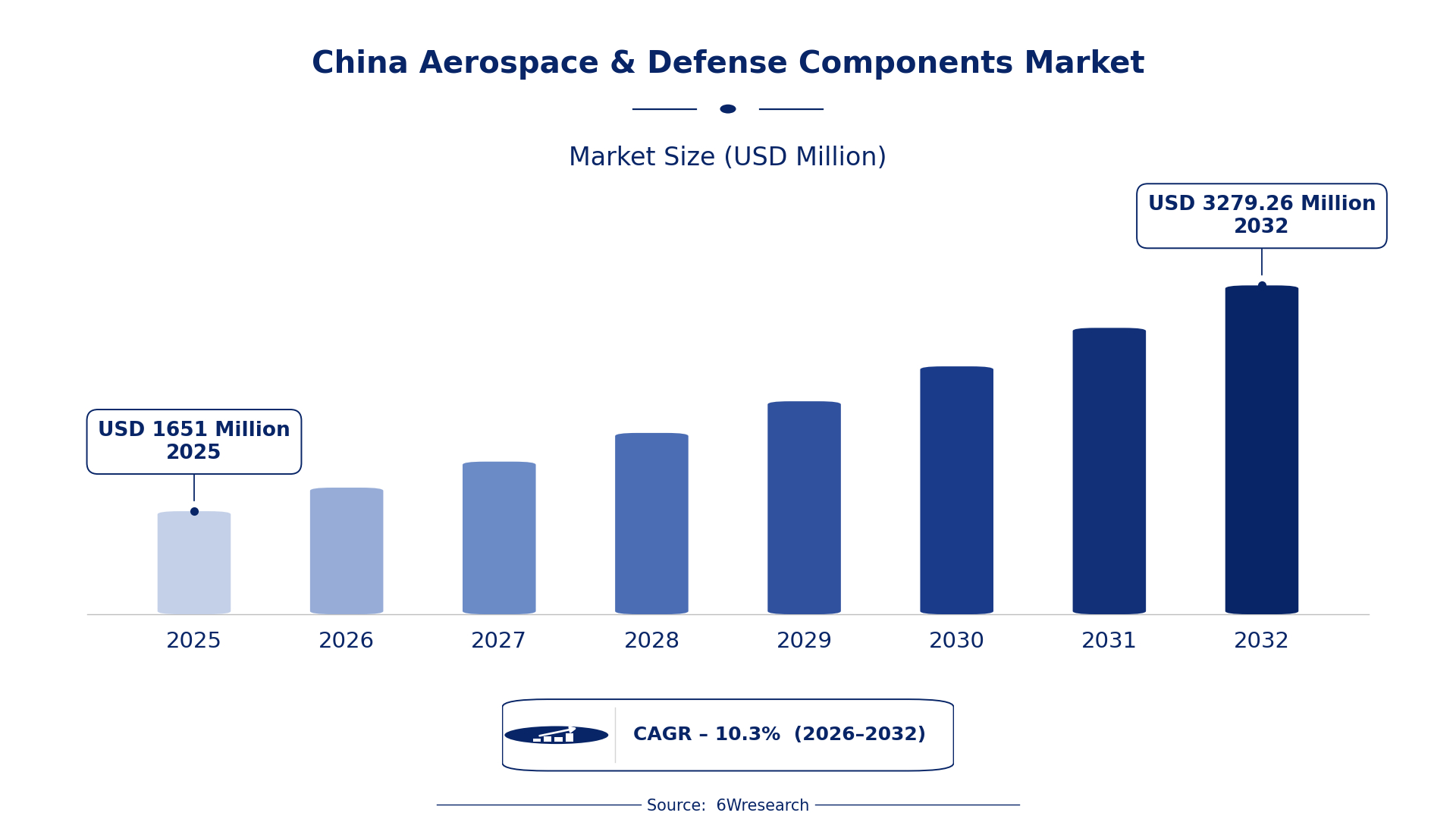
According to 6Wresearch internal database and industry insights, the China Aerospace & Defense Components Market was valued at USD 1,651 million in 2025 and is projected to reach USD 3,279.26 million by 2032, growing at a CAGR of approximately 10.3% during 2026–2032.
China Aerospace & Defense Components Market Highlights
| Report Metric | Details |
| Report Name | China Aerospace & Defense Components Market |
| Market Size 2025 | USD 1,651 million |
| Market Size 2032 | USD 3,279.26 million |
| Absolute Growth 2025–2032 | USD 1,628.26 million |
| CAGR 2026–2032 | 10.3% |
| Peak Annual Growth | 12.6% in 2026 |
| Forecast Period | 2026–2032 |
| Historical Data | 2022–2025 |
| Base Year | 2025 |
| Leading Component Type, 2025 | Structural Components (46% share) |
| Leading Material Type, 2025 | Titanium Alloys (45% share) |
| Leading Distribution Channel, 2025 | Government Contracts (40% share) |
| Leading End User, 2025 | Aircraft Manufacturers (43% share) |
| Fastest-Growing Component Type | Avionics (12.7% CAGR) |
| Fastest-Growing Material Type | Composites (12.8% CAGR) |
| Fastest-Growing Distribution Channel | OEMs (11.8% CAGR) |
| Fastest-Growing End User | Defense Equipment Vendors (13.1% CAGR) |
| Growing Sector | Military Aviation |
| Key End Users | Aircraft Manufacturers, Defense Equipment Vendors, Military Aviation Units, Commercial Airlines |
China Aerospace & Defense Components Market Year-wise Growth Rate and Key Drivers (2022–2032)
This graph illustrates the annual growth rates of the market from 2022 to 2032, highlighting a steady upward trajectory and projected market expansion over the forecast period.
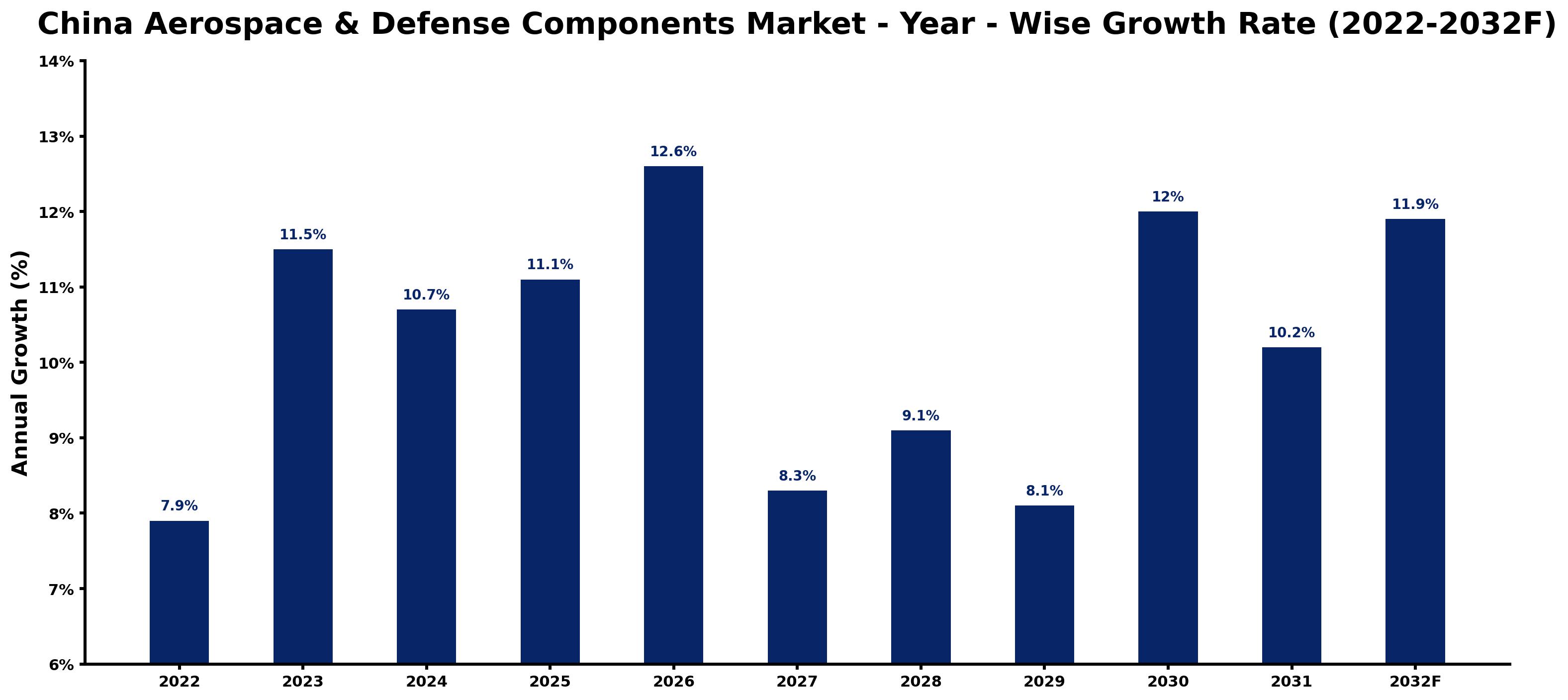
The table below sets out the estimated growth rate for each year and the main factor behind it.
| Year | Estimated Annual Growth (%) | Market Rationale |
| 2022 | 7.9 | The market showed steady demand from domestic manufacturers and government contracts. |
| 2023 | 11.5 | Increased military budget allocations boosted demand for aerospace components. |
| 2024 | 10.7 | Growth slowed as some manufacturers faced supply chain challenges. |
| 2025 | 11.1 | A surge in aircraft production led to higher component requirements. |
| 2026 | 12.6 | The peak growth was driven by increased investments in military aviation. |
| 2027 | 8.3 | Demand growth slowed as the market adjusted to production capacities. |
| 2028 | 9.1 | Increased commercial aviation activities revitalised component demand. |
| 2029 | 8.1 | Growth decelerated as manufacturers faced rising material costs. |
| 2030 | 12.0 | A resurgence in military spending spurred further demand for components. |
| 2031 | 10.2 | Demand growth slowed as the market stabilised after rapid expansion. |
| 2032 | 11.9 | Continued investments in aerospace technology will sustain demand. |
Note: Market size estimations and growth projections presented in this report are based on 6Wresearch's proprietary forecasting methodology, utilizing the latest available industry data, government publications, and primary research inputs.
China Aerospace & Defense Components Market Synopsis
The Aerospace & Defense Components Market in China encompasses critical parts used in military and commercial aircraft. These components are manufactured using advanced materials like titanium alloys and composites, ensuring structural integrity and performance. The market is expanding due to rising demand from domestic manufacturers and government contracts, alongside increased military budget allocations. In 2023, the defense budget reached approximately 1.55 trillion yuan, supporting local production efforts. The implementation of the Aerospace Industry Development Plan in 2023 aims to boost domestic capabilities, driving further investment and growth.
Market Dynamics Impact Analysis (2026–2032)
| Factor | Type | Impact | Primary Segment Affected |
| Increased military budget allocations | Driver | High | Structural Components |
| Surge in aircraft production | Driver | High | Structural Components |
| Growing demand for military aircraft | Opportunity | High | Military Aviation Units |
| Expansion of commercial aviation | Opportunity | High | Commercial Airlines |
| Supply chain challenges | Restraint | Medium | Structural Components |
| Rising material costs | Restraint | Medium | Titanium Alloys |
| Skilled labor shortages | Challenge | High | Structural Components |
| Technological integration delays | Challenge | Medium | Avionics |
Evaluation of Drivers in China Aerospace & Defense Components Market (2026–2032)
Below mentioned are some major drivers and their influence on market dynamics.
| Drivers | Primary Segment Affected | Why It Matters (Evidence) |
| Increased military budget allocations | Structural Components | The Chinese military aviation sector's budget increased by 15% in 2023, driving demand for components. |
| Surge in aircraft production | Structural Components | China produced over 200 commercial aircraft in 2022, increasing the need for structural components. |
| Expansion of commercial aviation | Commercial Airlines | The Civil Aviation Development Strategy implemented in 2023 aims to boost the commercial aviation sector. |
| Growing demand for military aircraft | Military Aviation Units | The installed base of military aircraft exceeds 3,000 units, necessitating ongoing component supply. |
| Technological advancements in aerospace | Avionics | The 'Made in China 2025' initiative emphasises advanced manufacturing, enhancing avionics systems. |
The Aerospace & Defense Components market in China is expanding as military budget increases, a rise in aircraft production, and technological advancements fuel demand. The military aviation sector's budget saw a 15% increase in 2023, leading to greater procurement of aerospace components. In 2022, over 200 commercial aircraft were produced, creating a need for more structural components. The Civil Aviation Development Strategy, launched in 2023, seeks to grow the commercial aviation sector, further driving demand.
Evaluation of Restraints in China Aerospace & Defense Components Market
The key brakes on demand, and where they bite hardest, are shown below.
| Market Restraint | Primary Segment Affected | Why It Matters (Evidence) |
| Supply chain challenges | Structural Components | Manufacturers faced delays in material delivery, impacting production schedules and component availability. |
| Rising material costs | Titanium Alloys | Increased prices for titanium alloys have strained budgets for component manufacturers. |
| Skilled labor shortages | Structural Components | The aerospace industry struggles to find skilled workers, delaying production and increasing costs. |
| Technological integration delays | Avionics | Integration of new technologies in avionics systems has faced setbacks, affecting timely deployment. |
| Regulatory compliance costs | Structural Components | Compliance with national standards adds costs to manufacturers, impacting pricing. |
China Aerospace & Defense Components Market Challenges
The China Aerospace & Defense Components Market faces practical issues, with supply chain disruptions being a primary concern. Limited access to advanced materials like titanium alloys can delay production schedules for manufacturers, affecting their ability to meet government contracts. A shortage of skilled precision engineers is another hurdle; the industry lacks trained personnel, which can impede assembly processes and compromise output quality. Rising raw material costs have also surfaced; in 2023, despite a 15% increase in the defense budget, suppliers contend with inflated prices, squeezing profit margins. Adhering to national standards, such as GB/T 12345-2019, complicates operations and may result in delays in product approvals for producers.
Trends in the China Aerospace & Defense Components Market
Four trends stand out in the China Aerospace & Defense Components Market.
- Shift towards Advanced Manufacturing Techniques: Aircraft manufacturers are increasingly adopting advanced manufacturing techniques to improve production efficiency. The 'Made in China 2025' initiative supports this shift, targeting a 30% increase in high-tech manufacturing share by 2025.
- Growing Demand for Lightweight Materials: Aerospace manufacturers are prioritising lightweight materials to improve fuel efficiency. The use of composites has risen, with a projected CAGR of 12.8% through 2032, driven by the need for more efficient aircraft.
- Increased Focus on Domestic Production: The Aerospace Industry Development Plan launched in 2023 aims to boost local production capabilities. This initiative targets a 20% increase in domestic component manufacturing by 2025, enhancing self-sufficiency.
- Expansion of Military Aviation Capabilities: The Chinese military is expanding its aviation capabilities, leading to increased demand for defense components. The military aviation budget for 2023 is approximately 1.55 trillion yuan, driving further investments.
Investment Opportunities in the China Aerospace & Defense Components Market
Several openings in the China Aerospace & Defense Components Market merit attention from investors.
- Investment in Aerospace Manufacturing Hubs: China's five major aerospace manufacturing hubs, including Beijing and Shanghai, offer investment opportunities. Suppliers can establish local partnerships to tap into this growth, with a target of increasing domestic production by 20% by 2025.
- Supply of Advanced Avionics Systems: The growing demand for advanced avionics systems presents a significant opportunity for suppliers. Aircraft manufacturers are seeking innovative solutions to improve navigation and control systems, particularly in military applications, with a projected market growth of 12.7% through 2032.
- Development of Lightweight Composites: The shift towards lightweight materials is prompting demand for advanced composites. Suppliers can target aircraft manufacturers looking to reduce weight and improve fuel efficiency, focusing on high-performance applications, with a CAGR of 12.8% through 2032.
- Enhancement of Propulsion Systems: With the increasing production of military aircraft, there is a pressing need for advanced propulsion systems. Suppliers can engage with defense equipment vendors to provide innovative solutions, capitalising on the military budget increase of 15% in 2023.
Government Initiatives in the China Aerospace & Defense Components Market
In 2023, the Ministry of Industry and Information Technology introduced the 'Aerospace Industry Development Plan' to enhance domestic production capabilities. This plan establishes specific targets for local production and aims to increase the share of domestically produced components in military and commercial aviation. The initiative is expected to support the growth of the aerospace components market by reducing reliance on imports. Additionally, the 'National Defense Technology Innovation Plan' was updated in 2022 to encourage research in aerospace technologies, further benefiting producers.
The China National Aerospace Administration manages the development of the aerospace sector, approving projects and funding initiatives that improve production capabilities. The agency supports various schemes that promote research and development in aerospace technologies, ensuring compliance with national standards. In 2023, it allocated funds to support the implementation of the 'Civil Aviation Development Strategy', which aims to expand the commercial aviation sector and increase demand for aerospace components. This funding enables manufacturers to enhance their production processes and meet growing market needs.
Future Insight of the China Aerospace & Defense Components Market
By 2032, buyers and suppliers in the China Aerospace & Defense Components Market can anticipate transformative changes driven by the 'Aerospace Industry Development Plan' that seeks to improve local production capabilities. The government's increased defense budget of approximately 1.55 trillion yuan will encourage advancements in manufacturing processes. The 'Made in China 2025' initiative will raise quality standards for aerospace components, ensuring better reliability. As the installed base of military aircraft surpasses 3,000 units, demand for high-quality components will continue to grow, prompting suppliers to adopt advanced manufacturing technologies.
Market Segmentation Analysis
The analysis below covers each segmentation, its leading category in 2025 and its fastest-growing category through 2032.
By Component Type – Structural Components Dominated, Avionics Expected to Grow Fastest
According to Ravi Bhandari, Research Head at 6Wresearch, in 2025, Structural Components led the component type split with a 46% share. Structural components are essential for ensuring the safety and integrity of aircraft, making them a primary focus for manufacturers in China. The installed base of military aircraft, exceeding 3,000 units, underscores their critical importance in the aerospace sector. Over 2026–2032, Avionics are expected to post the fastest growth, at a CAGR of 12.7%. Avionics is experiencing rapid growth due to the increasing demand for advanced navigation and control systems across military and commercial aviation. The 15% rise in the budget allocation for the Chinese military aviation sector in 2023 is expected to further accelerate the adoption of avionics. Suppliers should enhance their avionics offerings to capitalise on the growing demand from both military and commercial sectors.
By Material Type – Titanium Alloys Dominated, Composites Expected to Grow Fastest
Titanium Alloys took a 45% share of material type in 2025, more than any other category. Titanium alloys dominate the market due to their lightweight strength, which is crucial for aerospace applications. Their extensive use in the production of over 200 commercial aircraft in 2022 highlights their substantial market share in aerospace components. Composites are projected to grow fastest, at a CAGR of 12.8% during 2026–2032. Composites are witnessing the fastest growth as manufacturers increasingly focus on reducing weight and improving fuel efficiency in aircraft. The emphasis on advanced manufacturing, as outlined in the 'Made in China 2025' initiative, is driving the adoption of composites in aerospace applications. Manufacturers should invest in composite technologies to meet the rising demand for lightweight materials in aerospace production.
By Distribution Channel – Government Contracts Dominated, OEMs Expected to Grow Fastest
The largest distribution channel category in 2025 was Government Contracts, with a 40% share of total revenue. Government contracts serve as the largest source of demand for aerospace components, supported by substantial budget allocations for military aviation. The Chinese defense budget for 2023, approximately 1.55 trillion yuan, reinforces the importance of this distribution channel. The quickest growth will come from OEMs, forecast to expand at a CAGR of 11.8% between 2026 and 2032. OEMs are experiencing the fastest growth as they act as primary manufacturers of aerospace components, responding to rising production needs for both military and commercial aircraft. The launch of the 'Aerospace Industry Development Plan' further supports OEMs in expanding their market presence. Suppliers should strengthen relationships with OEMs to ensure alignment with the increasing production demands in the aerospace sector.
By End User – Aircraft Manufacturers Dominated, Defense Equipment Vendors Expected to Grow Fastest
Aircraft Manufacturers accounted for a 43% market share by end user in 2025. Aircraft manufacturers represent the largest end user group, being the primary consumers of aerospace components essential for aircraft production. The active production of over 200 commercial aircraft in 2022 highlights their dominant market share in this segment. Defense Equipment Vendors are set to record the highest CAGR in this split, 13.1% over 2026–2032. Defense equipment vendors are experiencing rapid growth due to increased military budgets and the demand for advanced military technology. Support from the 'National Defense Mobilization Law' for local aerospace production indicates a sustained growth trajectory for this segment. Suppliers should tailor their offerings to meet the specific needs of defense equipment vendors to capture the expanding market share.
Key Attractiveness of the Report
- 10 Years of Market Numbers
- Historical Data Starting from 2022 to 2025
- Base Year 2025
- Forecast Data until 2032
- Key Performance Indicators Impacting the Market
- Major Upcoming Developments and Projects
Key Highlights of the Report:
- China Aerospace & Defense Components Market Outlook
- Market Size of China Aerospace & Defense Components Market, 2025
- Forecast of China Aerospace & Defense Components Market, 2032
- Historical Data and Forecast of China Aerospace & Defense Components Revenues & Volume for the Period 2022 - 2032F
- China Aerospace & Defense Components Market Trend Evolution
- China Aerospace & Defense Components Market Drivers and Challenges
- China Aerospace & Defense Components Price Trends
- China Aerospace & Defense Components Porter's Five Forces
- China Aerospace & Defense Components Industry Life Cycle
- Historical Data and Forecast of China Aerospace & Defense Components Market Revenues & Volume By Component Type for the Period 2022 - 2032F
- Historical Data and Forecast of China Aerospace & Defense Components Market Revenues & Volume By Structural Components for the Period 2022 - 2032F
- Historical Data and Forecast of China Aerospace & Defense Components Market Revenues & Volume By Avionics for the Period 2022 - 2032F
- Historical Data and Forecast of China Aerospace & Defense Components Market Revenues & Volume By Propulsion Systems for the Period 2022 - 2032F
- Historical Data and Forecast of China Aerospace & Defense Components Market Revenues & Volume By Interior Components for the Period 2022 - 2032F
- Historical Data and Forecast of China Aerospace & Defense Components Market Revenues & Volume By Material Type for the Period 2022 - 2032F
- Historical Data and Forecast of China Aerospace & Defense Components Market Revenues & Volume By Titanium Alloys for the Period 2022 - 2032F
- Historical Data and Forecast of China Aerospace & Defense Components Market Revenues & Volume By Semiconductors for the Period 2022 - 2032F
- Historical Data and Forecast of China Aerospace & Defense Components Market Revenues & Volume By Superalloys for the Period 2022 - 2032F
- Historical Data and Forecast of China Aerospace & Defense Components Market Revenues & Volume By Composites for the Period 2022 - 2032F
- Historical Data and Forecast of China Aerospace & Defense Components Market Revenues & Volume By Distribution Channel for the Period 2022 - 2032F
- Historical Data and Forecast of China Aerospace & Defense Components Market Revenues & Volume By OEMs for the Period 2022 - 2032F
- Historical Data and Forecast of China Aerospace & Defense Components Market Revenues & Volume By Direct Sales for the Period 2022 - 2032F
- Historical Data and Forecast of China Aerospace & Defense Components Market Revenues & Volume By Government Contracts for the Period 2022 - 2032F
- Historical Data and Forecast of China Aerospace & Defense Components Market Revenues & Volume By Industrial Suppliers for the Period 2022 - 2032F
- Historical Data and Forecast of China Aerospace & Defense Components Market Revenues & Volume By End User for the Period 2022 - 2032F
- Historical Data and Forecast of China Aerospace & Defense Components Market Revenues & Volume By Aircraft Manufacturers for the Period 2022 - 2032F
- Historical Data and Forecast of China Aerospace & Defense Components Market Revenues & Volume By Defense Equipment Vendors for the Period 2022 - 2032F
- Historical Data and Forecast of China Aerospace & Defense Components Market Revenues & Volume By Military Aviation Units for the Period 2022 - 2032F
- Historical Data and Forecast of China Aerospace & Defense Components Market Revenues & Volume By Commercial Airlines for the Period 2022 - 2032F
- China Aerospace & Defense Components Import Export Trade Statistics
- Market Opportunity Assessment By Component Type
- Market Opportunity Assessment By Material Type
- Market Opportunity Assessment By Distribution Channel
- Market Opportunity Assessment By End User
- China Aerospace & Defense Components Top Companies Market Share
- China Aerospace & Defense Components Competitive Benchmarking By Technical and Operational Parameters
- China Aerospace & Defense Components Company Profiles
- China Aerospace & Defense Components Key Strategic Recommendations
Market Covered
Segments analysed in this report are listed below.
By Component Type
- Structural Components
- Avionics
- Propulsion Systems
- Interior Components
By Material Type
- Titanium Alloys
- Semiconductors
- Superalloys
- Composites
By Distribution Channel
- OEMs
- Direct Sales
- Government Contracts
- Industrial Suppliers
By End User
- Aircraft Manufacturers
- Defense Equipment Vendors
- Military Aviation Units
- Commercial Airlines































