China Aerospace Design and Simulation Services Market Size & Growth Rate
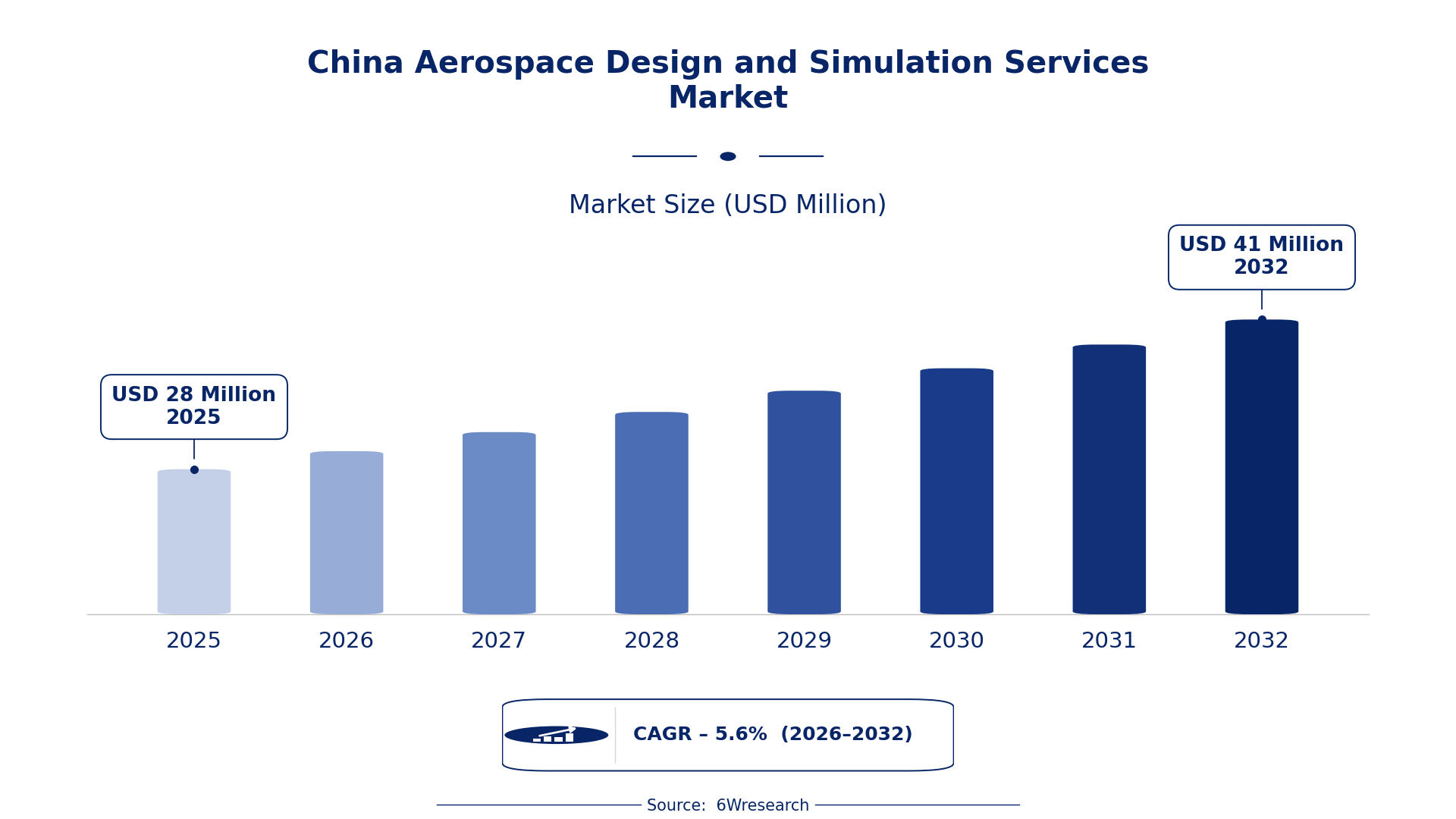
According to 6Wresearch internal database and industry insights, the China Aerospace Design and Simulation Services Market was valued at USD 28.0 million in 2025 and is projected to reach USD 41 million by 2032, growing at a CAGR of approximately 5.6% during 2026–2032.
China Aerospace Design and Simulation Services Market Highlights
| Report Metric | Details |
| Report Name | China Aerospace Design and Simulation Services Market |
| Market Size 2025 | USD 28.0 million |
| Market Size 2032 | USD 41 million |
| Absolute Growth 2025–2032 | USD 13 million |
| CAGR 2026–2032 | 5.6% |
| Peak Annual Growth | 8.5% in 2032 |
| Forecast Period | 2026–2032 |
| Historical Data | 2022–2025 |
| Base Year | 2025 |
| Leading Service Type, 2025 | Structural Analysis (40% share) |
| Leading Tool Type, 2025 | Finite Element Method (35% share) |
| Leading Simulation Domain, 2025 | Airframe Design (46% share) |
| Leading Distribution Channel, 2025 | Direct Engagement (43% share) |
| Leading End User, 2025 | Aircraft Manufacturers (48% share) |
| Fastest-Growing Service Type | CFD Simulation (7.8% CAGR) |
| Fastest-Growing Tool Type | Multi-Physics Software (8.1% CAGR) |
| Fastest-Growing Simulation Domain | Aerodynamics (8.4% CAGR) |
| Fastest-Growing Distribution Channel | SaaS Model (6.8% CAGR) |
| Fastest-Growing End User | Aerospace R&D Labs (7.6% CAGR) |
| Growing Sector | Aerospace R&D Labs |
| Key End Users | Aircraft Manufacturers, Aerospace R&D Labs, Propulsion System OEMs, Defense Equipment Makers |
China Aerospace Design and Simulation Services Market Year-wise Growth Rate and Key Drivers (2022–2032)
This graph illustrates the annual growth rates of the market from 2022 to 2032, highlighting a steady upward trajectory and projected market expansion over the forecast period.
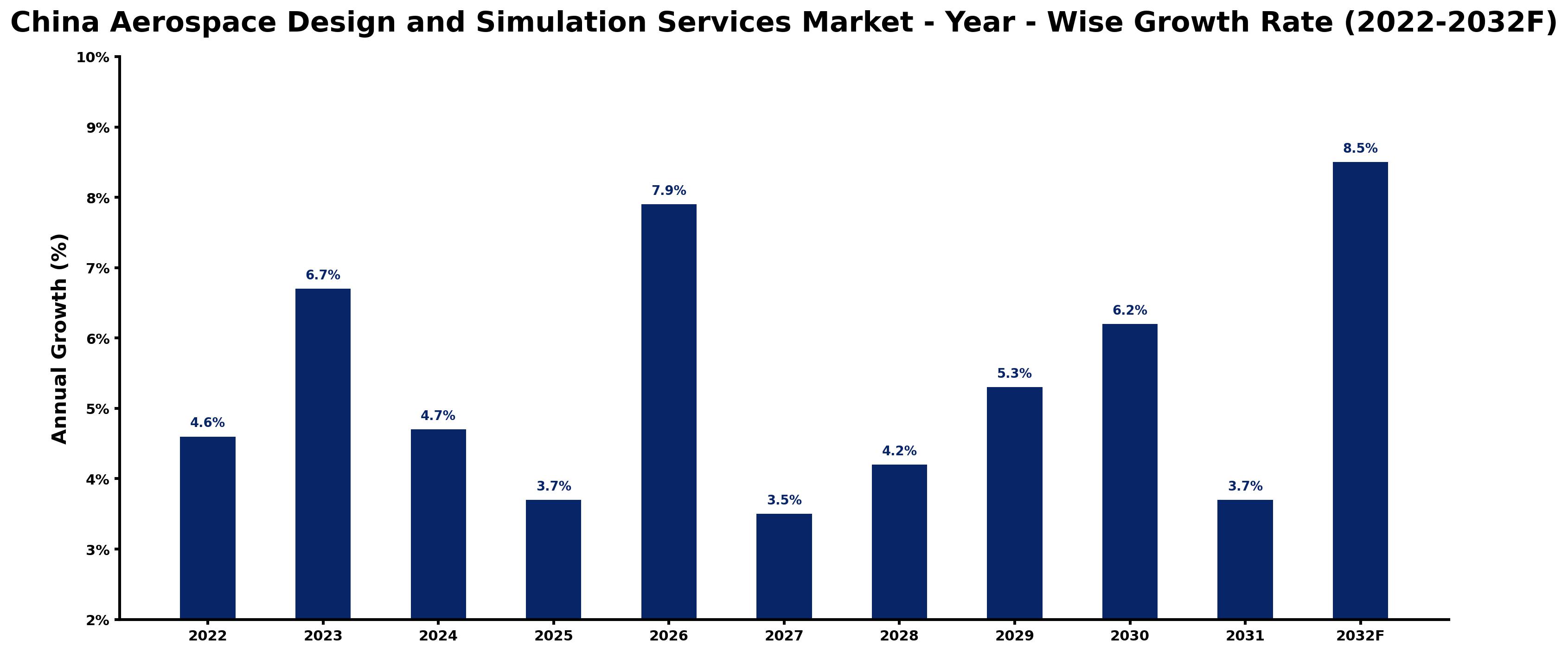
Below, each year's estimated growth is shown next to the factor that most influenced it.
| Year | Estimated Annual Growth (%) | Market Rationale |
| 2022 | 4.6 | The market experienced steady growth, driven by increased demand from aerospace manufacturers. |
| 2023 | 6.7 | Growth accelerated as investments in aerospace technology surged, particularly in R&D institutions. |
| 2024 | 4.7 | A slowdown occurred as projects faced delays, yet demand remained strong from key sectors. |
| 2025 | 3.7 | Continued investment in aerospace technology development contributed to slower growth rates. |
| 2026 | 7.9 | A rebound in growth was noted, supported by advancements in simulation technologies. |
| 2027 | 3.5 | Growth slowed again due to increased competition among service providers in the market. |
| 2028 | 4.2 | An uptick in demand for innovative design solutions led to improved growth rates. |
| 2029 | 5.3 | The market saw a further increase as aerospace R&D labs expanded their capabilities. |
| 2030 | 6.2 | Growth continued as more manufacturers adopted advanced simulation tools for design. |
| 2031 | 3.7 | A slowdown was observed as market dynamics shifted towards consolidation among firms. |
| 2032 | 8.5 | The market peaked with significant investments in aerospace design and simulation services. |
Note: Market size estimations and growth projections presented in this report are based on 6Wresearch's proprietary forecasting methodology, utilizing the latest available industry data, government publications, and primary research inputs.
China Aerospace Design and Simulation Services Market Synopsis
Aerospace Design and Simulation Services in China involve sophisticated computational techniques that refine aircraft design and testing. These services employ software tools and engineering expertise to optimise performance and safety. The China Aerospace Design and Simulation Services Market is growing due to increasing demand from domestic manufacturers and R&D institutions. Notable investments, including the 50 billion yuan allocated in 2022, are propelling this expansion. The emphasis on innovation and technology transfer is advancing the market, with projections indicating a size of 1 trillion yuan by 2035.
Market Dynamics Impact Analysis (2026–2032)
| Factor | Type | Impact | Primary Segment Affected |
| Increasing investments in aerospace technology development | Driver | High | Aerospace R&D Labs |
| Growing demand for advanced simulation tools | Driver | High | Aircraft Manufacturers |
| Emerging opportunities in international collaborations | Opportunity | Medium | Aerospace R&D Labs |
| Expansion of the aerospace workforce exceeding 1 million professionals | Opportunity | High | Aircraft Manufacturers |
| High competition among service providers | Restraint | Medium | Structural Analysis |
| Challenges in meeting updated quality assurance standards | Restraint | High | Structural Analysis |
| Limited funding for smaller aerospace firms | Challenge | High | Aerospace R&D Labs |
| Technological gaps in simulation capabilities | Challenge | Medium | Structural Analysis |
Evaluation of Drivers in China Aerospace Design and Simulation Services Market (2026–2032)
The main growth drivers and the segments they affect most are set out below.
| Drivers | Primary Segment Affected | Why It Matters (Evidence) |
| Increased investment in aerospace technology development | Aerospace R&D Labs | In 2022, the government invested 50 billion yuan, boosting demand for design services and innovation. |
| Growing need for advanced simulation tools | Aircraft Manufacturers | The aerospace sector's growth drives manufacturers to seek effective design solutions, increasing demand for simulation services. |
| Focus on international collaborations in aerospace | Aerospace R&D Labs | The 14th Five-Year Plan promotes partnerships, enhancing service demand through collaborative projects and knowledge sharing. |
| Expansion of the aerospace workforce | Aircraft Manufacturers | With over 1 million professionals, the workforce supports increased service requirements and drives demand for advanced tools. |
| Technological advancements in simulation | Structural Analysis | New tools and methods improve design efficiency, driving service uptake and attracting more clients to simulation providers. |
The Aerospace Design and Simulation Services market in China is expanding as end-use demand rises from manufacturers and R&D institutions. The sector's workforce, exceeding 1 million professionals, supports increased requirements for design and simulation services. International collaborations, as outlined in the 14th Five-Year Plan, promote partnerships that drive innovation and improve capabilities. Technological advancements in simulation tools are further stimulating the market, leading to a surge in demand from manufacturers seeking effective solutions.
Evaluation of Restraints in China Aerospace Design and Simulation Services Market
The following restraints limit how fast demand can grow.
| Market Restraint | Primary Segment Affected | Why It Matters (Evidence) |
| High competition among service providers | Structural Analysis | With numerous firms in the market, pricing pressures affect profitability for service providers, limiting their operational capacity. |
| Challenges in meeting updated quality assurance standards | Structural Analysis | The National Standard for Aerospace Software Quality Assurance requires rigorous compliance, straining resources and increasing operational costs. |
| Limited funding for smaller aerospace firms | Aerospace R&D Labs | Smaller firms struggle to secure investments, impacting their ability to compete effectively in the market. |
| Technological gaps in simulation capabilities | Structural Analysis | Some firms lack access to the latest tools, limiting their service offerings and market reach, affecting competitiveness. |
| Regulatory hurdles in aerospace project approvals | Aerospace R&D Labs | Complex regulations can delay project timelines, impacting service demand and increasing costs for buyers. |
China Aerospace Design and Simulation Services Market Challenges
Buyers in the China Aerospace Design and Simulation Services market encounter a notable lack of skilled professionals, as the workforce is large but insufficiently trained in advanced computational techniques. Regulatory hurdles stem from stringent standards set by the Civil Aviation Administration, leading to project approval delays of up to six months, which affects suppliers' timelines. Additionally, buyers face challenges in sourcing reliable service providers, resulting in inconsistent quality that can prolong project completion times. Escalating technology investment costs have compelled buyers to increase their budgets by as much as 20%, straining their financial resources and limiting project scopes.
Trends in the China Aerospace Design and Simulation Services Market
The trends below show where the China Aerospace Design and Simulation Services Market is heading.
- Shift towards Advanced Simulation Technologies: Aerospace R&D Labs are increasingly adopting advanced simulation technologies to improve design accuracy. The investment of 50 billion yuan in 2022 has accelerated this transition, enabling more efficient project execution and better performance outcomes.
- Growing Preference for Direct Engagement: Since 2021, there has been a notable shift towards direct engagement as a preferred distribution channel. This approach allows for personalised service delivery, capturing a 43% market share by 2025, improving client relationships.
- Emergence of Multi-Physics Software: The adoption of multi-physics software is transforming the aerospace design process, integrating various physical phenomena. This trend is expected to grow by 8.1% from 2026 to 2032, improving design capabilities and efficiency.
- Increased Focus on International Collaboration: The 14th Five-Year Plan encourages international collaboration in aerospace R&D. This initiative aims to strengthen partnerships, with a target of increasing joint projects by 20% by 2030, fostering innovation.
Investment Opportunities in the China Aerospace Design and Simulation Services Market
Investors looking at the China Aerospace Design and Simulation Services Market should consider the following areas.
- Partnerships with Aerospace R&D Labs: Now is an opportune time for partnerships, given the growth in aerospace R&D institutions, which number over 200. Collaborating with these labs can improve service offerings and market presence, capitalising on emerging technologies.
- Investment in Simulation Technologies: With the market projected to reach 1 trillion yuan by 2035, investing in simulation technologies is vital. Aerospace manufacturers are actively seeking effective solutions to improve design efficiency and reduce costs, creating opportunities for suppliers.
- Expansion into the Shanghai Free Trade Zone: The Shanghai Free Trade Zone promotes aerospace innovation, providing a conducive environment for new entrants. This zone is critical for accessing local partnerships and expanding service reach, driving growth in the sector.
- Development of SaaS Models: The increasing demand for flexible access to simulation tools presents a gap in the market. Developing SaaS models can cater to the needs of aerospace manufacturers looking for cost-effective solutions and improved accessibility.
Government Initiatives in the China Aerospace Design and Simulation Services Market
The National Aerospace Industry Development Plan (2021) aims to strengthen domestic capabilities in aerospace design and simulation. This plan focuses on innovation and technology transfer, ensuring that firms comply with updated standards and invest in advanced tools. By creating a supportive environment, the government encourages growth in the aerospace sector, targeting a market size of 1 trillion yuan by 2035. The policy framework promotes collaboration between industry players and research institutions, facilitating knowledge sharing and resource allocation, ultimately benefiting design and simulation services.
The Aerospace Innovation Fund, overseen by the Ministry of Industry and Information Technology, was launched in 2022 with an allocation of 10 billion yuan. This fund supports startups in aerospace technologies, aiming to boost innovation and competitiveness in the sector. Additionally, the Defense Technology Innovation Program initiated by the State Administration for Science, Technology and Industry for National Defense in 2023 focuses on enhancing aerospace defense capabilities through simulation technologies. These initiatives are essential for ensuring that firms can access funding and resources necessary for growth in design and simulation services.
Future Insight of the China Aerospace Design and Simulation Services Market
Several forward-looking factors should support the China Aerospace Design and Simulation Services market by 2032. The government's 14th Five-Year Plan prioritises advancements in aerospace technologies, fostering innovation and efficiency. The Shanghai Free Trade Zone will facilitate collaboration among aerospace firms, boosting competitiveness. By 2035, the aerospace sector is expected to reach a market size of 1 trillion yuan, presenting ample opportunities for suppliers and buyers to enhance their operational capabilities and expand their market presence.
Market Segmentation Analysis
Each segment group is reviewed below, with the leader by share and the fastest grower by CAGR.
By Service Type – Structural Analysis Dominated, CFD Simulation Expected to Grow Fastest
According to Ravi Bhandari, Research Head at 6Wresearch, in 2025, Structural Analysis led the service type split with a 40% share. Structural Analysis holds the largest share due to its critical function in ensuring the integrity of aerospace structures, which is vital for safety and compliance. Aircraft manufacturers heavily rely on these analyses to meet the stringent standards established by the Civil Aviation Administration of China. CFD Simulation is projected to grow fastest, at a CAGR of 7.8% during 2026–2032. CFD Simulation is witnessing rapid growth as it is essential for analysing fluid flow around aircraft surfaces, which is crucial for performance enhancement. The aerospace industry's increasing focus on efficiency is expected to significantly boost the demand for CFD tools. Suppliers should prioritise the development of advanced CFD solutions to cater to the growing requirements of the aerospace sector.
By Tool Type – Finite Element Method Dominated, Multi-Physics Software Expected to Grow Fastest
Finite Element Method accounted for a 35% market share by tool type in 2025. The Finite Element Method commands the largest market share as it is extensively used for structural analysis in aerospace applications, providing vital insights into material behaviour under various conditions. Its established presence in the industry makes it a preferred choice among aerospace firms. The quickest growth will come from Multi-Physics Software, forecast to expand at a CAGR of 8.1% between 2026 and 2032. Multi-Physics Software is experiencing rapid growth as it integrates multiple physical phenomena for comprehensive analysis, allowing for more accurate simulations. The rising complexity of aerospace designs necessitates such advanced tools, driving their adoption. Buyers will gain a competitive edge by investing in Multi-Physics Software to enhance their design capabilities.
By Simulation Domain – Airframe Design Dominated, Aerodynamics Expected to Grow Fastest
With a 46% revenue share in 2025, Airframe Design was the largest simulation domain category. Airframe Design captures the largest market share as it is fundamental for creating the overall structure of aircraft, directly influencing safety and performance. This area is essential for aircraft manufacturers who prioritise structural integrity in their designs. Aerodynamics are set to record the highest CAGR in this split, 8.4% over 2026–2032. Aerodynamics is the fastest-growing segment due to its critical role in optimising flight performance, particularly as manufacturers strive to improve fuel efficiency and reduce emissions. The emphasis on sustainable aviation is driving increased interest in aerodynamic simulations. Suppliers should focus on developing aerodynamic simulation tools to meet the evolving demands of the aerospace industry.
By Distribution Channel – Direct Engagement Dominated, SaaS Model Expected to Grow Fastest
Direct Engagement took a 43% share of distribution channel in 2025, more than any other category. Direct Engagement dominates the market share as it is commonly used for personalised service delivery, allowing for tailored solutions that meet specific client needs. This approach is particularly effective in complex aerospace projects requiring close collaboration. Over 2026–2032, SaaS Model is expected to post the fastest growth, at a CAGR of 6.8%. The SaaS Model is rapidly gaining traction due to its flexibility, providing users with easy access to simulation tools without the need for extensive infrastructure. This model supports the growing trend towards remote work and collaboration in the aerospace sector. Buyers should consider SaaS solutions for their accessibility and cost-effectiveness in simulation services.
By End User – Aircraft Manufacturers Dominated, Aerospace R&D Labs Expected to Grow Fastest
Aircraft Manufacturers held a 48% share of the China Aerospace Design and Simulation Services Market by end user in 2025. Aircraft Manufacturers represent the largest share of the market as they are the primary users of design and simulation services, which are essential for developing new aircraft models. Their substantial investment in research and development significantly drives the demand for these services. Aerospace R&D Labs are projected to grow fastest, at a CAGR of 7.6% during 2026–2032. Aerospace R&D Labs are the fastest-growing segment as they play a key role in innovating aerospace technologies, focusing on the development of advanced systems and materials. Their contribution to pushing the boundaries of aerospace capabilities is crucial for future growth. Suppliers should engage with R&D Labs to foster innovation and expand their market presence.
Key Attractiveness of the Report
- 10 Years of Market Numbers
- Historical Data Starting from 2022 to 2025
- Base Year 2025
- Forecast Data until 2032
- Key Performance Indicators Impacting the Market
- Major Upcoming Developments and Projects
Key Highlights of the Report:
- China Aerospace Design and Simulation Services Market Outlook
- Market Size of China Aerospace Design and Simulation Services Market, 2025
- Forecast of China Aerospace Design and Simulation Services Market, 2032
- Historical Data and Forecast of China Aerospace Design and Simulation Services Revenues & Volume for the Period 2022 - 2032F
- China Aerospace Design and Simulation Services Market Trend Evolution
- China Aerospace Design and Simulation Services Market Drivers and Challenges
- China Aerospace Design and Simulation Services Price Trends
- China Aerospace Design and Simulation Services Porter's Five Forces
- China Aerospace Design and Simulation Services Industry Life Cycle
- Historical Data and Forecast of China Aerospace Design and Simulation Services Market Revenues & Volume By Service Type for the Period 2022 - 2032F
- Historical Data and Forecast of China Aerospace Design and Simulation Services Market Revenues & Volume By Structural Analysis for the Period 2022 - 2032F
- Historical Data and Forecast of China Aerospace Design and Simulation Services Market Revenues & Volume By CFD Simulation for the Period 2022 - 2032F
- Historical Data and Forecast of China Aerospace Design and Simulation Services Market Revenues & Volume By Thermal Modeling for the Period 2022 - 2032F
- Historical Data and Forecast of China Aerospace Design and Simulation Services Market Revenues & Volume By Electrical Simulation for the Period 2022 - 2032F
- Historical Data and Forecast of China Aerospace Design and Simulation Services Market Revenues & Volume By Tool Type for the Period 2022 - 2032F
- Historical Data and Forecast of China Aerospace Design and Simulation Services Market Revenues & Volume By Finite Element Method for the Period 2022 - 2032F
- Historical Data and Forecast of China Aerospace Design and Simulation Services Market Revenues & Volume By Fluid Dynamics Tools for the Period 2022 - 2032F
- Historical Data and Forecast of China Aerospace Design and Simulation Services Market Revenues & Volume By Multi-Physics Software for the Period 2022 - 2032F
- Historical Data and Forecast of China Aerospace Design and Simulation Services Market Revenues & Volume By Digital Twins for the Period 2022 - 2032F
- Historical Data and Forecast of China Aerospace Design and Simulation Services Market Revenues & Volume By Simulation Domain for the Period 2022 - 2032F
- Historical Data and Forecast of China Aerospace Design and Simulation Services Market Revenues & Volume By Airframe Design for the Period 2022 - 2032F
- Historical Data and Forecast of China Aerospace Design and Simulation Services Market Revenues & Volume By Aerodynamics for the Period 2022 - 2032F
- Historical Data and Forecast of China Aerospace Design and Simulation Services Market Revenues & Volume By Engine Performance for the Period 2022 - 2032F
- Historical Data and Forecast of China Aerospace Design and Simulation Services Market Revenues & Volume By Avionics Testing for the Period 2022 - 2032F
- Historical Data and Forecast of China Aerospace Design and Simulation Services Market Revenues & Volume By Distribution Channel for the Period 2022 - 2032F
- Historical Data and Forecast of China Aerospace Design and Simulation Services Market Revenues & Volume By Direct Engagement for the Period 2022 - 2032F
- Historical Data and Forecast of China Aerospace Design and Simulation Services Market Revenues & Volume By SaaS Model for the Period 2022 - 2032F
- Historical Data and Forecast of China Aerospace Design and Simulation Services Market Revenues & Volume By Online Consulting for the Period 2022 - 2032F
- Historical Data and Forecast of China Aerospace Design and Simulation Services Market Revenues & Volume By Engineering Firms for the Period 2022 - 2032F
- Historical Data and Forecast of China Aerospace Design and Simulation Services Market Revenues & Volume By End User for the Period 2022 - 2032F
- Historical Data and Forecast of China Aerospace Design and Simulation Services Market Revenues & Volume By Aircraft Manufacturers for the Period 2022 - 2032F
- Historical Data and Forecast of China Aerospace Design and Simulation Services Market Revenues & Volume By Aerospace R&D Labs for the Period 2022 - 2032F
- Historical Data and Forecast of China Aerospace Design and Simulation Services Market Revenues & Volume By Propulsion System OEMs for the Period 2022 - 2032F
- Historical Data and Forecast of China Aerospace Design and Simulation Services Market Revenues & Volume By Defense Equipment Makers for the Period 2022 - 2032F
- China Aerospace Design and Simulation Services Import Export Trade Statistics
- Market Opportunity Assessment By Service Type
- Market Opportunity Assessment By Tool Type
- Market Opportunity Assessment By Simulation Domain
- Market Opportunity Assessment By Distribution Channel
- Market Opportunity Assessment By End User
- China Aerospace Design and Simulation Services Top Companies Market Share
- China Aerospace Design and Simulation Services Competitive Benchmarking By Technical and Operational Parameters
- China Aerospace Design and Simulation Services Company Profiles
- China Aerospace Design and Simulation Services Key Strategic Recommendations
Market Covered
Segments analysed in this report are listed below.
By Service Type
- Structural Analysis
- CFD Simulation
- Thermal Modeling
- Electrical Simulation
By Tool Type
- Finite Element Method
- Fluid Dynamics Tools
- Multi-Physics Software
- Digital Twins
By Simulation Domain
- Airframe Design
- Aerodynamics
- Engine Performance
- Avionics Testing
By Distribution Channel
- Direct Engagement
- SaaS Model
- Online Consulting
- Engineering Firms
By End User
- Aircraft Manufacturers
- Aerospace R&D Labs
- Propulsion System OEMs
- Defense Equipment Makers































