China Aerospace Die Casting Market Size & Growth Rate
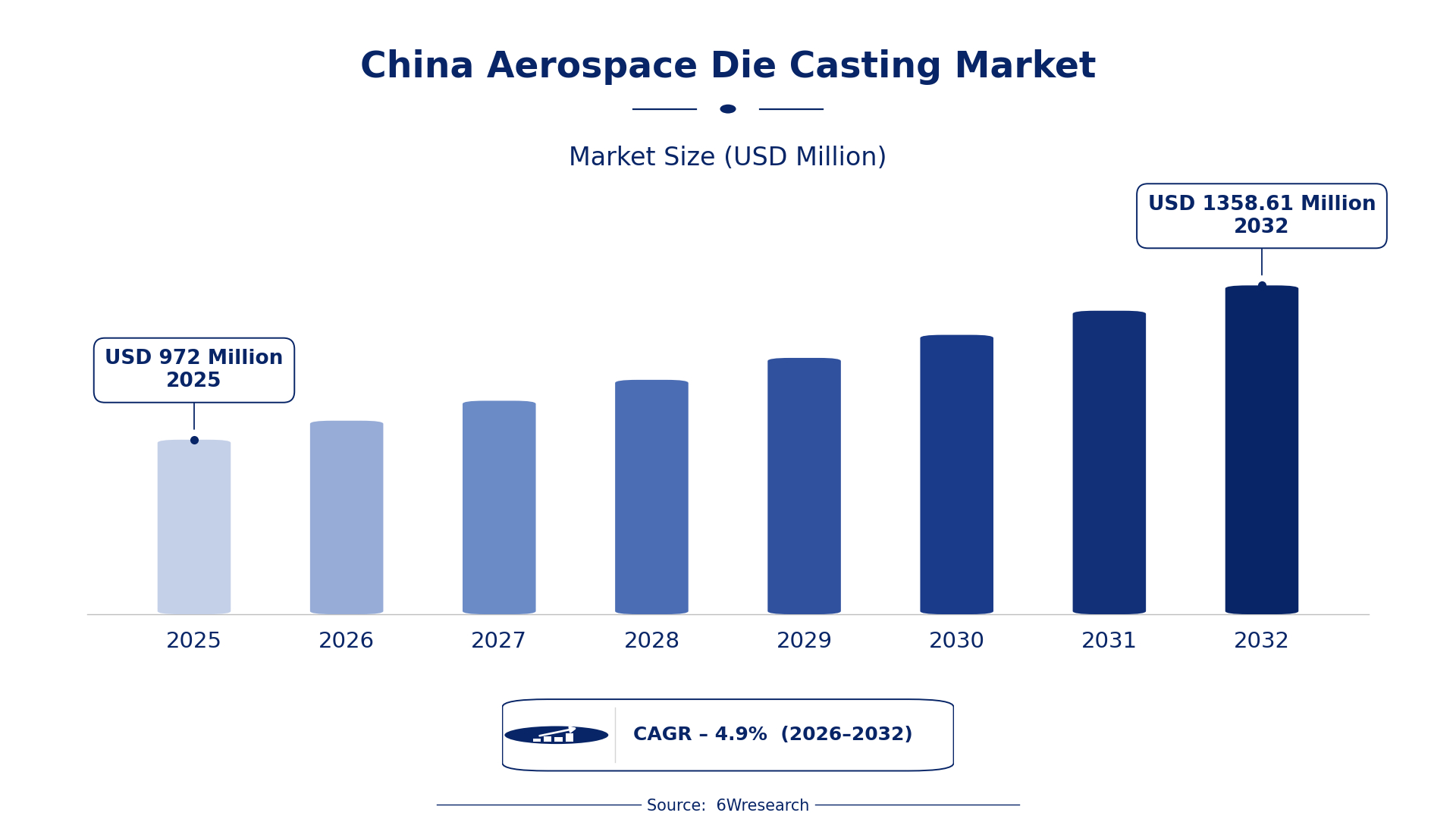
According to 6Wresearch internal database and industry insights, the China Aerospace Die Casting Market was valued at USD 972.0 million in 2025 and is projected to reach USD 1,358.61 million by 2032, growing at a CAGR of approximately 4.9% during 2026–2032.
China Aerospace Die Casting Market Highlights
| Report Metric | Details |
| Report Name | China Aerospace Die Casting Market |
| Market Size 2025 | USD 972.0 million |
| Market Size 2032 | USD 1,358.61 million |
| Absolute Growth 2025–2032 | USD 386.61 million |
| CAGR 2026–2032 | 4.9% |
| Peak Annual Growth | 7.4% in 2026 |
| Forecast Period | 2026–2032 |
| Historical Data | 2022–2025 |
| Base Year | 2025 |
| Leading Casting Type, 2025 | Pressure Die Casting (35% share) |
| Leading Material Type, 2025 | Aluminum (41% share) |
| Leading Distribution Channel, 2025 | Direct Sales (45% share) |
| Leading End User, 2025 | Aerospace OEMs (42% share) |
| Fastest-Growing Casting Type | Vacuum Die Casting (6.6% CAGR) |
| Fastest-Growing Material Type | Titanium (7.0% CAGR) |
| Fastest-Growing Distribution Channel | Online Platforms (6.8% CAGR) |
| Fastest-Growing End User | Defense Contractors (7.3% CAGR) |
| Growing Sector | Aerospace |
| Key End Users | Aerospace OEMs, Defense Contractors, Aircraft Engine Suppliers |
China Aerospace Die Casting Market Year-wise Growth Rate and Key Drivers (2022–2032)
This graph illustrates the annual growth rates of the market from 2022 to 2032, highlighting a steady upward trajectory and projected market expansion over the forecast period.
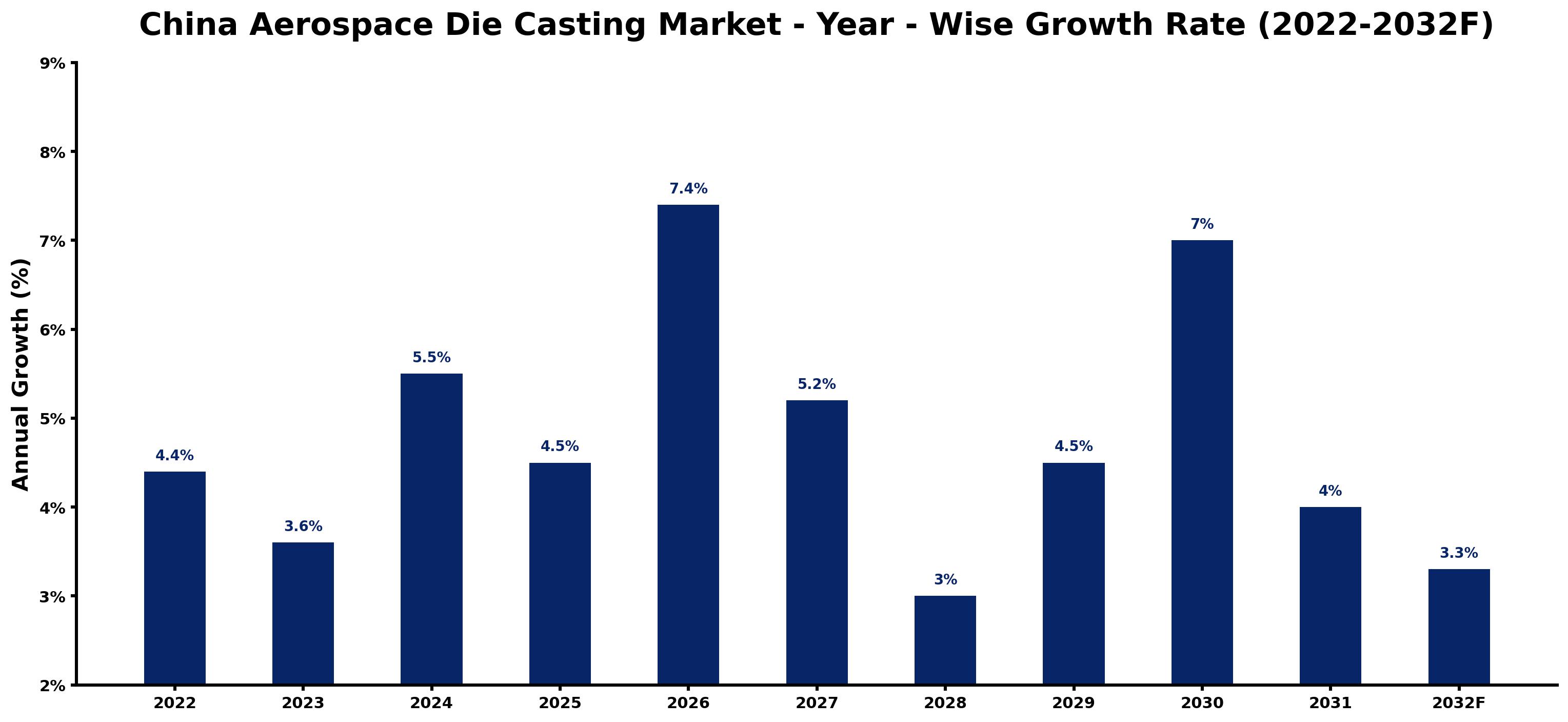
The table below sets out the estimated growth rate for each year and the main factor behind it.
| Year | Estimated Annual Growth (%) | Market Rationale |
| 2022 | 4.4 | The market experienced steady growth, driven by the 'Made in China 2025' initiative promoting aerospace manufacturing. |
| 2023 | 3.6 | Growth slowed due to a temporary reduction in aerospace investments and production adjustments from the CAAC. |
| 2024 | 5.5 | The market rebounded with faster growth as domestic demand surged alongside international collaborations in the Guangdong province. |
| 2025 | 4.5 | Growth slowed again as manufacturers adjusted to supply chain challenges and fluctuating material costs in the industry. |
| 2026 | 7.4 | A notable increase in demand is anticipated as new aerospace projects commence and investment rises in advanced technologies. |
| 2027 | 5.2 | Growth is projected to slow as the market stabilises after the peak demand period from 2026. |
| 2028 | 3.0 | Demand growth is expected to decelerate as the market reaches a more mature phase with increased competition. |
| 2029 | 4.5 | An uptick in growth is anticipated as defence contracts expand and new technologies are adopted in aerospace manufacturing. |
| 2030 | 7.0 | The market is projected to grow rapidly as the aerospace industry targets $1 trillion by 2030, boosting die casting demand. |
| 2031 | 4.0 | Growth is expected to moderate as the market adjusts to increased production capacities and material costs. |
| 2032 | 3.3 | A slowdown in growth is projected as the market approaches saturation in certain segments, particularly in aluminum die casting. |
Note: Market size estimations and growth projections presented in this report are based on 6Wresearch's proprietary forecasting methodology, utilizing the latest available industry data, government publications, and primary research inputs.
China Aerospace Die Casting Market Synopsis
Aerospace Die Casting in China involves pouring molten metal into molds to create components for aircraft engines and airframes. This process primarily utilises aluminum, magnesium, and titanium, known for their strength-to-weight ratios. The China Aerospace Die Casting Market is expanding due to rising domestic demand driven by over 1,000 aircraft produced in 2022 and substantial investments in aerospace technology, which reached $15 billion in 2022. The 'Made in China 2025' initiative further supports this growth by improving local manufacturing capabilities.
Market Dynamics Impact Analysis (2026–2032)
| Factor | Type | Impact | Primary Segment Affected |
| Rising domestic aircraft production | Driver | High | Aerospace OEMs |
| Increased investment in aerospace technology | Driver | High | Industrial Suppliers |
| Growing demand for lightweight components | Opportunity | High | Aluminum |
| Emerging online sales channels | Opportunity | Medium | Online Platforms |
| High material costs impacting production | Restraint | High | Pressure Die Casting |
| Regulatory compliance costs for manufacturers | Restraint | Medium | Vacuum Die Casting |
| Limited skilled workforce availability | Challenge | High | Aerospace OEMs |
| Supply chain disruptions affecting material availability | Challenge | Medium | Industrial Suppliers |
Evaluation of Drivers in China Aerospace Die Casting Market (2026–2032)
Key forces behind demand, with the segment each one moves most, are listed below.
| Drivers | Primary Segment Affected | Why It Matters (Evidence) |
| Increased aircraft production | Aerospace OEMs | Over 1,000 aircraft produced in 2022 drives demand for die-cast components. |
| Investment in advanced manufacturing technologies | Industrial Suppliers | $15 billion invested in 2022 improves die casting capabilities and efficiency. |
| Demand for lightweight materials | Aluminum | Aluminum accounts for approximately 70% of the market, due to its strength-to-weight ratio. |
| Expansion of online sales channels | Online Platforms | Growth in e-commerce allows smaller suppliers to reach aerospace clients effectively. |
| Increased defence spending | Defense Contractors | Rising military contracts drive demand for specialized die-cast components. |
The Aerospace Die Casting market in China is growing on the back of increased aircraft production, investment in advanced manufacturing technologies, and rising demand for lightweight materials. Over 1,000 aircraft were produced in 2022, driving the need for die-cast components. Investment in aerospace technology reached $15 billion in 2022, improving manufacturing capabilities. The expansion of online sales channels has enabled smaller suppliers to effectively reach aerospace clients, further boosting market growth. Increased defence spending is driving demand for specialized die-cast components, creating opportunities for producers.
Evaluation of Restraints in China Aerospace Die Casting Market
The key brakes on demand, and where they bite hardest, are shown below.
| Market Restraint | Primary Segment Affected | Why It Matters (Evidence) |
| High material costs impacting production | Pressure Die Casting | Material costs have risen by 15%, affecting profit margins for manufacturers. |
| Regulatory compliance costs for manufacturers | Vacuum Die Casting | Compliance with ISO 9001 certification increases operational costs for producers. |
| Limited skilled workforce availability | Aerospace OEMs | The aerospace workforce in China exceeds 1 million, but specific skills are in short supply. |
| Supply chain disruptions affecting material availability | Industrial Suppliers | Global supply chain issues have delayed material deliveries, impacting production timelines. |
| Competition from international manufacturers | Aerospace OEMs | Local manufacturers face challenges from established foreign competitors in pricing and technology. |
China Aerospace Die Casting Market Challenges
The China Aerospace Die Casting Market faces challenges, starting with outdated manufacturing technologies that slow production and inflate costs for buyers. Many local manufacturers rely on legacy systems, causing lead times to extend by up to 20%. A shortage of skilled workers compounds this issue, as the rapid growth of the aerospace sector outpaces training efforts, leading to project delays and increased labour costs for producers. Material costs, especially for aluminum, have surged by 15% over the past year, straining budgets for manufacturers and driving prices higher for buyers. Intense competition from international firms forces local manufacturers to lower prices, often compromising quality and sustainability.
Trends in the China Aerospace Die Casting Market
Several trends are reshaping the China Aerospace Die Casting Market; the most important are set out below.
- Shift from Traditional to Advanced Die Casting Techniques: In 2022, the adoption of advanced die casting techniques increased, with Vacuum Die Casting growing at a CAGR of 6.6%. This shift allows for better quality and reduced porosity in critical aerospace components.
- Emergence of Online Sales Channels: Online Platforms are becoming increasingly popular, with a projected CAGR of 6.8% through 2032. This trend allows smaller suppliers to reach a broader range of aerospace clients more efficiently.
- Focus on Lightweight Materials: Aluminum remains the dominant material, accounting for 70% of the market. The trend towards lightweight components is driven by the need for fuel efficiency in aircraft.
- Increased Defence Spending: The Chinese government has ramped up defence spending, with military contracts driving demand for specialized die-cast components. This sector is expected to grow, reflecting the strategic focus on national security.
Investment Opportunities in the China Aerospace Die Casting Market
Several openings in the China Aerospace Die Casting Market merit attention from investors.
- Investment in Lightweight Aerospace Components: With the aerospace industry projected to reach $1 trillion by 2030, there is an opportunity to invest in lightweight components. Aerospace OEMs are actively seeking suppliers who can provide advanced materials.
- Expansion into Online Sales Channels: The online sales channel is growing rapidly. Suppliers can capitalise on this trend by partnering with e-commerce platforms to reach aerospace clients directly.
- Development of Advanced Die Casting Technologies: Investment in advanced die casting technologies is timely now, with $15 billion allocated in 2022. Suppliers should focus on solutions to meet the evolving demands of the aerospace sector.
- Collaboration with Defence Contractors: The defence sector is expanding, and suppliers can benefit from partnerships with Defence Contractors. Engaging in joint ventures can enhance capabilities and access to lucrative contracts.
Government Initiatives in the China Aerospace Die Casting Market
The Ministry of Industry and Information Technology launched the 'Aerospace Industry Development Plan' in 2021, aiming to increase domestic production by 30% by 2025. This plan sets a clear framework for manufacturers to improve their production capabilities. The National Development and Reform Commission introduced the 'Aerospace Manufacturing Support Program' in 2022, providing subsidies for advanced die casting technologies. These measures are designed to support the growth of the aerospace die casting sector and improve competitiveness. The National Aerospace Technology Innovation Program was updated in 2022 to prioritise funding for die casting innovations, further strengthening the sector's capabilities.
The State Administration for Science, Technology and Industry for National Defense oversees the enhancement of aerospace material standards, focusing on die casting materials. In 2023, the agency initiated a program to ensure compliance with these standards. The Ministry of Finance allocated $5 billion in 2023 for the development of aerospace technologies, including die casting processes. These funding initiatives aim to strengthen the capabilities of manufacturers and ensure adherence to industry standards.
Future Insight of the China Aerospace Die Casting Market
The trajectory of the China Aerospace Die Casting Market points towards robust growth driven by significant investment in aerospace technology. Stricter manufacturing standards, such as ISO 9001, will enhance product reliability, benefiting buyers with higher quality components. The Guangdong province's rise as a production hub will streamline supply chains and reduce lead times, improving operational efficiency for suppliers and positively impacting the broader aerospace industry.
Market Segmentation Analysis
The analysis below covers each segmentation, its leading category in 2025 and its fastest-growing category through 2032.
By Casting Type – Pressure Die Casting Dominated, Vacuum Die Casting Expected to Grow Fastest
According to Ravi Bhandari, Research Head at 6Wresearch, the largest casting type category in 2025 was Pressure Die Casting, with a 35% share of total revenue. Pressure die casting holds the largest market share due to its ability to deliver high precision and excellent surface finishes, which are crucial for aerospace components. This method is particularly sought after by manufacturers in Guangdong, a key region for aerospace die casting production. Vacuum Die Casting is projected to grow fastest, at a CAGR of 6.6% during 2026–2032. Vacuum die casting is experiencing rapid growth as it significantly reduces porosity in critical aerospace parts, enhancing their reliability. The increasing demand for high-quality components in the aerospace sector is a major factor driving this trend. Suppliers should focus on advancing their vacuum die casting technologies to cater to the rising demand for high-performance aerospace components.
By Material Type – Aluminum Dominated, Titanium Expected to Grow Fastest
In 2025, Aluminum led the material type split with a 41% share. Aluminum dominates the market share as it is extensively used in aerospace applications for its lightweight and strength properties, essential for optimal aircraft performance. The production of over 1,000 aircraft in 2022 highlights its prevalent use across the industry. Titanium is set to record the highest CAGR in this split, 7.0% over 2026–2032. Titanium is the fastest-growing material type, valued for its superior strength and corrosion resistance, making it ideal for high-performance aerospace components. The aerospace sector's increasing focus on advanced materials is propelling this growth. Buyers should integrate titanium into their material sourcing strategies for applications that require enhanced performance and durability.
By Distribution Channel – Direct Sales Dominated, Online Platforms Expected to Grow Fastest
Direct Sales took a 45% share of distribution channel in 2025, more than any other category. Direct sales account for the largest share as they provide manufacturers with a direct line to aerospace clients, ensuring tailored solutions and strong relationships. This method is particularly effective in a market with over 200 aerospace manufacturers across China. Over 2026–2032, Online Platforms are expected to post the fastest growth, at a CAGR of 6.8%. Online platforms are the fastest-growing distribution channel, allowing smaller suppliers to reach a broader customer base without the overhead of traditional sales methods. The digital shift in procurement processes is driving this rapid adoption. Suppliers should invest in online sales strategies to tap into the expanding market of aerospace clients seeking efficient purchasing options.
By End User – Aerospace OEMs Dominated, Defense Contractors Expected to Grow Fastest
With a 42% revenue share in 2025, Aerospace OEMs was the largest end user category. Aerospace OEMs represent the largest market share as they are the primary consumers of die-cast parts essential for aircraft assembly. Their critical role in aircraft production highlights the significance of die casting within the aerospace supply chain. The quickest growth will come from Defense Contractors, forecast to expand at a CAGR of 7.3% between 2026 and 2032. Defense contractors are the fastest-growing end user segment, utilising die-cast parts for military aerospace applications that demand high reliability and performance. The increase in defence budgets and emphasis on advanced military capabilities are driving this growth. Suppliers should adapt their offerings to meet the specific needs of defense contractors to capitalise on this expanding segment.
Key Attractiveness of the Report
- 10 Years of Market Numbers
- Historical Data Starting from 2022 to 2025
- Base Year 2025
- Forecast Data until 2032
- Key Performance Indicators Impacting the Market
- Major Upcoming Developments and Projects
Key Highlights of the Report:
- China Aerospace Die Casting Market Outlook
- Market Size of China Aerospace Die Casting Market, 2025
- Forecast of China Aerospace Die Casting Market, 2032
- Historical Data and Forecast of China Aerospace Die Casting Revenues & Volume for the Period 2022 - 2032F
- China Aerospace Die Casting Market Trend Evolution
- China Aerospace Die Casting Market Drivers and Challenges
- China Aerospace Die Casting Price Trends
- China Aerospace Die Casting Porter's Five Forces
- China Aerospace Die Casting Industry Life Cycle
- Historical Data and Forecast of China Aerospace Die Casting Market Revenues & Volume By Casting Type for the Period 2022 - 2032F
- Historical Data and Forecast of China Aerospace Die Casting Market Revenues & Volume By Gravity Die Casting for the Period 2022 - 2032F
- Historical Data and Forecast of China Aerospace Die Casting Market Revenues & Volume By Pressure Die Casting for the Period 2022 - 2032F
- Historical Data and Forecast of China Aerospace Die Casting Market Revenues & Volume By Vacuum Die Casting for the Period 2022 - 2032F
- Historical Data and Forecast of China Aerospace Die Casting Market Revenues & Volume By Squeeze Die Casting for the Period 2022 - 2032F
- Historical Data and Forecast of China Aerospace Die Casting Market Revenues & Volume By Material Type for the Period 2022 - 2032F
- Historical Data and Forecast of China Aerospace Die Casting Market Revenues & Volume By Aluminum for the Period 2022 - 2032F
- Historical Data and Forecast of China Aerospace Die Casting Market Revenues & Volume By Magnesium for the Period 2022 - 2032F
- Historical Data and Forecast of China Aerospace Die Casting Market Revenues & Volume By Zinc Alloy for the Period 2022 - 2032F
- Historical Data and Forecast of China Aerospace Die Casting Market Revenues & Volume By Titanium for the Period 2022 - 2032F
- Historical Data and Forecast of China Aerospace Die Casting Market Revenues & Volume By Distribution Channel for the Period 2022 - 2032F
- Historical Data and Forecast of China Aerospace Die Casting Market Revenues & Volume By Direct Sales for the Period 2022 - 2032F
- Historical Data and Forecast of China Aerospace Die Casting Market Revenues & Volume By Industrial Suppliers for the Period 2022 - 2032F
- Historical Data and Forecast of China Aerospace Die Casting Market Revenues & Volume By Online Platforms for the Period 2022 - 2032F
- Historical Data and Forecast of China Aerospace Die Casting Market Revenues & Volume By Specialty Stores for the Period 2022 - 2032F
- Historical Data and Forecast of China Aerospace Die Casting Market Revenues & Volume By End User for the Period 2022 - 2032F
- Historical Data and Forecast of China Aerospace Die Casting Market Revenues & Volume By Aircraft Engine Suppliers for the Period 2022 - 2032F
- Historical Data and Forecast of China Aerospace Die Casting Market Revenues & Volume By Aerospace OEMs for the Period 2022 - 2032F
- Historical Data and Forecast of China Aerospace Die Casting Market Revenues & Volume By Helicopter Manufacturers for the Period 2022 - 2032F
- Historical Data and Forecast of China Aerospace Die Casting Market Revenues & Volume By Defense Contractors for the Period 2022 - 2032F
- China Aerospace Die Casting Import Export Trade Statistics
- Market Opportunity Assessment By Casting Type
- Market Opportunity Assessment By Material Type
- Market Opportunity Assessment By Distribution Channel
- Market Opportunity Assessment By End User
- China Aerospace Die Casting Top Companies Market Share
- China Aerospace Die Casting Competitive Benchmarking By Technical and Operational Parameters
- China Aerospace Die Casting Company Profiles
- China Aerospace Die Casting Key Strategic Recommendations
Market Covered
The report offers an extensive study of the following market segments.
By Casting Type
- Gravity Die Casting
- Pressure Die Casting
- Vacuum Die Casting
- Squeeze Die Casting
By Material Type
- Aluminum
- Magnesium
- Zinc Alloy
- Titanium
By Distribution Channel
- Direct Sales
- Industrial Suppliers
- Online Platforms
- Specialty Stores
By End User
- Aircraft Engine Suppliers
- Aerospace OEMs
- Helicopter Manufacturers
- Defense Contractors































