China Aerospace Fluid Handling Market Size & Growth Rate
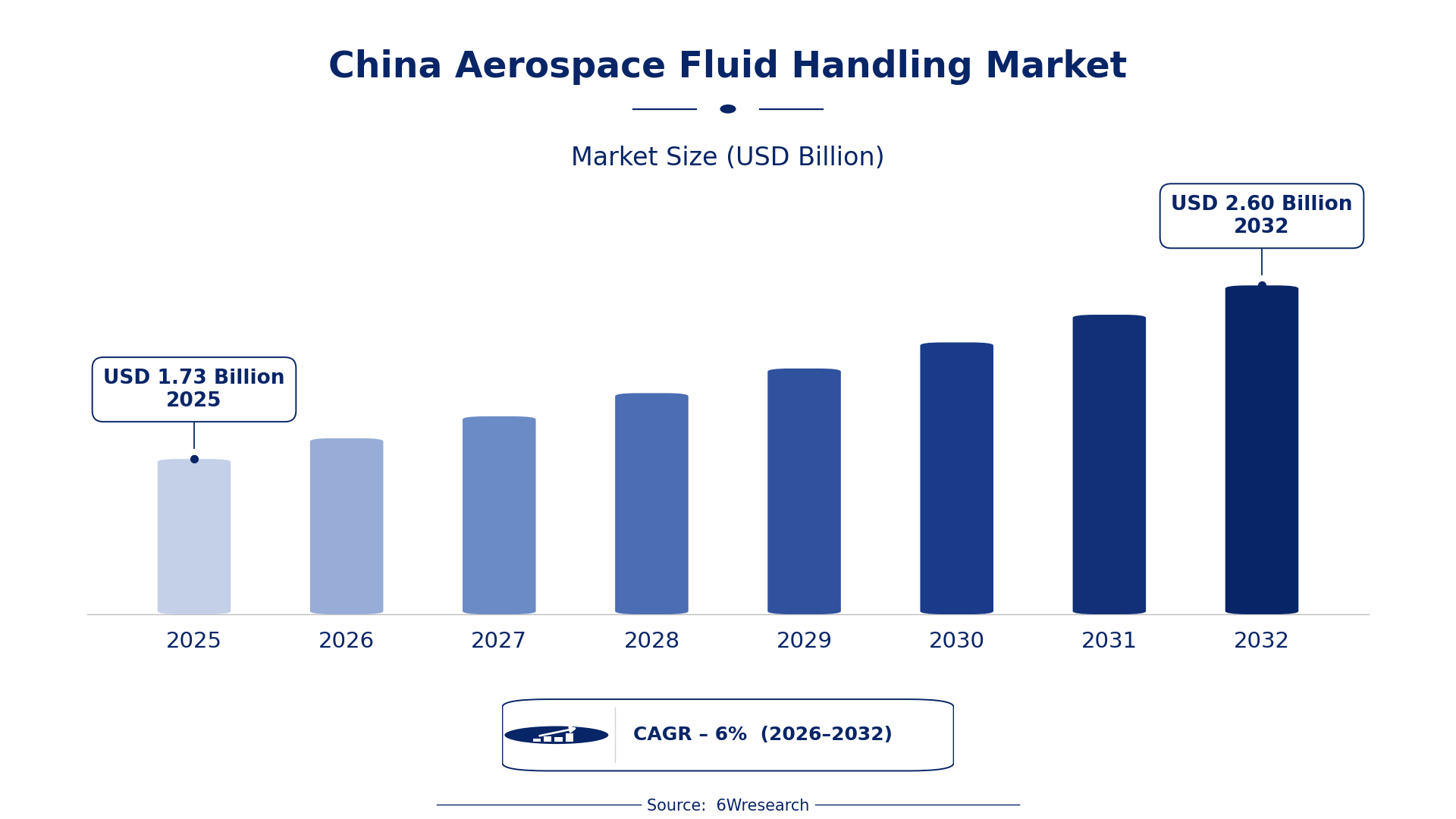
According to 6Wresearch internal database and industry insights, the China Aerospace Fluid Handling Market was valued at USD 1.73 billion in 2025 and is projected to reach USD 2.60 billion by 2032, growing at a CAGR of approximately 6% during 2026–2032.
China Aerospace Fluid Handling Market Highlights
| Report Metric | Details |
| Report Name | China Aerospace Fluid Handling Market |
| Market Size 2025 | USD 1.73 billion |
| Market Size 2032 | USD 2.60 billion |
| Absolute Growth 2025–2032 | USD 0.87 billion |
| CAGR 2026–2032 | 6% |
| Peak Annual Growth | 8.6% in 2031 |
| Forecast Period | 2026–2032 |
| Historical Data | 2022–2025 |
| Base Year | 2025 |
| Leading System Type, 2025 | Fuel Systems (51% share) |
| Leading Fluid Type, 2025 | Jet Fuel (46% share) |
| Leading Distribution Channel, 2025 | Direct Sales (38% share) |
| Leading End User, 2025 | Aerospace Manufacturing Plants (45% share) |
| Fastest-Growing System Type | Cooling Systems (8.4% CAGR) |
| Fastest-Growing Fluid Type | Synthetic Oil (7.4% CAGR) |
| Fastest-Growing Distribution Channel | Online Platforms (7.4% CAGR) |
| Growing Sector | Aerospace Manufacturing |
| Key End Users | Aerospace Manufacturing Plants, Aircraft Maintenance Firms, Aircraft Engine OEMs, Defense Aircraft Units |
China Aerospace Fluid Handling Market Year-wise Growth Rate and Key Drivers (2022–2032)
This graph illustrates the annual growth rates of the market from 2022 to 2032, highlighting a steady upward trajectory and projected market expansion over the forecast period.
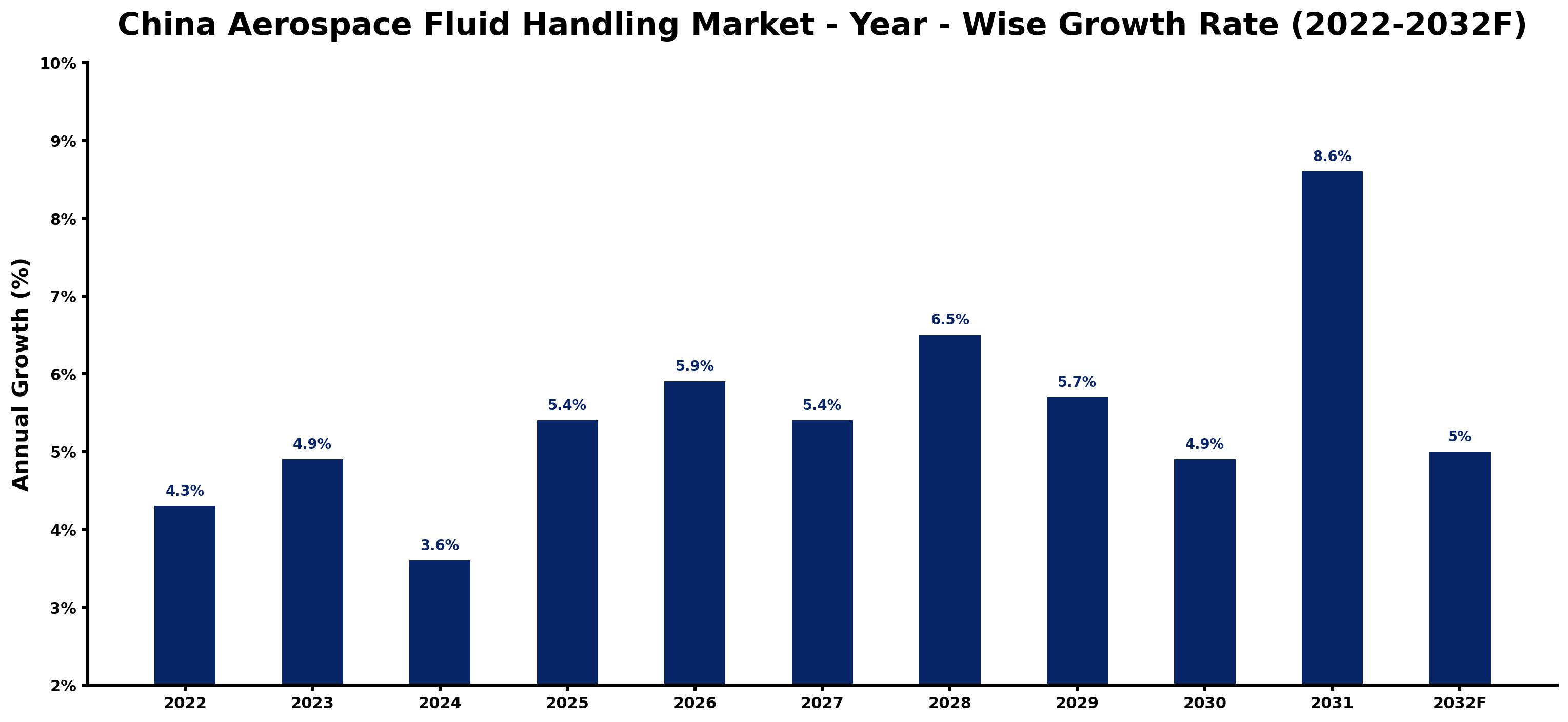
Below, each year's estimated growth is shown next to the factor that most influenced it.
| Year | Estimated Annual Growth (%) | Market Rationale |
| 2022 | 4.3 | The market showed steady growth due to existing aerospace operations and demand from manufacturers. |
| 2023 | 4.9 | Growth accelerated as domestic production of aircraft increased, boosting fluid handling requirements. |
| 2024 | 3.6 | Demand growth slowed as manufacturers adjusted to market conditions and production capacities. |
| 2025 | 5.4 | A surge in aircraft production led to heightened demand for fluid handling systems. |
| 2026 | 5.9 | Continued investment in aerospace technology drove further demand for fluid handling solutions. |
| 2027 | 5.4 | Growth decelerated as the market stabilised after previous rapid expansions in production. |
| 2028 | 6.5 | Increased production capacity and technological advancements spurred demand for fluid handling systems. |
| 2029 | 5.7 | Demand growth slowed as manufacturers focused on optimising existing operations and resources. |
| 2030 | 4.9 | A slight deceleration was noted as the market adjusted to evolving industry standards. |
| 2031 | 8.6 | The market experienced a significant upswing driven by new aerospace projects and military investments. |
| 2032 | 5.0 | Growth moderated as the market stabilises post-peak demand, reflecting ongoing industry maturation. |
Note: Market size estimations and growth projections presented in this report are based on 6Wresearch's proprietary forecasting methodology, utilizing the latest available industry data, government publications, and primary research inputs.
China Aerospace Fluid Handling Market Synopsis
Aerospace Fluid Handling in China includes systems and components that manage fluids in aircraft, such as hydraulic fluids, fuels, and lubricants. These systems are crucial for safe aircraft operation and optimal engine performance. The China Aerospace Fluid Handling Market is growing due to a rise in domestic aircraft production and an expanding aerospace workforce. In 2022, around 300 commercial aircraft were produced, which increased the demand for fluid handling systems. Government initiatives aimed at strengthening the aerospace supply chain further contribute to this growth.
Market Dynamics Impact Analysis (2026–2032)
| Factor | Type | Impact | Primary Segment Affected |
| Increased domestic aircraft production drives demand for fluid handling systems. | Driver | High | Fuel Systems |
| Growing military investments enhance demand for specialized fluid handling solutions. | Driver | High | Hydraulic Systems |
| Rising demand for high-performance lubricants presents opportunities in the market. | Opportunity | High | Lubrication Systems |
| The shift towards online sales channels opens new market entry points. | Opportunity | Medium | Fuel Systems |
| Stringent regulatory standards may limit product approvals and market entry. | Restraint | High | Fuel Systems |
| Supply chain disruptions can affect the availability of critical components. | Restraint | Medium | Fuel Systems |
| Aerospace Fluid Handling in China faces challenges from fluctuating material costs. | Challenge | High | Fuel Systems |
| Technological advancements require continuous investment, straining smaller firms. | Challenge | Medium | Fuel Systems |
Evaluation of Drivers in China Aerospace Fluid Handling Market (2026–2032)
The main growth drivers and the segments they affect most are set out below.
| Drivers | Primary Segment Affected | Why It Matters (Evidence) |
| Increased aircraft production | Fuel Systems | China produced approximately 300 commercial aircraft in 2022, leading to higher fluid handling system demand. |
| Military budget allocation | Hydraulic Systems | The defense budget for 2023 allocated $224 billion, driving military aerospace fluid handling needs. |
| Technological advancements in lubricants | Lubrication Systems | The demand for high-performance lubricants is rising as manufacturers seek to improve engine longevity and reliability. |
| Growing aerospace workforce | Cooling Systems | China's aerospace workforce is projected to reach 1 million skilled workers by 2025, improving expertise in fluid handling. |
| Emergence of online sales channels | Online Platforms | Online platforms are becoming a significant sales channel, with a projected growth rate of 7.4%. |
Growth across the Aerospace Fluid Handling market in China is anchored in increased aircraft production, military budget allocations, and technological advancements. In 2022, approximately 300 commercial aircraft were produced, boosting demand for fluid handling systems. The defense budget for 2023 allocated $224 billion, driving military aerospace fluid handling needs. The aerospace workforce is expected to reach 1 million skilled workers by 2025, improving expertise in fluid handling. The rise of online sales channels is reshaping distribution, with a projected growth rate of 7.4%. These factors drive demand for advanced fluid handling solutions.
Evaluation of Restraints in China Aerospace Fluid Handling Market
The main factors holding the market back are set out below.
| Market Restraint | Primary Segment Affected | Why It Matters (Evidence) |
| Stringent regulatory standards | Fuel Systems | National standard GB/T 20077-2019 governs hydraulic fluids, complicating compliance for manufacturers. |
| Supply chain disruptions | Fuel Systems | Recent global supply chain issues have affected the availability of critical components for fluid systems. |
| Fluctuating material costs | Fuel Systems | Rising costs of raw materials impact pricing and profitability for fluid handling manufacturers. |
| Limited presence of specialty stores | Specialty Stores | Specialty stores have a minor presence in aerospace, limiting distribution options for manufacturers. |
| Technological investment requirements | Lubrication Systems | Continuous investment in new technologies is necessary, straining resources for smaller firms. |
China Aerospace Fluid Handling Market Challenges
In China, the aerospace fluid handling market faces fierce competition, with over 200 firms competing for market share, which compresses profit margins for suppliers. Compliance with regulations poses another challenge; for example, meeting the national standard GB/T 20077-2019 for hydraulic fluids can postpone product launches by several months, affecting buyers' project timelines. Buyers also face rising costs due to dependence on imported specialised components, which can increase expenses by up to 15% during supply chain disruptions. A skills gap exists, as the aerospace workforce is expected to reach only 1 million skilled workers by 2025, limiting the expertise available for fluid handling advancements.
Trends in the China Aerospace Fluid Handling Market
The trends below show where the China Aerospace Fluid Handling Market is heading.
- Shift towards Online Sales Channels: In 2023, online platforms are becoming a primary sales channel for fluid handling systems, projected to grow at 7.4%. This transition enables manufacturers to connect with a wider audience and optimise distribution.
- Increased Focus on High-Performance Lubricants: Aerospace manufacturing facilities are increasingly utilising high-performance lubricants to extend engine life. The demand for synthetic oil is anticipated to grow at 7.4%, reflecting this shift.
- Aerospace Safety Standards Revision: The Civil Aviation Administration of China issued the 'Aerospace Safety Standards Revision' in 2023, updating regulations for fluid handling systems. This initiative ensures compliance and safety in commercial aviation.
- Growing Military Aerospace Investments: China's defence budget for 2023 allocated $224 billion, which drives advancements in military aerospace fluid handling systems. This funding is expected to enhance capabilities and operational efficiency.
Investment Opportunities in the China Aerospace Fluid Handling Market
Some of the investment opportunities in the China Aerospace Fluid Handling Market are mentioned below.
- Partnerships with Local Firms: Establishing joint ventures with local aerospace manufacturers is timely to boost fluid handling production. The Shanghai Aerospace Industry Association promotes local innovations, creating opportunities for collaboration.
- Investment in High-Performance Lubricants: With the rising demand for high-performance lubricants, suppliers should focus on developing advanced formulations. Aerospace manufacturing plants are key buyers, seeking improved engine performance.
- Expansion into Online Sales: Investing in online sales platforms presents a timely opportunity to reach a broader customer base. The growing trend towards e-commerce in aerospace can facilitate market entry.
- Supply Chain Resilience Initiatives: Investing in supply chain resilience is essential as disruptions impact fluid handling availability. The Ministry of Industry and Information Technology's initiatives support this goal.
Government Initiatives in the China Aerospace Fluid Handling Market
In 2023, the Civil Aviation Administration of China issued the 'Aerospace Safety Standards Revision', updating regulations for fluid handling systems in commercial aviation. This measure ensures higher safety and compliance levels for manufacturers and buyers. The 'Aerospace Industry Development Plan' launched in 2021 aims to increase domestic production by 30% by 2025, enhancing local capabilities and reducing reliance on imports.
The Ministry of Industry and Information Technology oversees the implementation of various aerospace initiatives, including funding for technology upgrades. The 'Aerospace Innovation Strategy' approved in 2022 focuses on advanced fluid handling technologies, with a budget of $10 billion. This funding supports research and development, promoting innovation in the aerospace sector.
Future Insight of the China Aerospace Fluid Handling Market
Several forward-looking factors should support the aerospace fluid handling market in China over the coming years. The Ministry of Industry and Information Technology's new program aims to improve supply chain resilience, benefiting both buyers and suppliers. By 2030, the installed base of aircraft is expected to exceed 7,000, driving substantial demand for fluid handling systems. The Civil Aviation Administration's evolving standards will encourage improvements in quality and reliability, prompting suppliers to innovate and refine their offerings.
Market Segmentation Analysis
Each segment group is reviewed below, with the leader by share and the fastest grower by CAGR.
By System Type – Fuel Systems Dominated, Cooling Systems Expected to Grow Fastest
According to Ravi Bhandari, Research Head at 6Wresearch, Fuel Systems took a 51% share of system type in 2025, more than any other category. Fuel systems dominate the China Aerospace Fluid Handling Market because they are critical for propulsion in commercial aircraft. The production of around 300 commercial aircraft in 2022 has significantly heightened the demand for reliable fuel systems. Over 2026–2032, Cooling Systems are expected to post the fastest growth, at a CAGR of 8.4%. Cooling systems are experiencing rapid growth driven by the increasing need for efficient thermal management in high-performance aircraft. With the installed base of aircraft expected to surpass 7,000 by 2030, the demand for advanced cooling solutions will continue to rise. Suppliers should focus on enhancing the reliability of fuel systems while also investing in cooling system innovations to meet the growing market demands.
By Fluid Type – Jet Fuel Dominated, Synthetic Oil Expected to Grow Fastest
With a 46% revenue share in 2025, Jet Fuel was the largest fluid type category. Jet fuel commands the largest market share as it is essential for flight operations in both commercial and military aircraft. The stringent standards set by the Civil Aviation Administration of China ensure that the quality of jet fuel is a top priority for manufacturers. The quickest growth will come from Synthetic Oil, forecast to expand at a CAGR of 7.4% between 2026 and 2032. The growth of synthetic oil is propelled by its use in high-performance engines, which are becoming increasingly prevalent in modern aircraft designs. As manufacturers seek to improve engine efficiency, the demand for synthetic oil is projected to increase significantly. Buyers should prioritise sourcing high-quality jet fuel while also considering synthetic oil to enhance engine performance.
By Distribution Channel – Direct Sales Dominated, Online Platforms Expected to Grow Fastest
In 2025, Direct Sales led the distribution channel split with a 38% share. Direct sales lead the market as they provide the primary channel for manufacturers to engage directly with aerospace firms. This approach fosters better communication and understanding of customer needs, especially in regions with a high concentration of aerospace manufacturing firms. Online Platforms are projected to grow fastest, at a CAGR of 7.4% during 2026–2032. Online platforms are quickly becoming a preferred distribution channel, driven by the growing digitalisation of sales processes in the aerospace sector. As manufacturers adapt to changing purchasing behaviours, online sales are expected to see substantial growth. Suppliers must enhance their online presence to capture the increasing segment of buyers who prefer digital purchasing options.
By End User – Aerospace Manufacturing Plants Dominated and Is Expected to Record the Fastest Growth
Aerospace Manufacturing Plants held a 45% share of the China Aerospace Fluid Handling Market by end user in 2025. Aerospace manufacturing plants lead the market due to their role as the primary producers of components required for aircraft assembly. With the continuous growth of the aerospace sector in China, these plants are essential for meeting the increasing demand for fluid handling systems. Aerospace Manufacturing Plants are also forecast to expand faster than any other category, at a CAGR of 8.4% over 2026–2032. Aerospace manufacturing plants are also the fastest-growing end user segment, as they expand operations to accommodate the rising production of commercial aircraft. The projected growth of the aerospace workforce to 1 million skilled workers by 2025 will further support this expansion. Suppliers should align their strategies to cater specifically to the needs of aerospace manufacturing plants, ensuring timely delivery of fluid handling systems.
Key Attractiveness of the Report
- 10 Years of Market Numbers
- Historical Data Starting from 2022 to 2025
- Base Year 2025
- Forecast Data until 2032
- Key Performance Indicators Impacting the Market
- Major Upcoming Developments and Projects
Key Highlights of the Report:
- China Aerospace Fluid Handling Market Outlook
- Market Size of China Aerospace Fluid Handling Market, 2025
- Forecast of China Aerospace Fluid Handling Market, 2032
- Historical Data and Forecast of China Aerospace Fluid Handling Revenues & Volume for the Period 2022 - 2032F
- China Aerospace Fluid Handling Market Trend Evolution
- China Aerospace Fluid Handling Market Drivers and Challenges
- China Aerospace Fluid Handling Price Trends
- China Aerospace Fluid Handling Porter's Five Forces
- China Aerospace Fluid Handling Industry Life Cycle
- Historical Data and Forecast of China Aerospace Fluid Handling Market Revenues & Volume By System Type for the Period 2022 - 2032F
- Historical Data and Forecast of China Aerospace Fluid Handling Market Revenues & Volume By Hydraulic Systems for the Period 2022 - 2032F
- Historical Data and Forecast of China Aerospace Fluid Handling Market Revenues & Volume By Fuel Systems for the Period 2022 - 2032F
- Historical Data and Forecast of China Aerospace Fluid Handling Market Revenues & Volume By Lubrication Systems for the Period 2022 - 2032F
- Historical Data and Forecast of China Aerospace Fluid Handling Market Revenues & Volume By Cooling Systems for the Period 2022 - 2032F
- Historical Data and Forecast of China Aerospace Fluid Handling Market Revenues & Volume By Fluid Type for the Period 2022 - 2032F
- Historical Data and Forecast of China Aerospace Fluid Handling Market Revenues & Volume By Hydraulic Oil for the Period 2022 - 2032F
- Historical Data and Forecast of China Aerospace Fluid Handling Market Revenues & Volume By Jet Fuel for the Period 2022 - 2032F
- Historical Data and Forecast of China Aerospace Fluid Handling Market Revenues & Volume By Synthetic Oil for the Period 2022 - 2032F
- Historical Data and Forecast of China Aerospace Fluid Handling Market Revenues & Volume By Coolants for the Period 2022 - 2032F
- Historical Data and Forecast of China Aerospace Fluid Handling Market Revenues & Volume By Distribution Channel for the Period 2022 - 2032F
- Historical Data and Forecast of China Aerospace Fluid Handling Market Revenues & Volume By Direct Sales for the Period 2022 - 2032F
- Historical Data and Forecast of China Aerospace Fluid Handling Market Revenues & Volume By Industrial Suppliers for the Period 2022 - 2032F
- Historical Data and Forecast of China Aerospace Fluid Handling Market Revenues & Volume By Online Platforms for the Period 2022 - 2032F
- Historical Data and Forecast of China Aerospace Fluid Handling Market Revenues & Volume By Specialty Stores for the Period 2022 - 2032F
- Historical Data and Forecast of China Aerospace Fluid Handling Market Revenues & Volume By End User for the Period 2022 - 2032F
- Historical Data and Forecast of China Aerospace Fluid Handling Market Revenues & Volume By Aircraft Maintenance Firms for the Period 2022 - 2032F
- Historical Data and Forecast of China Aerospace Fluid Handling Market Revenues & Volume By Aircraft Engine OEMs for the Period 2022 - 2032F
- Historical Data and Forecast of China Aerospace Fluid Handling Market Revenues & Volume By Aerospace Manufacturing Plants for the Period 2022 - 2032F
- Historical Data and Forecast of China Aerospace Fluid Handling Market Revenues & Volume By Defense Aircraft Units for the Period 2022 - 2032F
- China Aerospace Fluid Handling Import Export Trade Statistics
- Market Opportunity Assessment By System Type
- Market Opportunity Assessment By Fluid Type
- Market Opportunity Assessment By Distribution Channel
- Market Opportunity Assessment By End User
- China Aerospace Fluid Handling Top Companies Market Share
- China Aerospace Fluid Handling Competitive Benchmarking By Technical and Operational Parameters
- China Aerospace Fluid Handling Company Profiles
- China Aerospace Fluid Handling Key Strategic Recommendations
Market Covered
Segments analysed in this report are listed below.
By System Type
- Hydraulic Systems
- Fuel Systems
- Lubrication Systems
- Cooling Systems
By Fluid Type
- Hydraulic Oil
- Jet Fuel
- Synthetic Oil
- Coolants
By Distribution Channel
- Direct Sales
- Industrial Suppliers
- Online Platforms
- Specialty Stores
By End User
- Aircraft Maintenance Firms
- Aircraft Engine OEMs
- Aerospace Manufacturing Plants
- Defense Aircraft Units































