India Aerospace Fluid Handling Market Size & Growth Rate
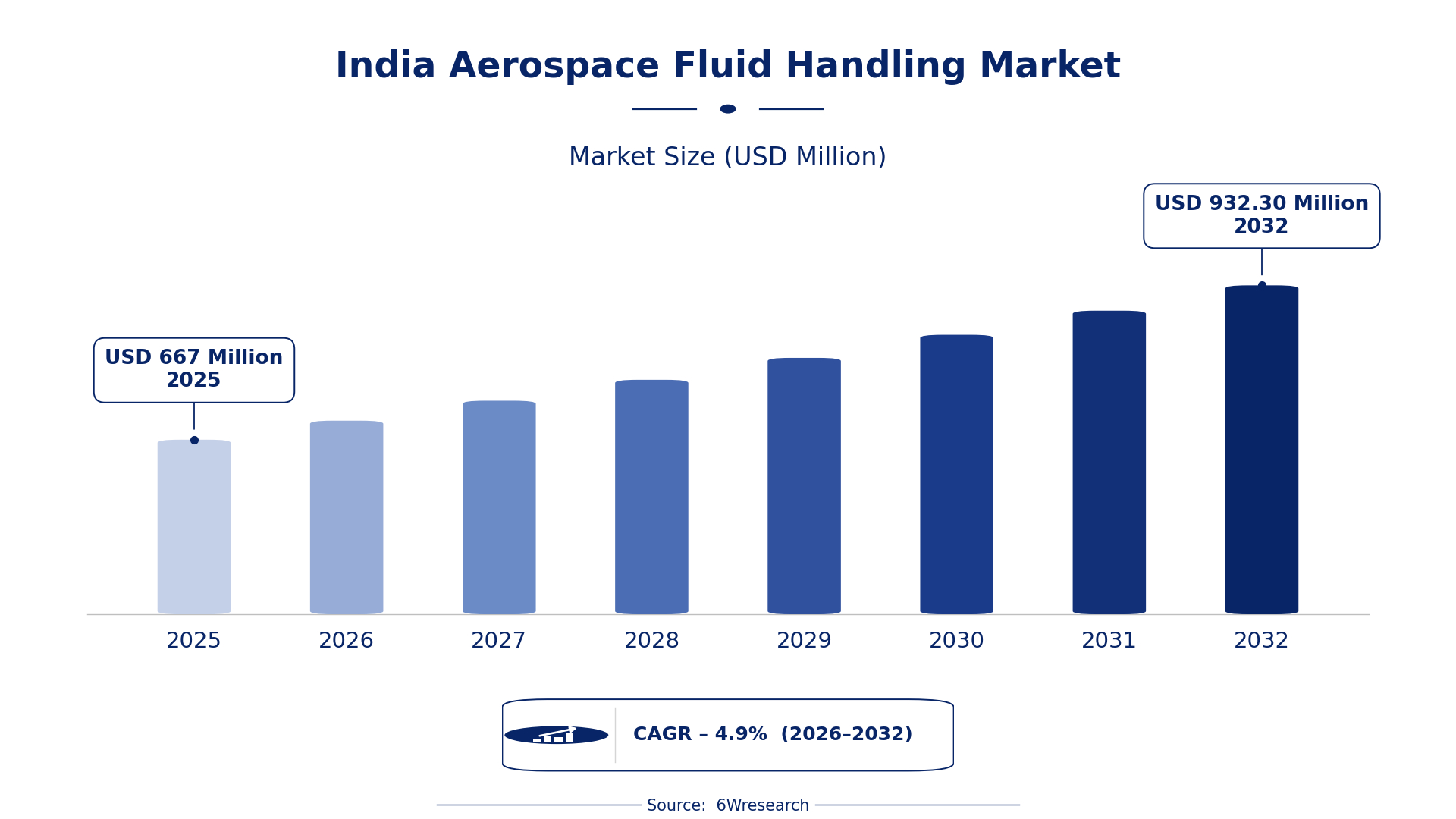
According to 6Wresearch internal database and industry insights, the India Aerospace Fluid Handling Market was valued at USD 667.0 million in 2025 and is projected to reach USD 932.30 million by 2032, growing at a CAGR of approximately 4.9% during 2026–2032.
India Aerospace Fluid Handling Market Highlights
| Report Metric | Details |
| Report Name | India Aerospace Fluid Handling Market |
| Market Size 2025 | USD 667.0 million |
| Market Size 2032 | USD 932.30 million |
| Absolute Growth 2025–2032 | USD 265.30 million |
| CAGR 2026–2032 | 4.9% |
| Peak Annual Growth | 7.2% in 2027 |
| Forecast Period | 2026–2032 |
| Historical Data | 2022–2025 |
| Base Year | 2025 |
| Leading System Type, 2025 | Hydraulic Systems (40% share) |
| Leading Fluid Type, 2025 | Jet Fuel (46% share) |
| Leading Distribution Channel, 2025 | Direct Sales (41% share) |
| Leading End User, 2025 | Aircraft Maintenance Firms (38% share) |
| Fastest-Growing System Type | Lubrication Systems (6.7% CAGR) |
| Fastest-Growing Fluid Type | Synthetic Oil (7.2% CAGR) |
| Fastest-Growing Distribution Channel | Online Platforms (6.3% CAGR) |
| Fastest-Growing End User | Aerospace Manufacturing Plants (6.8% CAGR) |
| Growing Sector | Aerospace Manufacturing |
| Key End Users | Aircraft Maintenance Firms, Aerospace Manufacturing Plants, Defense Aircraft Units |
India Aerospace Fluid Handling Market Year-wise Growth Rate and Key Drivers (2022–2032)
This graph illustrates the annual growth rates of the market from 2022 to 2032, highlighting a steady upward trajectory and projected market expansion over the forecast period.
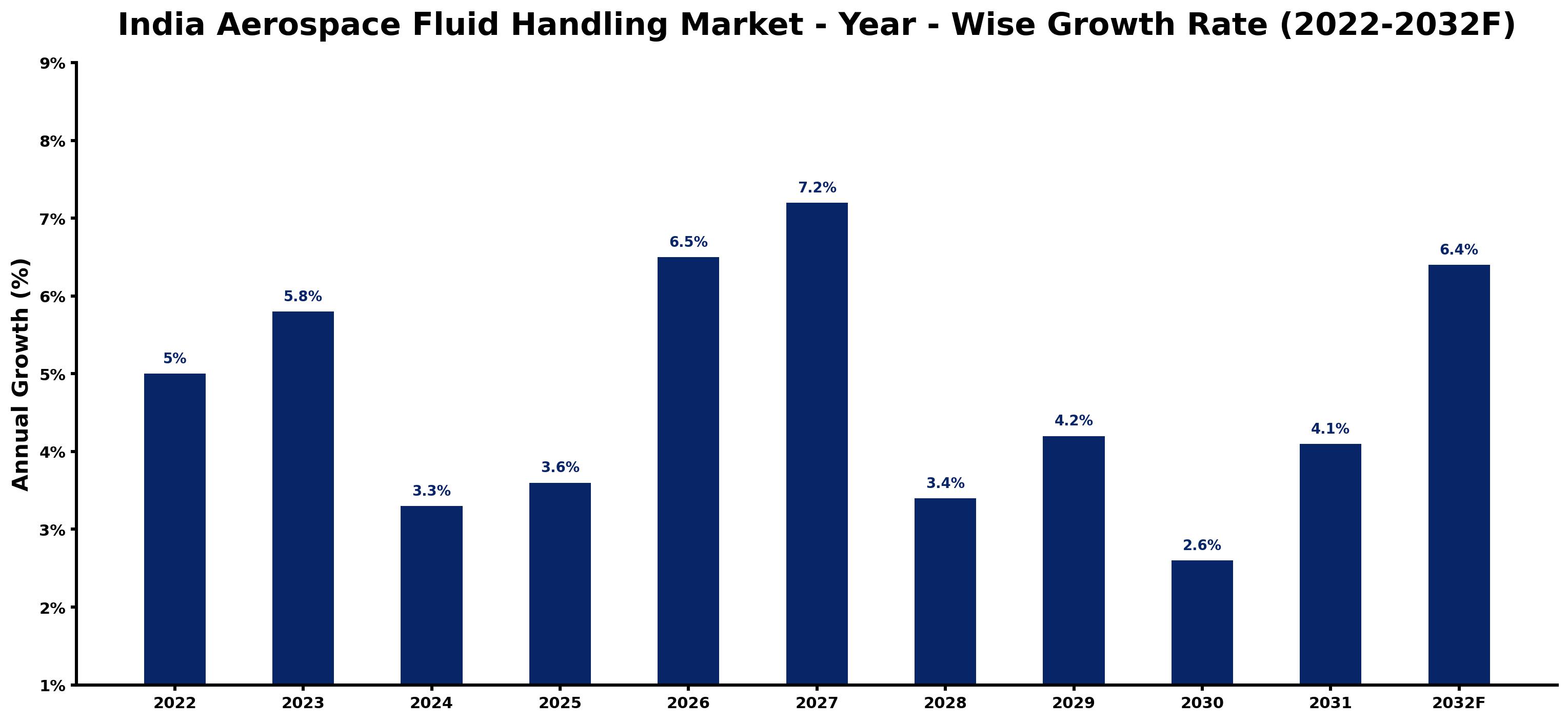
The table below sets out the estimated growth rate for each year and the main factor behind it.
| Year | Estimated Annual Growth (%) | Market Rationale |
| 2022 | 5.0 | The market experienced steady growth driven by increased aerospace activity and the Indian Air Force's operational needs. |
| 2023 | 5.8 | Demand surged due to the Indian Air Force's operational requirements for fluid handling systems. |
| 2024 | 3.3 | Growth slowed as manufacturers adjusted to supply chain challenges and fluctuating demand. |
| 2025 | 3.6 | A recovery in demand occurred as maintenance operations ramped up across the sector. |
| 2026 | 6.5 | Increased defense spending is expected to spur growth in aerospace fluid handling systems procurement. |
| 2027 | 7.2 | The peak growth year will see substantial investments in domestic manufacturing capabilities. |
| 2028 | 3.4 | A slowdown is anticipated as the market stabilises after rapid expansion in previous years. |
| 2029 | 4.2 | Growth is projected to resume as aerospace manufacturers increase production to meet rising demand. |
| 2030 | 2.6 | A further slowdown is anticipated as market conditions normalise post-peak growth. |
| 2031 | 4.1 | Demand is expected to increase again as the focus shifts to improving operational efficiencies. |
| 2032 | 6.4 | The market is projected to grow steadily due to ongoing investments in aerospace infrastructure. |
Note: Market size estimations and growth projections presented in this report are based on 6Wresearch's proprietary forecasting methodology, utilizing the latest available industry data, government publications, and primary research inputs.
India Aerospace Fluid Handling Market Synopsis
Aerospace Fluid Handling involves managing and transferring fluids in aircraft systems, including hydraulic, fuel, lubrication, and cooling systems. This sector is essential for maintaining engine performance and operational efficiency. The India Aerospace Fluid Handling Market is projected to grow, driven by the Indian Air Force's extensive operational fleet and the government's push for local manufacturing. With over 1,500 aircraft requiring advanced fluid handling systems, demand is expected to rise, supported by initiatives like 'Make in India' and the 'Production Linked Incentive Scheme.'
Market Dynamics Impact Analysis (2026–2032)
| Factor | Type | Impact | Primary Segment Affected |
| Increased defense budget allocations | Driver | High | Hydraulic Systems |
| Growing domestic manufacturing capabilities | Driver | High | Fuel Systems |
| Emerging demand for synthetic oils | Opportunity | Medium | Synthetic Oil |
| Investment in aerospace manufacturing hubs | Opportunity | High | Aerospace Manufacturing Plants |
| Quality standards set by the Bureau of Indian Standards | Restraint | High | Jet Fuel |
| Supply chain disruptions affecting procurement timelines | Restraint | Medium | Lubrication Systems |
| Competition for skilled workforce in aerospace manufacturing | Challenge | High | Aircraft Maintenance Firms |
| Rising costs of raw materials impacting pricing | Challenge | Medium | Cooling Systems |
Evaluation of Drivers in India Aerospace Fluid Handling Market (2026–2032)
Below mentioned are some major drivers and their influence on market dynamics.
| Drivers | Primary Segment Affected | Why It Matters (Evidence) |
| Increased defense spending | Hydraulic Systems | The Indian defense budget for 2023 is approximately $76 billion, driving demand for hydraulic systems in military aircraft. |
| Growth in aircraft maintenance operations | Fuel Systems | With over 1,500 aircraft in operation, maintenance firms are increasing their procurement of fuel systems. |
| Focus on local production | Lubrication Systems | The 'Make in India' initiative encourages local sourcing of lubrication systems, boosting domestic manufacturers. |
| Expansion of aerospace manufacturing hubs | Cooling Systems | Bengaluru, known as the aerospace capital, hosts numerous manufacturers driving demand for cooling systems. |
| Rising operational efficiency needs | Jet Fuel | The push for operational efficiency in aircraft operations increases the demand for high-quality jet fuel. |
Market growth for Aerospace Fluid Handling in India is underpinned by rising end-use demand from the aerospace sector and a strong supply response from local manufacturers. The Indian Air Force operates over 1,500 aircraft, necessitating extensive fluid handling systems to ensure operational efficiency. Investment in aerospace infrastructure is expected to stimulate market growth further, as manufacturers respond to rising demand from maintenance firms and defense units.
Evaluation of Restraints in India Aerospace Fluid Handling Market
Below mentioned are some major restraints and their influence on market dynamics.
| Market Restraint | Primary Segment Affected | Why It Matters (Evidence) |
| Strict quality standards imposed by the Bureau of Indian Standards | Jet Fuel | Compliance with BIS standards requires substantial investment in testing and certification for jet fuel suppliers. |
| Supply chain disruptions affecting timely deliveries | Lubrication Systems | Manufacturers face delays in sourcing critical components, impacting production schedules and maintenance operations. |
| High costs associated with advanced fluid handling technologies | Cooling Systems | The need for specialized equipment increases operational costs for maintenance firms, limiting procurement. |
| Limited availability of skilled workforce | Hydraulic Systems | The aerospace sector struggles to find qualified technicians, affecting production and service capabilities. |
| Regulatory hurdles in obtaining approvals for new products | Fuel Systems | Manufacturers face lengthy approval processes, delaying the introduction of new fuel systems. |
India Aerospace Fluid Handling Market Challenges
Buyers and suppliers in the India Aerospace Fluid Handling market encounter stringent regulations from the Directorate General of Civil Aviation, complicating product approvals and potentially delaying market entry for manufacturers. Rising raw material costs have resulted in a 15% increase in production expenses, pressuring pricing strategies for domestic buyers. A shortage of skilled engineers in the aerospace sector has caused project delays, impacting timelines for defence contractors who depend on timely execution. Increased competition among local manufacturers has narrowed profit margins, forcing some to operate at a loss, jeopardising their sustainability in the market.
Trends in the India Aerospace Fluid Handling Market
Below mentioned are some of the trends shaping the India Aerospace Fluid Handling Market growth.
- Shift towards Synthetic Oils: The Indian aerospace sector is increasingly adopting synthetic oils for lubrication applications, improving performance and reliability. In 2023, synthetic oil usage rose by 15%, driven by demand from aircraft maintenance firms.
- Transition to Advanced Cooling Solutions: Since 2022, there has been a notable shift towards advanced cooling systems in aircraft, improving efficiency and performance. The introduction of new cooling technologies has led to a 20% increase in demand from aerospace manufacturing plants.
- Emergence of Online Procurement Channels: The aerospace industry is seeing a transition towards online procurement platforms, facilitating easier access to suppliers. In 2023, online sales accounted for 10% of total fluid handling sales, reflecting changing buyer preferences.
- Prioritisation of Local Manufacturing: The 'Make in India' initiative has spurred a focus on local manufacturing in the aerospace sector since 2020. By 2025, the initiative aims to increase indigenous production by 30%, benefiting local suppliers.
Investment Opportunities in the India Aerospace Fluid Handling Market
Several openings in the India Aerospace Fluid Handling Market merit attention from investors.
- Investment in Aerospace Manufacturing Hubs: With 12 major aerospace manufacturing hubs in India, there is an opportunity for investment in facilities. The government aims to increase defense exports to $5 billion by 2025, attracting local and foreign investors.
- Supply of Synthetic Oils for Aerospace Applications: The growing demand for synthetic oils presents an opportunity for suppliers to enter the market. With a projected increase of 7.2% for synthetic oils, manufacturers can target aircraft maintenance firms.
- Expansion of Direct Sales Channels: Direct sales channels are becoming increasingly important, accounting for 41% of fluid handling sales. Suppliers can enhance their market presence by establishing partnerships with aircraft maintenance firms.
- Development of Advanced Cooling Systems: The need for efficient cooling solutions is rising, creating opportunities for suppliers of advanced cooling systems. Aerospace manufacturing plants are actively seeking innovative cooling technologies.
Government Initiatives in the India Aerospace Fluid Handling Market
The 'Production Linked Incentive Scheme' launched in 2021 aims to boost local production in the aerospace sector, complementing the 'Aerospace and Defence Policy' of 2020. This scheme incentivises manufacturers to increase output and reduce reliance on imports, impacting production capabilities. The 'National Civil Aviation Policy' updated in 2022 also supports infrastructure improvements, facilitating growth in the aerospace sector.
The Directorate General of Civil Aviation (DGCA) oversees compliance with aerospace fluid standards, ensuring quality and safety. The Ministry of Defence plays a key role in approving new products, allowing manufacturers to meet regulatory requirements and enhancing market access for buyers. In 2023, the DGCA approved 50 new products, streamlining the approval process for manufacturers.
Future Insight of the India Aerospace Fluid Handling Market
By 2032, the India Aerospace Fluid Handling market will undergo notable changes driven by advancements in fluid management technologies and the government's push for local production through the 'Make in India' initiative. The Indian Air Force's plans to expand its fleet will create a heightened demand for innovative fluid handling systems. With the defence budget projected to reach $76 billion, procurement of advanced aerospace components will see a substantial increase. The aim to elevate defence exports to $5 billion by 2025 will motivate manufacturers to improve their product offerings.
Market Segmentation Analysis
The analysis below covers each segmentation, its leading category in 2025 and its fastest-growing category through 2032.
By System Type – Hydraulic Systems Dominated, Lubrication Systems Expected to Grow Fastest
According to Ravi Bhandari, Research Head at 6Wresearch, in 2025, Hydraulic Systems led the system type split with a 40% share. Hydraulic systems capture the largest market share because they are crucial for aircraft operation and control, particularly for the Indian Air Force's fleet of over 1,500 aircraft. This reliance translates into a consistent demand for effective fluid handling solutions within the aerospace sector. Lubrication Systems are projected to grow fastest, at a CAGR of 6.7% during 2026–2032. Lubrication systems are witnessing rapid growth as the aerospace manufacturing sector expands, necessitating improved friction reduction in moving parts. The 'Make in India' initiative also stimulates this growth by promoting local production of essential aerospace components. Suppliers should prioritise the development of lubrication system solutions to address the increasing demand within the aerospace industry.
By Fluid Type – Jet Fuel Dominated, Synthetic Oil Expected to Grow Fastest
Jet Fuel held a 46% share of the India Aerospace Fluid Handling Market by fluid type in 2025. Jet fuel dominates the market share since it is the primary fuel type for aircraft engines, essential for powering the extensive fleet in India's aerospace sector. The strong reliance on jet fuel by both military and commercial aviation solidifies its leading position in the market. Synthetic Oil is set to record the highest CAGR in this split, 7.2% over 2026–2032. Synthetic oil is the fastest-growing segment, driven by its expanding use in specialised lubrication applications, which is supported by advancements in aerospace technology. This trend aligns with the industry's emphasis on enhancing operational efficiency and engine performance. Buyers should consider investing in synthetic oil solutions to enhance the performance and longevity of their aerospace systems.
By Distribution Channel – Direct Sales Dominated, Online Platforms Expected to Grow Fastest
With a 41% revenue share in 2025, Direct Sales was the largest distribution channel category. Direct sales capture the largest market share as they serve as the primary procurement channel for firms, allowing aerospace manufacturers to efficiently acquire essential fluid handling systems. This method effectively addresses the specific requirements of large-scale operations in the industry. Over 2026–2032, Online Platforms are expected to post the fastest growth, at a CAGR of 6.3%. Online platforms are emerging as the fastest-growing distribution channel, reflecting the shift towards digital procurement in the aerospace sector. This trend is influenced by the increasing demand for convenience and accessibility in sourcing fluid handling products. Suppliers need to strengthen their online presence to attract the growing number of buyers who prefer digital channels for procurement.
By End User – Aircraft Maintenance Firms Dominated, Aerospace Manufacturing Plants Expected to Grow Fastest
Aircraft Maintenance Firms accounted for a 38% market share by end user in 2025. Aircraft maintenance firms represent the largest market share as they are major users of aerospace fluid handling systems for maintenance and repair operations, ensuring the safety and reliability of aircraft. The extensive network of maintenance firms across India supports the sustained demand for these systems. The quickest growth will come from Aerospace Manufacturing Plants, forecast to expand at a CAGR of 6.8% between 2026 and 2032. Aerospace manufacturing plants are the fastest-growing end user segment, driven by the increasing production of aircraft components and systems. The expansion of manufacturing capabilities in regions like Bengaluru is a key factor in this growth. Suppliers should target aerospace manufacturing plants to align with the rapid growth in production and fluid handling requirements.
Key Attractiveness of the Report
- 10 Years of Market Numbers
- Historical Data Starting from 2022 to 2025
- Base Year 2025
- Forecast Data until 2032
- Key Performance Indicators Impacting the Market
- Major Upcoming Developments and Projects
Key Highlights of the Report:
- India Aerospace Fluid Handling Market Outlook
- Market Size of India Aerospace Fluid Handling Market, 2025
- Forecast of India Aerospace Fluid Handling Market, 2032
- Historical Data and Forecast of India Aerospace Fluid Handling Revenues & Volume for the Period 2022 - 2032F
- India Aerospace Fluid Handling Market Trend Evolution
- India Aerospace Fluid Handling Market Drivers and Challenges
- India Aerospace Fluid Handling Price Trends
- India Aerospace Fluid Handling Porter's Five Forces
- India Aerospace Fluid Handling Industry Life Cycle
- Historical Data and Forecast of India Aerospace Fluid Handling Market Revenues & Volume By System Type for the Period 2022 - 2032F
- Historical Data and Forecast of India Aerospace Fluid Handling Market Revenues & Volume By Hydraulic Systems for the Period 2022 - 2032F
- Historical Data and Forecast of India Aerospace Fluid Handling Market Revenues & Volume By Fuel Systems for the Period 2022 - 2032F
- Historical Data and Forecast of India Aerospace Fluid Handling Market Revenues & Volume By Lubrication Systems for the Period 2022 - 2032F
- Historical Data and Forecast of India Aerospace Fluid Handling Market Revenues & Volume By Cooling Systems for the Period 2022 - 2032F
- Historical Data and Forecast of India Aerospace Fluid Handling Market Revenues & Volume By Fluid Type for the Period 2022 - 2032F
- Historical Data and Forecast of India Aerospace Fluid Handling Market Revenues & Volume By Hydraulic Oil for the Period 2022 - 2032F
- Historical Data and Forecast of India Aerospace Fluid Handling Market Revenues & Volume By Jet Fuel for the Period 2022 - 2032F
- Historical Data and Forecast of India Aerospace Fluid Handling Market Revenues & Volume By Synthetic Oil for the Period 2022 - 2032F
- Historical Data and Forecast of India Aerospace Fluid Handling Market Revenues & Volume By Coolants for the Period 2022 - 2032F
- Historical Data and Forecast of India Aerospace Fluid Handling Market Revenues & Volume By Distribution Channel for the Period 2022 - 2032F
- Historical Data and Forecast of India Aerospace Fluid Handling Market Revenues & Volume By Direct Sales for the Period 2022 - 2032F
- Historical Data and Forecast of India Aerospace Fluid Handling Market Revenues & Volume By Industrial Suppliers for the Period 2022 - 2032F
- Historical Data and Forecast of India Aerospace Fluid Handling Market Revenues & Volume By Online Platforms for the Period 2022 - 2032F
- Historical Data and Forecast of India Aerospace Fluid Handling Market Revenues & Volume By Specialty Stores for the Period 2022 - 2032F
- Historical Data and Forecast of India Aerospace Fluid Handling Market Revenues & Volume By End User for the Period 2022 - 2032F
- Historical Data and Forecast of India Aerospace Fluid Handling Market Revenues & Volume By Aircraft Maintenance Firms for the Period 2022 - 2032F
- Historical Data and Forecast of India Aerospace Fluid Handling Market Revenues & Volume By Aircraft Engine OEMs for the Period 2022 - 2032F
- Historical Data and Forecast of India Aerospace Fluid Handling Market Revenues & Volume By Aerospace Manufacturing Plants for the Period 2022 - 2032F
- Historical Data and Forecast of India Aerospace Fluid Handling Market Revenues & Volume By Defense Aircraft Units for the Period 2022 - 2032F
- India Aerospace Fluid Handling Import Export Trade Statistics
- Market Opportunity Assessment By System Type
- Market Opportunity Assessment By Fluid Type
- Market Opportunity Assessment By Distribution Channel
- Market Opportunity Assessment By End User
- India Aerospace Fluid Handling Top Companies Market Share
- India Aerospace Fluid Handling Competitive Benchmarking By Technical and Operational Parameters
- India Aerospace Fluid Handling Company Profiles
- India Aerospace Fluid Handling Key Strategic Recommendations
Market Covered
This report examines the market across the segments below.
By System Type
- Hydraulic Systems
- Fuel Systems
- Lubrication Systems
- Cooling Systems
By Fluid Type
- Hydraulic Oil
- Jet Fuel
- Synthetic Oil
- Coolants
By Distribution Channel
- Direct Sales
- Industrial Suppliers
- Online Platforms
- Specialty Stores
By End User
- Aircraft Maintenance Firms
- Aircraft Engine OEMs
- Aerospace Manufacturing Plants
- Defense Aircraft Units































