China Aerospace IoT Sensors Market Size & Growth Rate
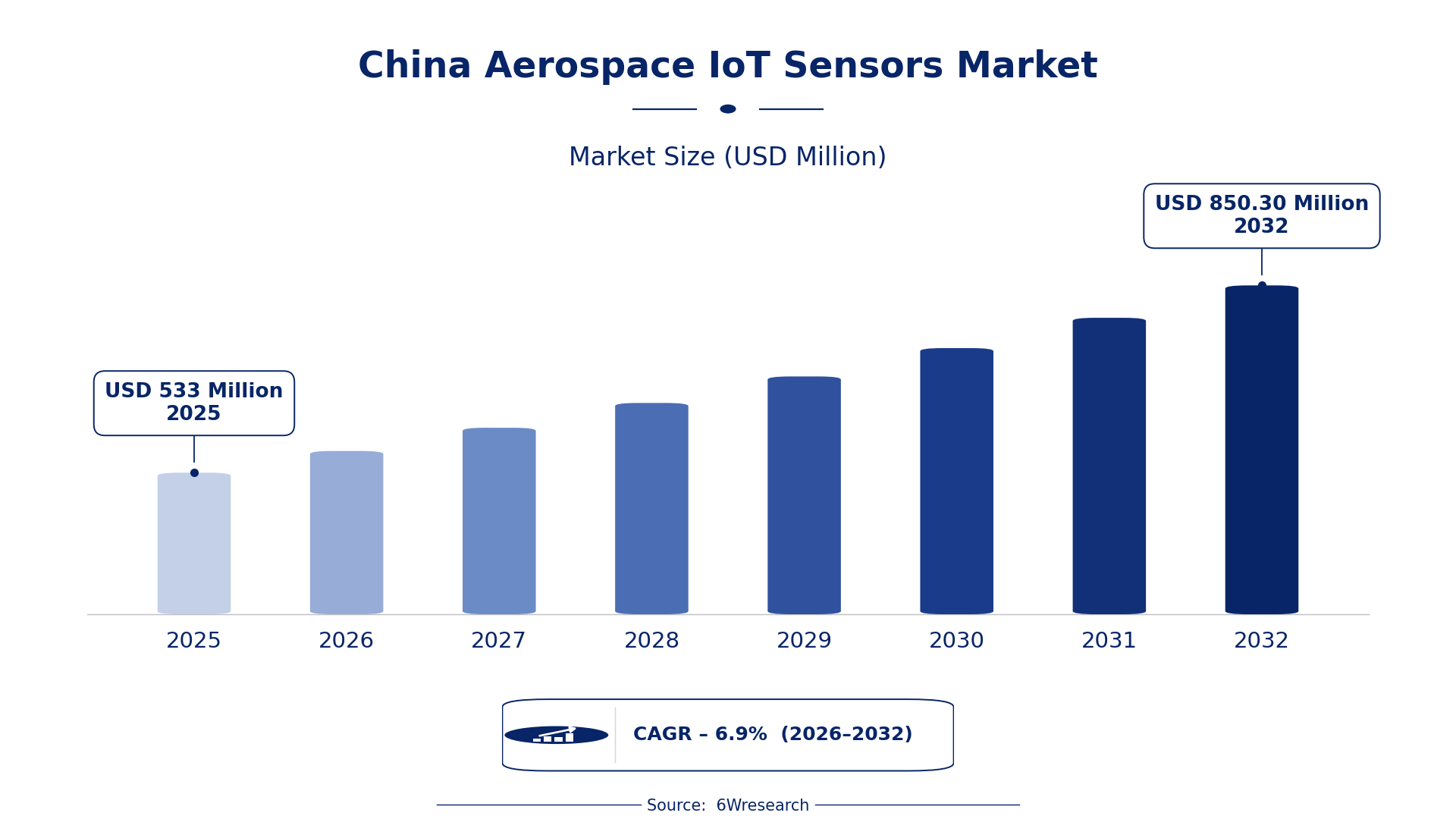
According to 6Wresearch internal database and industry insights, the China Aerospace IoT Sensors Market was valued at USD 533.0 million in 2025 and is projected to reach USD 850.30 million by 2032, growing at a CAGR of approximately 6.9% during 2026–2032.
China Aerospace IoT Sensors Market Highlights
| Report Metric | Details |
| Report Name | China Aerospace IoT Sensors Market |
| Market Size 2025 | USD 533.0 million |
| Market Size 2032 | USD 850.30 million |
| Absolute Growth 2025–2032 | USD 317.30 million |
| CAGR 2026–2032 | 6.9% |
| Peak Annual Growth | 9.5% in 2032 |
| Forecast Period | 2026–2032 |
| Historical Data | 2022–2025 |
| Base Year | 2025 |
| Leading Sensor Type, 2025 | Temperature Sensors (41% share) |
| Leading Connectivity Type, 2025 | Wireless (47% share) |
| Leading Distribution Channel, 2025 | Direct Sales (49% share) |
| Leading End User, 2025 | Aircraft Maintenance Teams (48% share) |
| Fastest-Growing Sensor Type | Vibration Sensors (9.1% CAGR) |
| Fastest-Growing Connectivity Type | IoT-Integrated (9.2% CAGR) |
| Fastest-Growing Distribution Channel | Industrial Suppliers (8.4% CAGR) |
| Fastest-Growing End User | UAV Manufacturers (8.7% CAGR) |
| Growing Sector | Aerospace |
| Key End Users | Aircraft Maintenance Teams, UAV Manufacturers, Defense Fleet Operators |
China Aerospace IoT Sensors Market Year-wise Growth Rate and Key Drivers (2022–2032)
This graph illustrates the annual growth rates of the market from 2022 to 2032, highlighting a steady upward trajectory and projected market expansion over the forecast period.
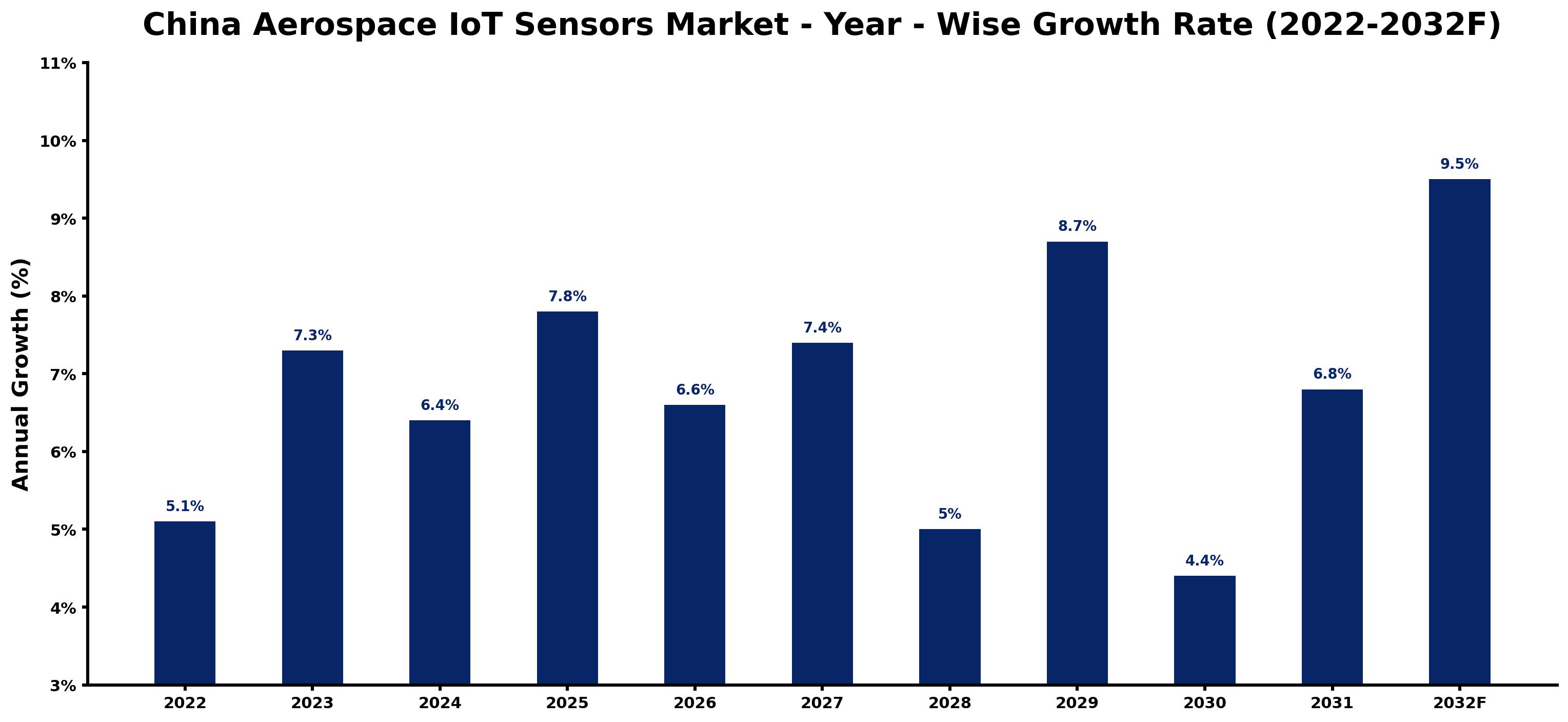
Annual growth estimates for each year appear below with the principal reason behind them, explaining the shifts that set the pace of the market.
| Year | Estimated Annual Growth (%) | Market Rationale |
| 2022 | 5.1 | The market exhibited steady growth, driven by increasing demand for advanced aerospace technologies. |
| 2023 | 7.3 | Growth accelerated due to heightened production of commercial aircraft in the Beijing-Tianjin-Hebei region. |
| 2024 | 6.4 | Growth slowed slightly as manufacturers adjusted to new regulatory standards for aerospace sensors. |
| 2025 | 7.8 | Demand surged as the Civil Aviation Administration of China mandated advanced sensor systems for safety. |
| 2026 | 6.6 | Growth moderated as manufacturers focused on integrating IoT technologies into existing systems. |
| 2027 | 7.4 | An increase in UAV production drove demand for IoT sensors, boosting market performance. |
| 2028 | 5.0 | Growth decelerated due to the saturation of certain sensor types in the market. |
| 2029 | 8.7 | Demand rose sharply as the UAV market expanded, increasing sensor requirements. |
| 2030 | 4.4 | Growth slowed as manufacturers faced challenges in meeting new quality standards set by the CAAC. |
| 2031 | 6.8 | A resurgence in aircraft production led to increased orders for aerospace IoT sensors. |
| 2032 | 9.5 | The market peaked as the National Aerospace Industry Development Plan drove technology advancements. |
Note: Market size estimations and growth projections presented in this report are based on 6Wresearch's proprietary forecasting methodology, utilizing the latest available industry data, government publications, and primary research inputs.
China Aerospace IoT Sensors Market Synopsis
Aerospace IoT Sensors in China include cutting-edge devices designed to gather and transmit data on aircraft performance and environmental conditions. These sensors play a crucial role in monitoring aircraft systems, ensuring safety, and optimising maintenance schedules. The China Aerospace IoT Sensors Market is growing due to increased domestic aircraft production and heightened demand from the defence sector. With an installed base exceeding 3,000 aircraft, advanced sensors are required to maintain operational readiness. Investments in aerospace technology are driving market expansion.
Market Dynamics Impact Analysis (2026–2032)
| Factor | Type | Impact | Primary Segment Affected |
| Rising domestic aircraft production increases demand for advanced monitoring systems. | Driver | High | Temperature Sensors |
| Growing UAV market drives the need for integrated sensor solutions. | Driver | High | IoT-Integrated |
| Investment in aerospace technology development creates opportunities for sensor manufacturers. | Opportunity | High | Wireless |
| The National Aerospace Industry Development Plan aims to enhance sensor technology by 2025, creating demand. | Opportunity | High | Pressure Sensors |
| Strict compliance with ISO 9001 certification can limit the number of manufacturers. | Restraint | High | Vibration Sensors |
| High production costs for advanced sensors can deter new entrants into the market. | Restraint | Medium | Proximity Sensors |
| The China Aerospace IoT Sensors Market faces challenges due to regulatory compliance issues. | Challenge | High | Wired |
| Limited adoption of certain sensor types can restrict market growth potential. | Challenge | Medium | Bluetooth/LoRaWAN |
Evaluation of Drivers in China Aerospace IoT Sensors Market (2026–2032)
The factors lifting demand, and the evidence behind each, are summarised below.
| Drivers | Primary Segment Affected | Why It Matters (Evidence) |
| Increased production of commercial aircraft drives demand for Temperature Sensors. | Temperature Sensors | In 2022, China produced over 200 commercial aircraft, necessitating advanced monitoring systems. |
| Rising UAV production boosts the need for IoT-Integrated sensors. | IoT-Integrated | China's UAV market is projected to grow by over 15% annually, increasing demand for IoT sensors. |
| Investment in aerospace technology enhances Wireless sensor capabilities. | Wireless | The Guangdong province is a leading region for aerospace technology development, fostering innovation. |
| Regulatory standards from the CAAC mandate advanced sensor systems for safety improvements. | Pressure Sensors | In 2023, the CAAC updated regulations to mandate advanced sensor systems in new aircraft designs. |
| The Smart Aerospace Initiative promotes research and development of Vibration Sensors. | Vibration Sensors | The Ministry of Science and Technology initiated the Smart Aerospace Initiative in 2022. |
Growth in the Aerospace IoT Sensors market in China is driven by rising domestic aircraft production, increased UAV deployment, and substantial investments in aerospace technology. In 2022, over 200 commercial aircraft were produced, which spurred demand for advanced monitoring systems. The UAV market is expected to grow by over 15% annually, creating a greater need for IoT-Integrated sensors. The Guangdong province is becoming a centre for aerospace technology development, improving wireless sensor capabilities.
Evaluation of Restraints in China Aerospace IoT Sensors Market
The following restraints limit how fast demand can grow.
| Market Restraint | Primary Segment Affected | Why It Matters (Evidence) |
| Strict compliance with ISO 9001 certification limits the number of manufacturers. | Vibration Sensors | ISO 9001 certification is a standard requirement for aerospace sensor manufacturers in China. |
| High production costs for advanced sensors deter new entrants. | Proximity Sensors | The cost of advanced sensor technology can be prohibitive for smaller manufacturers. |
| Limited adoption of Bluetooth/LoRaWAN sensors restricts market growth potential. | Bluetooth/LoRaWAN | Bluetooth/LoRaWAN has limited use in aerospace applications compared to other connectivity types. |
| Regulatory compliance issues can slow down product development timelines. | Wired | Manufacturers face challenges in meeting stringent regulatory standards set by the CAAC. |
| Market saturation in certain sensor types can limit growth opportunities. | Temperature Sensors | The installed base of aircraft in China is over 3,000, necessitating advanced sensors. |
China Aerospace IoT Sensors Market Challenges
The China Aerospace IoT Sensors Market encounters various practical issues, with regulatory compliance being a major concern. The Civil Aviation Administration of China's strict standards can delay product approvals, costing producers up to six months in time-to-market. Buyers face challenges as well; the production of over 200 commercial aircraft in 2022 has escalated the demand for advanced sensors, putting pressure on their budgets. Rising material costs can elevate prices by 15%, complicating procurement strategies for buyers. Technology limitations also impede progress; while the National Aerospace Industry Development Plan aims for improvements by 2025, current gaps restrict immediate advancements for producers.
Trends in the China Aerospace IoT Sensors Market
Four trends stand out in the China Aerospace IoT Sensors Market.
- Launch of the Aerospace Sensor Development Plan: The Ministry of Industry and Information Technology's Aerospace Sensor Development Plan, initiated in 2021, aims to improve domestic production capabilities. This initiative is expected to increase the quality and availability of sensors in the market.
- UAV Manufacturers Increasing Demand for IoT Sensors: UAV Manufacturers are significantly increasing their demand for IoT sensors, with the UAV market projected to grow significantly. In 2023, this sector is expected to drive a notable rise in sensor integration.
- Focus on Wireless Connectivity in Aerospace Sensors: The shift towards Wireless connectivity is evident, with Wireless sensors holding a 47% market share in 2025. This trend supports real-time data transmission, essential for modern aerospace applications.
- Expansion of the Smart Aerospace Initiative: The Smart Aerospace Initiative, launched in 2022, promotes research in IoT sensor technology. This initiative is expected to support the integration of advanced sensor systems in aerospace applications.
Investment Opportunities in the China Aerospace IoT Sensors Market
The following opportunities in the China Aerospace IoT Sensors Market pair current demand with a clear way in.
- Supply of Advanced Temperature Sensors: With over 200 commercial aircraft produced in 2022, there is a strong opportunity to supply advanced Temperature Sensors. Aircraft Maintenance Teams are actively seeking reliable monitoring solutions.
- Investment in IoT-Integrated Sensors: Now is an opportune time to invest in IoT-Integrated sensors, as the UAV market is projected to grow significantly. Collaborating with UAV Manufacturers can facilitate market entry.
- Development of Wireless Sensor Solutions: The growing demand for Wireless sensors presents an opportunity for manufacturers to develop effective solutions. The Guangdong province is a key market for these advancements.
- Enhancement of Pressure Sensor Technology: The CAAC's new regulations create a need for enhanced Pressure Sensor technology. Manufacturers can enter this market by obtaining necessary certifications and collaborating with aircraft manufacturers.
Government Initiatives in the China Aerospace IoT Sensors Market
The Aerospace Sensor Development Plan, launched by the Ministry of Industry and Information Technology in 2021, aims to improve domestic production capabilities for aerospace sensors. This initiative encourages manufacturers to invest in advanced technologies and improve production quality. The National Development and Reform Commission approved the Aerospace Technology Innovation Strategy in 2022, focusing on IoT integration in aerospace applications. This strategy is expected to drive innovation and increase the competitiveness of domestic sensor manufacturers. In 2023, the CAAC updated regulations to mandate advanced sensor systems in new aircraft designs, ensuring safety improvements.
The Smart Aerospace Initiative promotes research and development in IoT sensor technology, providing funding for innovative projects. The CAAC plays a vital role in implementing regulations that impact aerospace sensor producers. In 2023, the CAAC updated regulations to mandate advanced sensor systems in new aircraft designs, ensuring safety improvements. Furthermore, the Smart Aerospace Initiative promotes research and development in IoT sensor technology, providing funding for innovative projects. These measures support manufacturers in enhancing their product offerings and meeting regulatory requirements.
Future Insight of the China Aerospace IoT Sensors Market
Several forward-looking factors should support the China Aerospace IoT Sensors Market over the coming years. The rapid growth of the UAV market will significantly boost demand for sophisticated sensors, aligning with the 2023 initiative focused on enhancing aerospace IoT integration. By 2025, advancements in sensor technology will transform product offerings and operational efficiencies. With over 3,000 aircraft in operation, continuous innovation in sensor capabilities will be essential for both buyers and suppliers to maintain competitive advantages.
Market Segmentation Analysis
The analysis below covers each segmentation, its leading category in 2025 and its fastest-growing category through 2032.
By Sensor Type – Temperature Sensors Dominated, Vibration Sensors Expected to Grow Fastest
According to Ravi Bhandari, Research Head at 6Wresearch, Temperature Sensors held a 41% share of the China Aerospace IoT Sensors Market by sensor type in 2025. Temperature Sensors hold the largest share in the China Aerospace IoT Sensors Market due to their critical function in monitoring thermal conditions in aircraft systems. With over 3,000 aircraft installed, the demand for these sensors is crucial for maintaining safety and operational efficiency. Vibration Sensors are projected to grow fastest, at a CAGR of 9.1% during 2026–2032. Vibration Sensors are experiencing rapid growth as they gain importance for predictive maintenance in the aerospace sector. The production of over 200 commercial aircraft in 2022 is propelling this demand, as manufacturers strive to enhance reliability and operational performance. This indicates that suppliers should concentrate on advancing temperature and vibration sensors to satisfy the increasing requirements of the aerospace industry.
By Connectivity Type – Wireless Dominated, IoT-Integrated Expected to Grow Fastest
In 2025, Wireless led the connectivity type split with a 47% share. Wireless connectivity commands the largest market share as it facilitates real-time data transmission without the constraints of physical connections. This preference is particularly pronounced in the Beijing-Tianjin-Hebei region, a pivotal hub for aerospace manufacturing, where efficiency is paramount. Over 2026–2032, IoT-Integrated is expected to post the fastest growth, at a CAGR of 9.2%. IoT-Integrated connectivity is the fastest-growing segment, driven by the rising need for real-time data integration in aerospace applications. The 2023 initiative aimed at improving aerospace IoT integration significantly fuels this growth, aligning with industry advancements. Suppliers should focus on enhancing wireless and IoT-Integrated technologies to capitalise on expanding market opportunities within aerospace.
By Distribution Channel – Direct Sales Dominated, Industrial Suppliers Expected to Grow Fastest
Direct Sales took a 49% share of distribution channel in 2025, more than any other category. Direct Sales is the leading distribution channel, serving as the primary method for selling aerospace sensors directly to manufacturers. This approach is particularly vital in high aerospace activity regions, such as Guangdong province, where direct relationships enhance market effectiveness. Industrial Suppliers are set to record the highest CAGR in this split, 8.4% over 2026–2032. Industrial Suppliers represent the fastest-growing channel, acting as a crucial link between sensor manufacturers and end users. As the demand for aerospace IoT sensors escalates, industrial suppliers are becoming increasingly essential for timely distribution and market responsiveness. This trend suggests that suppliers should reinforce partnerships with industrial suppliers to broaden their market reach and improve service delivery.
By End User – Aircraft Maintenance Teams Dominated, UAV Manufacturers Expected to Grow Fastest
With a 48% revenue share in 2025, Aircraft Maintenance Teams was the largest end user category. Aircraft Maintenance Teams account for the largest share of end users, as they depend heavily on sensors to ensure aircraft safety and performance. Their operational needs are underscored by the ongoing production of over 200 commercial aircraft in 2022, which necessitates advanced monitoring solutions. The quickest growth will come from UAV Manufacturers, forecast to expand at a CAGR of 8.7% between 2026 and 2032. UAV Manufacturers are the fastest-growing end user segment, propelled by the surging demand for unmanned aerial vehicles. The expected growth in China's UAV market significantly contributes to this rapid expansion, highlighting a shift in industry focus. This growth suggests that suppliers should tailor their offerings to address the specific requirements of UAV manufacturers alongside traditional aircraft maintenance teams.
Key Attractiveness of the Report
- 10 Years of Market Numbers
- Historical Data Starting from 2022 to 2025
- Base Year 2025
- Forecast Data until 2032
- Key Performance Indicators Impacting the Market
- Major Upcoming Developments and Projects
Key Highlights of the Report:
- China Aerospace IoT Sensors Market Outlook
- Market Size of China Aerospace IoT Sensors Market, 2025
- Forecast of China Aerospace IoT Sensors Market, 2032
- Historical Data and Forecast of China Aerospace IoT Sensors Revenues & Volume for the Period 2022 - 2032F
- China Aerospace IoT Sensors Market Trend Evolution
- China Aerospace IoT Sensors Market Drivers and Challenges
- China Aerospace IoT Sensors Price Trends
- China Aerospace IoT Sensors Porter's Five Forces
- China Aerospace IoT Sensors Industry Life Cycle
- Historical Data and Forecast of China Aerospace IoT Sensors Market Revenues & Volume By Sensor Type for the Period 2022 - 2032F
- Historical Data and Forecast of China Aerospace IoT Sensors Market Revenues & Volume By Temperature Sensors for the Period 2022 - 2032F
- Historical Data and Forecast of China Aerospace IoT Sensors Market Revenues & Volume By Pressure Sensors for the Period 2022 - 2032F
- Historical Data and Forecast of China Aerospace IoT Sensors Market Revenues & Volume By Proximity Sensors for the Period 2022 - 2032F
- Historical Data and Forecast of China Aerospace IoT Sensors Market Revenues & Volume By Vibration Sensors for the Period 2022 - 2032F
- Historical Data and Forecast of China Aerospace IoT Sensors Market Revenues & Volume By Connectivity Type for the Period 2022 - 2032F
- Historical Data and Forecast of China Aerospace IoT Sensors Market Revenues & Volume By Wireless for the Period 2022 - 2032F
- Historical Data and Forecast of China Aerospace IoT Sensors Market Revenues & Volume By Wired for the Period 2022 - 2032F
- Historical Data and Forecast of China Aerospace IoT Sensors Market Revenues & Volume By Bluetooth/LoRaWAN for the Period 2022 - 2032F
- Historical Data and Forecast of China Aerospace IoT Sensors Market Revenues & Volume By IoT-Integrated for the Period 2022 - 2032F
- Historical Data and Forecast of China Aerospace IoT Sensors Market Revenues & Volume By Distribution Channel for the Period 2022 - 2032F
- Historical Data and Forecast of China Aerospace IoT Sensors Market Revenues & Volume By Direct Sales for the Period 2022 - 2032F
- Historical Data and Forecast of China Aerospace IoT Sensors Market Revenues & Volume By Online Platforms for the Period 2022 - 2032F
- Historical Data and Forecast of China Aerospace IoT Sensors Market Revenues & Volume By Industrial Suppliers for the Period 2022 - 2032F
- Historical Data and Forecast of China Aerospace IoT Sensors Market Revenues & Volume By Specialty Stores for the Period 2022 - 2032F
- Historical Data and Forecast of China Aerospace IoT Sensors Market Revenues & Volume By End User for the Period 2022 - 2032F
- Historical Data and Forecast of China Aerospace IoT Sensors Market Revenues & Volume By Aircraft Maintenance Teams for the Period 2022 - 2032F
- Historical Data and Forecast of China Aerospace IoT Sensors Market Revenues & Volume By Engine Monitoring Units for the Period 2022 - 2032F
- Historical Data and Forecast of China Aerospace IoT Sensors Market Revenues & Volume By UAV Manufacturers for the Period 2022 - 2032F
- Historical Data and Forecast of China Aerospace IoT Sensors Market Revenues & Volume By Defense Fleet Operators for the Period 2022 - 2032F
- China Aerospace IoT Sensors Import Export Trade Statistics
- Market Opportunity Assessment By Sensor Type
- Market Opportunity Assessment By Connectivity Type
- Market Opportunity Assessment By Distribution Channel
- Market Opportunity Assessment By End User
- China Aerospace IoT Sensors Top Companies Market Share
- China Aerospace IoT Sensors Competitive Benchmarking By Technical and Operational Parameters
- China Aerospace IoT Sensors Company Profiles
- China Aerospace IoT Sensors Key Strategic Recommendations
Market Covered
The report offers an extensive study of the following market segments.
By Sensor Type
- Temperature Sensors
- Pressure Sensors
- Proximity Sensors
- Vibration Sensors
By Connectivity Type
- Wireless
- Wired
- Bluetooth/LoRaWAN
- IoT-Integrated
By Distribution Channel
- Direct Sales
- Online Platforms
- Industrial Suppliers
- Specialty Stores
By End User
- Aircraft Maintenance Teams
- Engine Monitoring Units
- UAV Manufacturers
- Defense Fleet Operators































