India Aerospace IoT Sensors Market Size & Growth Rate
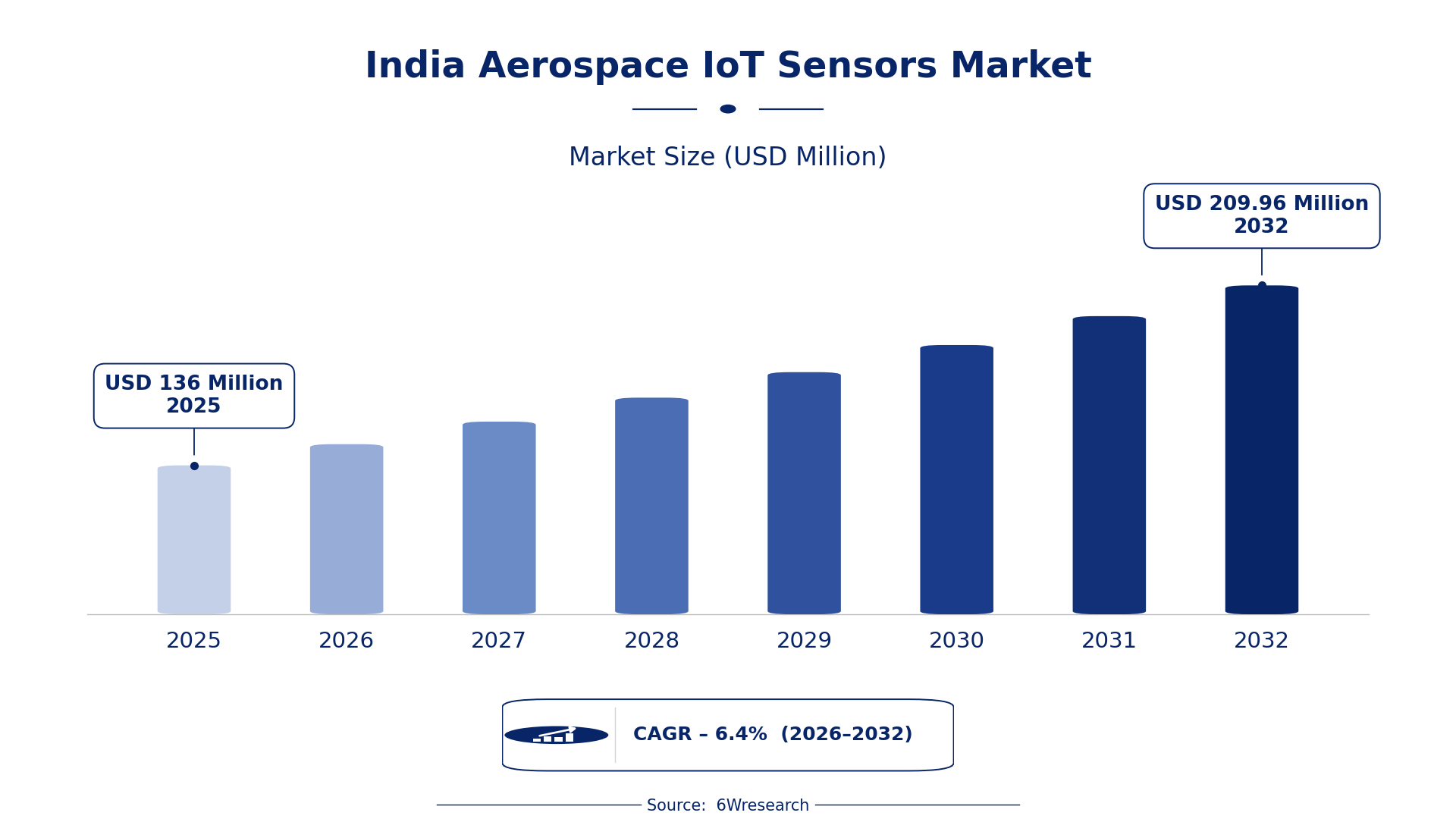
According to 6Wresearch internal database and industry insights, the India Aerospace IoT Sensors Market was valued at USD 136.0 million in 2025 and is projected to reach USD 209.96 million by 2032, growing at a CAGR of approximately 6.4% during 2026–2032.
India Aerospace IoT Sensors Market Highlights
| Report Metric | Details |
| Report Name | India Aerospace IoT Sensors Market |
| Market Size 2025 | USD 136.0 million |
| Market Size 2032 | USD 209.96 million |
| Absolute Growth 2025–2032 | USD 73.96 million |
| CAGR 2026–2032 | 6.4% |
| Peak Annual Growth | 8.6% in 2026 |
| Forecast Period | 2026–2032 |
| Historical Data | 2022–2025 |
| Base Year | 2025 |
| Leading Sensor Type, 2025 | Temperature Sensors (47% share) |
| Leading Connectivity Type, 2025 | Wireless (35% share) |
| Leading Distribution Channel, 2025 | Direct Sales (40% share) |
| Leading End User, 2025 | Aircraft Maintenance Teams (52% share) |
| Fastest-Growing Sensor Type | Pressure Sensors (7.9% CAGR) |
| Fastest-Growing Connectivity Type | Wired (7.5% CAGR) |
| Fastest-Growing Distribution Channel | Online Platforms (8.5% CAGR) |
| Fastest-Growing End User | Engine Monitoring Units (8.8% CAGR) |
| Growing Sector | Aerospace Maintenance |
| Key End Users | Aircraft Maintenance Teams, UAV Manufacturers, Defense Fleet Operators |
India Aerospace IoT Sensors Market Year-wise Growth Rate and Key Drivers (2022–2032)
This graph illustrates the annual growth rates of the market from 2022 to 2032, highlighting a steady upward trajectory and projected market expansion over the forecast period.
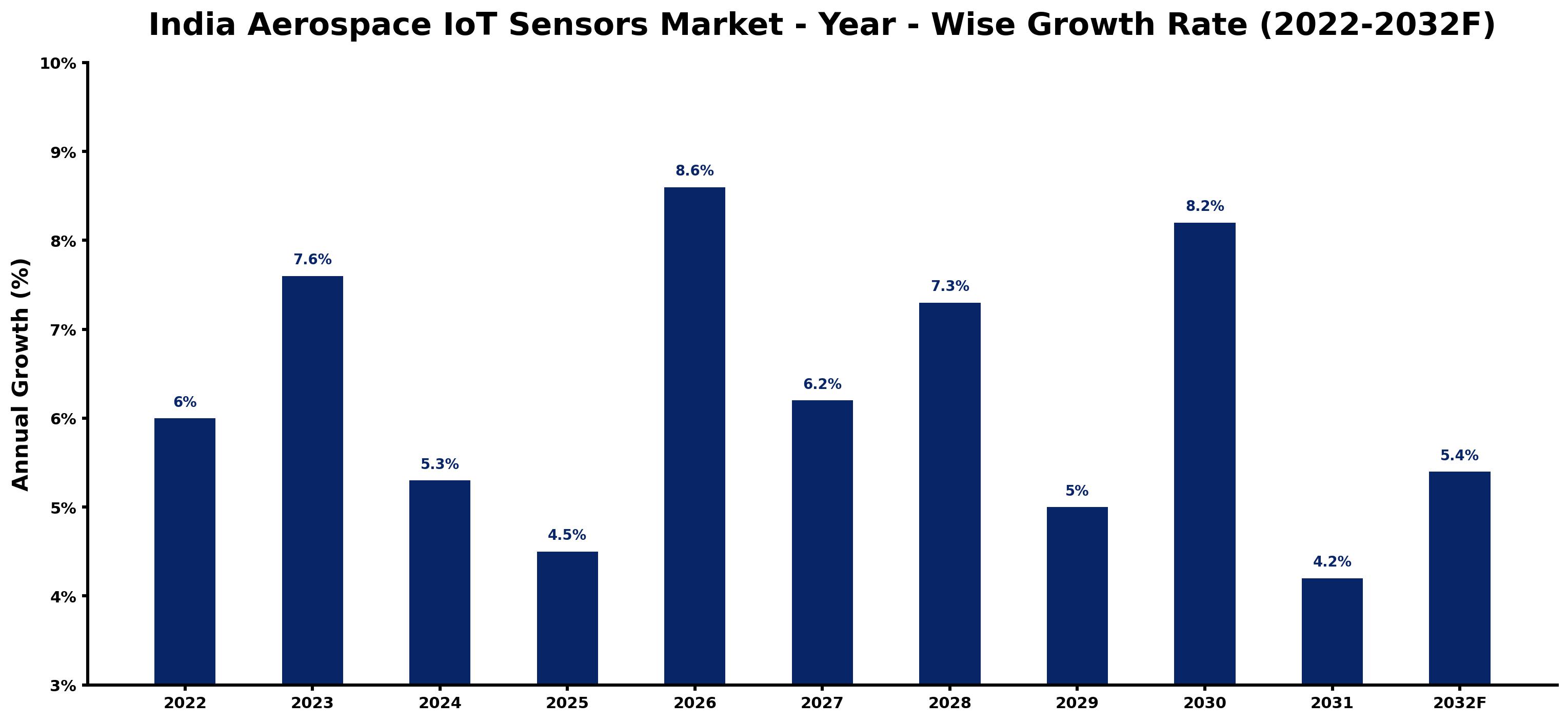
Year by year, the estimates below pair each growth rate with the development that shaped it.
| Year | Estimated Annual Growth (%) | Market Rationale |
| 2022 | 6.0 | The market experienced steady growth due to increased demand from domestic manufacturers. |
| 2023 | 7.6 | Demand accelerated as the Indian Air Force invested in modern sensor technology. |
| 2024 | 5.3 | Growth slowed as some manufacturers faced challenges in scaling production. |
| 2025 | 4.5 | A further slowdown occurred as market adjustments took place in sensor sourcing. |
| 2026 | 8.6 | The market rebounded sharply with the introduction of advanced sensor technologies. |
| 2027 | 6.2 | Growth slowed again as manufacturers adjusted to new operational standards. |
| 2028 | 7.3 | Demand increased as aircraft maintenance teams sought improved monitoring solutions. |
| 2029 | 5.0 | A slowdown followed as competition intensified among sensor providers. |
| 2030 | 8.2 | Growth picked up with increased investments in UAV technologies and sensors. |
| 2031 | 4.2 | The market saw slower growth as the focus shifted to quality and standards. |
| 2032 | 5.4 | Demand is expected to rise as the aerospace sector expands with new innovations. |
Note: Market size estimations and growth projections presented in this report are based on 6Wresearch's proprietary forecasting methodology, utilizing the latest available industry data, government publications, and primary research inputs.
India Aerospace IoT Sensors Market Synopsis
Aerospace IoT Sensors Market in India includes advanced devices that collect and transmit aircraft performance data. These sensors play a crucial role in monitoring systems, improving safety, and optimising maintenance schedules. The market is expanding due to substantial investments from domestic manufacturers and the Indian Air Force. The National Civil Aviation Policy aims to advance aerospace technology, further driving demand. With over 600 operational airports, the need for sophisticated aerospace sensors is rising, creating ample opportunities for growth in this sector.
Market Dynamics Impact Analysis (2026–2032)
| Factor | Type | Impact | Primary Segment Affected |
| Increased investments in indigenous sensor manufacturing | Driver | High | Temperature Sensors |
| Growing demand for UAV technologies | Driver | High | Pressure Sensors |
| Rising need for advanced monitoring solutions | Opportunity | High | Vibration Sensors |
| Expansion of aircraft maintenance teams | Opportunity | High | Aircraft Maintenance Teams |
| Challenges in sourcing high-quality components | Restraint | High | Pressure Sensors |
| Dependence on imported technologies for advanced sensors | Restraint | Medium | Temperature Sensors |
| Limited integration of new technologies in legacy systems | Challenge | High | Wired |
| Competition from established international sensor manufacturers | Challenge | Medium | Wireless |
Evaluation of Drivers in India Aerospace IoT Sensors Market (2026–2032)
The factors lifting demand, and the evidence behind each, are summarised below.
| Drivers | Primary Segment Affected | Why It Matters (Evidence) |
| Increased government funding for aerospace innovation | Temperature Sensors | The Indian government approved a $1 billion fund for aerospace innovation, boosting demand for advanced temperature sensors. |
| Growing UAV applications in defence and commercial sectors | Pressure Sensors | The target of 1,000 UAVs by 2025 increases the need for pressure sensors across various applications in the aerospace sector. |
| Focus on predictive maintenance in aircraft operations | Vibration Sensors | Aircraft Maintenance Teams are adopting vibration sensors to improve safety and reduce downtime, thereby increasing overall demand for these devices. |
| Rising operational standards in aerospace | Wireless | Standards set by the Bureau of Civil Aviation Security are driving demand for wireless sensors in aircraft operations, ensuring compliance with safety regulations. |
| Indigenous development of sensor technologies | IoT-Integrated | The Defense Research and Development Organization's initiatives are promoting local production of IoT-integrated sensors, reducing reliance on imports. |
The Aerospace IoT Sensors market in India is expanding as increased funding for aerospace innovation, growing UAV applications, and a focus on predictive maintenance drive demand. The target of 1,000 UAVs by 2025 increases demand for pressure sensors significantly. Aircraft Maintenance Teams are increasingly adopting vibration sensors to improve safety and reduce downtime.
Evaluation of Restraints in India Aerospace IoT Sensors Market
The main factors holding the market back are set out below.
| Market Restraint | Primary Segment Affected | Why It Matters (Evidence) |
| Challenges in sourcing high-quality components | Temperature Sensors | Manufacturers face difficulties in sourcing high-quality components, impacting production timelines and costs. |
| Dependence on imported technologies for advanced sensors | Pressure Sensors | A leading supplier on imported technologies can delay the integration of advanced sensors in local manufacturing processes. |
| Limited integration of new technologies in legacy systems | Wired | Legacy systems hinder the adoption of new sensor technologies, affecting overall market growth and innovation. |
| Competition from established international sensor manufacturers | Wireless | Local manufacturers struggle to compete with established international brands, impacting their market share and pricing strategies. |
| Regulatory hurdles in sensor approvals | IoT-Integrated | Strict regulatory requirements can delay the approval process for new IoT-integrated sensors, affecting market entry. |
India Aerospace IoT Sensors Market Challenges
Buyers in the India Aerospace IoT Sensors market encounter a notable technological challenge due to the limited availability of advanced sensor technology. This issue arises from domestic development not keeping pace with global advancements, delaying critical systems for aircraft performance monitoring. A shortage of skilled personnel exacerbates the problem, as manufacturers struggle to find trained workers, leading to project delays that can extend for several months. Supply chain complications stem from the concentration of aerospace manufacturing in states like Maharashtra and Karnataka, resulting in longer lead times for maintenance providers. Rising costs of raw materials are squeezing profit margins for producers, compelling them to raise prices by up to 15% for buyers.
Trends in the India Aerospace IoT Sensors Market
Below mentioned are some of the trends shaping the India Aerospace IoT Sensors Market growth.
- Shift towards IoT-Integrated Sensors: The Indian aerospace sector is increasingly adopting IoT-integrated sensors, driven by the need for real-time data. The expansion of satellite capabilities by the Indian Space Research Organization is a key factor, with a projected increase in demand for sensors by 30%.
- Focus on Predictive Maintenance: Aircraft Maintenance Teams are prioritising predictive maintenance strategies to improve operational efficiency. The Indian Air Force's investment in modern sensor technology supports this trend, with a 30% increase in sensor adoption for maintenance.
- Growth in UAV Applications: The push for UAV technologies is leading to a surge in demand for aerospace sensors. With the target of 1,000 UAVs by 2025, the market for related sensors is expected to grow, with an estimated 25% increase in sensor requirements.
- Expansion of Online Distribution Channels: Online platforms are becoming a vital distribution channel for aerospace IoT sensors. The growing trend of e-commerce in India is reflected in a projected 8.5% CAGR for online sales of these sensors.
Investment Opportunities in the India Aerospace IoT Sensors Market
Below are the investment opportunities with the strongest case in the India Aerospace IoT Sensors Market.
- Aircraft Maintenance Teams seeking advanced sensors: Aircraft Maintenance Teams are increasingly looking for advanced sensors to improve safety and efficiency. The projected market size of USD 136.0 million by 2025 presents a promising opportunity for suppliers.
- Investment in IoT-Integrated Sensors: The need for IoT-integrated sensors is rising as the aerospace sector modernises. With the Indian government promoting local production, suppliers can enter the market through partnerships with local manufacturers.
- Timing of increased UAV deployments: The push for UAV technologies creates immediate opportunities for sensor suppliers. With the target of 1,000 UAVs by 2025, there is a strong demand for pressure and temperature sensors.
- Entry through local partnerships: Local partnerships are essential for entering the aerospace sensor market. Collaborating with established industrial suppliers can facilitate access to the growing demand for advanced sensors.
Government Initiatives in the India Aerospace IoT Sensors Market
In 2021, the Ministry of Civil Aviation launched the National Aerospace Policy, which aims to boost indigenous sensor manufacturing and innovation. This policy complements earlier initiatives like the Make in India initiative, which encourages local production of aerospace components. The focus on indigenization is projected to improve the capabilities of local manufacturers and reduce reliance on imports, creating a more competitive environment in the aerospace IoT sensors market. Additionally, the Electronics Policy introduced in 2022 promotes R&D in aerospace IoT technologies, further enhancing local production capabilities.
The Defense Research and Development Organization (DRDO) plays a significant role in approving and funding sensor development projects. The DRDO's focus on indigenous sensor technologies is supported by the $1.5 billion allocated for UAV technologies, which enhances demand for related sensors. Furthermore, the Bureau of Civil Aviation Security oversees standards for aircraft safety, influencing sensor requirements and ensuring compliance with national safety regulations. This oversight is crucial for manufacturers aiming to meet regulatory standards in the aerospace IoT sensors market.
Future Insight of the India Aerospace IoT Sensors Market
The India Aerospace IoT Sensors market will undergo substantial changes by 2032, driven by the National Civil Aviation Policy that aims to advance aerospace technology. The Indian government's target of deploying 200 UAVs for various applications by 2025 will significantly increase sensor demand, contributing to a projected 30% rise in sensor production. Initiatives by the Defense Research and Development Organization will bolster local sensor development capabilities, decreasing reliance on imports. As satellite capabilities expand, the integration of aerospace sensors will be vital for operational efficiency across multiple applications.
Market Segmentation Analysis
Each segment group is reviewed below, with the leader by share and the fastest grower by CAGR.
By Sensor Type – Temperature Sensors Dominated, Pressure Sensors Expected to Grow Fastest
According to Ravi Bhandari, Research Head at 6Wresearch, with a 47% revenue share in 2025, Temperature Sensors was the largest sensor type category. Temperature sensors command the largest market share because they are essential for monitoring critical aircraft systems, which is vital for safety and performance. Their extensive use across India's 600 operational airports highlights their integral role in the aerospace industry. Pressure Sensors are projected to grow fastest, at a CAGR of 7.9% during 2026–2032. Pressure sensors are seeing rapid growth as they become increasingly vital for ensuring safety and operational efficiency in aircraft. The Indian Air Force's commitment to modernising its fleet with advanced sensor technology is a key factor driving this surge in demand. This suggests that suppliers should prioritise the development and availability of pressure sensors to align with the increasing market demand.
By Connectivity Type – Wireless Dominated, Wired Expected to Grow Fastest
In 2025, Wireless led the connectivity type split with a 35% share. Wireless connectivity types dominate the market share as they facilitate real-time data transmission, which is vital for modern aerospace applications. The increasing number of operational airports in India necessitates the use of advanced wireless technologies for efficient aircraft monitoring. The quickest growth will come from Wired, forecast to expand at a CAGR of 7.5% between 2026 and 2032. Wired connectivity is growing at a fast pace due to the need for integration with legacy systems, as many older aircraft still rely on these connections. This growth is supported by the ongoing upgrades within the Indian Air Force's fleet. Suppliers must consider both wireless and wired solutions to cater to the diverse needs of the aerospace sector.
By Distribution Channel – Direct Sales Dominated, Online Platforms Expected to Grow Fastest
Direct Sales held a 40% share of the India Aerospace IoT Sensors Market by distribution channel in 2025. Direct sales hold the largest market share as they facilitate direct engagement between manufacturers and buyers, ensuring customised service and support. This approach is particularly vital for high-value aerospace IoT sensors, which require in-depth customer interaction to address specific needs. Online Platforms are set to record the highest CAGR in this split, 8.5% over 2026–2032. Online platforms are experiencing rapid growth as they provide a convenient purchasing avenue, especially for smaller orders, despite their limited presence in high-value sensor transactions. The shift towards digital procurement methods is a key factor driving this segment's expansion. Suppliers must enhance their online presence to effectively connect with the growing customer base that increasingly prefers digital purchasing methods.
By End User – Aircraft Maintenance Teams Dominated, Engine Monitoring Units Expected to Grow Fastest
The largest end user category in 2025 was Aircraft Maintenance Teams, with a 52% share of total revenue. Aircraft maintenance teams represent the largest market share as they are the primary users of aerospace IoT sensors, essential for ensuring operational safety. Their critical role in maintaining aircraft performance drives consistent demand for these sensors. Over 2026–2032, Engine Monitoring Units are expected to post the fastest growth, at a CAGR of 8.8%. Engine monitoring units are growing rapidly as they increasingly rely on sensors for precise performance tracking, reflecting the industry's focus on efficiency. The emphasis on safety and performance in aircraft operations fuels this growth. Suppliers should tailor their offerings to meet the specific needs of engine monitoring units to capitalise on this growth opportunity.
Key Attractiveness of the Report
- 10 Years of Market Numbers
- Historical Data Starting from 2022 to 2025
- Base Year 2025
- Forecast Data until 2032
- Key Performance Indicators Impacting the Market
- Major Upcoming Developments and Projects
Key Highlights of the Report:
- India Aerospace IoT Sensors Market Outlook
- Market Size of India Aerospace IoT Sensors Market, 2025
- Forecast of India Aerospace IoT Sensors Market, 2032
- Historical Data and Forecast of India Aerospace IoT Sensors Revenues & Volume for the Period 2022 - 2032F
- India Aerospace IoT Sensors Market Trend Evolution
- India Aerospace IoT Sensors Market Drivers and Challenges
- India Aerospace IoT Sensors Price Trends
- India Aerospace IoT Sensors Porter's Five Forces
- India Aerospace IoT Sensors Industry Life Cycle
- Historical Data and Forecast of India Aerospace IoT Sensors Market Revenues & Volume By Sensor Type for the Period 2022 - 2032F
- Historical Data and Forecast of India Aerospace IoT Sensors Market Revenues & Volume By Temperature Sensors for the Period 2022 - 2032F
- Historical Data and Forecast of India Aerospace IoT Sensors Market Revenues & Volume By Pressure Sensors for the Period 2022 - 2032F
- Historical Data and Forecast of India Aerospace IoT Sensors Market Revenues & Volume By Proximity Sensors for the Period 2022 - 2032F
- Historical Data and Forecast of India Aerospace IoT Sensors Market Revenues & Volume By Vibration Sensors for the Period 2022 - 2032F
- Historical Data and Forecast of India Aerospace IoT Sensors Market Revenues & Volume By Connectivity Type for the Period 2022 - 2032F
- Historical Data and Forecast of India Aerospace IoT Sensors Market Revenues & Volume By Wireless for the Period 2022 - 2032F
- Historical Data and Forecast of India Aerospace IoT Sensors Market Revenues & Volume By Wired for the Period 2022 - 2032F
- Historical Data and Forecast of India Aerospace IoT Sensors Market Revenues & Volume By Bluetooth/LoRaWAN for the Period 2022 - 2032F
- Historical Data and Forecast of India Aerospace IoT Sensors Market Revenues & Volume By IoT-Integrated for the Period 2022 - 2032F
- Historical Data and Forecast of India Aerospace IoT Sensors Market Revenues & Volume By Distribution Channel for the Period 2022 - 2032F
- Historical Data and Forecast of India Aerospace IoT Sensors Market Revenues & Volume By Direct Sales for the Period 2022 - 2032F
- Historical Data and Forecast of India Aerospace IoT Sensors Market Revenues & Volume By Online Platforms for the Period 2022 - 2032F
- Historical Data and Forecast of India Aerospace IoT Sensors Market Revenues & Volume By Industrial Suppliers for the Period 2022 - 2032F
- Historical Data and Forecast of India Aerospace IoT Sensors Market Revenues & Volume By Specialty Stores for the Period 2022 - 2032F
- Historical Data and Forecast of India Aerospace IoT Sensors Market Revenues & Volume By End User for the Period 2022 - 2032F
- Historical Data and Forecast of India Aerospace IoT Sensors Market Revenues & Volume By Aircraft Maintenance Teams for the Period 2022 - 2032F
- Historical Data and Forecast of India Aerospace IoT Sensors Market Revenues & Volume By Engine Monitoring Units for the Period 2022 - 2032F
- Historical Data and Forecast of India Aerospace IoT Sensors Market Revenues & Volume By UAV Manufacturers for the Period 2022 - 2032F
- Historical Data and Forecast of India Aerospace IoT Sensors Market Revenues & Volume By Defense Fleet Operators for the Period 2022 - 2032F
- India Aerospace IoT Sensors Import Export Trade Statistics
- Market Opportunity Assessment By Sensor Type
- Market Opportunity Assessment By Connectivity Type
- Market Opportunity Assessment By Distribution Channel
- Market Opportunity Assessment By End User
- India Aerospace IoT Sensors Top Companies Market Share
- India Aerospace IoT Sensors Competitive Benchmarking By Technical and Operational Parameters
- India Aerospace IoT Sensors Company Profiles
- India Aerospace IoT Sensors Key Strategic Recommendations
Market Covered
Segments analysed in this report are listed below.
By Sensor Type
- Temperature Sensors
- Pressure Sensors
- Proximity Sensors
- Vibration Sensors
By Connectivity Type
- Wireless
- Wired
- Bluetooth/LoRaWAN
- IoT-Integrated
By Distribution Channel
- Direct Sales
- Online Platforms
- Industrial Suppliers
- Specialty Stores
By End User
- Aircraft Maintenance Teams
- Engine Monitoring Units
- UAV Manufacturers
- Defense Fleet Operators































